The caption on this card is ‘Besses O’ Th’ Barn Band’ and if you wonder where the strange name comes from you will be surprised to learn that the band is so called because the band members come from a place named Besses O’ Th’ Barn, a suburb in the metropolitan borough of Bury in greater Manchester.
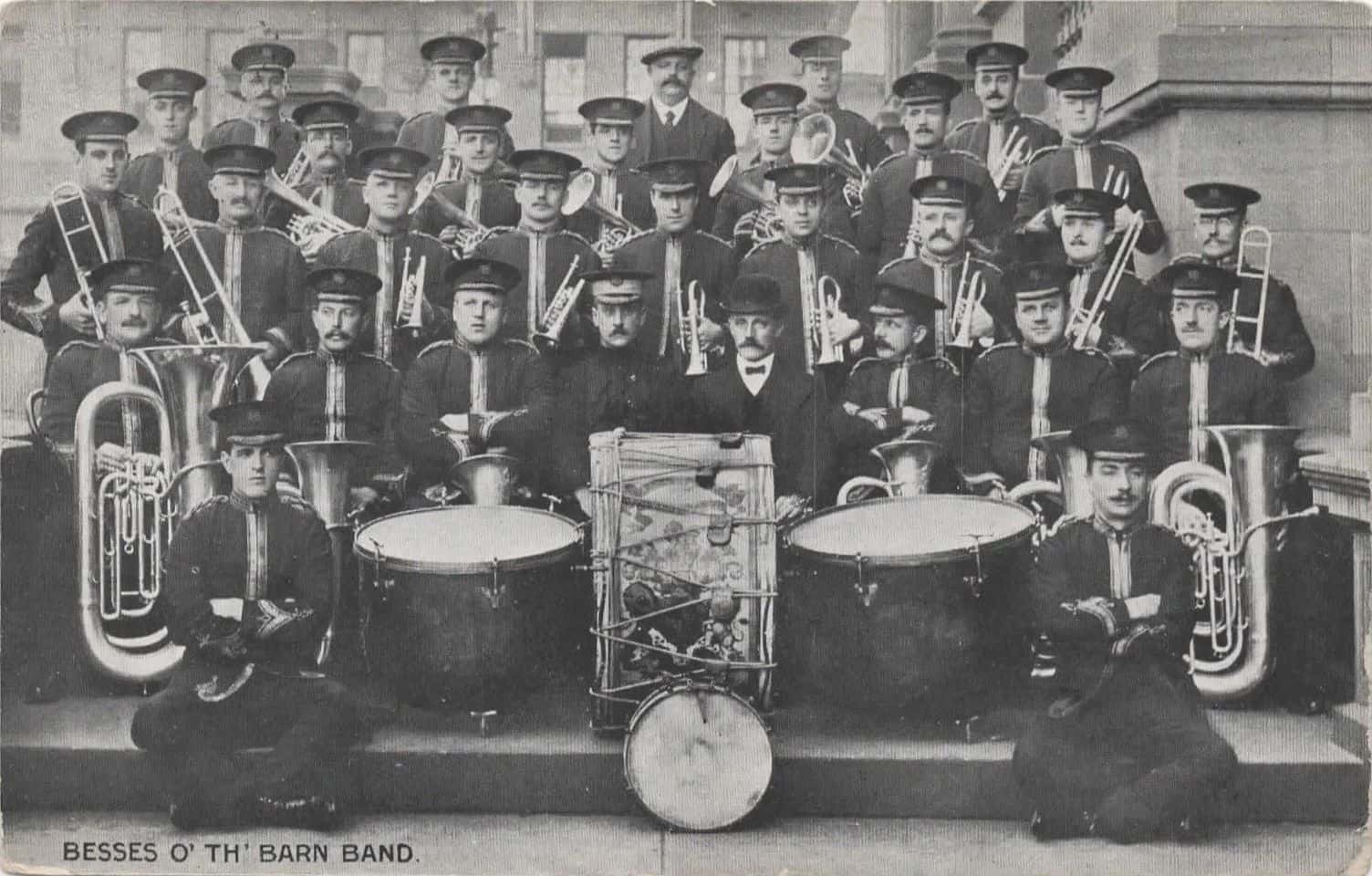
The origin of this strange name is uncertain, but the most reasonable explanation is that once there was a local pub that looked like a barn and was run by a lady called Bess. The local invitation to a drink would be, “let’s go see Bessie at th’ barn.” Later, as houses were built around, the name came to mean the whole village, not just the pub. Alternatively, there is another theory that involves highwayman Dick Turpin and his horse Black Bess. I’ll leave you to decide the better of the two theories, but you should consider that the place was named some time ago since a reference to the name has been found in an 1805 issue of the Manchester Mercury.
The band was formed in 1818 by the brothers John, James, and Joseph Clegg who were cotton manufacturers in Besses O’ Th’ Barn. A detailed history of the early years has been found in the 1893 publication Origin, History and Achievements of the Besses o’ th’ Barn Band, by Joseph Hampson, a local tobacconist and band member. (A PDF can be found and is free to download). The band was initially known as “Clegg’s Band” and was likely comprised of employees from the Clegg’s cotton business and other working-class men.
The earliest reference to the band in the newspaper archives is in the February 12, 1842, issue of the Yorkshire Gazette where an article headed ‘The Badsworth Hunt Ball’ includes the following: This ball … was, indeed, a splendid affair, being attended by about one hundred and thirty of the elite of fashion. Clegg’s band was, as usual, in attendance, and performed several very brilliant quadrilles.
The earliest reference found as “Besses O’ Th’ Barn Band” is in the Manchester Times of August 7, 1846. In a lengthy article, the newspaper reports on a parade in Manchester celebrating the repeal of the “Corn Laws.” [The Corn Laws of England were tariffs on imported grain.] The parade participants were listed, and it seems the Bess’s-o’ th’-Barn Band was followed by a large wagon containing Mr. James Charlton’s calendering machine at work. [Aside: in the early years of cotton fabric manufacturing, a calendaring machine operator worked with specialized equipment to press and smooth the fabric to ensure precision thickness and texture. Similar machines were also used in the manufacturing of rubber and paper.] There were about 200 of the calenderers walking behind the wagon.
The following is from an article in the Bury Times which in 2018 was commemorating the band having been in existence for 200 years. In the early 1900s the band began tours based on the railway network and would stop at each station along the way to perform, travelling for months at a time.
From other snippets we know that in 1904, to ease tensions on the continent, the band was invited by King Edward VII to perform at Windsor Castle for his queen, son, and grandsons. They were then sent on to tour around France, playing for dignitaries and to crowds of thousands, before returning to the UK and playing their way back to Manchester along the railway. This trip to France kick-started a golden period of travel for the band that included a world tour between 1906 and 1907 which took them across the Americas and the Pacific to Australia and New Zealand. The feat was then repeated between 1909 and 1911, with the band even reaching Africa.
As the First World War broke out the band ceased their touring since the members went off to fight, but they returned home and continued their winning ways into the 1930s, including for King George V and honoring an invitation to the World’s Fair in Canada in 1932.