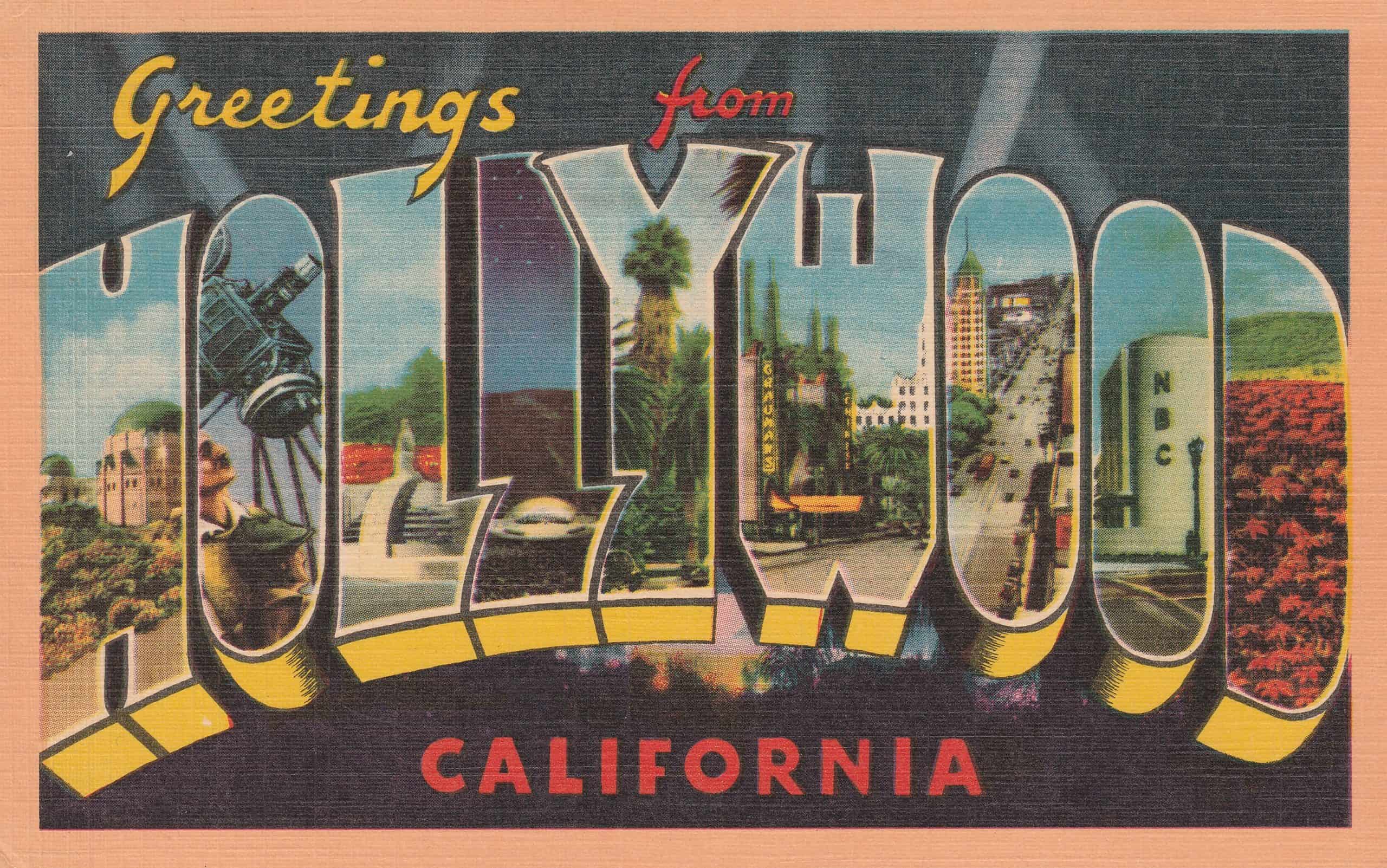
Welcome back on the virtual tour bus of the Hollywood homes of golden age movie stars.
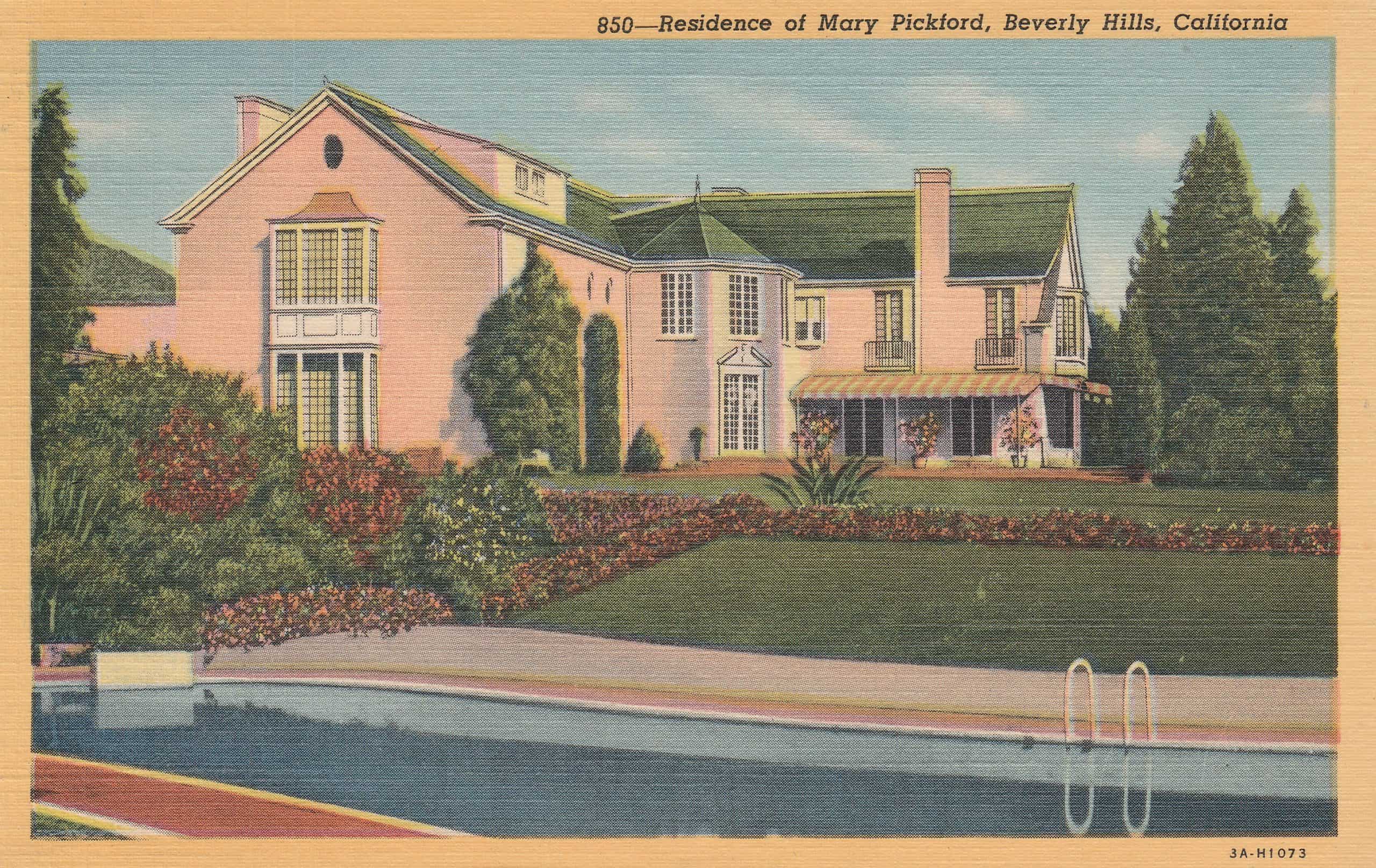
When they married in 1920, Mary Pickford and Douglas Fairbanks were two of the biggest stars of the silent film era. Fairbanks known for swashbuckling roles such as Zorro and Robin Hood was the “King of Hollywood” during the silent film era. In 1919, Fairbanks purchased a rustic hunting lodge in Beverly Hills as a wedding gift for Mary Pickford, “America’s Sweetheart.”
With the assistance of Hollywood architect Wallace Neff, the couple transformed the hunting lodge into America’s first celebrity home. Their estate, named Pickfair, set the standard for Hollywood luxury living. Located at 1143 Summit Drive in the San Ysidro Canyon area, the sixteen-acre property featured expansive gardens where the movie industry’s elite would gather for lavish parties.
Neff designed a four-story Tudor style mansion of 25-rooms with six bedrooms, and a screening room, bowling alley, billiard room, guest wing, stables, servants’ quarters, tennis courts, and garages. There was an Old West-themed barroom with an ornate mahogany bar taken from a California saloon. Pickfair was reported to have been the first private home in Los Angeles with an in-ground swimming pool.
Pickford and Fairbanks divorced in 1936. Fairbanks died of a heart attack in 1939. In 1937, Pickford married actor and musician, Buddy Rogers. She resided at Pickfair with Rogers until her death in 1979. Movie fans received a televised tour of Pickfair in 1976 when Miss Pickford was presented with an Honorary Oscar for her contributions to the film industry. Pickfair was torn down in the 1990s.
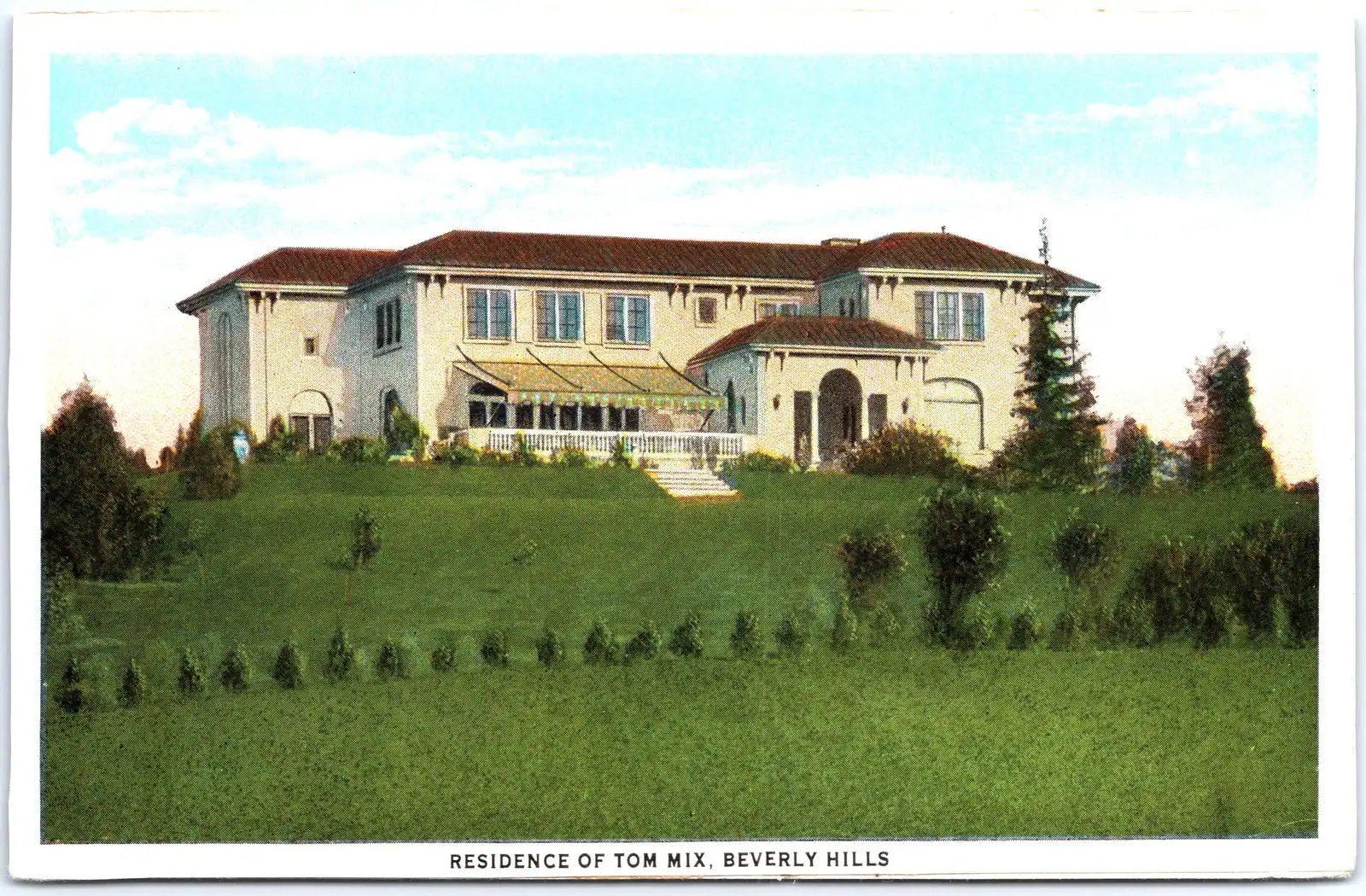
Tom Mix was the first cowboy movie hero, the John Wayne of the silent movie era. Mix was an Oklahoma ranch hand and performer in Wild West shows. He was a skilled horseman and excellent shot. He appeared in his first Western in 1909 and made 291 movies before his film career ended in 1935.
Instrumental in developing the Western movie genre, Mix wrote, directed, and produced many of his early movies and performed his own stunts leading to frequent injuries. His steed, Tony the Wonder Horse, was as famous as Roy Roger’s horse Trigger.
Mix became the highest paid star at Fox Studios, eventually earning $18,000 a week. In 1924, Mix built an opulent mansion for him, his fourth wife, actress Victoria Forde, and their daughter Thomasina. Located on six acres at 1010 Summit Drive in Beverly Hills, the Mediterranean style stucco house had three stories and a red tile roof. It featured nineteen rooms, nine marble baths, a dining room that seated eighteen, a tennis court, stable and paddock, pool, and pool house.
Mix’s film career waned in the late 1920s. His voice had been damaged by a bullet to the throat, so he was not suitable for the talkies. He made millions during his film career, but excessive spending dissipated much of his fortune. After his divorce from Forde, he sold the mansion and moved to a modest ranch in Sherman Oaks, California in 1936. The mansion was later demolished, and the six acres of prime real estate were redeveloped. Mix died in a car accident in Arizona in 1940. Less than 10% of his films survive to this day due to a fire at a film storage facility in 1937.
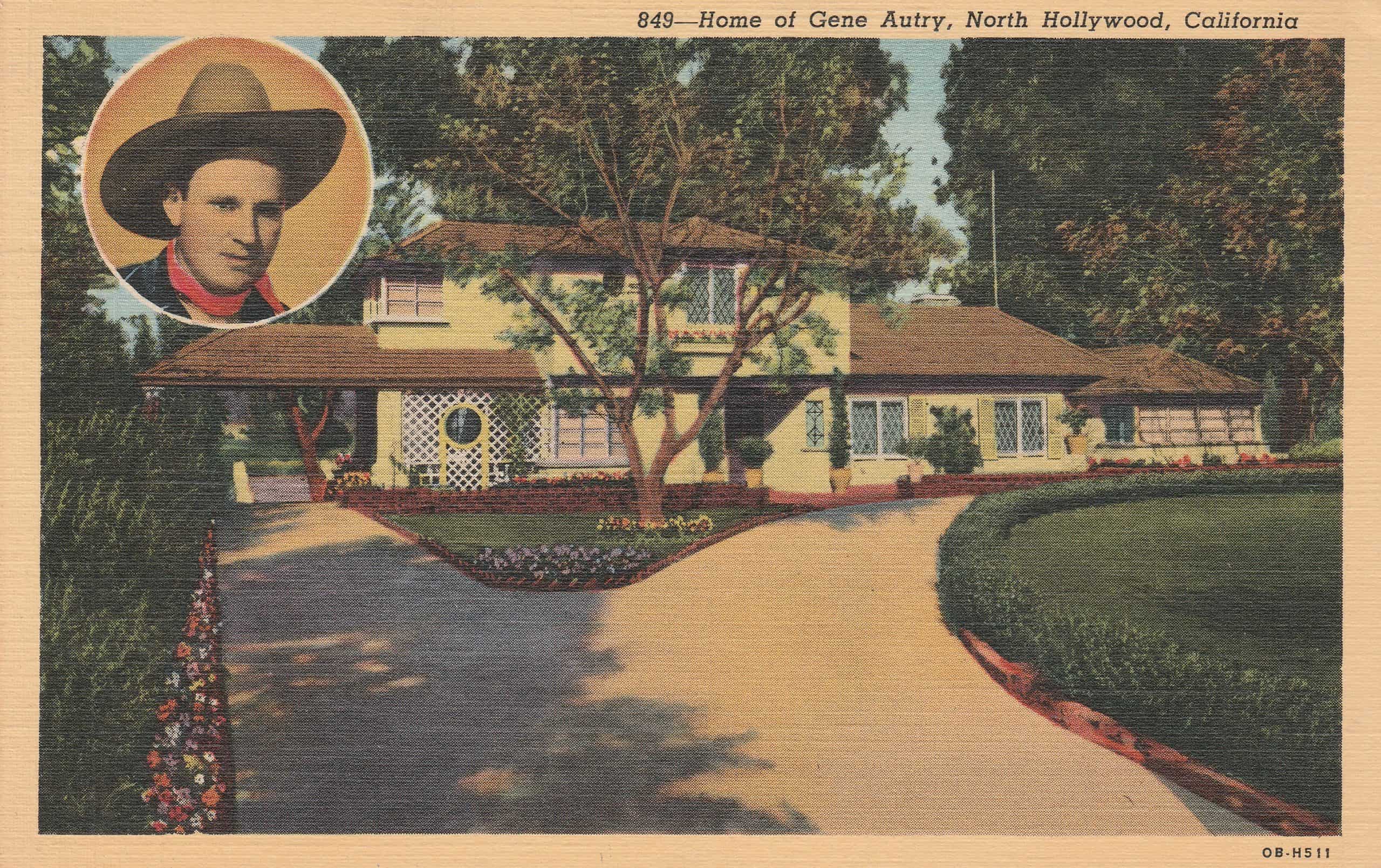
Already an established recording star when he arrived in Hollywood in the early 1930s, Gene Autry became the first singing cowboy of the movies. In 1937, Autry and his wife, Ina Mae, constructed the home of their dreams in North Hollywood. Located at 10985 Bluffside Drive just south of the Los Angeles River near Ventura Boulevard, the rambling two-story, 14-room house faced a manicured lawn decorated with flower beds.
Ina designed an elegant, English country-style interior with chintz upholstery, flowery wallpaper, and wall-to-wall carpeting. Because it was decorated with western memorabilia, Gene favored the den with its large stone fireplace, western-style furniture, and hardwood floors with hooked rugs. He later added stables, a rumpus room, an office, and a swimming pool on the 2-acre estate, all reached by brick walkways surrounded by timber fencing.
In the late 1940s, the Autrys built a secluded 7,200 square foot mansion on four acres in Fryman Canyon, just off Laurel Canyon Boulevard. A shrewd businessman, Autry later owned the California Angels of the American League.
At his death, Autry was estimated to have a net worth of $500 million.
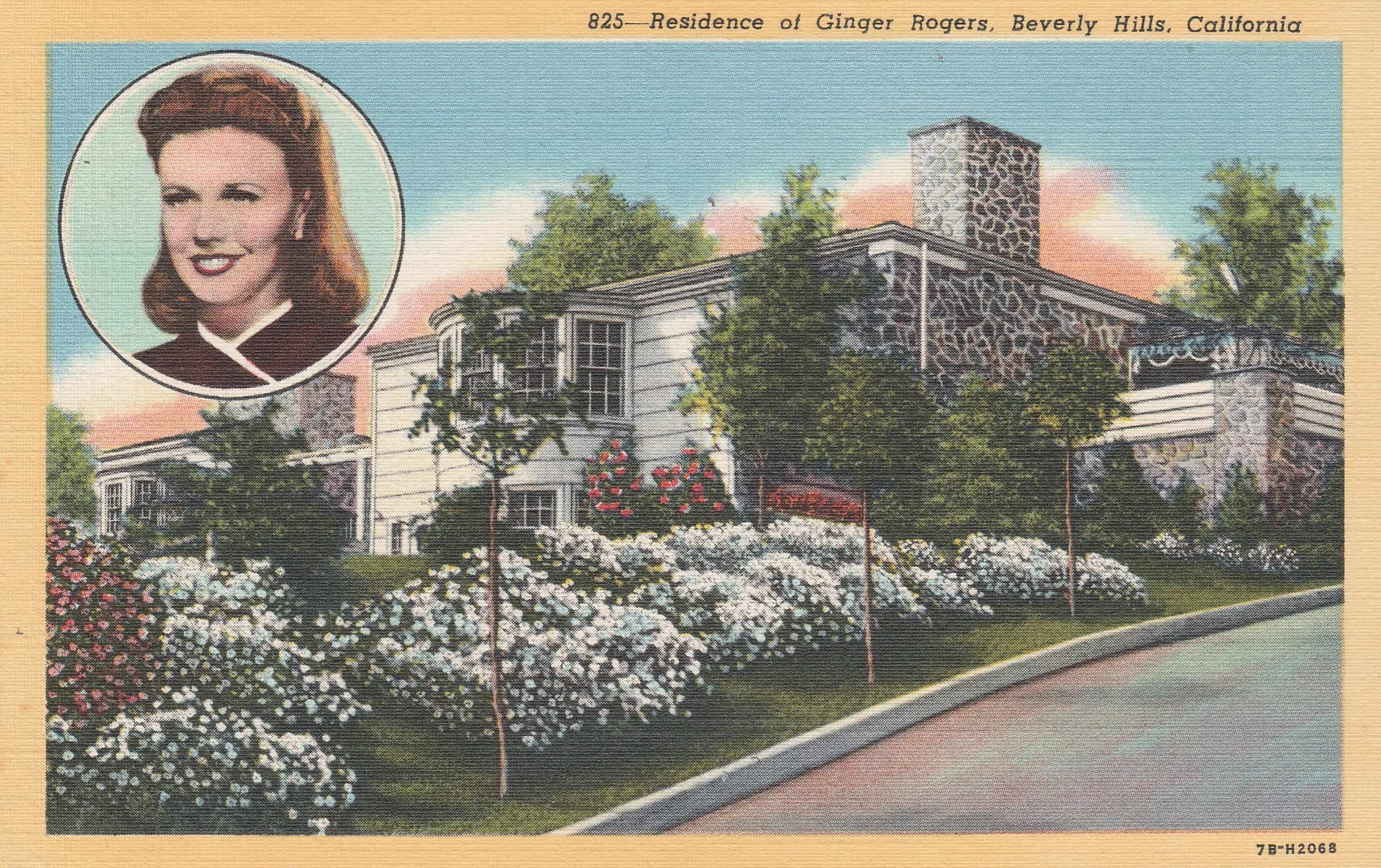
Ginger Rogers built her hilltop home at 1605 N. Gilchrist Drive in Beverly Hills in 1937. An unusual feature of her home was a soda fountain. Miss Rogers was a Christian Scientist and eschewed drinking so there was no bar in on the property.
During her long career in Hollywood, Rogers starred in 73 films. Rogers was equally adept at musicals, comedies, and dramas. She won the Academy Award in 1940 for her role in the drama Kitty Foyle. Other films for which she was critically lauded were Stage Door, Bachelor Mother, The Major and the Minor, Week-End at the Waldorf, Lady in the Dark, Tight Spot, and Monkey Business.
In the 1930s, Rogers was Fred Astaire’s dance partner in nine musicals for RKO Studios. Among the films in the Astaire–Rogers song and dance partnership were The Gay Divorcee, Flying Down to Rio, Roberta, Top Hat, Swing Time, Shall We Dance, and Follow the Fleet. These films were popular because of Astaire’s virtuosity on the dance floor, songs from top Broadway composers, and stunning cinematography. Rogers held her own on the dance floor with Astaire and many, including Astaire, consider her his greatest dance partner. In 1967, Astaire and Rogers reunited to present an Academy Award and received a standing ovation when they walked on stage.
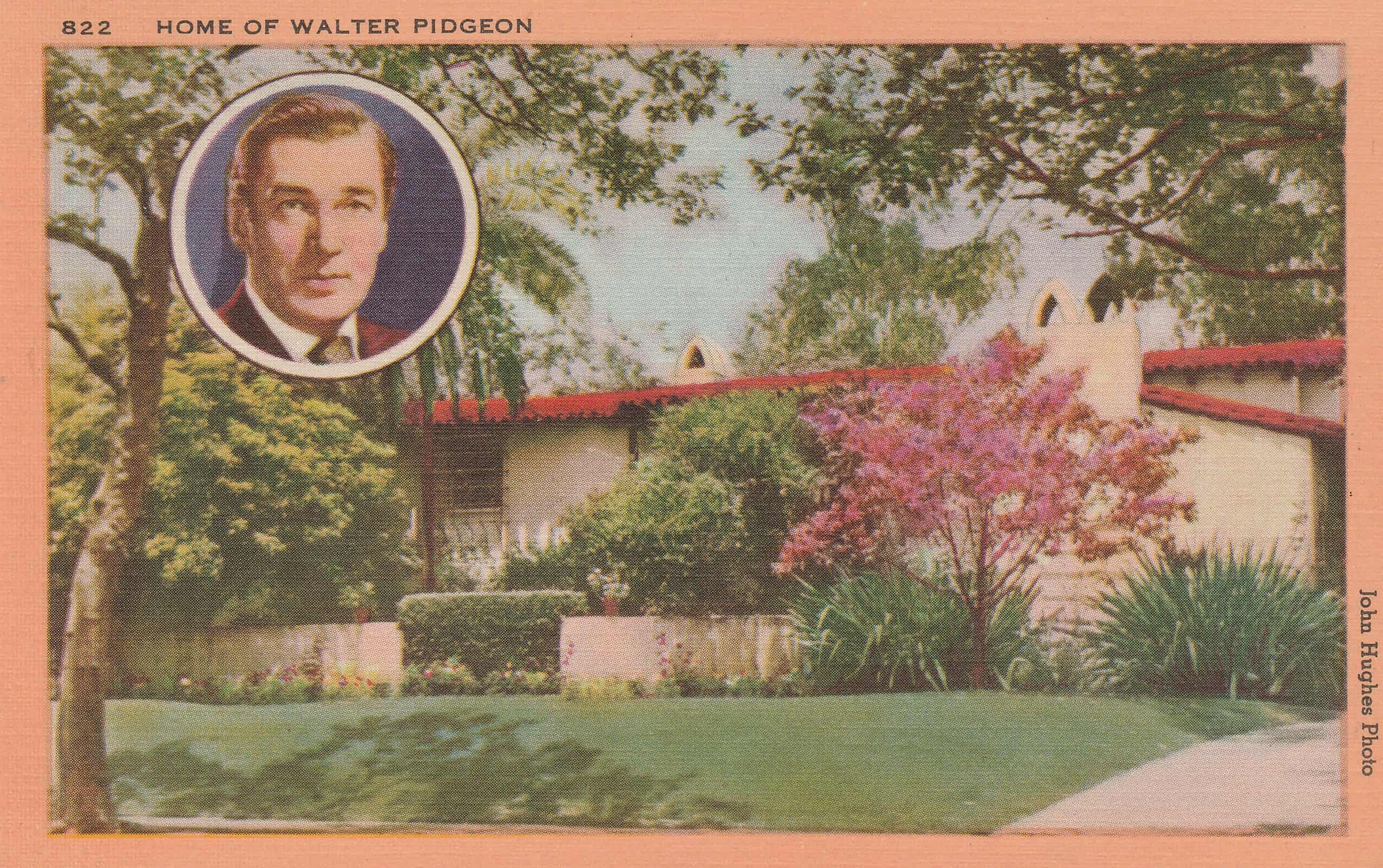
Canadian born actor Walter Pidgeon was a Hollywood leading man for more than twenty years. Equally adept at musicals, comedies, and dramas, Pidgeon was twice nominated for the Academy Award for Best Actor for his roles in Mrs. Miniver in 1942 and Madame Curie in 1943. In both films, he co-starred with Greer Garson with whom he made eight films between 1941 and 1953. Pidgeon and Garson’s best film together was MGM’s Mrs. Miniver, released in 1942. They portray an upper middle-class British couple who with their family endure the early days of World War II. The film infuriated Nazi propaganda minister, Joseph Goebbels, dismayed that his filmmakers failed to produce a similar movie to stir the German public.
Walter Pidgeon bought the Spanish-style stucco house at 710 Walden Drive in Beverly Hills in the late 1930s. The house appears modest but was over 5,000 square feet. Its living room featured a two-story cathedral ceiling. Designed by architect Walter Neff who was known for his California style that combined Spanish and Mediterranean elements.
Neff designed many celebrity homes in Los Angeles. Pidgeon sold the house in the 1940s and moved to an English-style house on Strata Corda Road in Bel Air where he resided until his death. During his film career Pidgeon frequently portrayed English characters and his Bel Air home more aptly fit his screen personality than a Spanish hacienda.
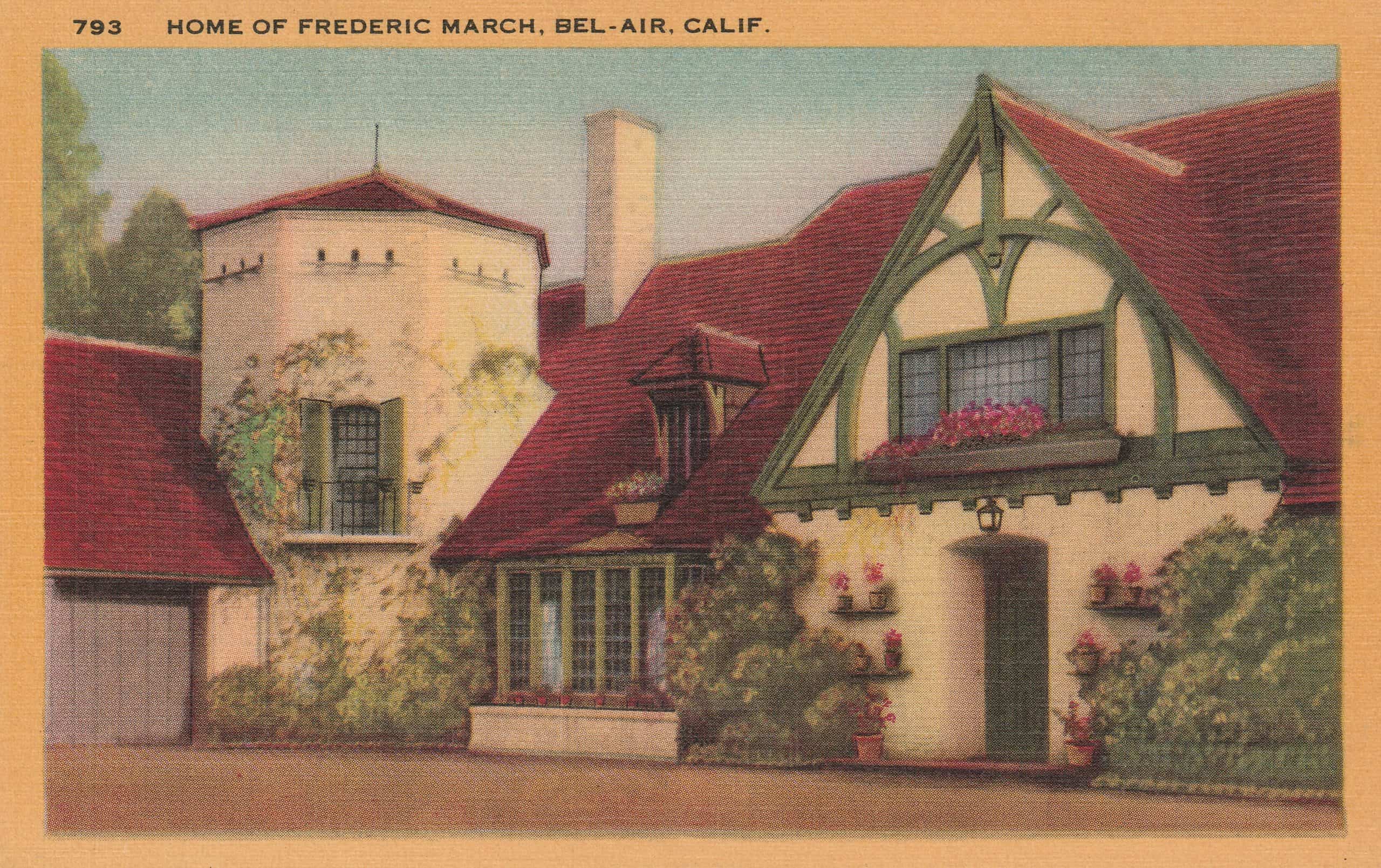
Frederic March was a leading man in films in the 1930s and 1940s. Nominated five times for the Academy Award for Best Actor; he won it twice for Dr. Jekyll and Mr. Hyde in 1931 and The Best Years of Our Lives in 1946. His other Oscar nominated roles were for The Royal Family of Broadway in 1930, A Star is Born in 1936, and Death of a Salesman in 1951.
In 1932, March and his wife actress Florence Eldridge commissioned Hollywood architect Wallace Neff to design a home for them and their two children at 1026 Ridgedale Road in Bel Air. Set on 1.2 acres, the home had an enormous swimming pool and a tennis court. It was a mix of Tudor Revival and French Norman architectural styles. An octagonal “dovecote tower” was a prominent feature of the house. There were 22 rooms, his and her living rooms, 11 bathrooms (7 full and 4 half baths), and a large dining room. There has been a succession of owners after March and Eldridge including Brad Pitt and Jennifer Anniston from 2001 through 2009.
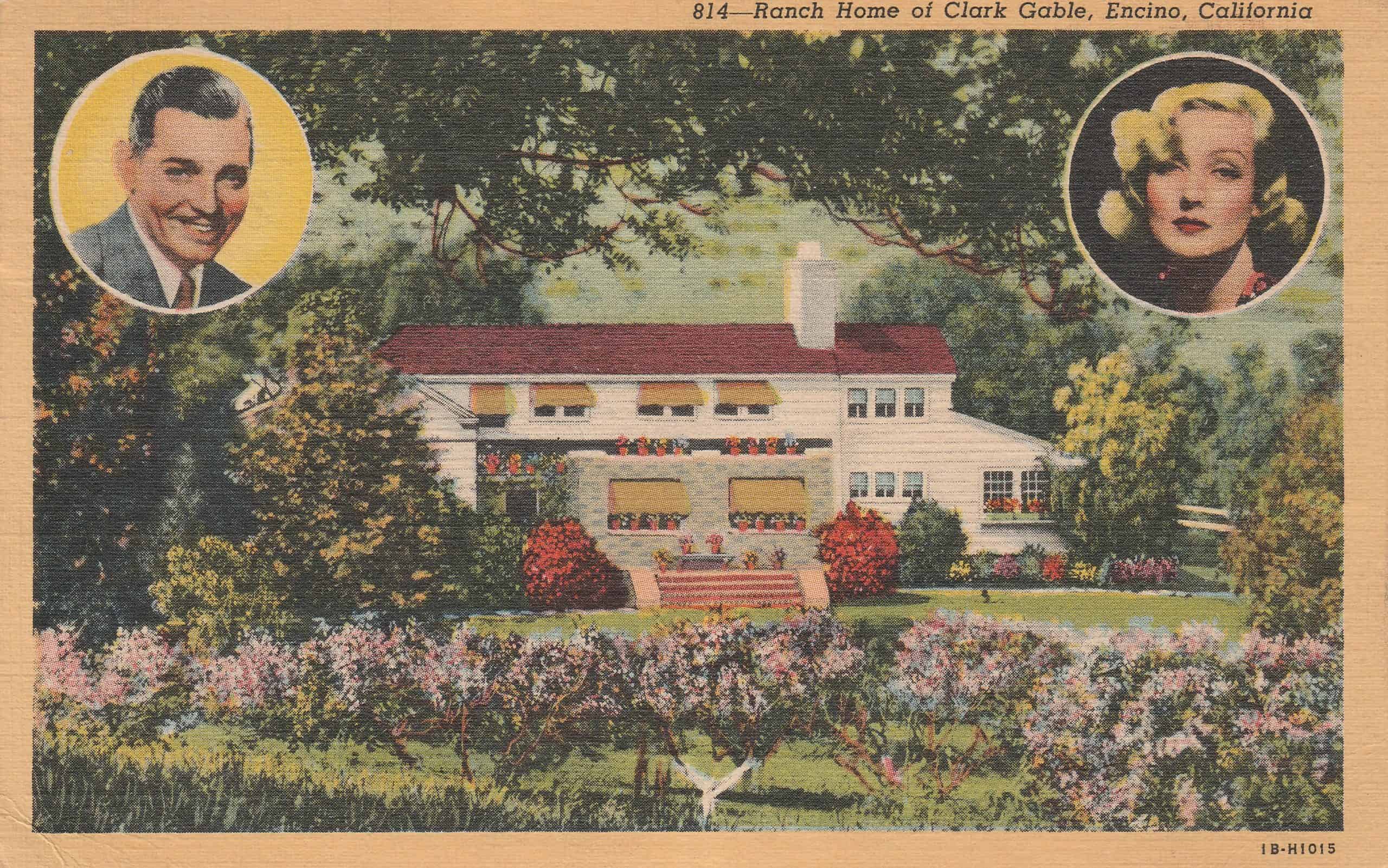
Clark Gable was the “King of Hollywood” in 1939 when he wed Carole Lombard, an actress known for her comedic talents. The couple purchased a remote ranch in Encino at 4543 Tara Drive that enabled them to escape Hollywood’s constant spotlight. Gable had become one of Hollywood’s most successful leading men after winning an Academy Award for Best Actor in Frank Capra’s It Happened One Night (1934), then by starring in Mutiny on the Bounty (1935), San Francisco (1936) and Gone With the Wind (1939).
Lombard was a popular leading lady in screwball comedies, who had appeared in films such as No Man of Her Own (1932), Twentieth Century (1934), My Man Godfrey (1936) and Nothing Sacred (1937).
Rustic charm and Hollywood romance blended perfectly in the 20-acre property that contrasted with their glamorous screen personas. Their ranch represented their shared love of country living. The property included a 7,100 square foot white colonial-style house with nine bedrooms, a barn, citrus groves, and plenty of space for their beloved dogs, chickens, and horses. The interior of the house was decorated in a rustic, early American style.
After Lombard’s tragic death in a plane crash in 1942, Gable resided there until his death from a heart attack in 1960. Gable’s widow, Kay Williams, lived there until 1973 with Gable’s son born four months after his death. The ranch was subdivided into an expensive housing development called the Gable Estates.
Very interesting look at how the early movie stars built their dream homes and decorated them highlighting so many quirks and creative ideas. Enjoyed it!
Nice little look back.
Another fascinating article by Dan. Some incredible homes.