My research on the Hassayampa River of Arizona has been a unique experience. Seldom have I undertaken a project with so many twists and turns. Each twist was a surprise, and every turn led to a very peculiar tale.
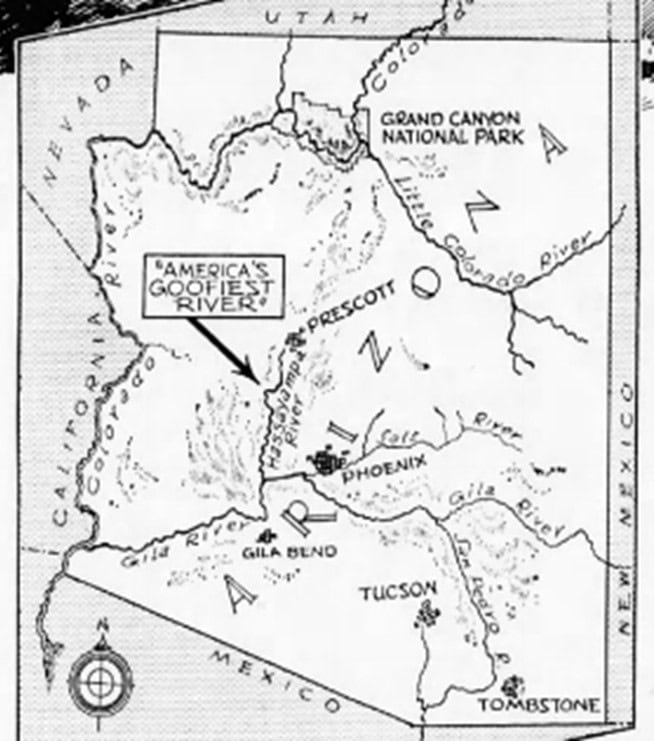
Long before I ever heard the name of this river a newspaper feature from the 1920s dubbed the Hassayampa, “America’s Goofiest River!”
The river rises in the foothills of the mountains in Prescott National Forest only 30 to 40 miles northwest of Prescott, Arizona. Generally, it flows 113 miles south and joins the Gila River at the small town of Arlington, Arizona.
Twist #1
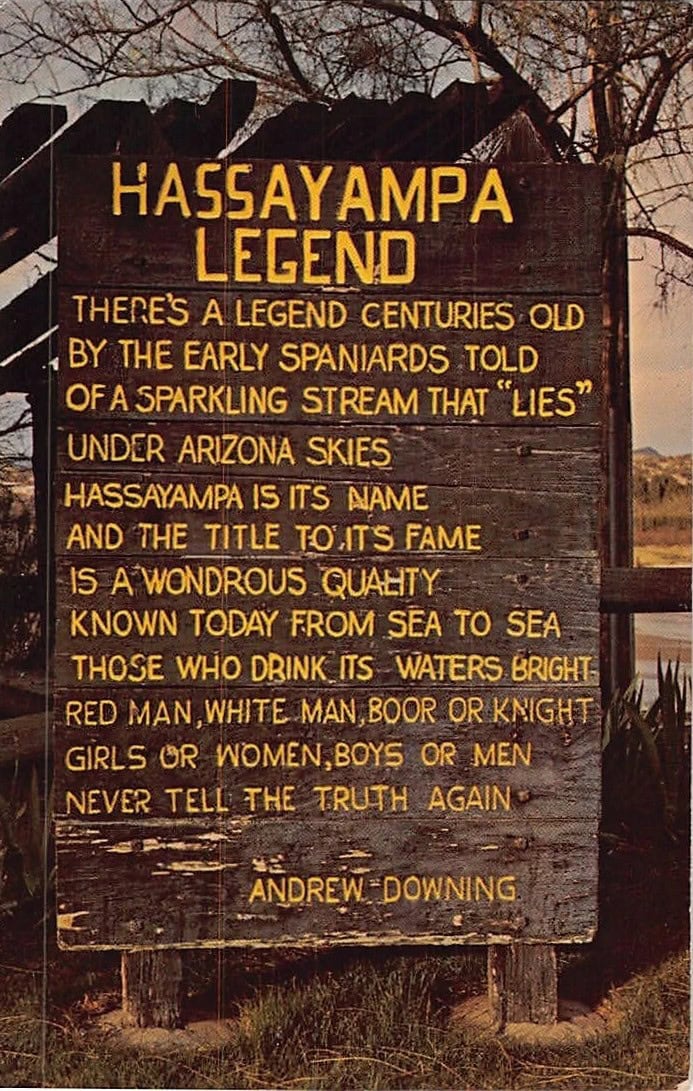
A simple Google search of the river’s name led me to an almost unbelievable Native American legend.
It has been said that once there was an Indian chief who had a son who was addicted to lying. The tribe’s medicine man suggested that the chief should take his son to the river and lash him to a rock that jutted into the water so that the water could flow over his body and wash away the boy’s falseness.
The chief agreed and the boy was bound to the rock. Food was taken to the boy every few days, but suddenly a famine came, and the boy was forgotten. Some time later when the boy was remembered only one bone was discovered. The rest of his body had been whisked away by the river.
Turn #1
A strange belief soon arose within the tribe that the waters of the stream had become so tainted with the boy’s falsehoods and deceptions that ever since the river water has had a magic power that makes those who drink it careless with the truth.
Twist #2
Around 1855, gold was discovered in the area and a new placer mine was opened to dig gold and minerals out of the Hassayampa Riverbed at Walnut Grove, Arizona, a small village just six miles south of Wickenburg in the west central part of the state.
Turn #2
The area around the mine was dry except for the river. The mining operation decided to use the “tailings” from the mine to dam the river near Walnut Grove as a water reservoir and irrigation source. After a short time, the rock and dirt were covered with a thin layer of mortar that did very little to secure the structure. The dam functioned without incident but was not constructed in a fashion that would withstand serious weather.
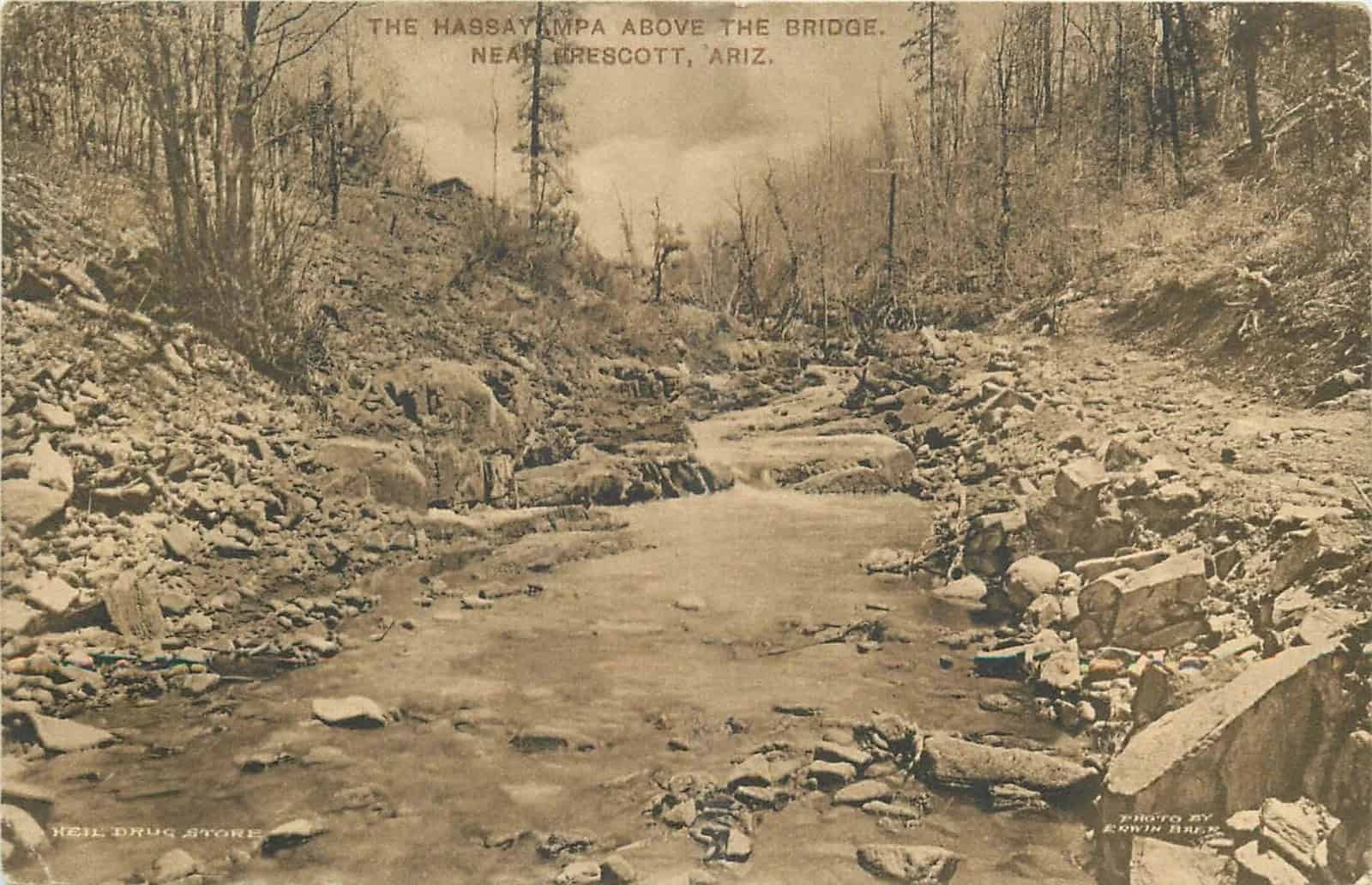
miles north of Walnut Grove), but the terrain is virtually identical
Twist #3
The winter of 1889-1890 was unusually wet and many heavy snows blanketed the region. One of the most torrential storms came when it started to rain on February 16th and for days the area was drenched in warm and heavy rain. The rains combining with the melting of the snow caused a constant flow into the riverbed and against the Walnut Grove Dam.
Turn #3
During the night of February 22, 1890, the flow had neared the crest of the dam and began pouring out of the spillway, which proved to be a feature inadequate to care for the overflow.
The water penetrated the mortar, ate into the earthworks, and soon developed a crevice that eventually opened and allowed millions of gallons of ice-cold water to spill into the valley below. The dam crumbled!
Seventy-six lives were lost.
Twist #4
On Sunday August 12, 1928, the Arizona Republican newspaper recounted the event of 38 years earlier. The article appeared with no less than three side bars. The primary piece was an announcement that the Nadaburg Project would build three dams on Hassayampa. To quote: … [with] financing assured, preliminary field work nearly completed, and its blueprint plans ready to be turned over to the state certification board within the next month, actual construction work on the $1,500,000 reclamation project may be expected to start within the next 90 days. The first side bar recounted the event that occurred in 1890, and the final part of the article was a human-interest tale based on a survivor’s account of the night in question. To wit, Miss Mary L. Hanlon was one of the few who escaped the disaster (unfortunately her maid lost her life because she stopped to secure some of Miss Hanlon’s valuables).
Turn #4
Alexander O. Brodie was one of Teddy Roosevelt’s Rough Riders. He graduated from West Point and was commissioned as a second lieutenant in the regular army and served in Idaho and Arizona. After his service, he settled in Prescott and worked as one of the five chief engineers of Walnut Grove Dam. Later in life from 1902 to 1905 Brodie served as the territorial governor of Arizona, but before he entered politics, on December 15, 1892, Brodie married Mary Louise Hanlon.
Twist #5
Nearly fifty years after the disaster (September 2, 1938), the same newspaper (but now renamed the Arizona Independent Republic) carried an exclusive on the campaign of one R. T. (“Bob”) Jones, a Democratic candidate for governor of Arizona.
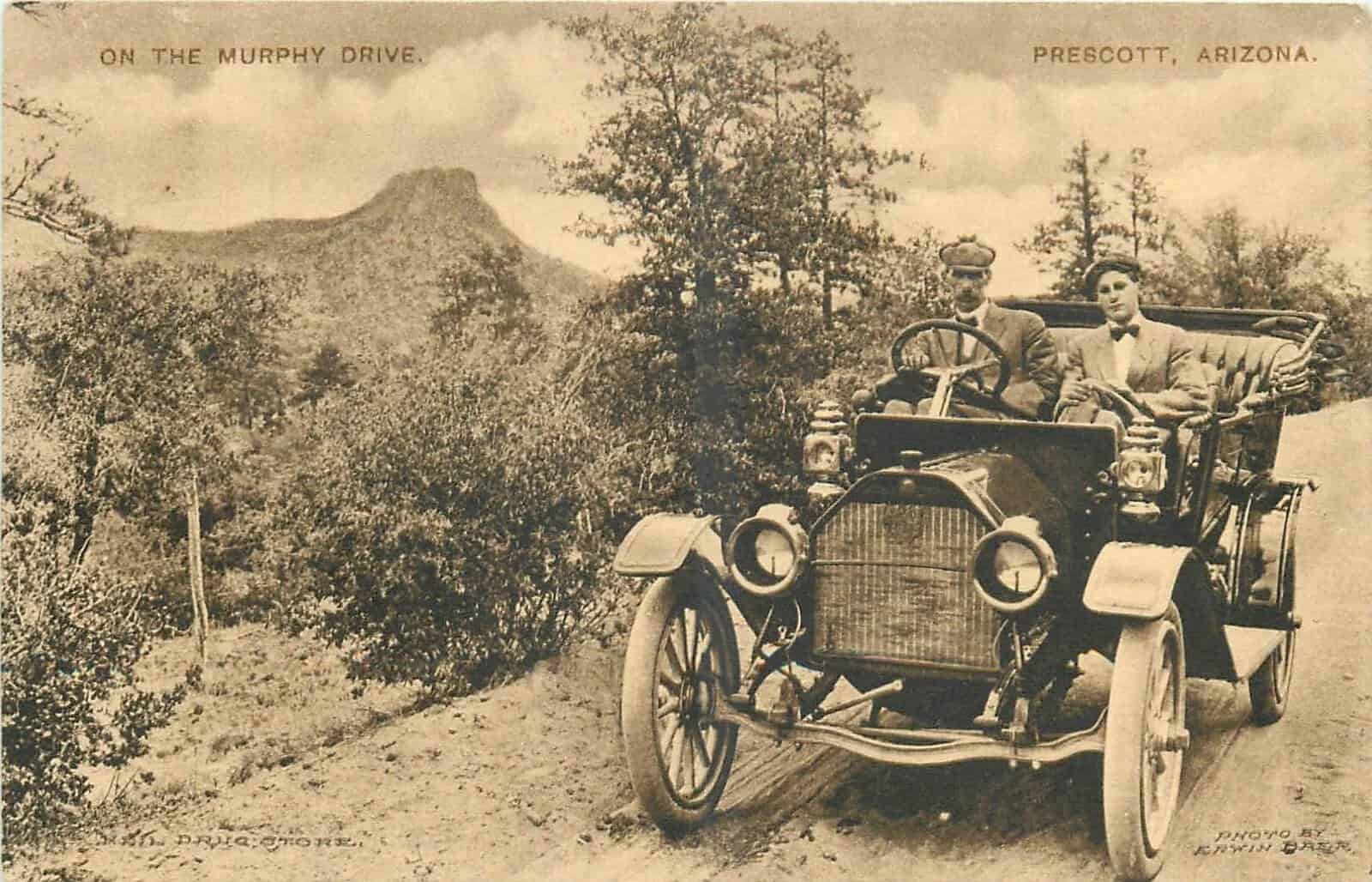
The Depression had hit the state hard and the general population was still unable to find good and substantial work. As Jones traveled around the state in a vehicle much like the one shown here, he advocated that the state needed two people, a competent businessman to oversee the workings of government and a construction engineer to supervise construction work within Arizona.
[It’s fairly clear that Mr. Jones was suggesting that he should be the businessman and perhaps someone he knew should be the engineer.]
One of the projects Jones was planning for his state was a dam on the Hassayampa River. The dam was to be designed as both a flood control and irrigation project. Jones promised that if he was elected, he would ask the federal government to fund the project.
Turn #5
As Jones crisscrossed the state, he frequently told his audiences, especially in Yavapai, Yuma, Maricopa counties and other places of the state familiar with the Legend of the Hassayampa River that his opponents must have been drinking the water. Whenever his followers heard him recite this bit of rhetoric they would burst into a roaring laugh. It’s hard to understand why the laughter was so genuine unless you know the backstory. But, now of course, you do.
Jones won the election, and he may have asked the federal government to fund the project, but it is unsure that he ever received the answer he wanted.
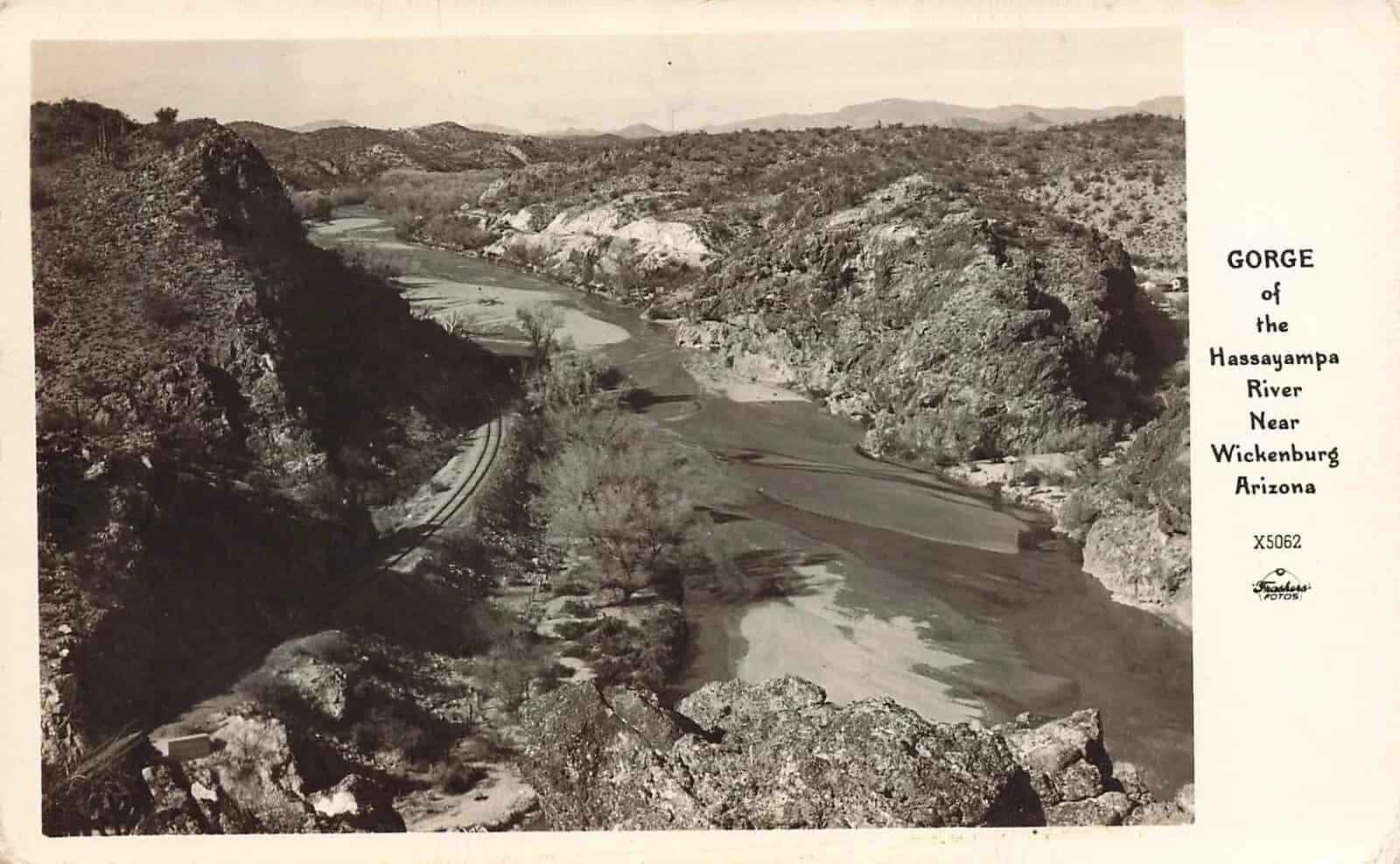
P.S. – No surprise here! There is no dam on the Hassayampa River.
What a superbly researched article, Ray! My friends and family in AZ are going to love it.
We loved this Ray! We are Sheila’s nieces in Arizona (I’m a native) and we didn’t know any of this! Thanks for the history.
Thanks for this article – so many twists & turns in one little river.