This postcard appealed to me because its title, “Armed Freedom Dome of the Capitol.”
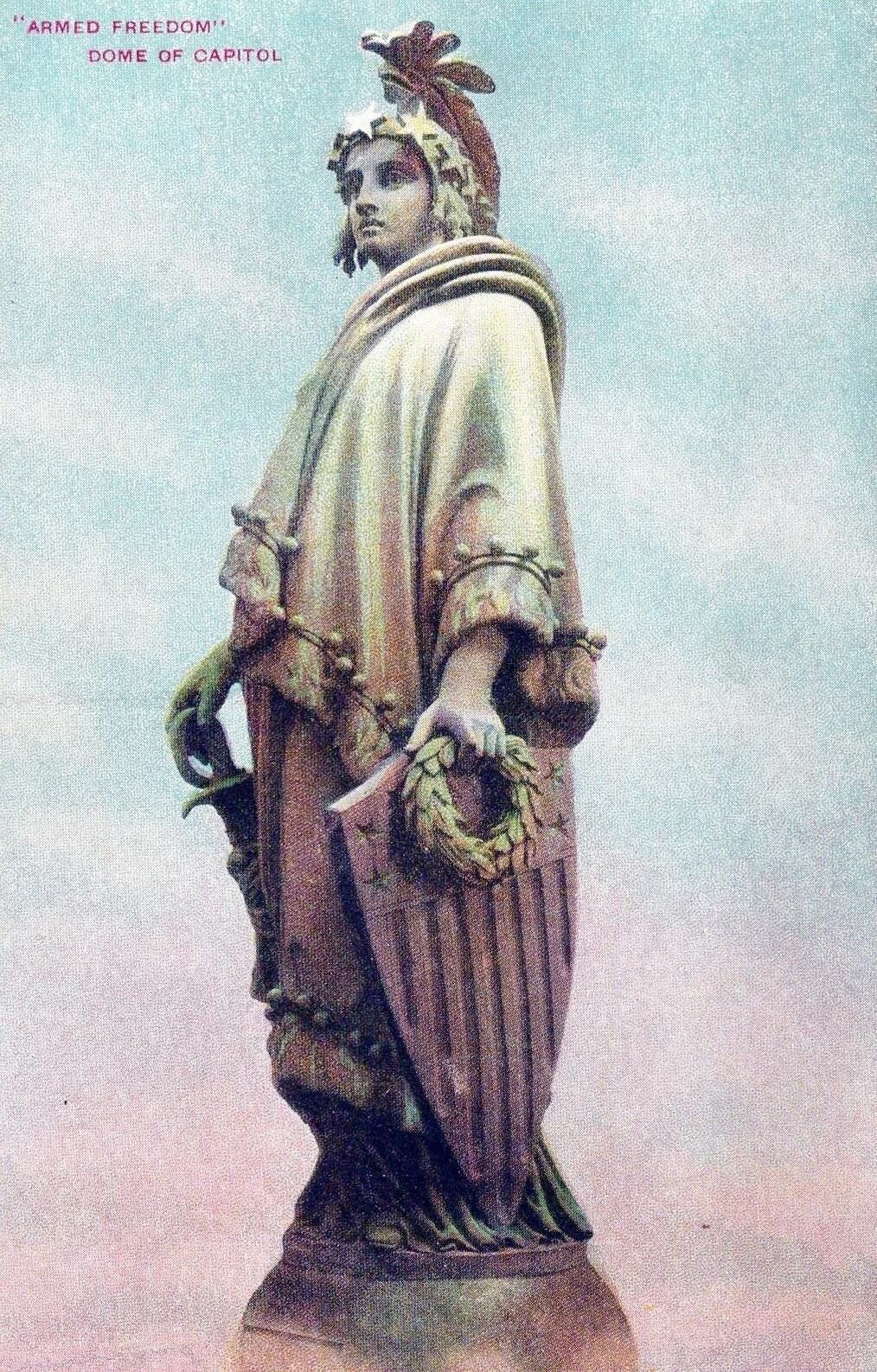
In the times I have looked at pictures of the capitol building (that is, the House of Representatives and the Senate building on Capitol Hill in Washington, DC), I never noticed that there was a statue on top of the dome. When we look at a tourist view of the Capitol building, you may see that there’s something up there, but I can’t tell what it is. In my European travels I don’t recall seeing statues on top of the great buildings, so it did not occur to me that there would be a statue on top of the U. S. Capitol.
The United States Constitution took effect in 1789, but the construction of a capital city did not begin until 1793. The state of Maryland provided land for the city of Washington in 1791 and a plan by a three-person commission headed by Pierre L’Enfant laid out various buildings, including the Capitol building on a hill that L’Enfant described as “a pedestal waiting for a monument.”
L’Enfant apparently was a difficult man to get along with and he was fired by the end of 1791, beginning a long and contentious process to construct the city of Washington and the Capitol building.
After L’Enfant’s dismissal, Thomas Jefferson, then the Secretary of State, proposed that an architecture competition for the Capitol and the “President’s House” be held, with a deadline for the submission of plans in mid-July 1792. Jefferson and President Washington (both of whom had active interests in architecture) rejected all the entries as amateurish.
An entry submitted after the deadline by amateur architect William Thornton was met with praise for its “Grandeur, Simplicity, and Beauty” by both Washington and Jefferson and the process moved a step closer to completion.
Egos flared from the rejected architects, so Jefferson convened a five-member committee to alter Thornton’s plan, with several individuals who had submitted earlier designs pushing their own ideas for revision. The commission approved a revised version of the design on April 5, 1793, and President Washington gave his formal approval on July 25, 1793.
Eight Masons and President Washington laid the cornerstone for the Capitol on September 18, 1793. The first and second architects to supervise the construction were dismissed for improper attempts to modify Thornton’s plan but a third architect, James Hoban, who had designed the “President’s House” (Executive Mansion or the White House), took over and finished the construction.
The Capitol was essentially completed by 1800, as was the White House, and John Adams moved to it in 1801. The Senate moved from Philadelphia into its wing of the Capitol building in November 1800. (The wing for the House of Representatives was delayed and was not fully complete until 1807.)
The three-story Capitol contained not only the two branches of Congress but also the Supreme Court, the Library of Congress, and the courts of the District of Columbia. Reorganizing the available space was a stopgap.
On June 18, 1812, the United States declared war on Britain, precipitating the War of 1812. Under President James Madison the British opposed issues of trade and embargos, America’s ambitions for new territory and states in the West. Such issues and the impressment of sailors on captured American ships inflamed tensions between the two countries.
A strategic decision by Madison came when the U.S. attacked British positions in upper Canada. The burning of the capital city, York (now Toronto) and the looting and burning of civilian homes and businesses within the city did not help matters.
On April 14, 1814, the British retaliated. British forces made an amphibious river landing and marched on Washington. Whether the burning of Washington’s buildings was in retaliation for York or whether taking Washington was strategic, the effect was that the Capitol and the White House were burned. The British held the city for a total of 26 hours.
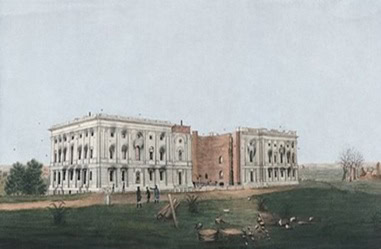
The reconstruction of the Capitol was managed by Charles Bulfinch, a Boston architect who began in 1818 not only to restore the Capitol but to enlarge it and, most importantly, to build a dome over the space between the two buildings that were the Capitol. A wooden dome was covered with copper.
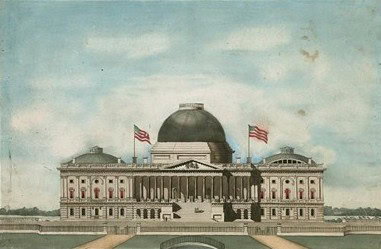
By 1850 it was clear that with the addition of new states and the growth of offices needed for departments of government, the Capitol had run out of space. A competition was held but no winner could be determined by Congress, so it was left to President Fillmore to decide. He selected one of the contestants, Thomas U. Walter.
Walter’s design added wings at both the north and the south ends of the Capitol, more than doubling the width of the building and making Bulfinch’s dome appear disproportionately small. The solution was to demolish the Bulfinch dome and construct the cast-iron dome we know today.
Walter’s new dome would stand three times the height of Bulfinch’s and span the space between the two buildings. On July 4, 1851, Daniel Webster delivered the principal oration and Fillmore laid the cornerstone. In the process of the renovation it was discovered that the original sandstone used in the construction of the Capitol had deteriorated badly, so white marble from local quarries was used throughout the exterior.
The construction superintendent, Captain Montgomery Meigs, a civil engineer, was also directed to select the artistic decorations of the rotunda under the dome and other parts of the Capitol. Meigs selected Thomas Crawford, an American sculptor whose studio was in Rome.
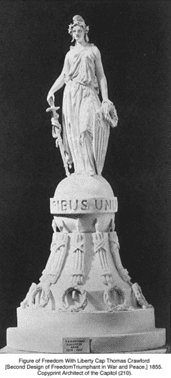
In May 1855, Meigs wrote to Crawford about a statue at the top of the dome. “We have too many Washingtons, we have America in the pediment. Victories and Liberties are rather pagan emblems, but a Liberty I fear is the best we can get.”
Crawford made three small models for Meigs to consider and sent him photos. All the images are of a female figure in slightly different poses holding different symbolic items. One of his models was wearing a liberty cap encircled with stars, an allegorical symbol of freedom well understood as such. It was called “Armed Freedom.”
Jefferson Davis, the then Secretary of War who was in overall charge of the construction project and who became the President of the Confederate States of America, objected to the liberty cap.
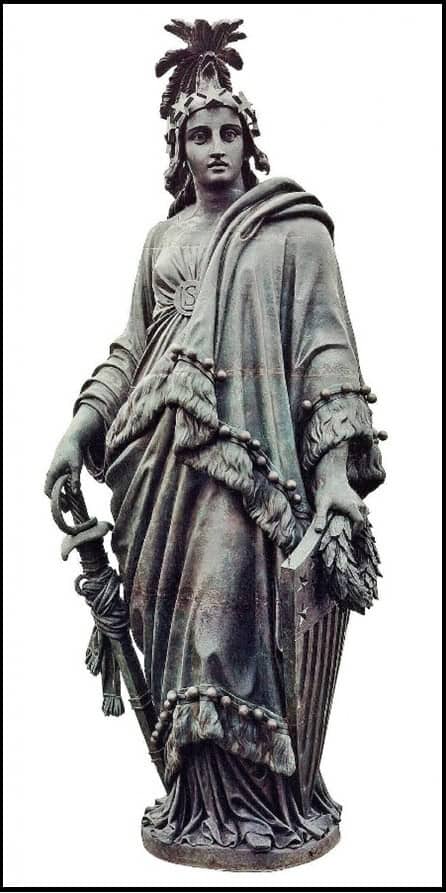
Davis felt that the cap’s history “renders it inappropriate to a people who were born free and would not be enslaved.” He wanted a helmet that would symbolize that the “conflict [is] over, her cause triumphant.”
Meigs explained the situation to Crawford in relation to the design for another sculpture for the Capitol Building: “Mr. Davis says that he does not like the cap of Liberty introduced into the composition [because] American Liberty is original & not the liberty of the free slave.” According to Davis, Meigs explained, the cap that became a revolutionary symbol in France derived from “the Roman custom of liberating slaves thence called freedmen & allowed to wear this cap.”
And so it is that the statue on my postcard, with the faint red caption “Armed Freedom,” lost its revolutionary cap to what is often thought as an Indian headdress.
I never knew about this statue. The article was very informative. Thanks!
Surprise, surprise, Jefferson Davis did not like the idea of a freed slave! Den
Great article!
Very interesting, and something I knew nothing about. Thanks very much.