Between 1902 to about 1912 many postcard publishers featured views of the triangular 22-story Flatiron Building (originally known as the Fuller Building) in New York City. The building was an eye-catching early skyscraper located at the busy intersection of Fifth Avenue, Broadway and 23rd Street. Most “Flatiron” postcard views are of the building looking south. Many having a comic theme related to this windy corner or courting couples or cheating husbands caught in the act or a pun on the building’s name.
This article showcases a smaller, less common type of Flatiron Building postcard – marketing postcards. These interesting and diverse postcards trade off the iconic nature of the building, or they advertise the building itself, or show the location of businesses in or near this building.
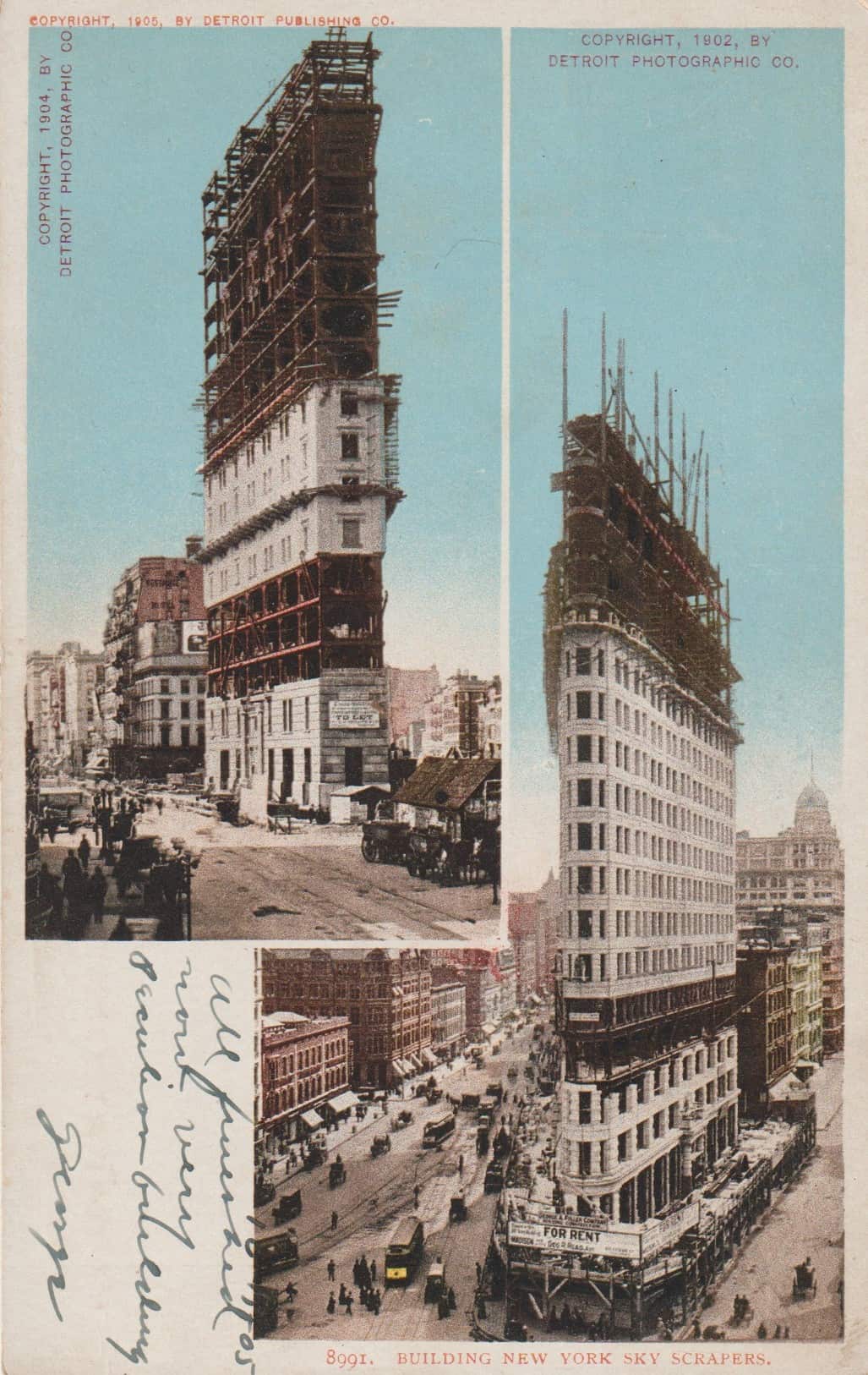
The Flatiron Building was constructed in 1901 and 1902 by the Fuller Company. Fuller Company was the first true general contractor that dealt with all aspects of a building’s construction (except for design). Their specialty was erecting skyscrapers.
When this postcard is enlarged, (click on the card for a full-screen view) signs can be seen for the George A. Fuller Company offering space “to let” or “for rent” in this building.
[This Detroit Publishing Company postcard was copyrighted in 1902.]
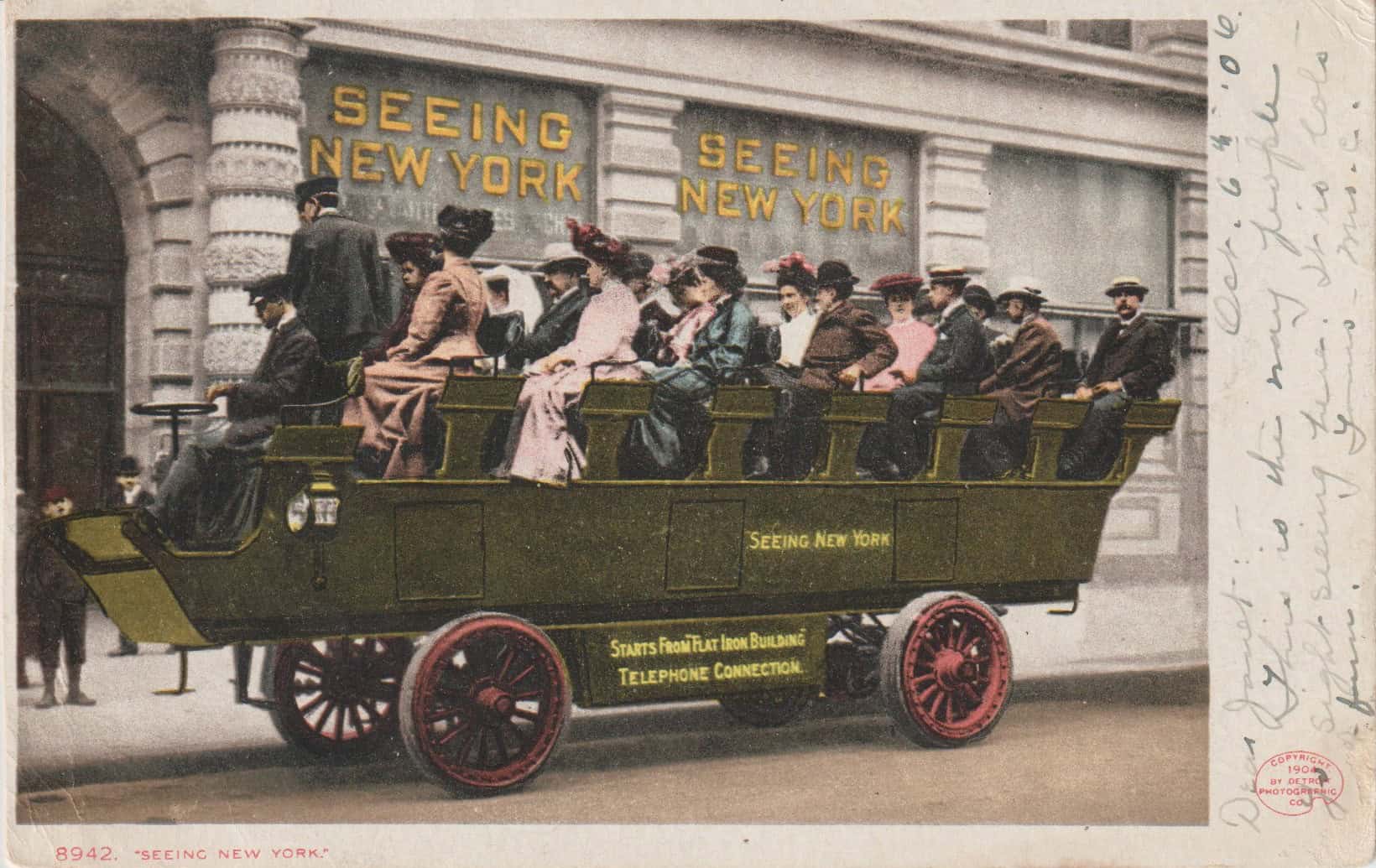
Seeing New York (officially Seeing New York Automobiles, Inc.) was a New York City sightseeing tour company that operated electric omnibuses and boats in the early twentieth century. Places visited on their tours include the Bowery, Chinatown, Brooklyn, Castle Garden, Central Park, Columbia University, and General Grant’s tomb.
[This Detroit Publishing Company postcard of a Seeing New York tour bus in front of the Flatiron Building was copyrighted in 1904.]
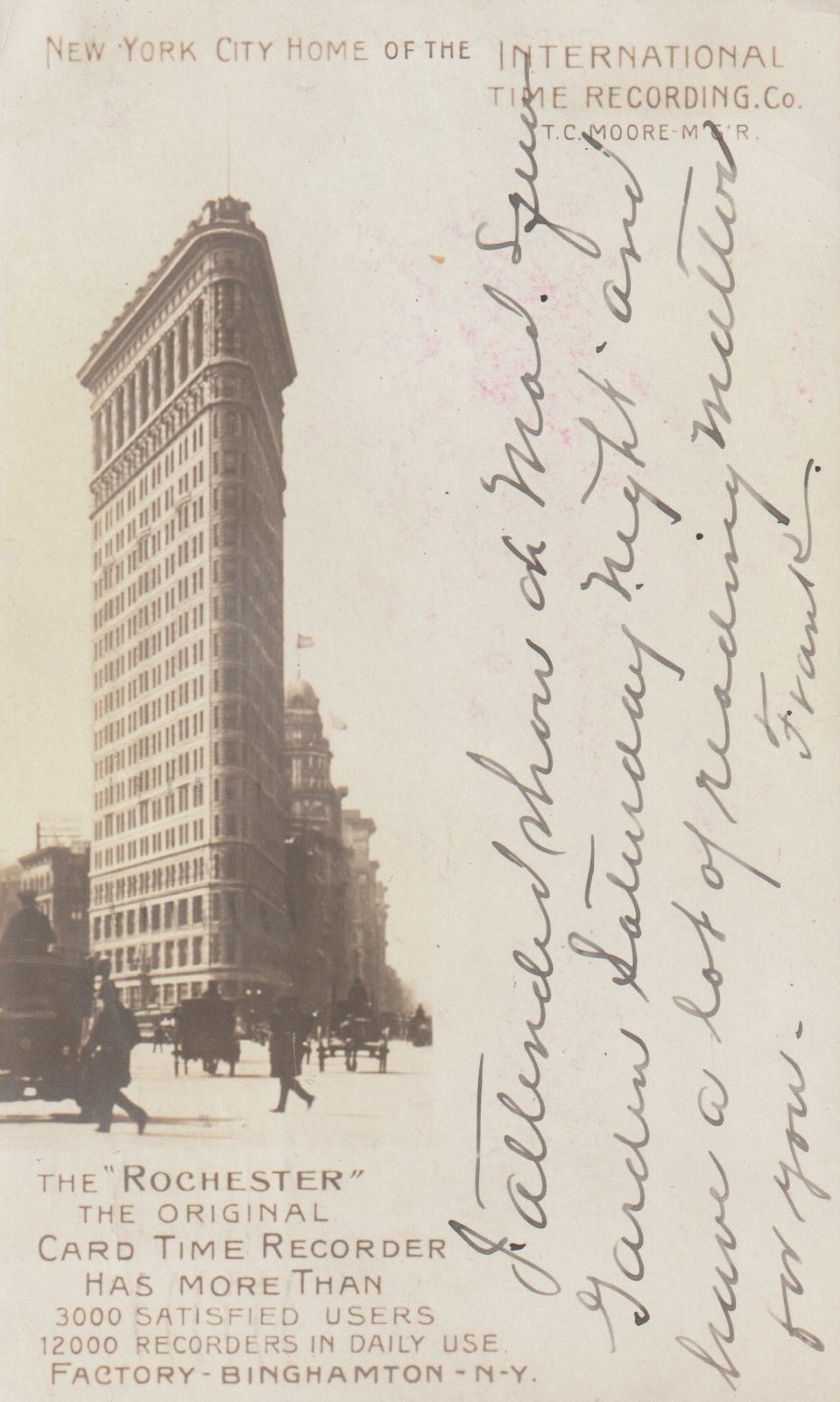
(Above, left) The International Time Recorder Company was a notable predecessor to the International Business Machines company (IBM). It was established in 1900 by George W. Fairchild. At first it was a sales agency for various time recording companies. In 1911, they merged with other companies to become the Computing-Tabulating-Recording Company, which was later renamed IBM.
[This rare, printed photograph postcard produced by the Rotograph Company was mailed in 1905.]
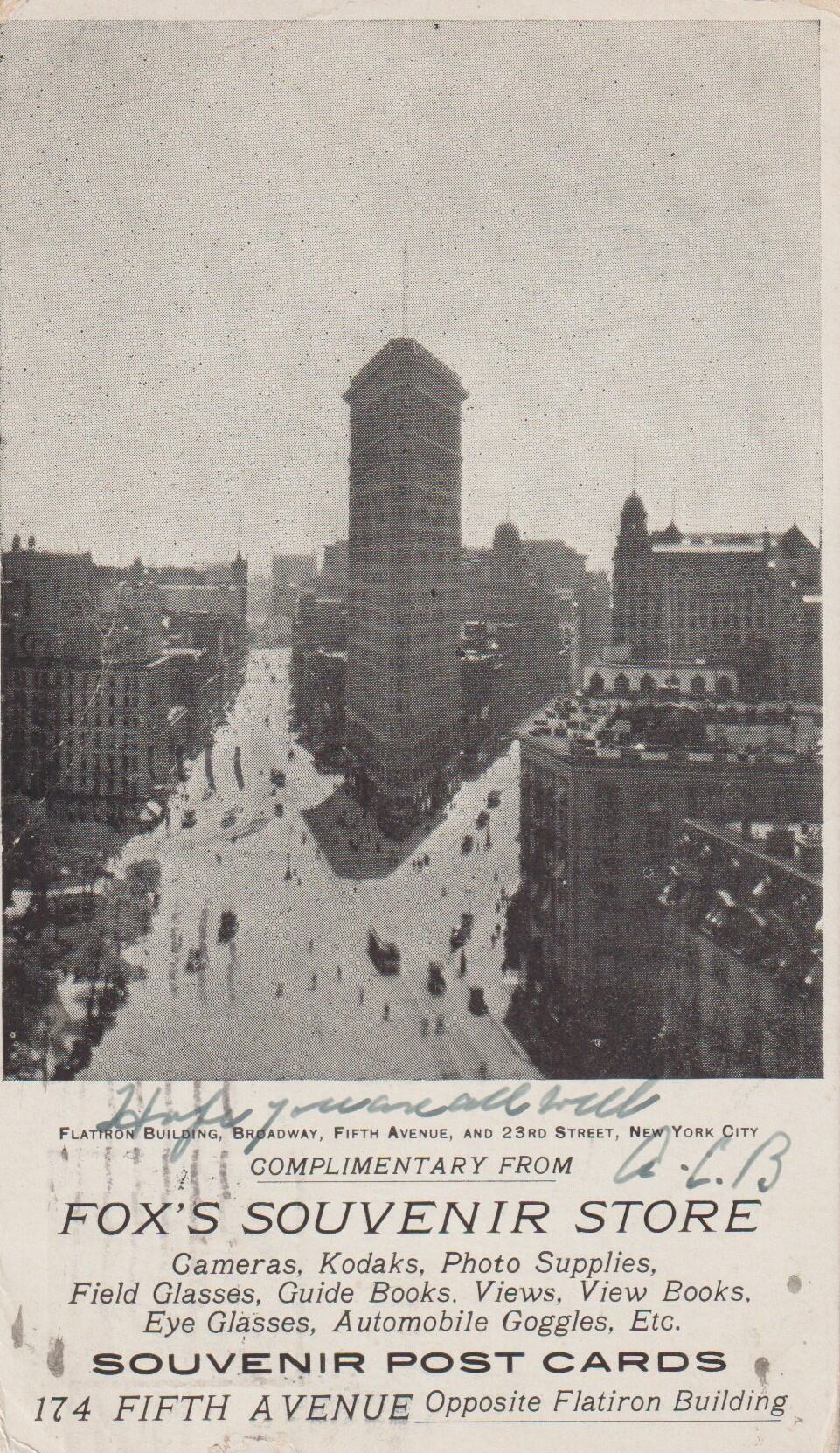
(Above, right) No information was found online about Fox’s Souvenir Store. However, by giving away postcards like this one, the store’s management definitely understood that postcards were a valuable advertising tool that could have a wide circulation.
[This postcard was mailed from New York to Toronto, Canada on April 20, 1906.]
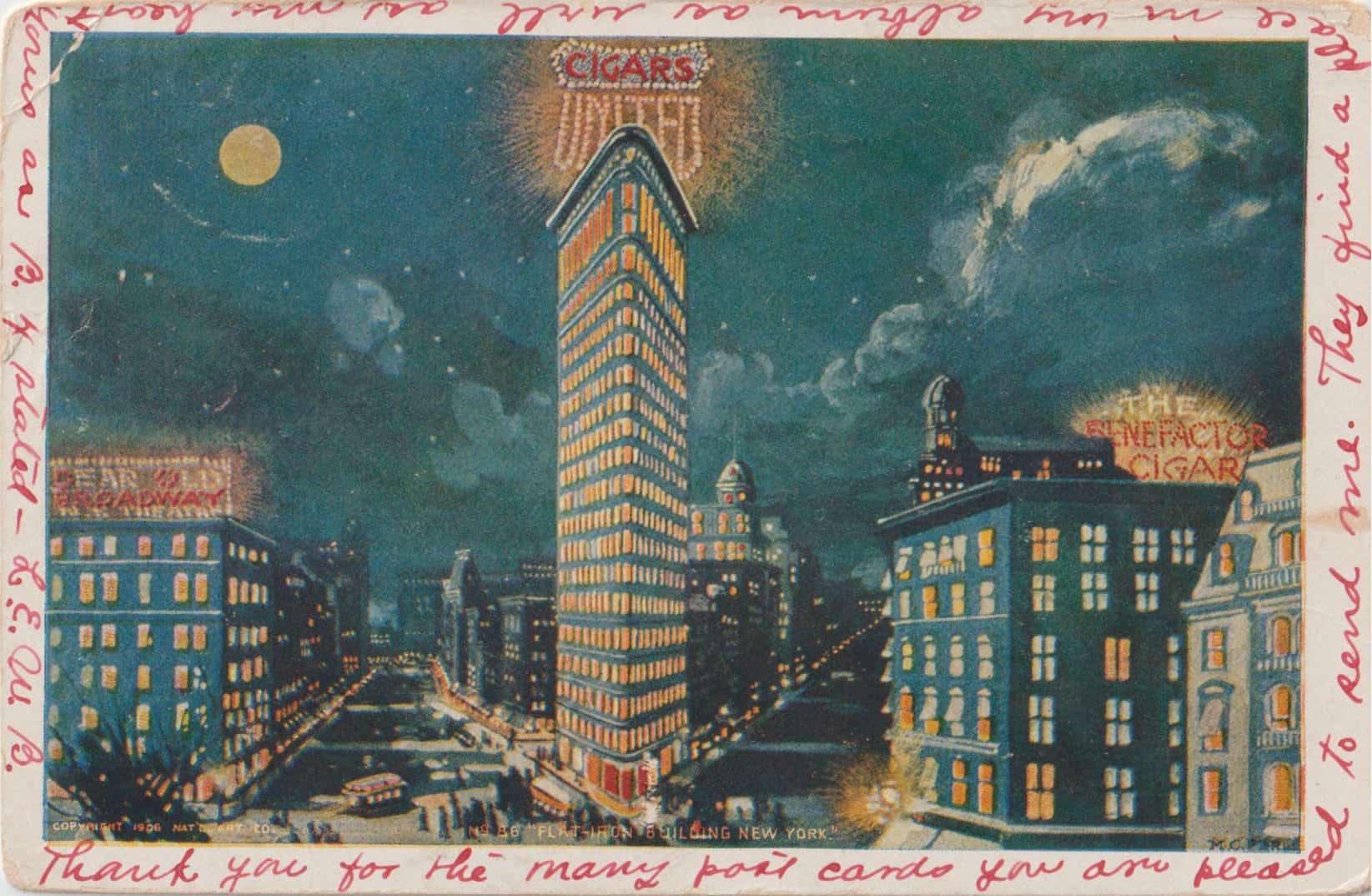
The Flatiron Building once had a one-story “cowcatcher” at its front where United Cigars were sold, but no reference has been found to prove that a huge illuminated United Cigars sign was ever on top of the building.
The rooftop signs on this card seem to be a case of artistic license taken by the National Art Company. There are similar postcards that are nighttime views of the Brooklyn Bridge, the Hudson River and lower Manhattan, Herald Square, and Newspaper Row.
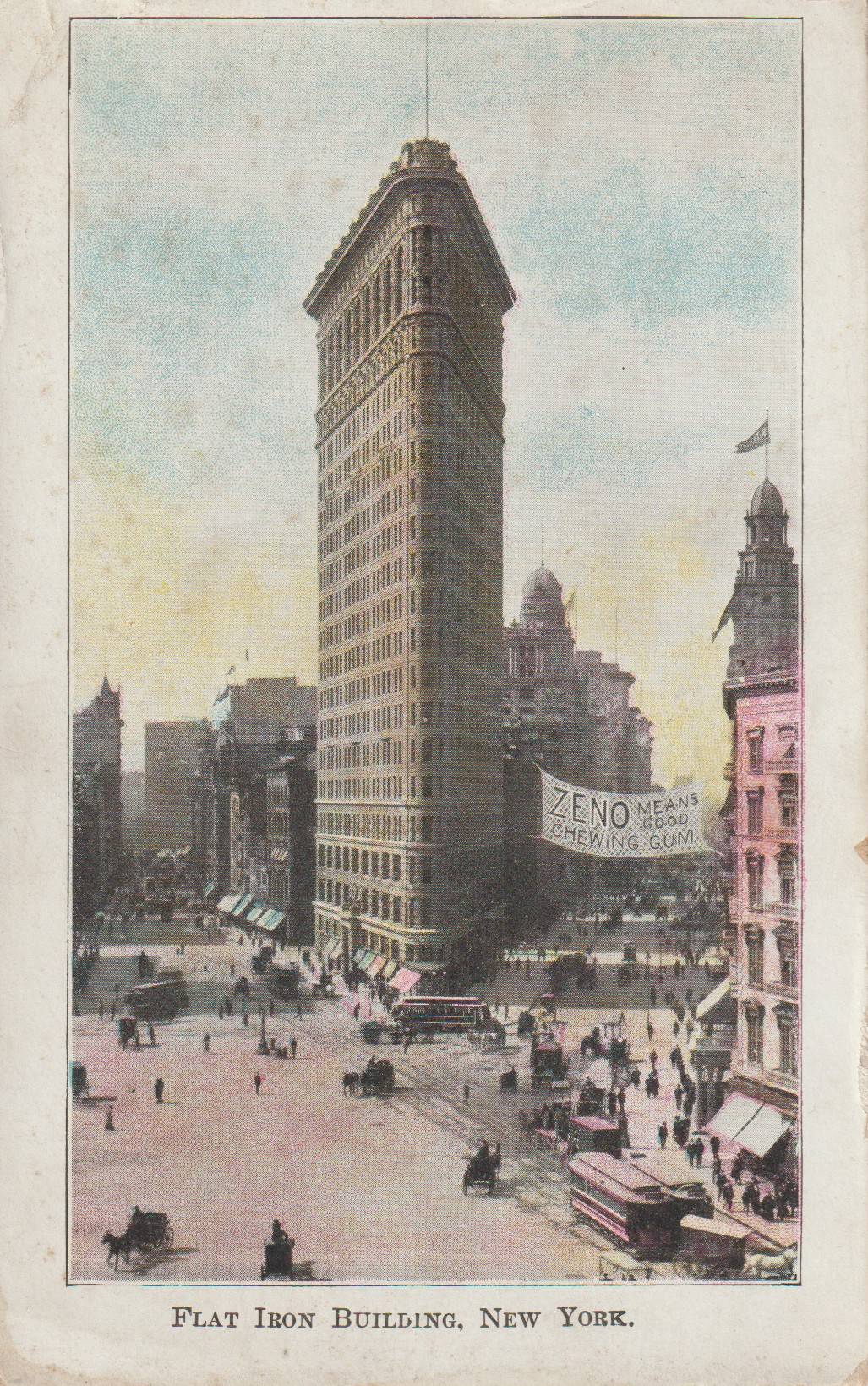
(Above, left) Zeno Manufacturing Company, established in Chicago around 1890, was a major player in the early chewing gum industry. It was known for its gum vending machines and its eventual role in the rise of William Wrigley, Jr.’s gum empire.
Zeno’s chewing gums, including brands like “Lotta” and “Vassar,” were first sold in penny vending machines. In 1911 the Wrigley Company acquired Zeno and Zeno’s entire production merged with Wrigley.
There are dozens of Zeno chewing gum postcards featuring famous American landmarks. They may have been included in tins of Zeno chewing gum or as part of a similar promotion by it.
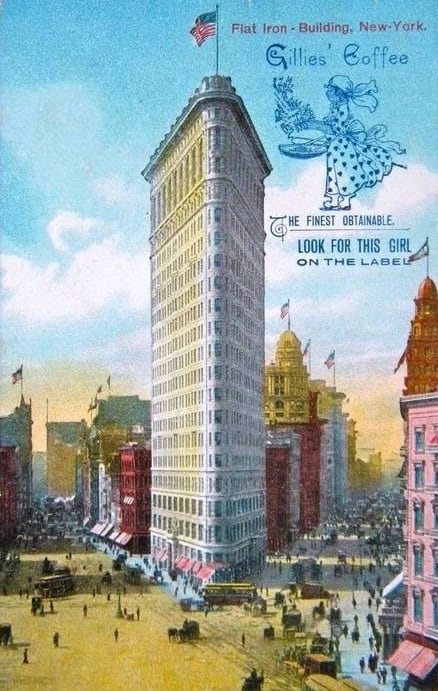
(Above, right) Founded in 1840 in New York City, Gillie’s Coffee is America’s largest coffee merchant.
At least thirteen other “This Girl” postcards of other New York City views exist. The “This Girl” logo on them was copyrighted in 1903 and appears on a “Will Call” postcard for this company mailed in 1905.
[The backs of some of these postcards record Edwin J. Gillies & Co. as the publisher. They appear to have been published around 1912.]
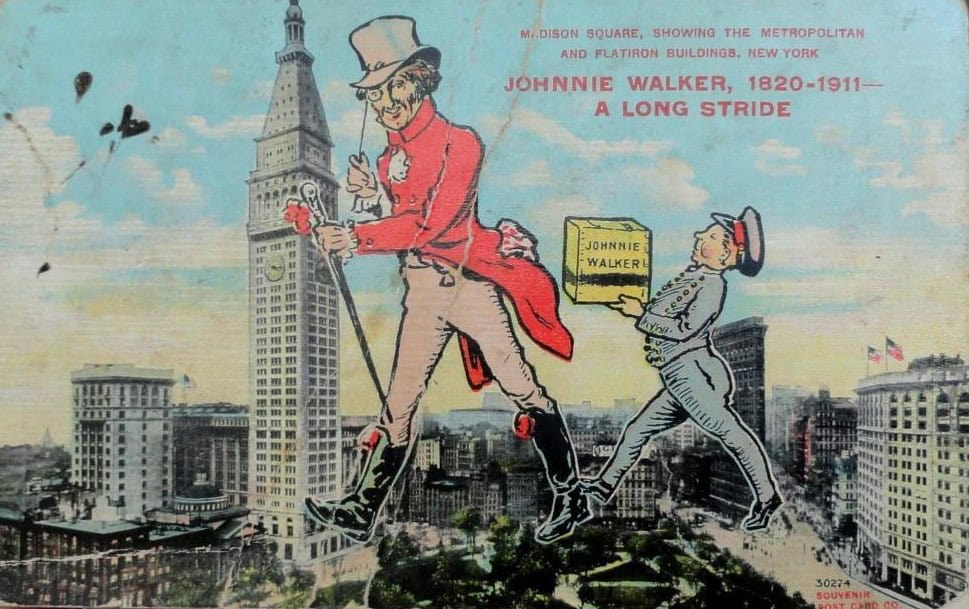
Johnny Walker is a world-famous brand of Scotch whisky that has been produced in Scotland since 1820. As part of a rebranding in 1909 the company introduced its Striding Man logo.
[This postcard dates from about 1912. A similar postcard exists for Herald Square in New York City.]
Great post – grew up in Stuy Town and the Flatiron Bldg is my favorite NYC bldg thank you –