Words come (into favor) and go (into antiquity). In this (the first quarter of the 21st century, which will end in about four months), we don’t hear the word “agony” often. We still read it in books – writers have not forgotten the word, but only a few people use the word in conversation. Could it be too harsh for our genteel society?
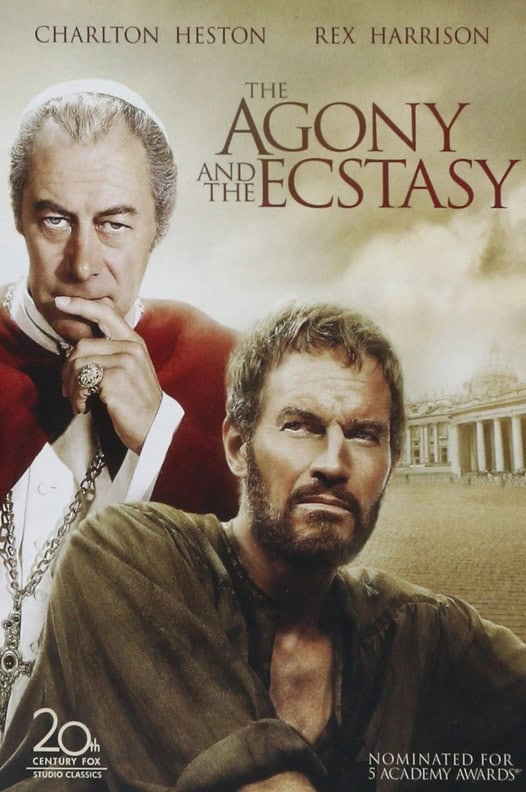
It could be that the best-known use of the word “agony” came in 1961 when Irving Stone entitled his biographical novel of Michelangelo, The Agony and the Ecstasy.
“Ecstasy” – the other half of Stone’s title also seems to be an antique word. “Never” is such an absolute, so I write this with a high degree of hesitation, I do not remember any time in my life that someone has used the word Ecstasy in a conversation with me.
The usage trends for these words began in the 1960s – six decades ago – and continued well into the 1980s. At one point, 1974, the term “Agony Aunt,” came into common usage in the United Kingdom to describe a newspaper columnist who freely gave advice solicited by readers who wrote agony-letters to the advisor. (The etymology comes from the Oxford English and Merriam-Webster dictionaries.) However, the practice of agony aunts giving advice in problem columns dates back much further, with the earliest examples appearing in the seventeenth century.
Now imagine my surprise while doing research on these words that I learned there is such a thing as an “Ecstasy Uncle.”
An “Ecstasy Uncle” is typically a person, often an older male, who is associated with the distribution, promotion, or use of the drug ecstasy (MDMA). Enough said, I have no desire to explore beyond knowing there really is such an individual. So, allow me to pursue the distaff side of the equation.
Agony is a weighty kind of suffering or distress that can be mental or physical. The term originates from the Greek word “agony,” meaning contests that involve intense emotional suffering. Mentally, it arises from situations involving loss, trauma, or hardship. Physically, agony is experienced as excruciating pain caused by injury or illness. Agony is often temporary, such as the pain after an injury, or prolonged, as in chronic illness.
On the other hand, “ecstasy” is associated with profound joy and bliss. Ecstasy is rooted in experiences that elevate the human spirit. It involves a sense of being completely immersed in the moment, feeling love or compassion. Ecstasy offers glimpses at understanding and enlightenment.
***
One dramatic personification of both emotions came October 7, 1965, when the Twentieth Century-Fox Studio premiered the film “The Agony and the Ecstasy,” directed by Carol Reed. It starred Charlton Heston as Michelangelo and Rex Harrison as Pope Julius II. The work was an enchanting film depicting the tumultuous life of Michelangelo, highlighting his artistic struggles and personal conflicts. The movie was true to Stone’s novel in the explorations of an artist’s creative passion and perseverance while creating a masterpiece like the Sistine Chapel ceiling.
The Agony Column By Bob Teeven
Another rendering of “agony” came when the publisher Misch & Stock, issued this postcard as part of their “The Agony Column” series, which were issued around 1904. It is a rare set so the exact number of issues in the set is unknown. Currently, twenty-seven examples have been found.
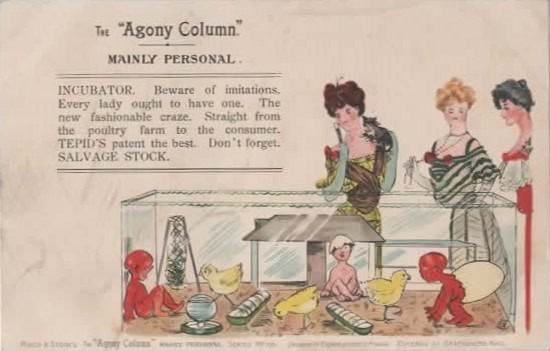
There is a fair chance that each card features an illustration by George Fyffe Christie and that the cards were styled to misrepresent genuine notices that appeared in a newspaper’s Agony Aunt advice column. They are similar in style to the Addled Ads cards which were also published by Misch & Stock. The “Ads” series were meant to mock newspaper classified ads and were also the work of George Fyffe Christie.
The illustration features three young women keeping a careful eye on their offspring which appear to be growing – from eggs to toddlers – using an incubator.
The earliest incubators were invented in ancient Egypt and China, where they were used to keep chicken eggs warm. Use of incubators revolutionized food production, since it allowed chicks to hatch from eggs without requiring a hen to sit on them.
In the nineteenth century, researchers recognized that the use of incubators could contribute to medical advancements. They began experiments to find the ideal environment for maintaining cell culture stocks. These early incubators were simply made up of bell jars that contained a single lit candle. Cultures were placed near the flame on the underside of the jar’s lid, and the entire jar was placed in a dry, heated oven.
In the late nineteenth century, doctors realized another practical use for an incubator, keeping premature or weak infants alive. The first infant incubator, used at a women’s hospital in Paris, was heated by kerosene lamps. Fifty years later, Julius H. Hess, an American physician often considered to be the father of neonatology, designed an electric infant incubator that closely resembles the infant incubators in use today.
***
Be there “agony” or “ecstasy” the two word describe days of our lives and have done so for centuries. Imagine all the effort we use to avoid “agony” and how little effort we expend to enjoy “ecstasy.”