A frustrating thing about collecting postcards is rediscovering one which you felt had some topicality at the time you purchased it, although you cannot now work out what that was. This, for me, is one such postcard.
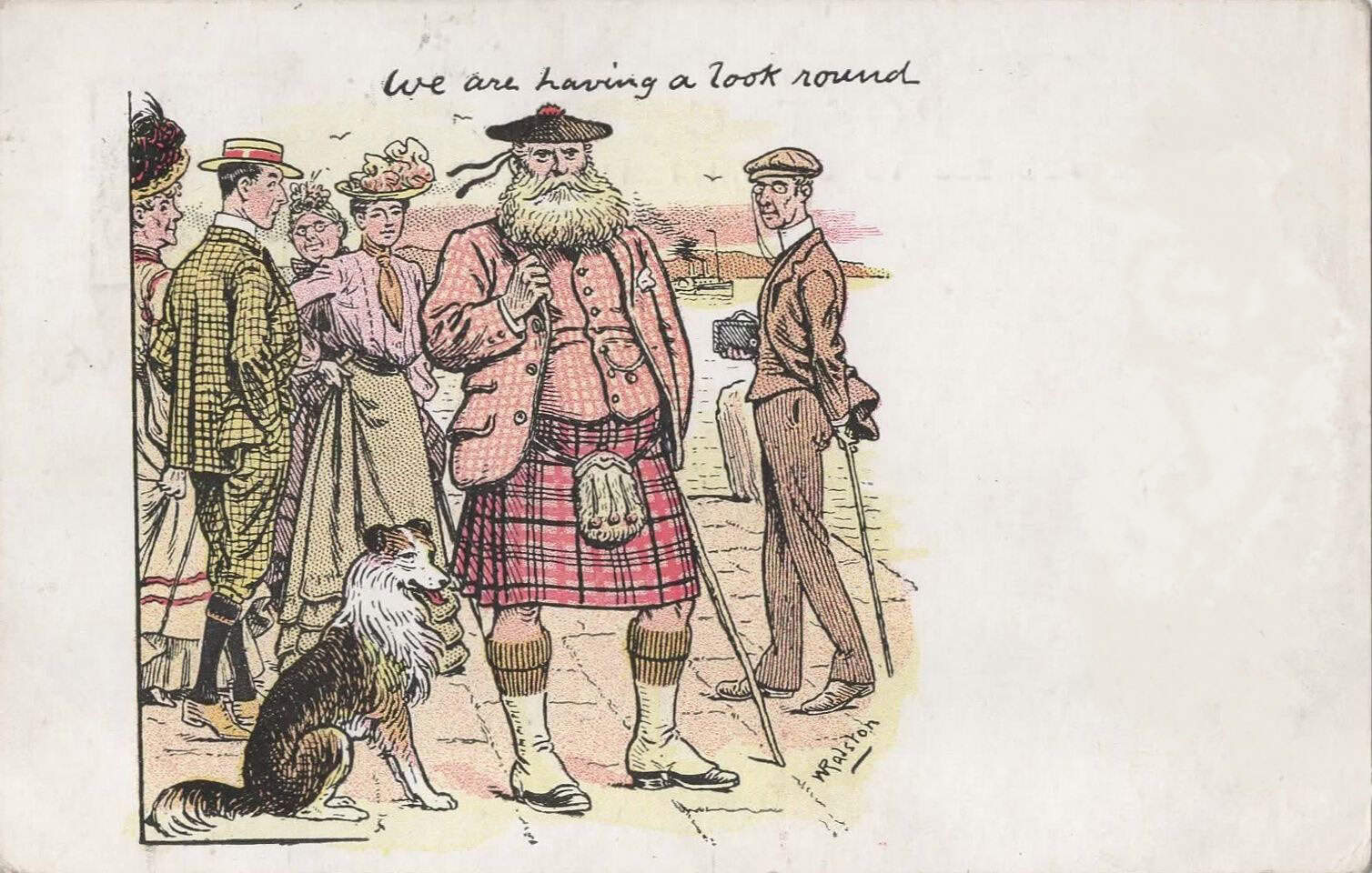
It is an undivided back postcard without details of a publisher. The illustration is signed “W. Ralston” and the well-drawn image features a well-dressed Scotsman and his obedient and contented dog.
The Scotsman stands amidst a small crowd who I suspect are sightseers or tourists with this suspicion based on the belief that the bespectacled man on the right is carrying a camera. The Kodak Box Brownie camera was introduced in the year 1900 and improved in the year 1902. Although knowing this does little to date the image.
The crowd appears to be looking at the Scotsman with curiosity and were the background an urban setting as opposed to a loch side (lake shore), I would suggest that they were locals eyeing up a potential neighbor and having some reservations about his suitability. After all, who would want a kilt wearing, whisky drinking, tight-fisted Scot as a neighbor.
The Scotsman in such a setting may have reassuringly said, “We are ‘just’ having a look round” although as the word ‘just’ is not included in the title of the card, it could be this was a mischievous comment uttered to provide some concern to the neighbors.
This is not however an urban setting so why would the Scot seek to justify himself having a look round. Perhaps this is not a loch side setting either, and the steamer behind is on a lake in the lake district. This would explain the lack of other ‘obvious’ Scots and suggest why the highland dress was thought peculiar.
The card was mailed in June 1903 and nothing has been found which suggests that the title was a catchphrase of any notable music hall artiste, nor can any news reports be found that suggest any particular anti-Scottish sentiment of the time. And, there is nothing to suggest that any Scot was buying up land throughout the country. Had the Scot been wearing a business suit or trousers and tails, then this may have alluded to the philanthropist Andrew Carnegie, although I do not think the illustration refers to him.
The illustrator was William Ralston who was born in Dumbarton in 1848 and was a household name at the end of the century. He toiled in art and displayed a high-level of productivity and unusual versatility. Though only minimally trained he ranged across the disciplines of painting and illustration, photography, and the design of book-covers.
Ralston produced celebrated work as a cartoonist for Punch and as a satirist for The Graphic. These engagements ran from 1870 until the closure of The Graphic in 1908, and he was concurrently involved in the family’s photographic business based in Glasgow, where he took hundreds of portraits. His other work included popular comic books for children such as The Demon Cat (1889) and travelogues of witty observations, notably K.B. and D.A.’s Yachting Holiday (1894). Ralston died in 1911.
The postcard is addressed to Mrs. M. Millar at 40 Main Street, Alexandria, and surely this was Mrs. Mary Millar who was the wife of William Millar, a baker, at the time of the 1901 census. The census records her as being 35 years of age in 1901 and the mother of four sons – ages 3 to 15 years.
When searching the newspaper archives for possible references to the title of the card – and therefore reasons for its creation – I found this article in the Ross Gazette of June 12, 1902. There would be great surprise if this were the reason for the publication of the card, but the story was featured in five newspapers that week and was perhaps therefore something which amused and inspired the illustrator.

SAVING THE JUDGE’S TIME
Charles Wilson, Francis FitzWalter, and Daniel Morrissy, three well-known criminals, were indicted, at the Old Bailey, for attempted burglary, and the first named also with shooting a policeman.
The prisoners caused great laughter by denying the charge and then adding, “We intended doing the place another night. We were having a look round to see if it was worthwhile.”
Mr. Justice Grantham said that the prisoners had addressed the jury so eloquently on behalf of the Crown that it was unnecessary for him to say anything. They had summed up the case for him.
Wilson was sentenced to ten years of penal servitude, and the other two to eighteen months hard labor.