The year 1927 was a spectacular success on Broadway. A total of 296 shows opened that year. “Good News!” was just one of the many.
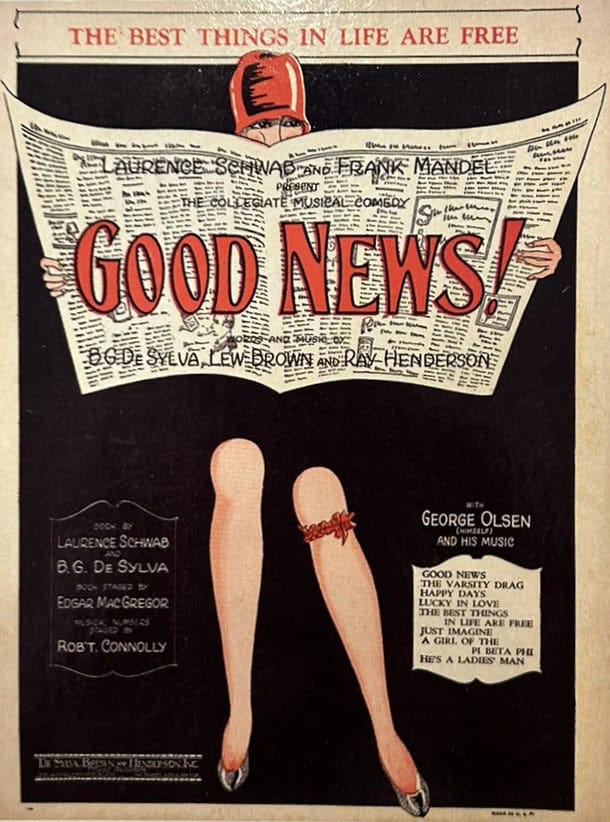
[By comparison, 1926 saw 268 new productions, including the play “Porgy” (not Gershwin’s “Porgy and Bess”) and in 1928, 264 new shows premiered, including “The New Moon” by Rodgers and Hammerstein. “Good News” had only one serious competitor, also a musical called, “Show Boat.”]
“Good News” was a classic. It premiered on September 6th at Chanin’s 46th Street Theatre and was soon renowned for its lively jazz-influenced score, cheerful themes, and innovative staging. It was a pioneer that contributed concepts to many future shows in the musical comedy genre.
The origins of “Good News” trace back to the early 1920s, a period marked by an increasing acceptance of jazz age music and a shift towards more upbeat entertainment. The musical was conceived by composer Ray Henderson, lyricist Lew Brown, and book writer B.G. DeSylva. The trio came together through a series of circumstances for this their first collaboration. Later they would work together again on “Hold Everything!”
“Good News” continued to capture the theater going public’s attention because vibrant music, energetic dance routines, and humorous storytelling resonated well with audiences of the era. The show was a far-flung departure from the serious works of the time. It was carefree and happy.
The plot of “Good News” centers around students at the fictional Tait College, which was portrayed as a lively, fun-loving institution. The story involves romantic entanglements between campus football hero, Tom, and a scholarly-minded co-ed, Connie; school spirit, and humorous situations, all set against the backdrop of college life. Tom wasn’t much of a student but his Astronomy professor was a devoted fan and finally gave him a passing grade. Its narrative was complemented by a score that included memorable songs such as “The Varsity Drag,” “Lucky in Love,” and “I Want to Be Happy.” These songs became instant hits.
Musically, “Good News” was groundbreaking because it included jazz and popular music styles into musical theater. The lively score, characterized by rhythms and melodies, helped to establish the musical as an emblem of the jazz age. The choreography also enhanced its appeal.
The success of “Good News” popularized the musical comedy format that dominated Broadway for decades – and to a degree, still does.
The original production was a major success, running for 551 performances (sources vary widely), a remarkable achievement at the time. Its popularity led to numerous “touring productions” and revivals over the years. Broadway revivals came in 1930, 1945, and 1993, each time reflecting the changing tastes and cultural contexts of the period. The 1945 revival, for instance, was staged during World War II and aimed to boost morale. The 1993 revival brought the show back with a more modern sensibility, though it retained much of the original’s charm.
Throughout its history, “Good News” has been recognized for its significant contributions to American musical theater. The show also played a role in popularizing the college musical genre, influencing later works that celebrated school and university life.
Musical achievements aside, “Good News” had a cultural impact. It captured the exuberance and optimism of the 1920s and its success helped establish the musical comedy as a staple of American entertainment.
The show’s legacy is a testament to the enduring appeal of joyful, spirited entertainment.
Interesting read! Can’t find the author though?
Can’t find post card