Wolverine shoes and boots are found on the feet of men and women almost everywhere. There isn’t a building site in America where heavy construction is being done where someone isn’t wearing Wolverine shoes or boots.
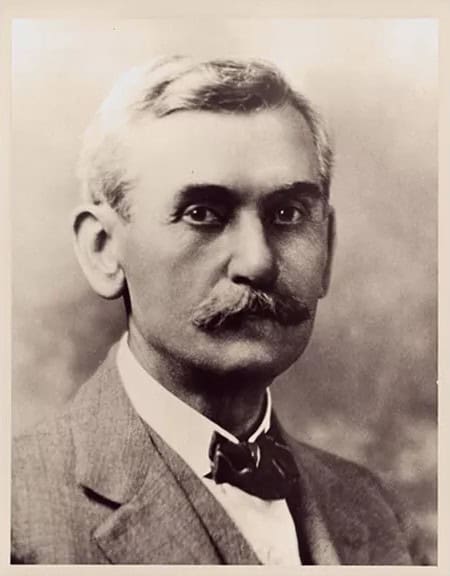
In 1883 G. (Gustav) A. (Adolph) Krause and Fredrick Hirth bought a small leather tannery in Michigan. Their initial focus was on producing high-quality leather boots for workers and outdoorsmen. The company’s early mission was to create footwear that could withstand the toughest conditions and reflect the rugged spirit of the American laborer and wilderness explorer.
Throughout the late-nineteenth century, Wolverine established a reputation for durable and comfortable boots. Their commitment to quality was evident in their use of premium leathers and their innovative manufacturing techniques. During World War I, Wolverine supplied more than half the boots worn by American Expeditionary Forces in Europe. During World War II the company first worked with the government from its tannery division. Their goal was to produce suede leather from pig skin from which gloves could be made. The process turned out to be a messy one; one employee was quoted as having said, “It looked like these pigs didn’t care to be skinned.” In the post-war years Wolverine experienced exponential growth and a significant expansion in their product range by using military-grade materials in their civilian footwear.
At the same time, Wolverine capitalized on the rising demand for work boots among industrial workers, miners, and construction crews. Their professionally styled boots, such as the Wolverine 1000 Mile Boot introduced in 1914, became a symbol of craftsmanship and resilience. These boots were crafted with Goodyear welt construction, ensuring longevity and ease of repair, values that remain part of Wolverine’s brand identity.
The mid-twentieth century saw Wolverine using new materials and designs, including waterproof leather and slip-resistant soles. In the 1960s and ‘70s, the brand expanded beyond work boots into casual and fashion footwear. In the 1980s Wolverine also embraced advancements in manufacturing by moving to some synthetic materials and ergonomic designs that greatly enhanced comfort.
In the early twenty-first century, Wolverine continued to evolve with a focus on sustainability and innovation. They introduced lightweight, energy-absorbing soles and completely waterproof materials. The brand also expanded globally, establishing a presence in international markets.
Today, Wolverine exhibits a very clever tagline on their American website: they claim, “We’re not good because we are old; we are old because we stayed good.” This claim is substantiated in numerous ways since the company is still in their hometown of Rockford, Michigan, and is respected for its blend of traditional craftsmanship and modern innovation. Their product lines include rugged work boots, outdoor footwear, and casual shoes under brand names like Hush Puppy, Keds, Chaco, Stride Rite, Saucony, and Sperry. They also manufacture licensed footwear for Caterpillar and Harley Davidson. And, not to be forgotten, are Wolverine’s commitments to police departments around the world that use their shoes as part of their uniform equipment.
***
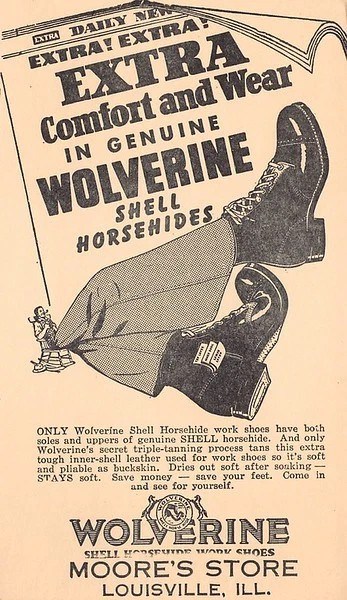
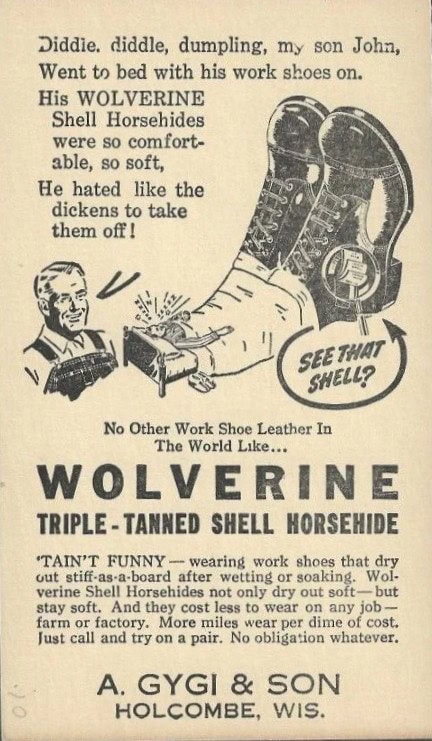
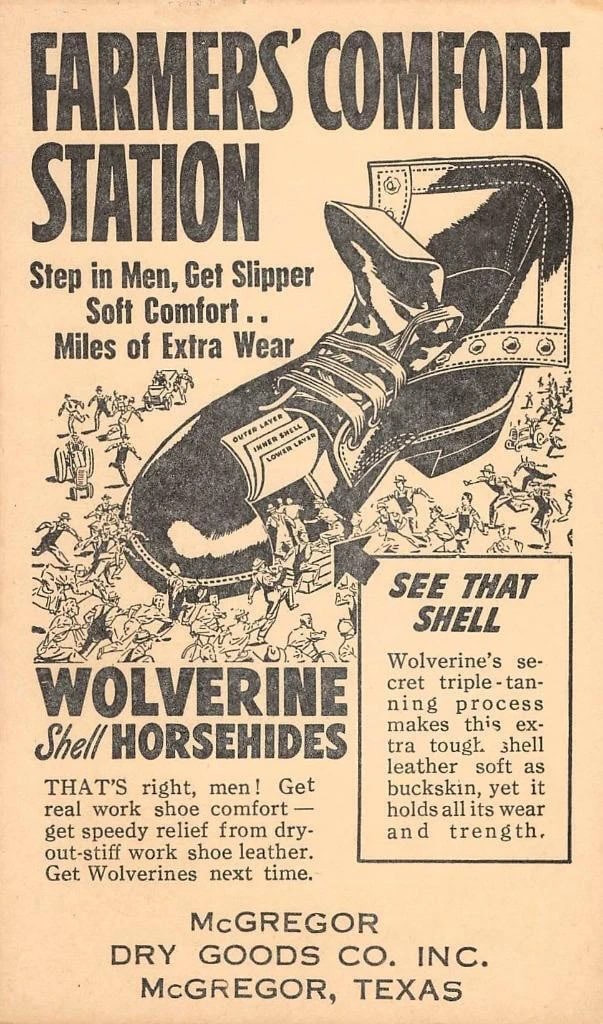
There is a curious mystery about the Wolverine Shoe Company, and it is something difficult to prove. However, it may be safe to assume, since one has yet to be discovered that they never made use of commercially produced postcards. They did however use what may have been millions of the 1¢, green Jefferson, postal cards. The process probably followed a routine pattern: an in-house artist prepared an illustration of the newest product, appropriate text was added, and the finished advertisement was printed on a postal card along with the name of a “Wolverine” outlet. The outlet locations were miles apart, but the cards were identical.
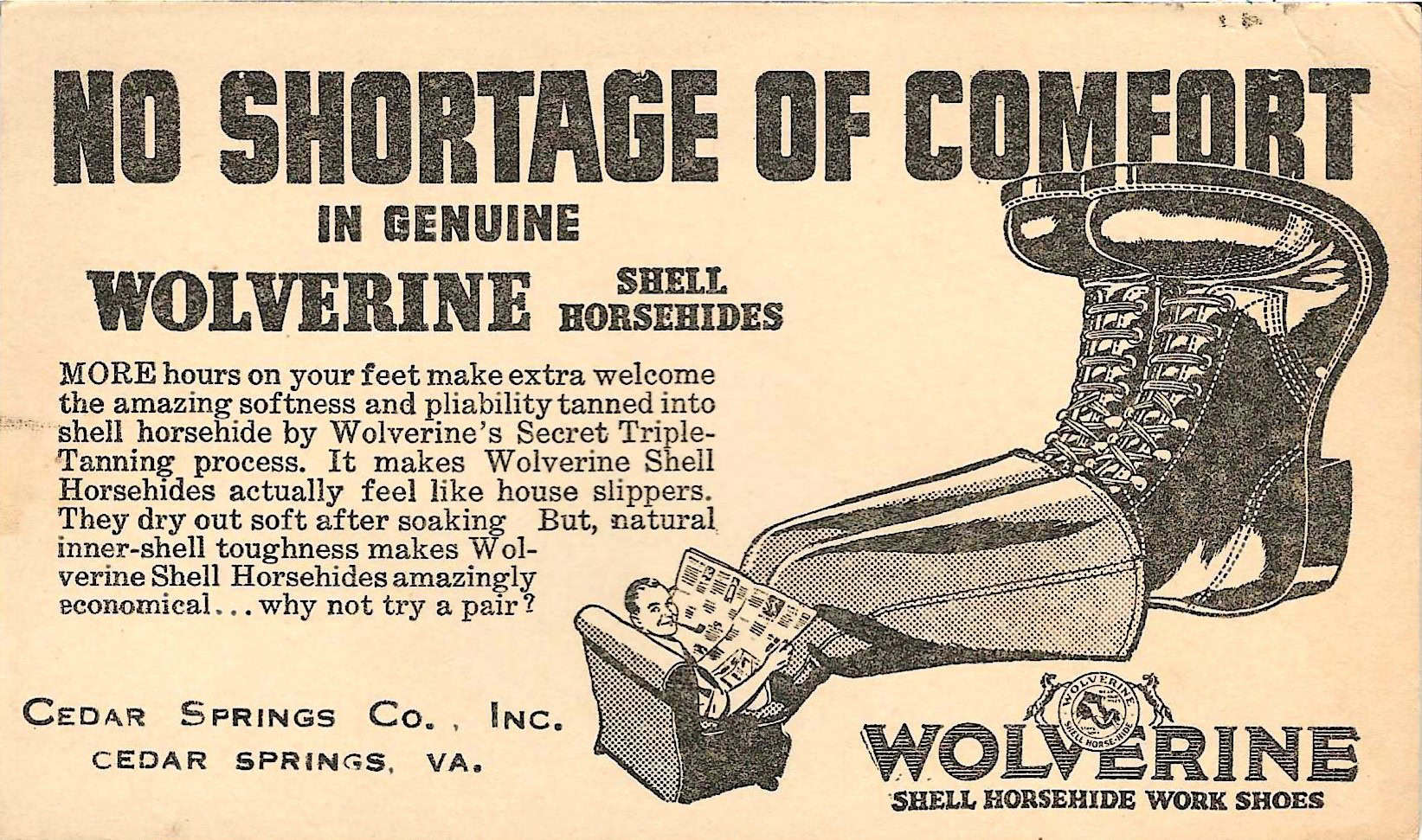
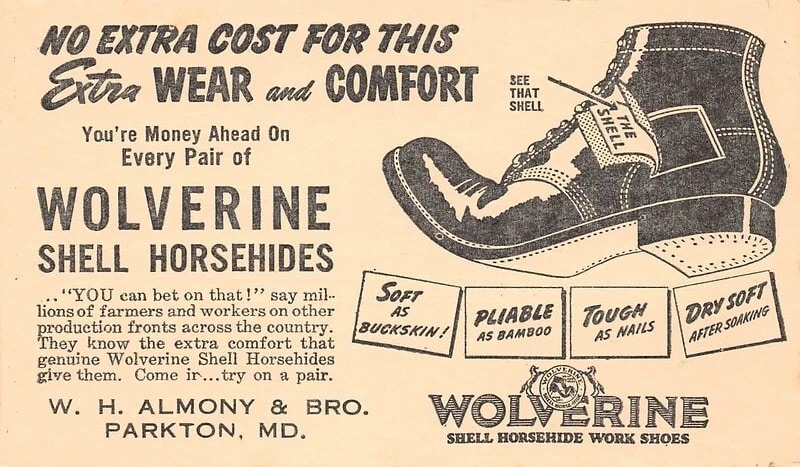
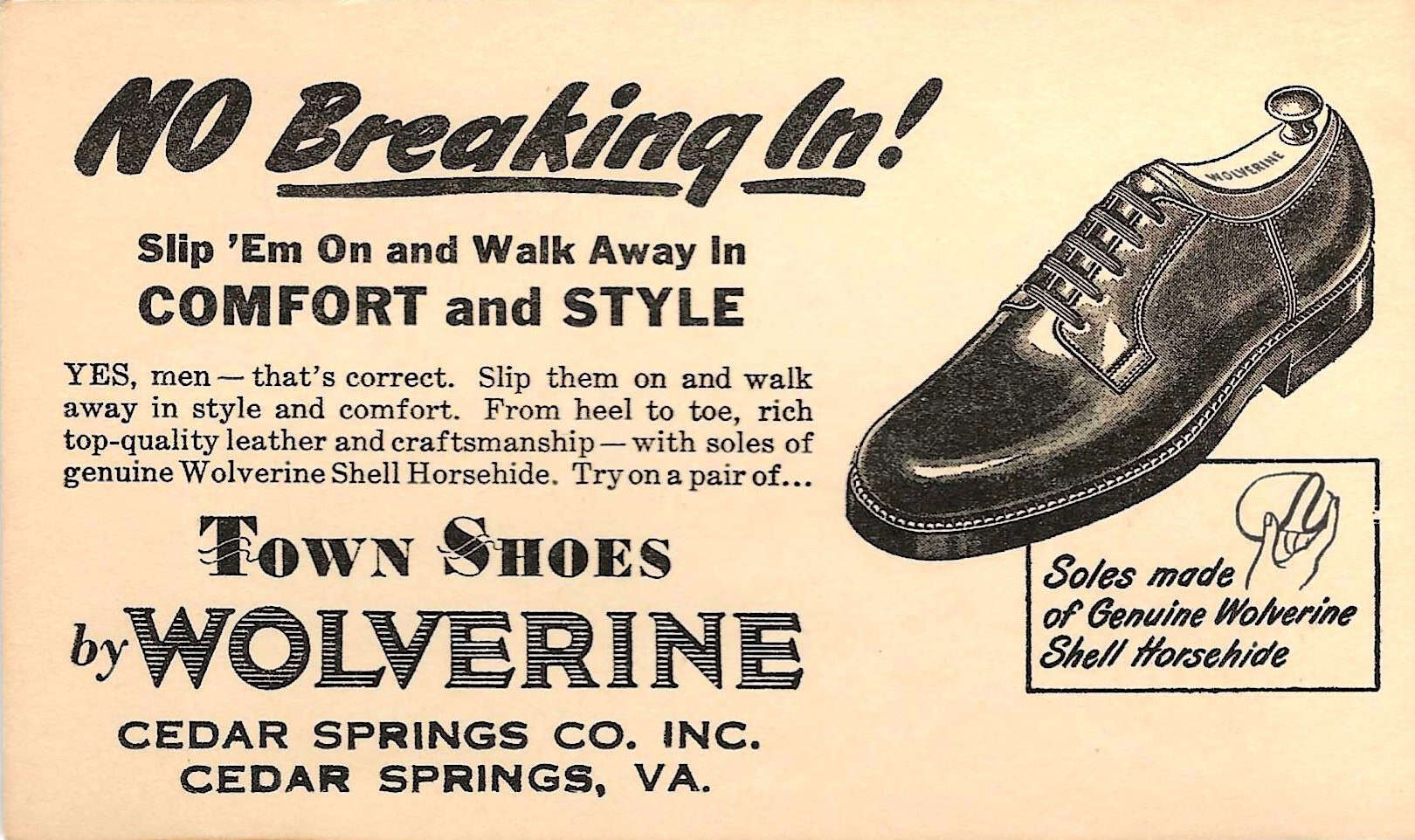
***

Tradition is a quality often talked about but seldom heeded these days. The Wolverine company logo first appeared in 1921 when the company changed its name to the Wolverine Shoe and Tanning Corporation. The paw of a Wolverine is a recognized, one-hundred-year-old tradition that reminds us of Wolverine’s commitment to quality and durability – characteristics of a heritage that remains because they continue to serve workers, outdoor enthusiasts, and fashion-conscious consumers worldwide.
***

The company’s namesake hails from the weasel family, but more closely resembles a small bear.
The word has a lengthy etymology and enjoys many uses. In addition to being a shoe company, Wolverine is a game, an animal, a hotel in Detroit, a movie, and a comic book character. It is also a University of Michigan mascot, a credit union, a tool company, but it is not, contrary to popular belief, the Michigan state animal. And there is a Wolverine Postcard Club.
Postcard History Online Magazine
salutes the collectors of the
Wolverine Postcard Club in Detroit, Michigan!
Enjoyed the article
Interesting to hear they used horse hide.
I live in LLBean country! Some similar themes here:) Thanks for the info!