Previously on Postcard History you read Part 1 of Discontinued Product Advertising.
That article included five products for which there are some beautiful postcards, but the products are no longer manufactured – there was a beer, baking soda, a polishing agent, a coffee, and a car. Today, we continue with a sewing machine, paint, evaporated milk, a brand of margarine, and ladies’ hosiery.
Titan Sewing Machines
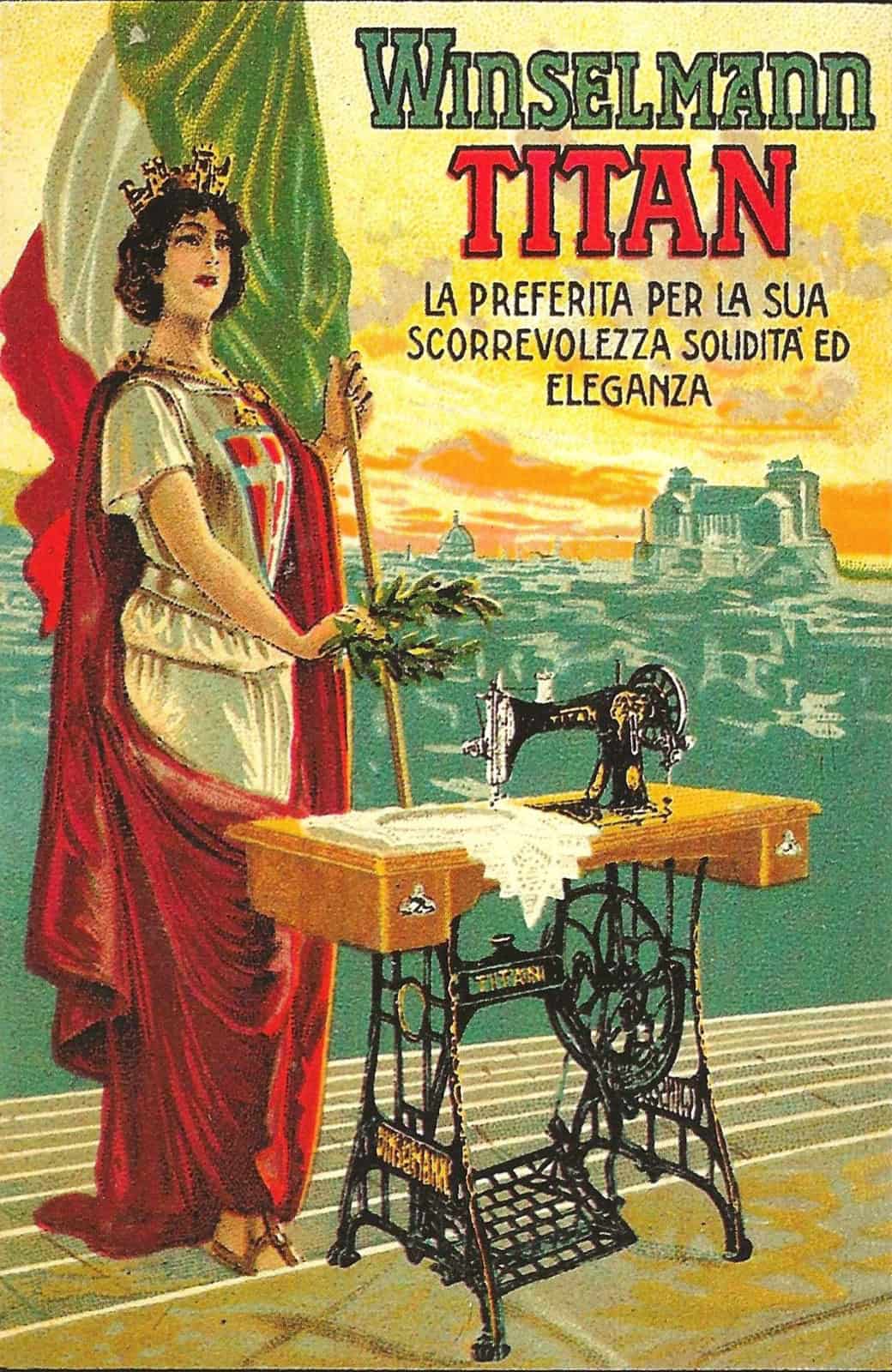
Nearly all the Titan sewing machines in America came here as baggage brought here by German immigrants at the end of the nineteenth century. Those sewing machines were manufactured by Gustav Winselmann in the small eastern province of Saxony (Germany). He opened his factory in 1892, and it continued there until the Second World War.
The roots of the business are traced back to the Clemens Muller Company where Gustav Winselmann and his two colleagues, Leopold Oskar Dietrich and Hermann Kohler, worked. They left Clemens Muller in 1871 to start their own workshop where they would manufacture sewing machines in the former Meushchee Brush factory under the name Dietrich & Company.
Their first model was produced a few months later under the name ‘Allemannia’ and by the end of the first year, more than 300 sewing machines had been made and sold.
After some disagreements between the partners, Dietrich resigned in 1873 and the company was renamed “Kohler and Winselmann.” In 1877 the factory was moved to Altenberg.
In 1891, Gustav Winselmann also left to start his own business in a one-time hat factory. Winselmann’s machine had innovations that pleased everyone who bought it, at what was considered, at the time, to be a very fair price. Historians have verified that by 1913 Winselmann had produced one million sewing machines of various types, many different models were known by the name “Titan.”
The factory underwent several major expansions after World War I, and by 1927 the work force numbered nearly 240 employees, however, after World War II, the company did not resume operations because Altenberg was in East Germany and the company would have been nationalized.
Evaporated Milk
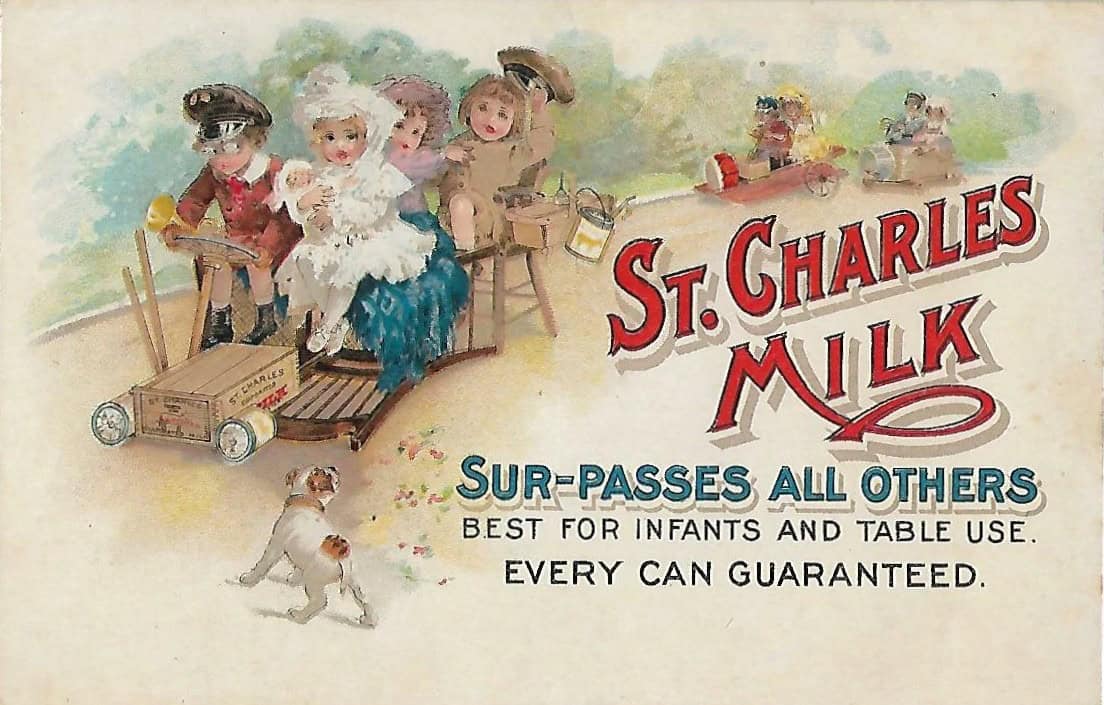
This pre-1907 advertisement for St. Charles Milk comes from Saint Charles, Illinois.
Founded in 1899 as the St. Charles Condenser Company its business focus was manufacturing condensed milk — evaporated milk with sugar added. The company had factories in several American locations but came to the peak of its popularity in 1899 when it wanted to expand by building a new plant in Canada. The town of Ingersoll, Ontario was chosen, but only because the town-council made it possible through bribes and bonuses. The company manufactured its own tins and condensed milk “on a large scale” but the promise of employment for more than seventy town residents, most of them young girls, was “too much” of a good thing. The only caveat from the company was the requirement that all of the milk they used had to be obtained within a radius of five miles, and the quantity had to be from 40,000 and 50,000 gallons daily.
The was a long list of shenanigans that the town council foisted on the voters but despite the negatives, on New Year’s Day, 1900, the citizens voted 265 to 151 for the measure. That did not make it lawful. There was plenty of blame for spreading around but the factory was built and everything worked out for the good of the “company” and its “employees” (most of whom were young girls).
The factory soon occupied an 11.5 acres site on the southwest corner of King and Whiting Streets in the town’s west end. The condensing plant was to become an anchor for an emerging west-end industrial district that was to include a tool company, a broom maker, and the Ingersoll Cone and Paper Box company.
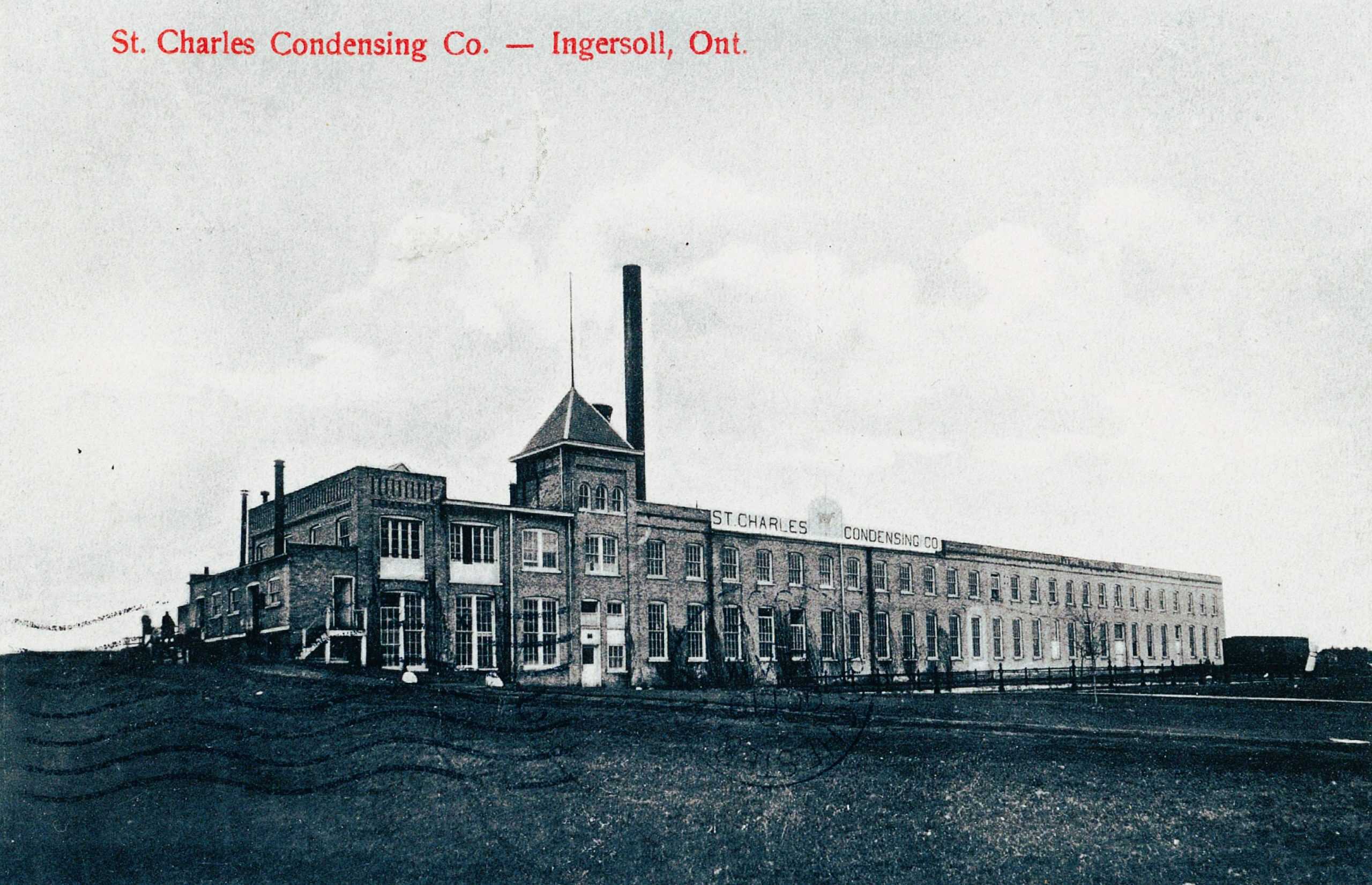
Needless to say, due to the self-interests of the town council, the city of Ingersoll was never paid the assessed taxes and levies after the company’s tax-exempt years, 1900-1909, its first tax assessment was $450 until 1903, then $9,500, on which it paid some $60 yearly for school tax. When its ten-year exemption expired in 1910, its assessment jumped to $32,000, on which they paid $204.80 for school tax and $569.60 that was a general levy.
Today there is no evidence of the building seen on the postcard above, but there is a medical care facility at that address.
Paints, Varnishes, Enamels
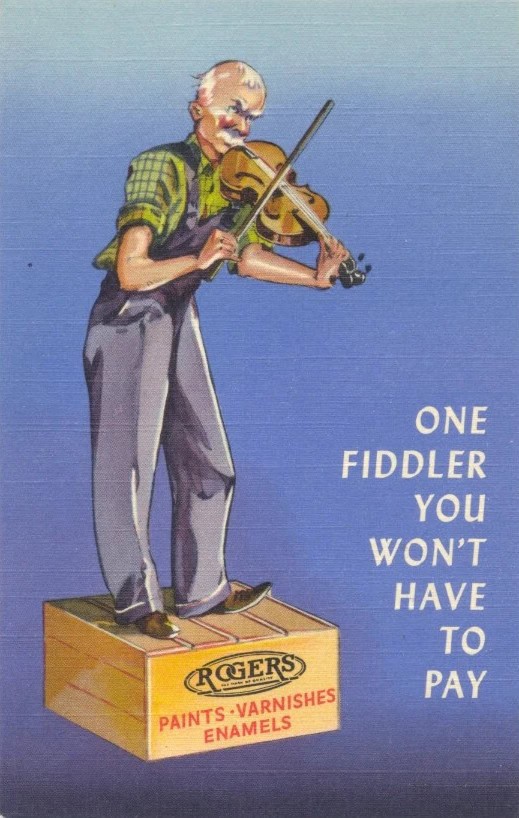
Roger’s Paints, Varnishes, and Enamels has been a difficult topic to research. I have gathered very little, but with lots of determination, a story has emerged that identifies “Roger” and his paints, varnishes, and enamels.
But first, let’s look at the idiom, “pay the fiddler.” It is an interesting twist in placing responsibility on the consumer, in that, if you buy the right paint (Rogers, of course) it will be a decision that you will not regret.
It is still a common expression in English that refers to taking responsibility for one’s actions or decisions. Its origins are not entirely clear, but it is believed to have originated in Ireland during the eighteenth century.
During that time, traditional Irish music was often played at social gatherings and events and fiddlers were hired to provide entertainment, but the guests had to pay them for their services.
At every event there were always those guests who would try to avoid paying the fiddler by leaving early or making excuses.
The idiom gained popularity in America during the nineteenth century and has been used ever since to mean everyone must face the consequences for their actions – so make your choices wisely. The same is true for this one.
***
Rogers Paint emerged from an idea driven by determination and the quiet ambition of a young veteran returning from war. Roger Bertrand grew up in West Warwick, Rhode Island, the son of Paul and Eva Bertrand. After graduating high school in 1947, he served in the U.S. Army during the Korean War, saving nearly every dollar he earned with a single goal in mind: he wanted to own his own store.
When his service in Korea ended, Bertrand returned to Rhode Island and his savings were turned into a modest paint and wallpaper shop on Washington Street. On March 30, 1953, Burtrand unlocked the front door of what would become Rogers Paint. At first he had but a tiny store, a limited inventory, and several dozen cans of Devoe brand paints he would sell faithfully for decades. (Devoe paint is still manufactured in Springfield, N.J.)
The early years were lean, but Bertrand’s reputation for honesty and hard work drew in homeowners, contractors, and neighbors who valued personal service over big‑box retailers. As profits slowly grew, he expanded the shop, enlarging the space and broadening the selection.
Rogers Paint became a fixture of the community, it was part hardware store, a gathering place, sort of an institution. For 63 years, the store endured and only ended when Roger Bertrand did.

1928-2015
Mr. Bertrand died on December 14, 2015. He was the personification of how steady presence and trust can build generations of loyal customers. Rogers Paints Store, though small in scale, represents the distinct character that makes American tradition. Its history is not just about paint—it’s about a life spent building something that mattered.
Margerine
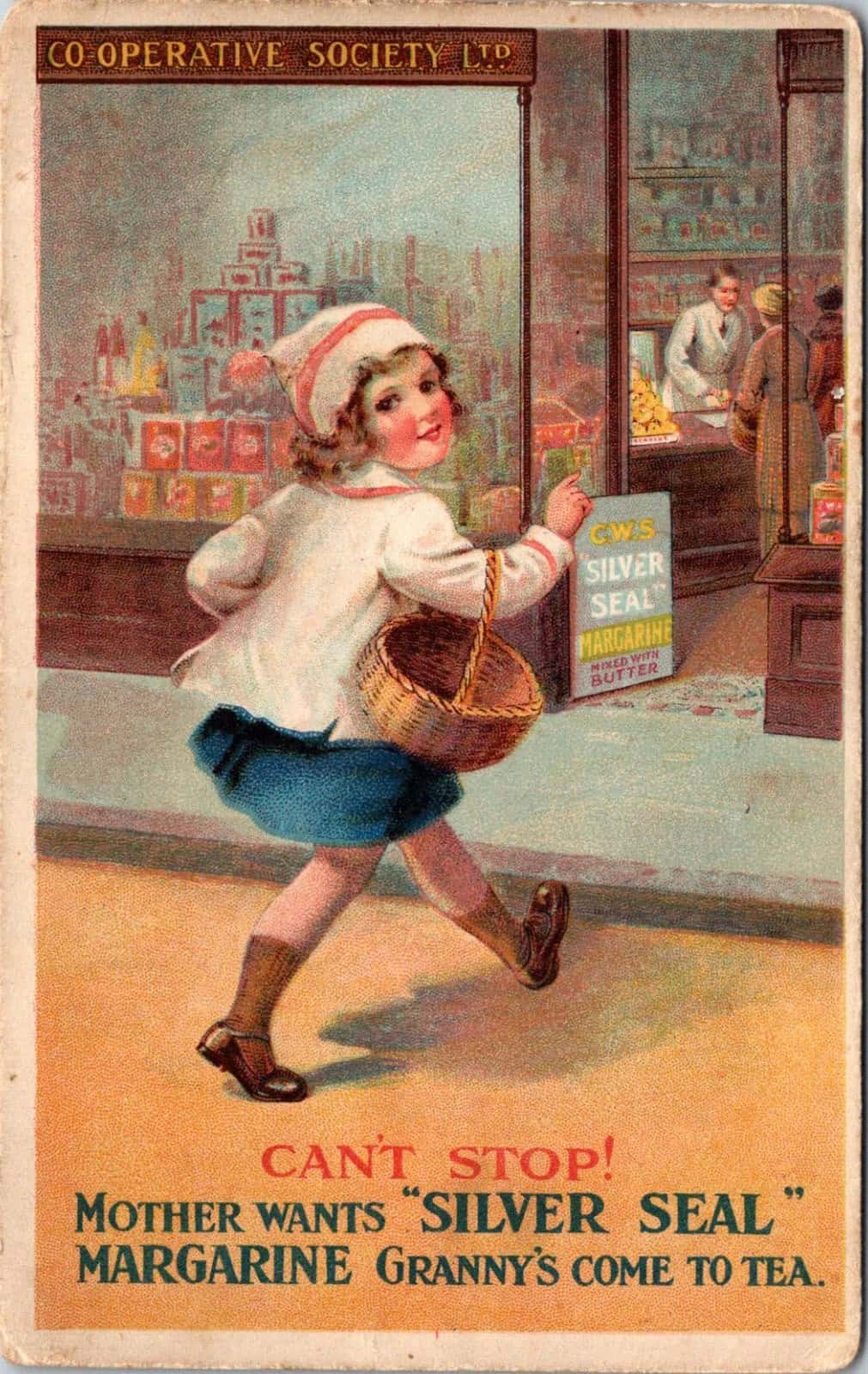
Oleomargarine was invented by a French chemist in 1869. He used a variety of soluble and insoluble ingredients, which quickly became an alternative to butter.
When “Silver Seal” oleomargarine manufacturing plants opened in Newfoundland using beef fat and lard as main ingredients they were established as an inexpensive alternative to butter that was manufactured traditionally using dairy products.
Since Newfoundland had almost no dairy production the new “oleo” was a welcome and thankfully, an inexpensive alternative. As the postcard states, “Granny’s come to tea.”
We Americans may not recognize Silver Seal Margarine, but our Canadian cousins will. In the 1930s, across Canada, the Newfoundland Butter (later Margarine) Company was Canada’s first oleomargarine manufacturing company, and a leading producer in the province of Newfoundland and Labrador.
Founded by Sir John Chalker Crosbie in 1925, the Crosbie concern was one of three margarine plants established during the early twentieth century.
With the expertise of a Danish chemist, the Crosbie family grew the firm into the largest margarine manufacturing firm in Newfoundland.
The company through acquisition and merger with other manufacturing plants was eventually sold in 1937 and became a subsidiary of Lever Brothers of Canada.
For a time around 1949, the operations of the company were protected by Canadian law and margarine production was banned in the rest of Canada. In 2004, the owners, reportedly for financial reasons, closed the plant.
Ladie’s Hosiery
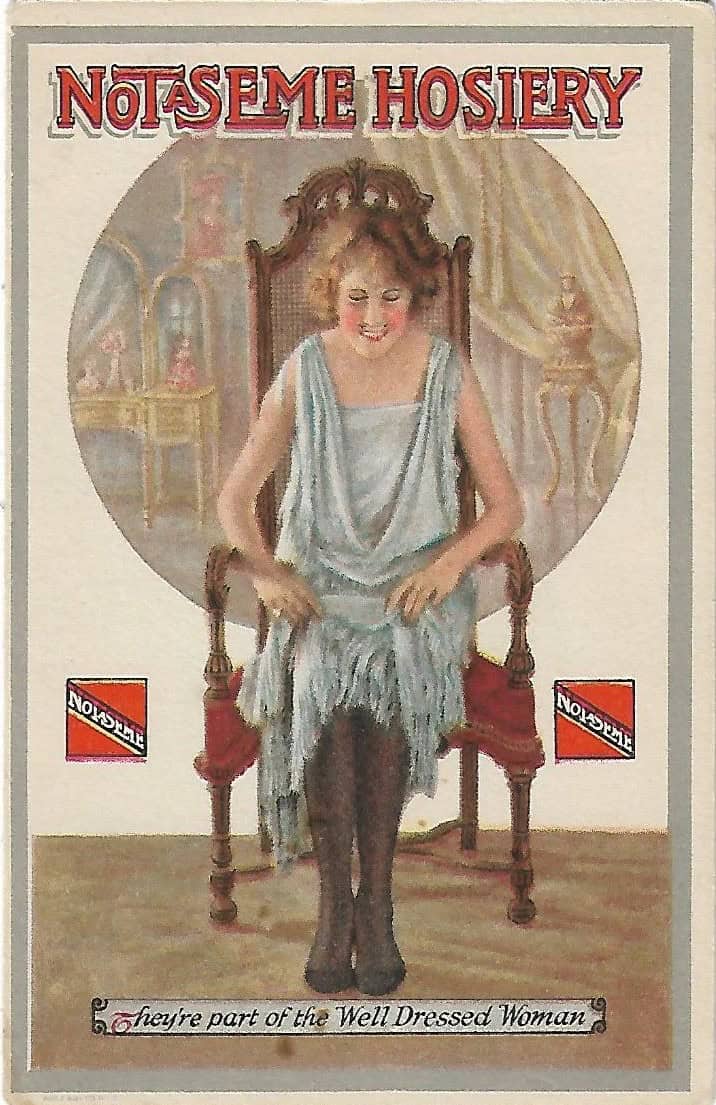
The earliest example of an item of hosiery was found in Egypt. Archaeologists discovered a pair of socks in a tomb where historically, Pharaohs were buried with food, gold, and garments that they believed would be needed in the afterlife. It was generally thought that having such item surrounding you in your tomb would prove helpful.
A pair of lady’s socks were found buried in the chamber of a rich noble. The socks were in no way crude. They had fitted heels and a draw chord at the top, making them one of the earliest examples of complex, manufactured clothing. The find dates to around 500AD, but they would have been constructed centuries, perhaps millennia earlier, making leg wear at least 2000 years old.
Notaseme (Not-A-Seam) Hosiery was founded in 1907 by M.T. Fleisher and Lester Wolf in Philadelphia, Pennsylvania. They specialized in seamless stockings, but the enterprise was short lived. It was sold in 1925, with the brand name later going to Rollins Hosiery.
Although the company headquarters was in Philadelphia their marketplaces were mostly wholesale outlets in New England and the South.
***
What can we do when a product we use is discontinued?
Sadly, the remedy is to find a substitute.