Vinegar Valentines came to be in an age that few remember. It was a time when insult-humor was not only condoned but appreciated. Vinegar Valentines began to appear in the 1840s – at the start of the Victorian era. They were, in general, rude, cruel, insulting, and sarcastic. Not surprisingly when postcards became popular, the genre was produced by dozens of British printers and publishers. As the century turned, firms like Raphael Tuck & Sons in England and The Illustrated Post Card Company in New York, along with Edward Stern and The Rose Company, both in Philadelphia, produced similar cards by the thousands, each designed to mock or offend rather than celebrate love. The Vinegar Valentine reveals the darker side of Valentine’s Day, showing how the holiday was used not only for romance but also for ridicule.
One bit of history that cannot be ignored is the cost. They were cheap to produce. Typically printed on one side of thin paper, they cost only a penny, making them accessible to almost anyone. The cards featured caricatures, crude drawings, and short insulting rhymes. Unlike ornate lace-trimmed valentines, the vinegar varieties were deliberately plain. Why they were so popular for such a long time – nearly ninety years – is a question for the sociologists.
When the professionals answer the popularity question, they may also attack the question of “mean-spirited” humor. Why is a taunt aimed at a spinster, a drunkard, a servant, and even a pastor so acceptable? Could it be an opportunity to be anonymously cruel?
While humorous to some, many recipients found Vinegar Valentines humiliating. Even postal workers complained about handling the flood of offensive cards each February. The insults never ended: women were mocked for their appearance or marital status; men were ridiculed for laziness, arrogance, or drunkenness.
The Vinegar Valentine reflected the real anxieties about courtship, gender roles, and social behavior. They were satirical mirrors of cultural norms. Thankfully by the early twentieth century, their popularity waned as Valentine’s Day became more commercialized and focused on romance rather than ridicule.
***
When the Vinegar Valentine faded from popularity, the postcards gained widespread acceptance as collectibles. One accomplished collector has compiled facts that she has drawn from her collection of more than 300 postcards:
- There are basically 10 designs (and variations) being collected today.
- Seven designs are British or European in origin.
- Three designs are purely American.
- One design seems to be universally popular – The Rose Company set of 30 cards. An illustrated checklist has been compiled to assist in collecting. You are free to copy and share the list with others.
***
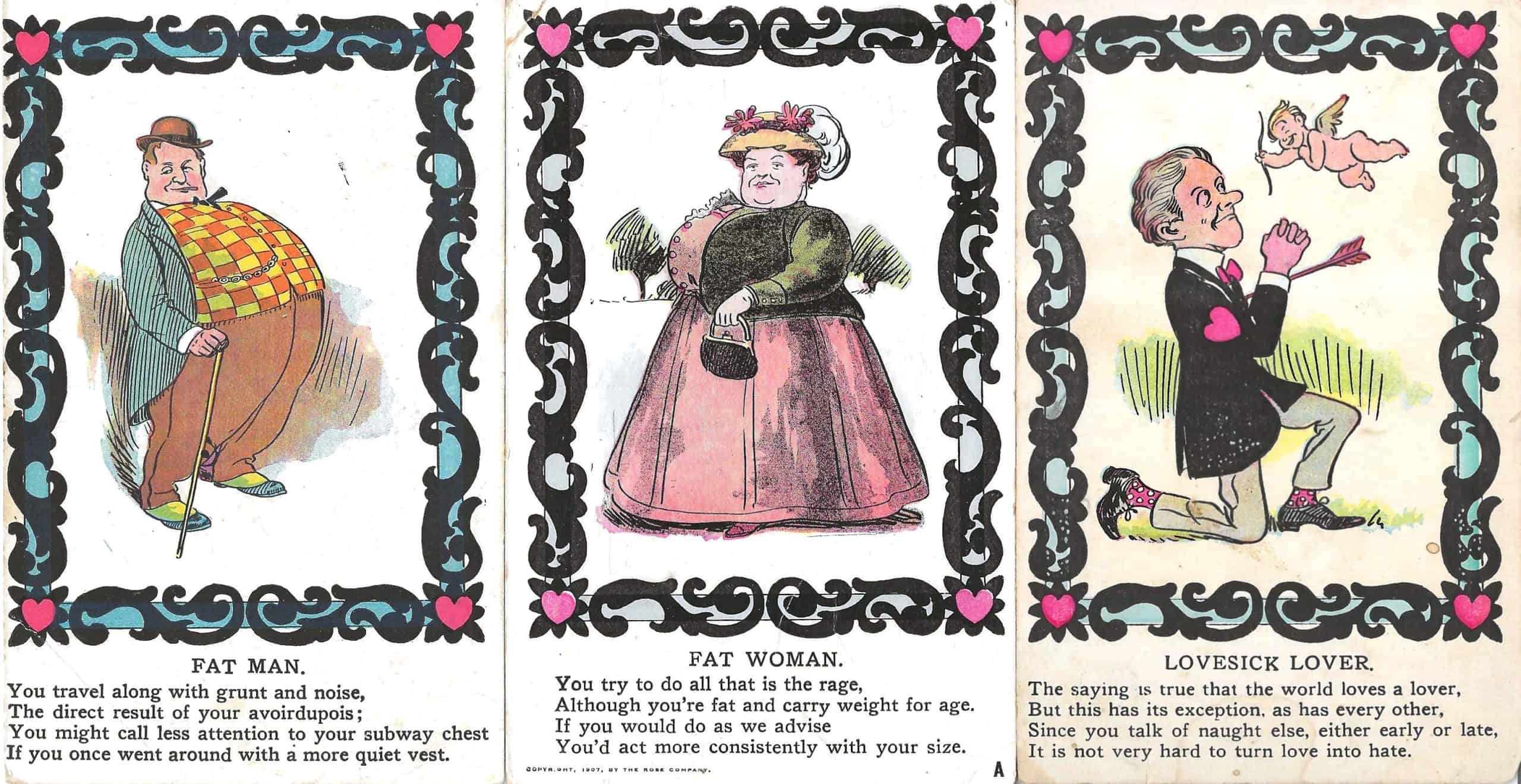
The Rose Company Copyright 1906 Vinegar Valentines
Set of 30 with Blue Bars/ Black Scroll/and Red Hearts borders.




***
H a p p y C o l l e c t i n g!
Thanks for the images of the entire set.
I’ve never seen or heard of Vinegar Valentine’s Cards. I think they are great! Love this aticle.