Perhaps you did not know there was a mystery, but the identity of a publisher has been in question. Now, the mystery has been solved.
***
I collect the Jewish stereotype on postcards of the pre-Nazi period. When I started investigating postcards, I not only researched the imagery, but the artists, the printers and the publishers. In some cases, it was the same person, as can be seen on postcards from Germany in the late nineteenth century.
The book entitled Hatemail: Anti-Semitism on Picture Postcards by Salo Aizenberg is a great resource for general knowledge but there is not much research into artists, printers, and publishers.
The height of American postcard popularity, often referred to as the “Golden Age of Postcards,” began around 1905, peaking between 1907 and 1910, and started to decline with the onset of World War I. During this peak, it is thought that millions of postcards were mailed every year, capitalizing on advances in printing and changes in postal regulations that allowed both messages and addresses on the back of the card.
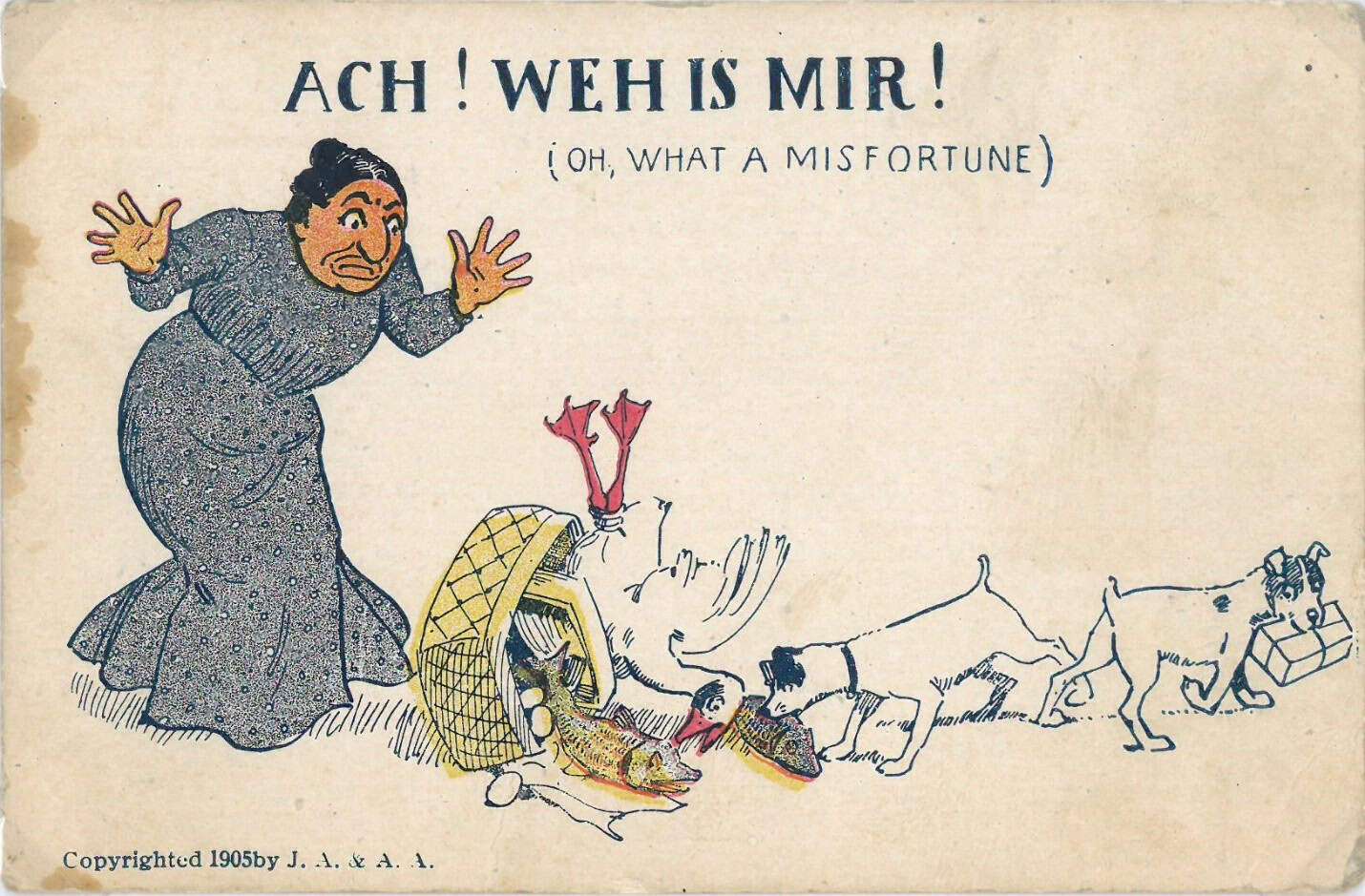
There has been a mystery surrounding a publisher from the early 1900s that signed their postcards simply as J. A. & A. A. Many collectors, historians, and even the “Hatemail” book left the identity behind these initials unclear, with speculation that they might belong to two separate companies.
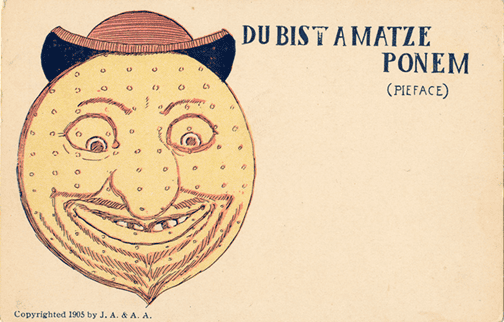
The first postcard I came across, shown above, depicts a Pieface or Matzeh Ponem, but there were others, not nearly as vividly antisemitic as this one. However, this helped the research done by a friend, Mr. Vance Pollack, and me. We focused on uncovering the truth behind these elusive initials by closely examining copyright records and contemporary advertisements.
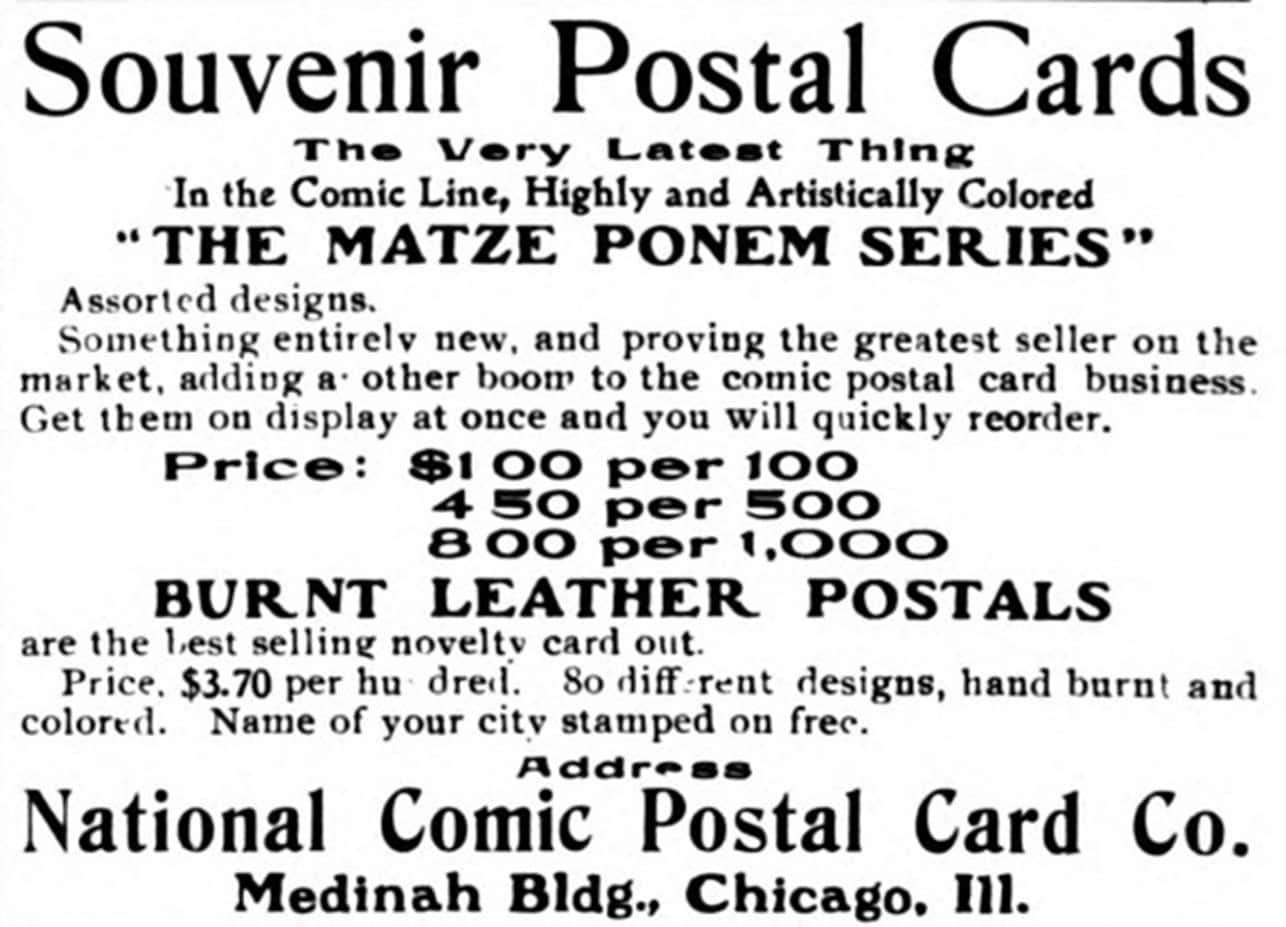
An advert in “Geyer’s Stationer”, vol. XL no 238, August 17, 1905, showed that the name of the publisher was the National Comic Postal Card Company, operating out of Chicago, Illinois. According to the advert it appears that this card is part of a series.
Delving into the copyright records of the time, we found that J. A. & A. A. were the initials of two individuals, Joseph Aronson and Adolph Aronson, who used their initials on the copyright.
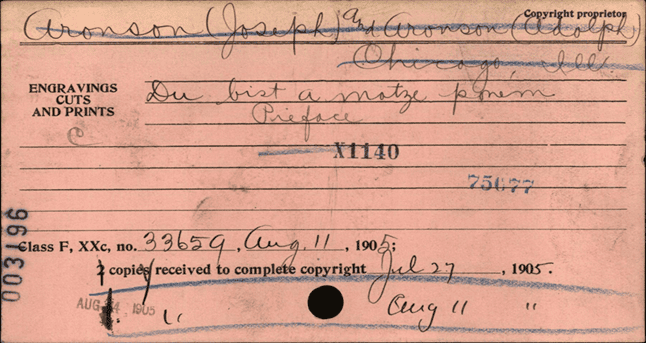
The Aronson brothers copyrighted a series called the “Matze Ponem Series,” which became quite popular for its unique blend of Jewish cultural humor and comic illustrations.
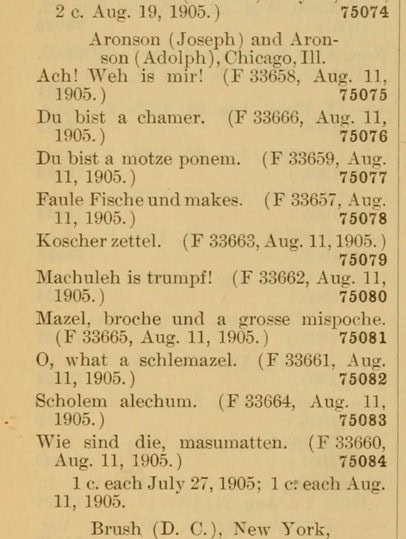
In an article in the National Druggist of March 1906, it was written that the National Comic Postal Card Company issued a series which they called the Jewish Comic Postcards “with their exceptionally humorous cards,” the list you can see here.
This discovery finally clarifies that the mysterious J. A. & A. A. signature does not represent multiple companies but a family partnership that left a distinctive mark on early American postcard history.
But who were the Aaronson’s? Were they brothers? Were they Jewish? Hard to know, but with the surname, it is quite possible that they were brothers and Jewish. However, either they owned and operated the National Comic Postal Card Company or else partnered with them, both operating out of Chicago. What was the purpose of printing these postcards? It is my belief that since many companies were publishing stereotypes on postcards, Jewish and others, they did it for purely financial purposes, but what is humorous for one may be hurtful to another.
While detailed personal information about Joseph and Adolph Aronson remains limited, their entrepreneurial spirit lives on through their postcards, which reflect a fascinating intersection of immigrant identity, humor, and early 20th-century American publishing culture.
Great research to discover the names of the artists.
Thank you
Thank you for an interesting article. The book HATEMAIL is very well written & one of my treasured postcard references. It is just packed with background history. 🏆
Thank you.
it has a lot of history, but lacking in information about the printer etc
Lawrence: My book, Jewish Firebugs, is coming out in July, and I include in it the Faule Fische postcard from Joseph and Adolf. I was totally stymied as to who the JA and AA artists were until I read your terrific article. Since then, I’ve uncovered their family story (I’m a genealogist) that I would be delighted to share with you, perhaps for a follow-up article you might want to do. As great, by the way, I think is the book, Hatemail, I believe the author misreads their postcards. Contact me at: Rabjmarx@gmail.com. With best wishes, Jeff Marx
Thank you very much