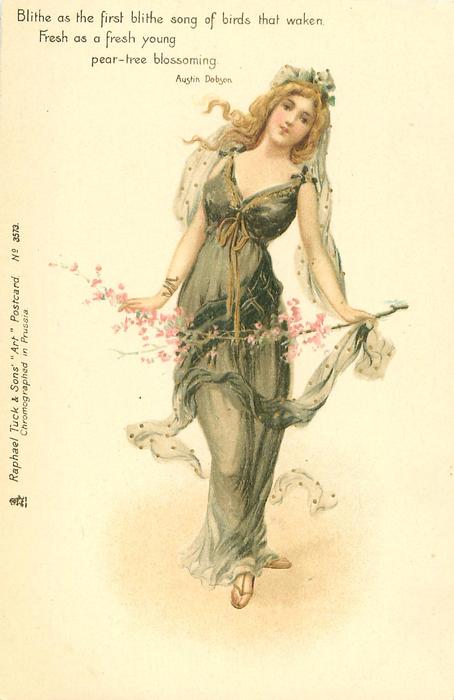
Please indulge this personal note. This card is one of a Tuck six-card set, I found at a Postcard Fair last year, just before the Summer Bank Holiday. I was gobsmacked at the resemblance to my daughter the night she left home with Bobby Essington for their Leavers’ Formal. For you Yanks, a “Leavers’ Formal” or “Leavers’ Ball” is what you call a High School Prom. The cards are magnificent and they bring back a flood of memories.
When at school in the late 1950s, UK history was taught with a mysterious attitude prominent among and associated with the post-war upper class. As I sat in classrooms listening to history professors drone on about the conquests of the empire, I was unable to say, because I didn’t know for sure, that our country’s history was taught only to the children of the upper-class citizens, because in middle- and under-class schools, history was omitted from the curricula because it was deemed unnecessary.
During the Tudors, including while Elizabeth I was Queen and later in the Stuart Era, troves of information on noble women found its way to the history books, but average women were virtually ignored. The situation continued unchecked for centuries; there was never a chance to celebrate the ladies until the Victorian age was drawing to an end.
Because of this historic neglect it is nearly impossible to identify a time when women could appear in public settings in dresses that were both classy and revealing. And, when that time came in the first few years of the twentieth century, no person, association, sisterhood, nor business missed an exploitive opportunity. Raphael Tuck & Sons was at the head-of-the-line when they published this “Art Series” that were first used in 1903.
***
Be this as it may, the Victorians were still very influential throughout the Edwardian era and well into the Windsor years (1917). And to explain the tolerance and attraction that society had for this kind of behavior an examination of Edward VII may be necessary.
Edward VII, reigned from the death of his mother in 1901 to 1910. He was the first king of the House of Saxe-Coburg-Gotha, but he had spent the previous 59 years as the playboy Prince of Wales, famous for his wayward lifestyle and succession of mistresses. He wasn’t expected to be a particularly good king, but his reign proved a remarkable success. Edward was able to re-establish the popularity of the monarchy, which had ebbed away during his mother’s long period of reclusive mourning. Although he died in 1910, it’s generally accepted that the Edwardian age lasted until the outbreak of World War I in 1914.
Political reforms continued through the Victorian era, but property qualifications still prevented most working-class men from having the vote. Women also continued to be disenfranchised. The Edwardian period saw a growing call for female suffrage and recognition. In law, single women were still not recognized and married women were only because of their ability to bear offspring.
What happens in society is reflected equally in literature. That was certainly true at the turn of the twentieth century. Early on there was a blossoming of children’s books such as The Little White Bird, Five Children and It, The Tale of Peter Rabbit (all penned in 1902), The Railway Children (1906), The Wind in the Willows (1908), and The Secret Garden (1910). These titles and others set new standards for parenting and established new goals for children’s behavior in public.
Concurrently, novelists in the mainstream were writing The Four Feathers (1902) by A.E.W. Mason, The Riddle of the Sands (1903), Where Angels Fear to Tread (1905 by E.M. Forster), Kipps (the 1905 masterpiece by H.G. Wells), The Longest Journey (1907 by E.M. Forster), A Room with a View (1908, also by E.M. Forster), Of Human Bondage (1915 by W. Somerset Maugham), and Piccadilly Jim (1917) by P.G. Wodehouse, an early farcical novel that is filled with chaos, ridiculous plots, and witty dialogue that Jimmy Crocker used to seduce the woman he once scorned.
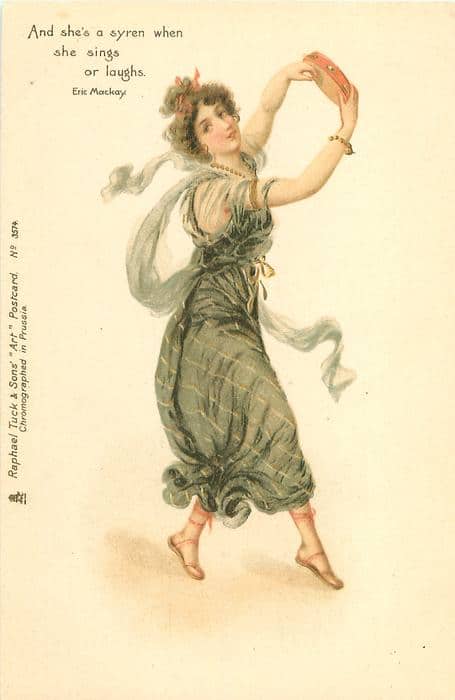
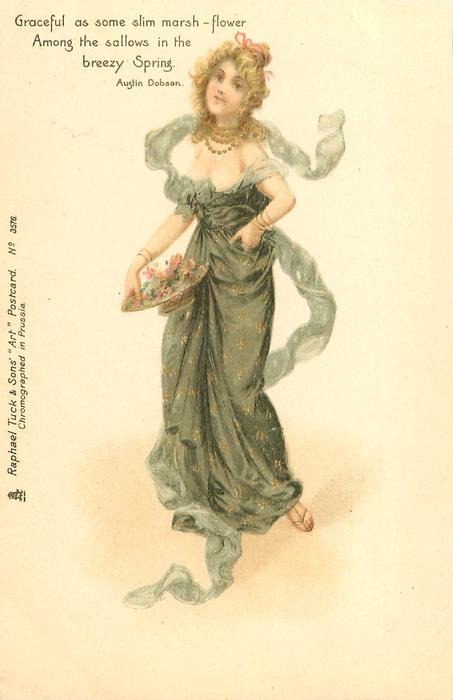
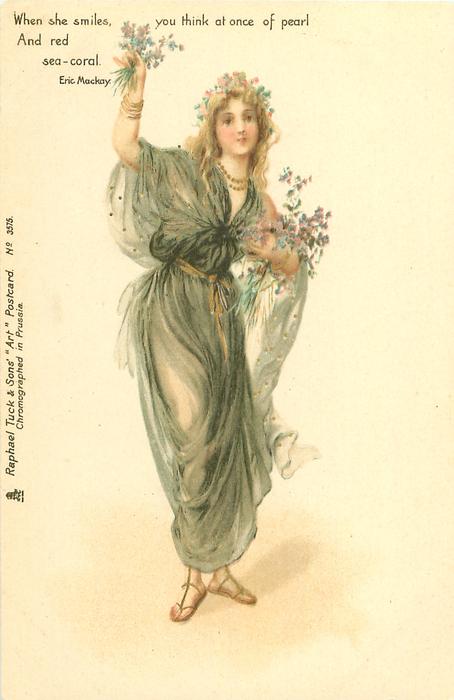
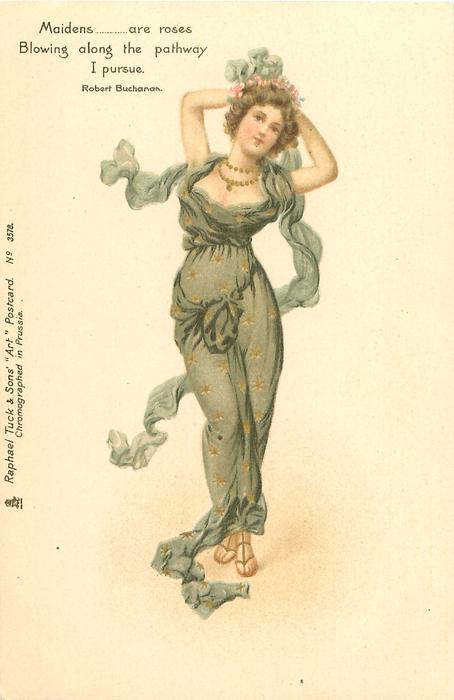
Oh, yes, the woman scorned could be the model for these postcards.
***
PS: these cards were instant favorites to one of my most trusted proofreaders. I sat with her as she read. When she finished, she turned to me and said, “I have to find a copy of Piccadilly Jim. That Jimmy Crocker must have been a real shithead.”
Interesting article for a beautiful series of cards. Thank you for it.
I must now go look for a particular book!
The Children’s books you mentioned sound interesting. The Railway Children caught my attention.
The postcards are lovely.