In the world of postcards, comprehensive information is essential for serious research and exhibition. We must look beyond the “pretty picture” to identify the artist, the printer, the publisher, and the printing method used. My investigations into postcards from around 1905, particularly those featuring the Jewish stereotype, has revealed a prolific production hub centered in Cincinnati, Ohio, led by the Henderson Lithographic Company.
The Sycamore Street Connection
For years, an “H” inside a circle logo was the primary clue that identified the Henderson Lithographic Company as the printer of many iconic American postcards. Henderson utilized high-quality chromolithography for these cards, a method well-established in the late nineteenth century.
Established in the early 1880s in Cincinnati, Ohio, the company was renowned for heavy-stock paper advertising prints for national clients, including major breweries like Anheuser-Busch and Budweiser. They were masters of chromolithography, a vibrant color printing method. After decades of dominance in the postcard industry, the company was purchased in 1925 by the Strobridge Lithographic Company, based in nearby Norwood, Ohio.
The Henderson Lithographic Company used the United States Novelty Company as its publisher of postcards, a publisher also based in Cincinnati. New research reveals a much closer tie between the printer and the publisher than previously understood.
Historical trade directories confirm that the Henderson Lithographing Company was located at 418 Sycamore Street, Cincinnati. Critically, these records state that Henderson controlled the United States Novelty Company, which shared the same physical space at 418 to 422 Sycamore Street. This definitive link proves that the two entities were effectively part of the same corporate operation, allowing for seamless production and distribution of their postcard lines.
The Journey of Frank S. Backus, From Washington to Ohio
The artist behind the “Say!” series, Frank S. Backus, provides a fascinating case study of a commercial artist’s evolution during the “Golden Age.”
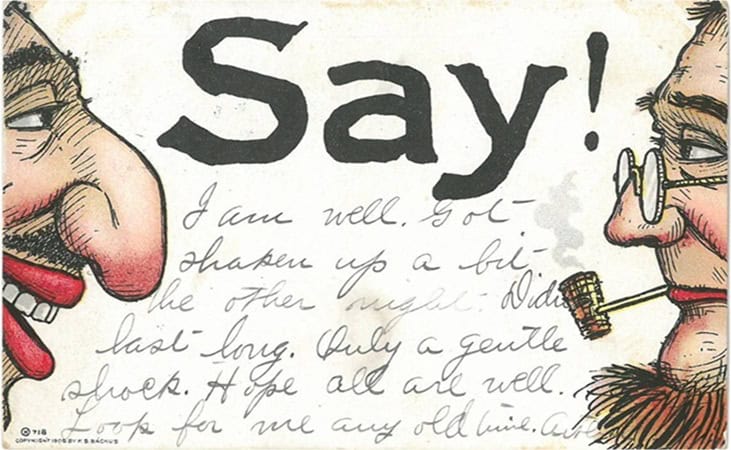
At the time he created the “Say!” series, Backus was not yet in Ohio. Records place him as an artist and publisher operating from 3116 McDougall Ave, Everett, Washington. It was from this Western outpost that he designed and copyrighted his “colorful cartoon series” in 1905, including the antisemitic caricature found in the “Say!” line.
By the 1920s, Backus had relocated to the Cincinnati area, likely due to his successful partnership with Henderson. He eventually transitioned from a commissioned artist to a high-ranking executive within the firm. City directories for Norwood, Ohio, list him as the second vice president of the Henderson Lithographing Company in 1924 and as assistant treasurer in 1928.
The firm also printed for other local artists, such as Alfred N. Yerkes, a Cincinnati-based lithographer’s clerk who also produced stereotypical caricatures in 1905.
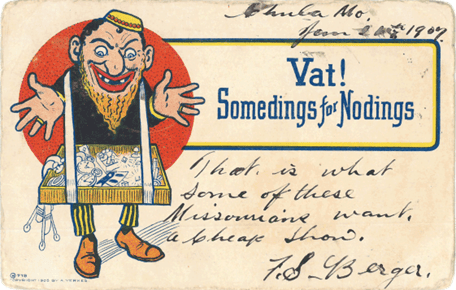
Little is known about Alfred N. Yerkes, including what his middle initial stood for or whether he primarily worked as an artist, printer, or publisher. What is known is that he was born April 15, 1852, in Cincinnati, and died July 18, 1936. His parents were Joshua Yerkes and Elizabeth Brown. He married Mary Frances and died a widower. City records indicate he worked as a clerk for a lithographer in Cincinnati for a period, but seeing as how Mr. Yerkes also used the Henderson Lithographic Company as the publisher of his postcards, it stands to reason that he worked at the Henderson company.
By uncovering the “Sycamore Street connection,” we see that the Henderson Lithographic Company was more than just a printer; it was a centralized hub that controlled the publishing arms and executive talent behind a significant portion of America’s stereotypical postcards.
Understanding this corporate structure allows us to document the industrial and financial motivations that powered the distribution of these images during the peak of the postcard craze.
Awesome historical research. Enjoyed the read.
Thank you very much. I do try my best
Excellent article. Thank you for sharing your research findings. I think we are all still trying to learn more about postcard publishers and artists.
Thank you very much Dennis. It really is not easy. I have since built myself a deltiology GPT
As a lifelong printer, as well as a postcard collector, this article was most interesting. Always anxious to learn more, thank you for sharing.
Thank you very much
Excellent research. It makes you wonder what the total volume of sales were for these types of cards.
Believe it or not, they are hard to find, so I don’t know. The two I displayed are very hard to get.
Maybe people threw them away after receiving them.