Nighttime postcard views, print and real photo, were especially popular during the Prohibition era (1920-1933) when cabarets attracted American tourists to Mexican border towns where drink and entertainment were widespread in businesses close to the international boundary. In subsequent decades when chrome postcards became popular, nighttime views were rediscovered by postcard photographers to capture colorful and dramatic night vistas.
Here you will see seven views of Mexican border cities that illustrate how these places appeared on postcards. Each card has an extended caption explaining both the view and how nighttime imagery was significant to the town as a tourist location.
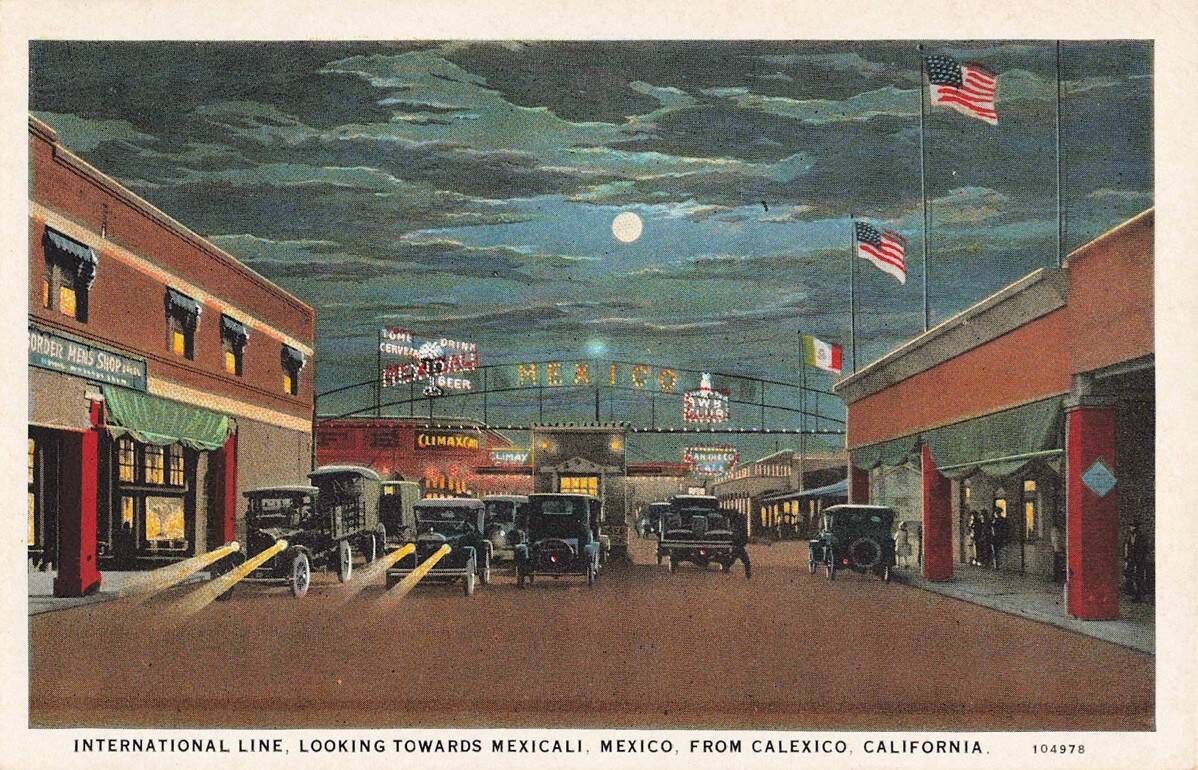
International Line, Looking Towards Mexicali, Mexico,
from Calexico, California, 1925 (C. T. American Art, 104978).
Mexicali, Baja California, abuts Calexico, California at their international boundary. By the second decade of the twentieth century during American Prohibition, the Mexican town was a bustling city of cabarets and adult entertainment venues. Visible in this early Curt Teich postcard are the Climax Club, the A.B.W. Club (also known as The Owl), and the San Diego Café. Period autos move into and out of Mexicali past a gated sentry box in the middle of the border line where an illuminated metal sign above announces Mexico.
Graphic artists at the Curt Teich studio inserted yellow lines emanating from the headlights of autos crossing in Calexico, a gesture that accentuates the nighttime scene. A full moon brightens a cloudy sky further enhancing the night view. Mexican and American flags fly above buildings on each side of the boundary. Like many print postcard views of this era, according to John Jakle in his Postcards of the Night: Views of American Cities (2003), the scene was likely adapted from a daytime photograph because U.S. protocol required flags flown at night to be directly illuminated by artificial lights.
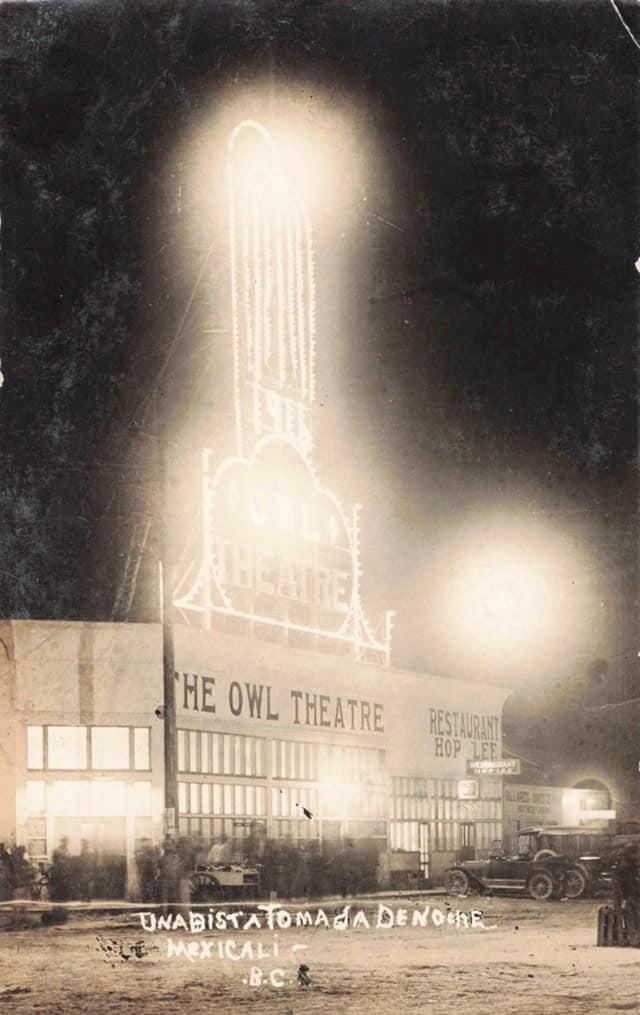
Una B[V]ista Tomada de Noche Mexicali, B.[Baja] C.[California] (Attributed to Foto., Iris, 1916).
This night view real photo shows a cabaret that came to be known in Mexicali as the Owl Theatre. The large fountain sign constructed with individual light bulbs strung along metal supports and visible from across the border in Calexico, was one of many illuminated cabaret facades at Mexicali called the “White Way.” The signs were intended to direct visitors to famous Prohibition-era joy palaces.
Street vendors and single men are collected on the sidewalk in front of the building and period autos are parked curbside.
The Owl was a gambling house, dance hall, bar, and theater occupying half a city block, and next door was the Hop Lee Chinese restaurant. Mexicali had the largest concentration of Chinese of any town in Mexico.
The Owl could accommodate 3,000 visitors with its own barbershop and photography studio, multiple stage musical venues, and floor shows with exotic performers. Its legendary popularity meant it was the subject of dozens of postcards, both interior and exterior views.
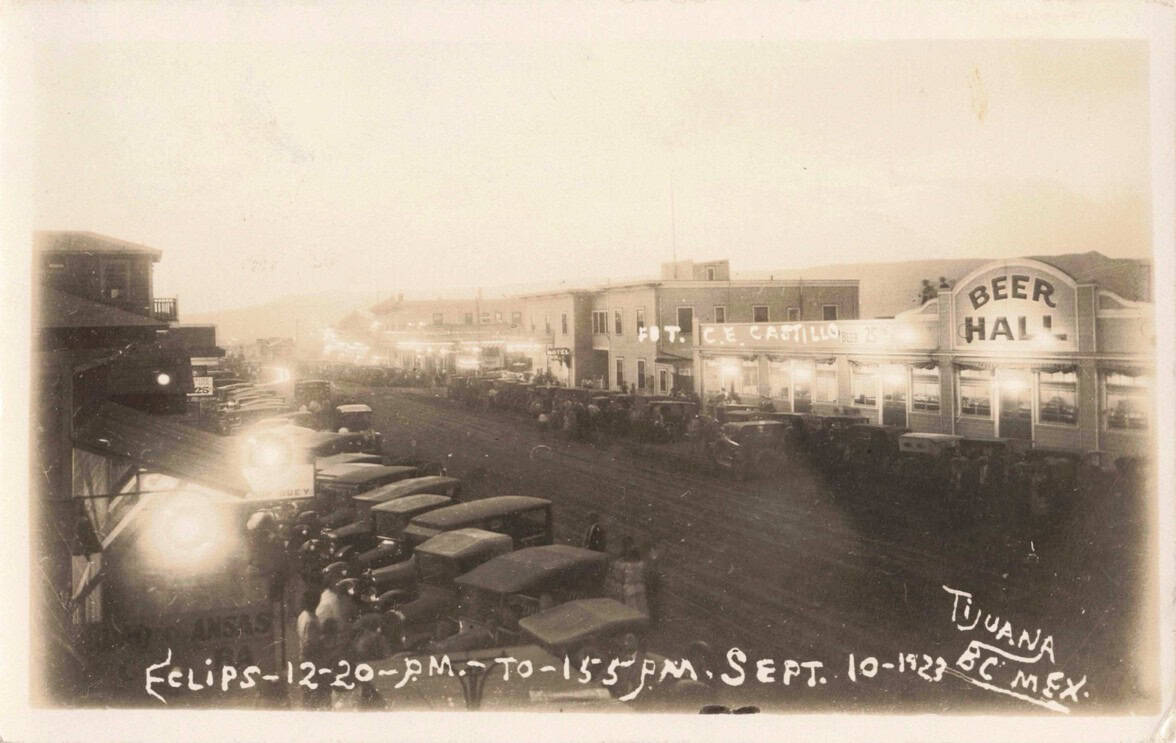
Eclips—12:20 p. m. to 1:55 p. m. Sept. 10, 1923,
Tijuana, BC [Baja California] Mex.[ico].
Solar eclipse at Tijuana, September 10, 1923. This real photo postcard was made by photographer C. E. Castillo. The view is looking north, probably from a balcony or rooftop, along Main Street, also known as Avenida Revolución, Tijuana’s principal tourist strip during Prohibition.
Parked cars crowd the street with the occasional pedestrian on sidewalks and in the street. The beer hall across the street is the early Mexicali Beer Hall. The building gained a reputation for the longest bar in the world—approximately 229 feet—and its Spanish nickname was La Ballena (The Whale). Infamous is the word popularly associated with the Mexicali Beer Hall, an institution in Tijuana for nearly half a century.
The establishment was also one of the most celebrated images on Tijuana postcards. A well-known collection includes some thirty separate representations in photo, print, and chrome formats showing exterior and interior views. The Mexicali Beer Hall survived into the 1960s, but in the 1970s it was torn down and replaced by a Woolworth’s store.
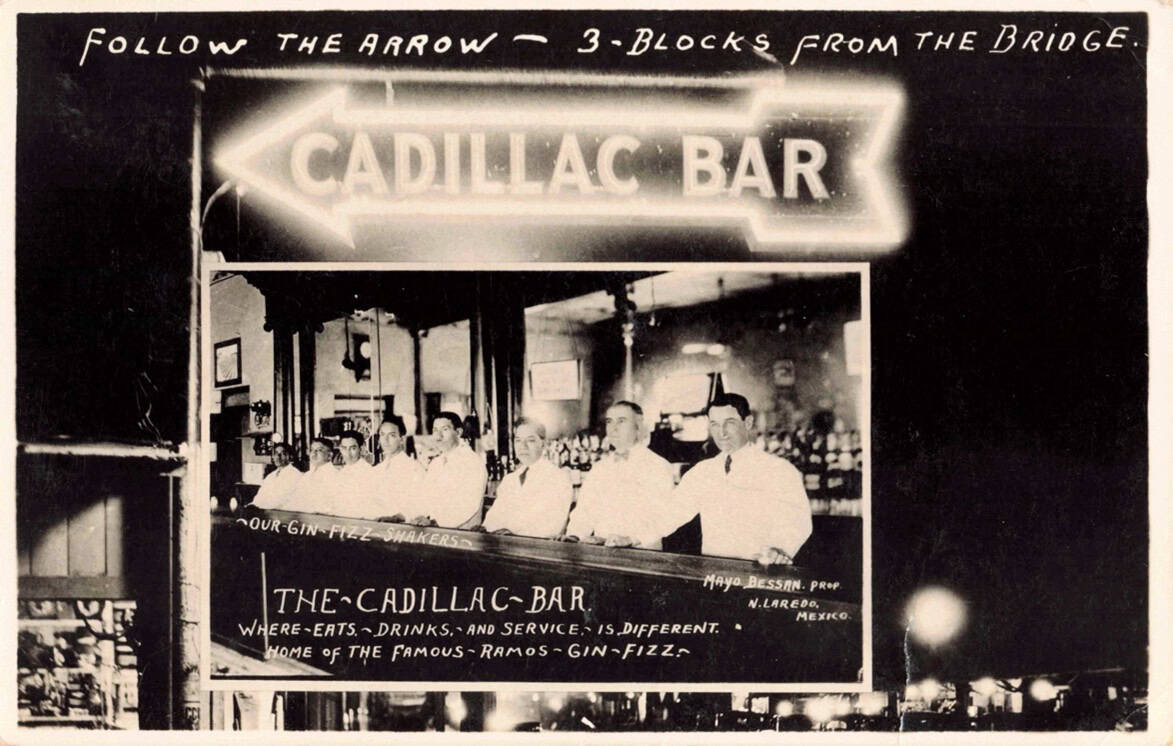
Follow The Arrow—3 Blocks from the Bridge. Cadillac Bar Where Eats, Drinks, and Service Is Different. Home of the Famous Ramos Gin Fizz. Mayo Bessan, Prop., N[uevo] Laredo, Mexico, circa 1941.
This real photo postcard uses a background night scene of the lighted Cadillac Bar arrow sign with an inset of the interior bar showcasing eight white jacketed servers identified as “Our Gin Fizz Shakers.” Arguably, one of the most famous bars on the Mexican border, the Cadillac Bar in Nuevo Laredo, was founded by Mayo Bessan, a New Orleans native in 1926, and was originally known as El Caballo Blanco Bar.
The name was changed in 1929, reputedly because Bessan wanted a rich-sounding name. The Cadillac was strategically located only a block from the border crossing. It became an international success, attracting celebrities and tourists to its diverse food and drink. Although Mexican food was available, the Cadillac prided itself on exotic fare like green turtle soup and frog legs, along with steaks, lobster, and Italian dishes.
The Ramos Gin Fizz, a famous egg white with cream and lemon juice cocktail and six other fizz and flip concoctions were the premier attractions. The Ramos Gin Fizz was invented in New Orleans in 1888 and interestingly 61 years later (1949) the use of the full name was legally contested for copyright infringement. Consequently, it was later renamed simply “the Ramos.”
Porter Gardiner, Jr., who took over operation of the bar from Bessan in 1947 noted that the Cadillac never served desserts. “When a customer eats dessert,” said Gardiner, “he tends to quit drinking.”
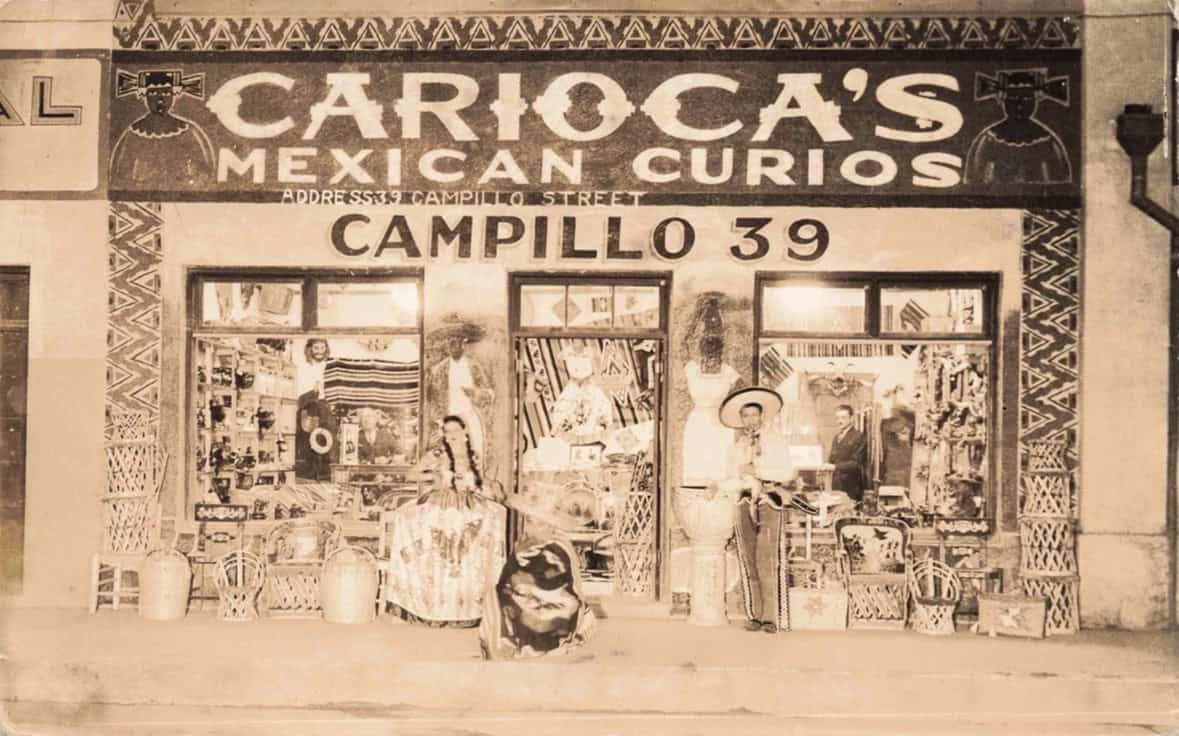
Carioca’s Mexican Curios, Nogales, Sonora, circa 1933.
Curio shops were a mainstay of Mexican border town postcard views. Shopping for silver, perfume, and assorted curios became a regular activity, with storeowners hiring sidewalk barkers to lure visitors to shops and vendor stalls.
A study of curio store postcards in Nogales, Sonora, revealed dozens located along major streets within walking distance of the international border, but most of those representations are daytime scenes. This is an unusual sepia real photo night view of Carioca’s store on Calle Campillo just blocks from the border crossing in Nogales, Sonora across from Nogales, Arizona.
The image shows displays of exotic exterior wall art and curio products like wicker chairs and baskets, pottery, and serapes. Also in view are family members who operate the store posed inside and out; some are dressed in traditional outfits.
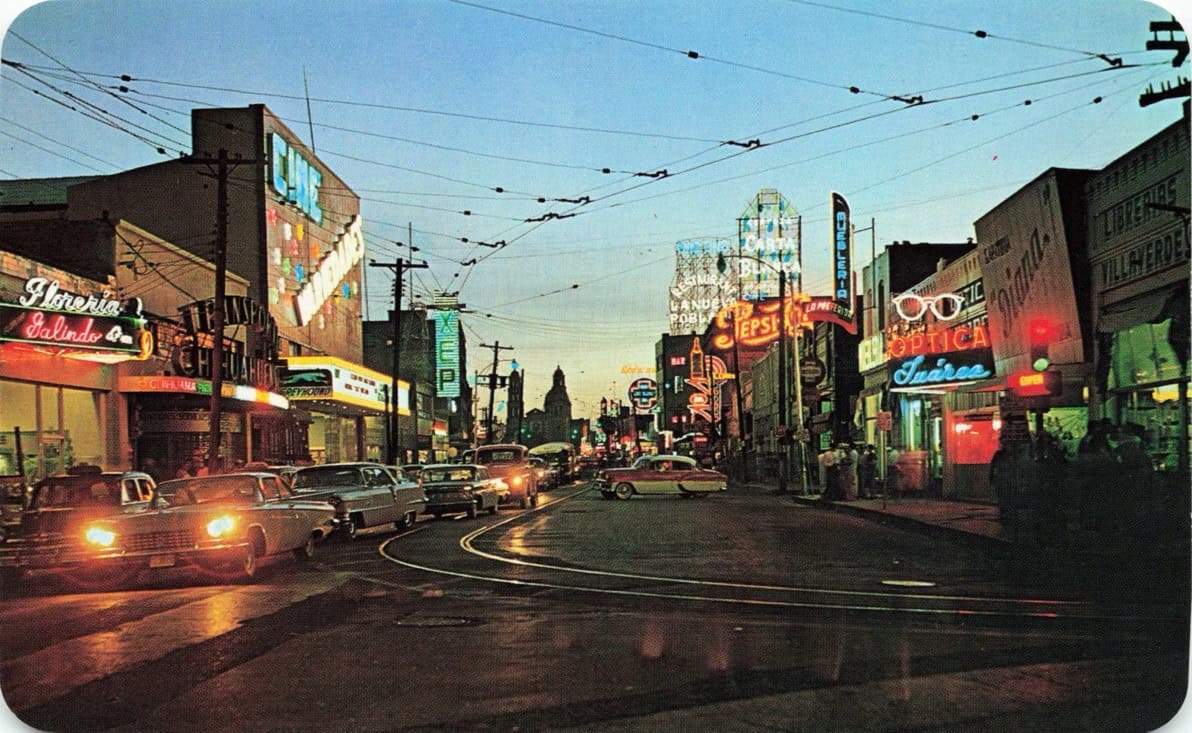
Av. 16 de Septiembre de Noche. Night View of 16th of September
Avenue. Ciudad Juárez, Chih.[huahua], México, circa 1959.
With the advent of highspeed color film in the 1950s, chrome postcard photographers were able to capture nighttime street scenes. 16th of September Avenue is a major commercial boulevard in Ciudad Juárez across the river from El Paso, Texas.
Effective night photography with color film is tricky in the best of circumstances, but this photographer had great success with this chrome-postcard view of the Lerdo streetcar tracks bending into 16 de Septiembre.
Starting in the background center, this view captures the new twin belfries of the Guadalupe Church facing the plaza. On each side of the street are tall buildings and a sea of neon signs. The streetcar system, first installed in the town during the late nineteenth century, was still serving Juárez, although it likely battled with the increased automobile traffic that swamped the city where the population increased from some 20,000 in 1920 to more than 276,000 by 1960.
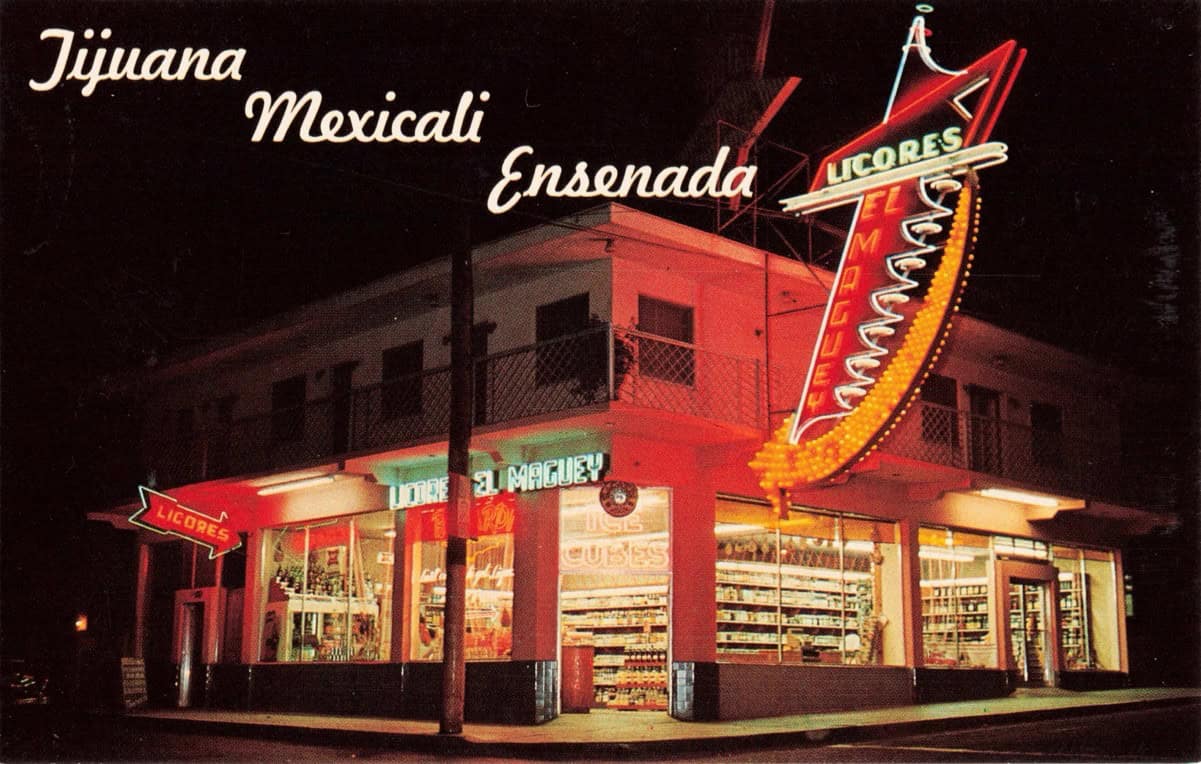
Licores El Maguey Tijuana Mexicali Ensenada, 1960s.
This is a 1960s chrome postcard showing Licores El Maguey, once the largest chain of liquor stores in Baja California. The dramatic night view is heightened by neon arrows directing customers to the store.
Liquor stores, like curio stores, were major commercial enterprises selling to border town tourists who could purchase tequila along with other spirits at high discounts. Although regulations vary as to the amount of alcohol that might be carried into individual states from Mexico and some like Texas adding sales taxes to declared purchases, the tradition of liquor shopping in Mexico border towns continues to the present.
The caption on the address side of this card is printed in Spanish and English. It has a divided-back, but no “Post Card” or “Postcard” designation.
Adíos y buenas noches!
Great article about how Mexico profited from one of the biggest mistakes ever made by the United States. Cuba became a popular tourist destination for Americans during the 1920’s due to Prohibition. There were also booze cruises to Canada from New York City during this era. Foreign flagged vessels could serve alcohol once they were outside U. S. territorial waters. American vessels could not serve liquor severely impacting the profitability of American shipping lines.
Very Interesting – thank you.
What a great history of the border! Thank you!