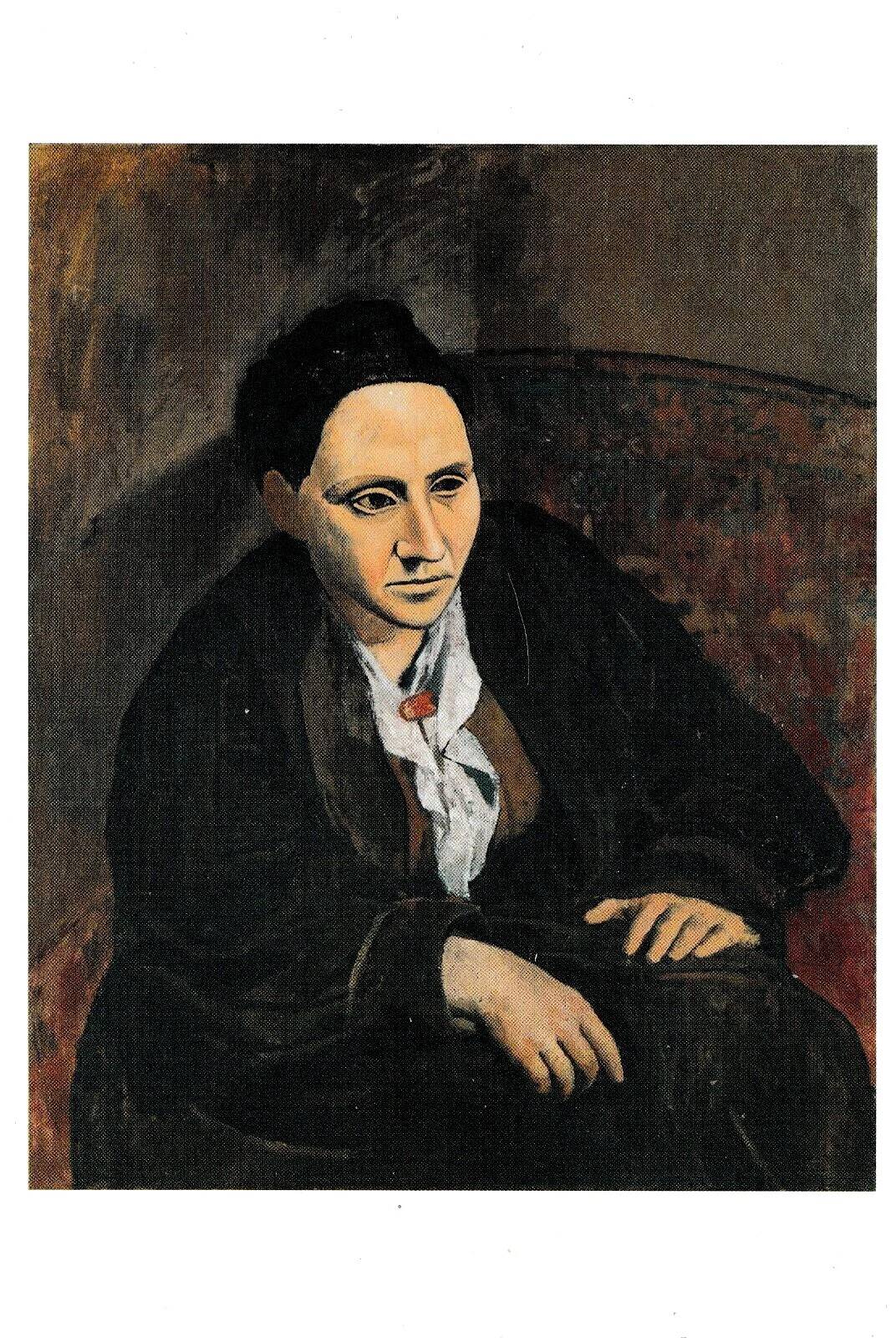
This article was inspired by the April 19, 1912, portion of Bad Days In History by Michael Farquhar. This title is highly recommended for it is, “a Gleefully grim chronicle of misfortune, mayhem, and misery for every day of the year.” Published in 2015 by the National Geographic Society, Washington, D.C.
The image on this postcard is of Gertrude Stein. It is a painting by Pablo Picasso done circa 1905. The original is oil on canvas (39” x 32”) and was a gift from the artist to Ms. Stein. In 1946, Stein’s estate bequeathed her portrait to the Metropolitan Museum of Art in New York City, shortly after her death in July. It is now part of the permanent collection.
Gertrude Stein, a novelist, poet, and playwright, was born in Pennsylvania and raised in California. Her parents both passed before Gertrude’s seventeenth birthday. She acquired an education at Radcliffe College, which was then an annex of Harvard University.
In 1903 at age 29, she moved to Paris and made France her home for the remainder of her life. She often hosted Paris salons, where the leading figures of modernism in literature and art, such as Pablo Picasso, Ernest Hemingway, F. Scott Fitzgerald, Sinclair Lewis, Ezra Pound, Sherwood Anderson, and Henri Matisse would meet.
Stein’s life in Paris was easy and, mostly, rewarding. She had her own way of funding her lifestyle and the moral and ethical support of the Americans (especially Hemingway, Fitzgerald, and Lewis) who shared her interest in literary experimentalism and modernistic influence. Her life is Paris was also troublesome.
Early in 1912, Stein submitted the manuscript that would later become The Making of Americans to Alfred C. Fifield, a London-based publisher.
Fifield was, by all accounts a surly and difficult individual who insisted that the books published by his firm meet all the standards of the traditional literary community. (Interestingly only one title published by Fifield, At the Back of the North Wind, by George MacDonald, a Scottish novelist and Christian minister, still appears on any university’s reading list.)
At the Back of the North Wind is a story of a poor stable boy living in Victorian London in which his and other lives are transformed by a force personified as a beautiful woman known as the North Wind. When she visits the small boy, she takes him along on her journeys. Through the eyes of an innocent and yet perceptive child, MacDonald surveys North Wind as a way of discovering the part death plays in our lives. Strangely, MacDonald, without being preachy, also conveys that the deepest need we have is for love and forgiveness, which are rooted in eternity.
It is uncertain if Fifield responded to others with similar vitriol, but his letter to Stein in 1912 has become a classic among other literary rejections. His rejection parodied Stein’s experimental, repetitive prose style. It essentially rejected her by imitating and ridiculing the very techniques she was known for.
It is transcribed, in full, in the following block quote:
Dear Madam,
I am only one. Only one. Only one. Only one being one of the same time. Not two, not three, only one. Only one life to live, only sixty minutes in one hour. Only one pair of eyes. Only one brain. Only one being. Being only one, having only one pair of eyes, having only one time, having only one life. I cannot read your M.S. [manuscript] three or four times. Not even one time. Only one look, only one look is enough. Hardly one copy would sell here. Hardly one. Hardly one.
Many thanks. I am returning the M.S. by registered post. Only one M.S. by one post.
The letter, which is dated 114 years-ago-today, (April 19th) has since become famous as an example of both the resistance Stein faced from commercial publishers and the difficulty many early readers had with her modernist style.
Stein’s writing was intentionally unconventional, dense, repetitive, and structurally experimental, and sadly, early twentieth century publishers found her work commercially risky.
However, the manuscript Fifield rejected was eventually published in France under the title De la Fabrication des Americains, now considered a major modernist work. One review stated, It is a shame that so much of Gertrude Stein’s work is dismissed because of its unconventionality. Though sometimes difficult to read, Stein’s writing has a lyrical quality about it unparalleled by the work of other writers.
**
This was not an isolated incident, neither is it a story from “out in the weeds.” There is a legion of similar tales. Authors by the dozen have had trying relationships with publishers, many of which are examples of resistance to change, misunderstanding, and a long struggle for recognition. Names like J.K. Rowling, James Joyce, William Faulkner, and even George Orwell all had legendary battles with publishers.
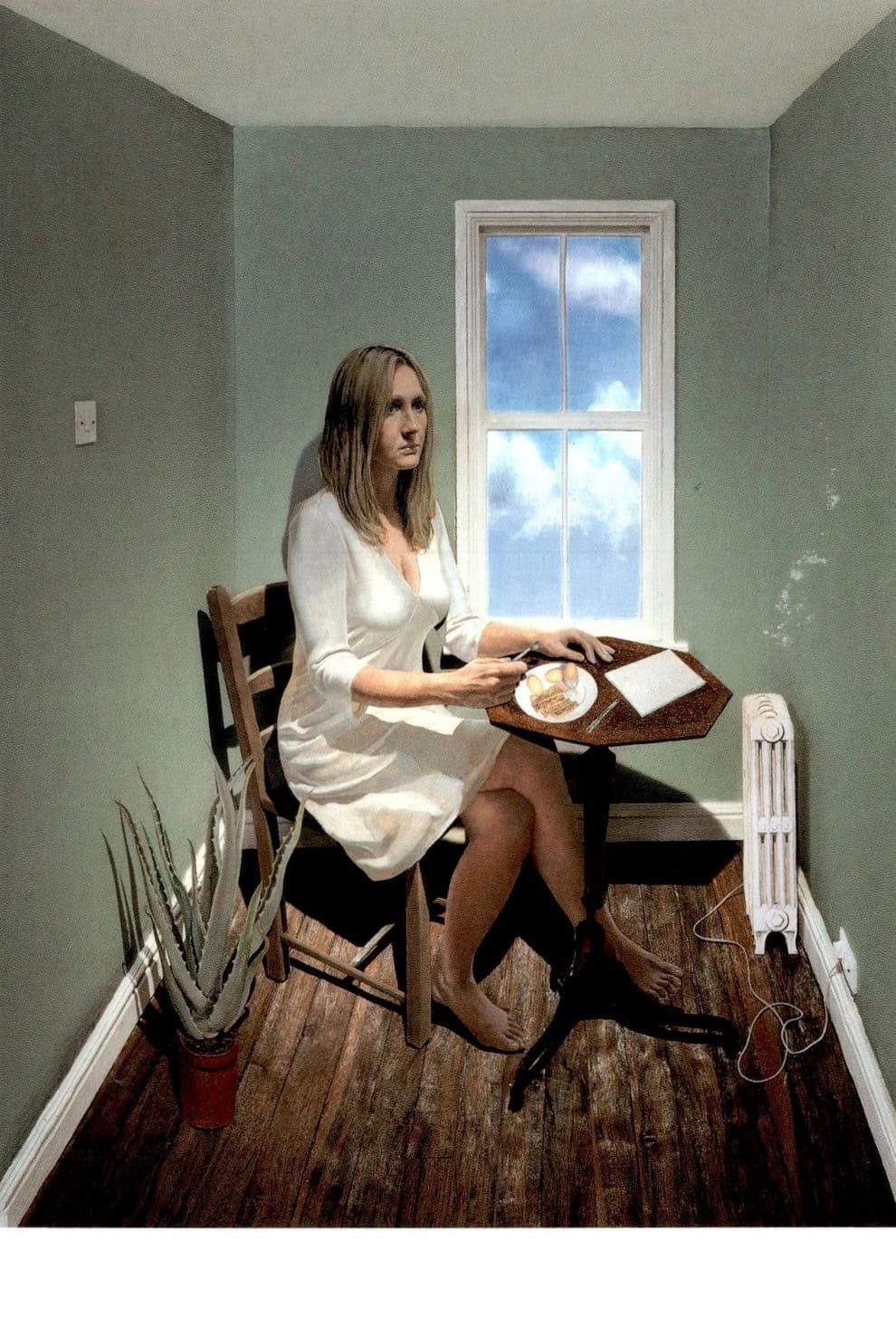
Rowling for example. Before Harry Potter became a global phenomenon, Rowling was working as a bilingual secretary and researcher for Amnesty International. In 1990 when she began the Harry Potter series, she faced a long string of rejections that seem trivial, but at the time appeared demonic.
When the manuscript of Harry Potter and the Philosopher’s Stone went out to a dozen major British publishers, one after another rejected it. The reasons varied, but the underlying sentiment was consistent: the book was too long, too strange, too slow to start, or simply not marketable enough to justify the risk.
One snide publisher even advised Rowling to take a typing course, implying she should pursue secretarial work instead of writing.
Rowling’s rejections, like the ones sent to Stein, were not malicious, they were simply a failure of imagination. Much like Stein’s publishers, these later publishing concerns couldn’t see the potential in a manuscript that didn’t fit the norms of the times.
The turning point for Rowling came when Bloomsbury’s chairman took the first chapter home. His eight‑year‑old daughter read it and immediately asked for more. That single moment of enthusiasm convinced Bloomsbury to take a chance — though even then, they printed only 500 copies in the first run, and Rowling was advised to “get a day job,” because children’s books rarely paid well. [Wait: as of mid-2025, J.K. Rowling is estimated to be a billionaire with a net worth approaching $1.2 billion.]
The irony is almost too perfect. The book that publishers dismissed as unpromising became one of the best‑selling novels in history, launching a series that reshaped children’s literature and global pop culture. Rowling’s story, like Stein’s, underscores how often publishers misjudge work that doesn’t fit their assumption and how easily a masterpiece can be overlooked.
**
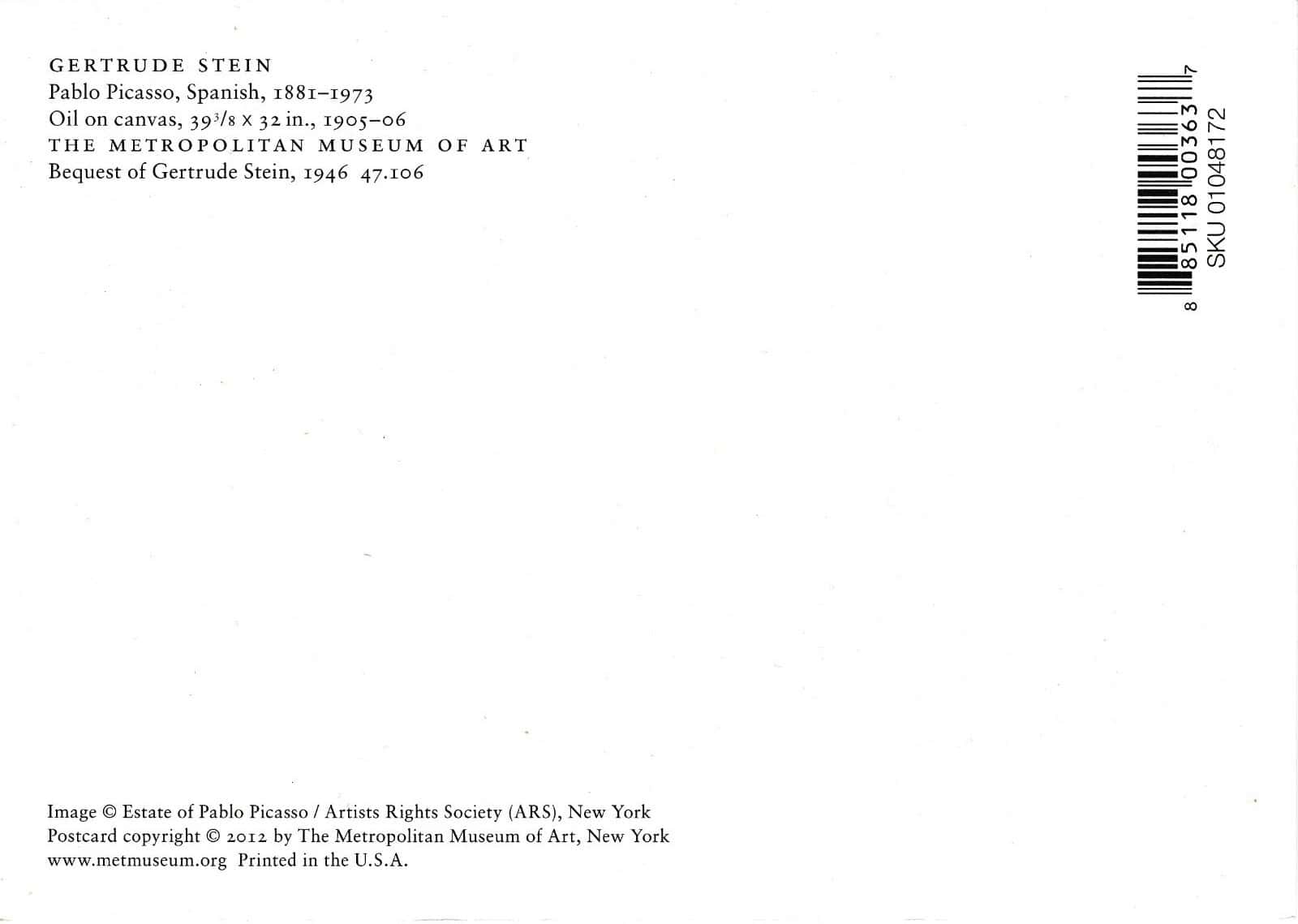
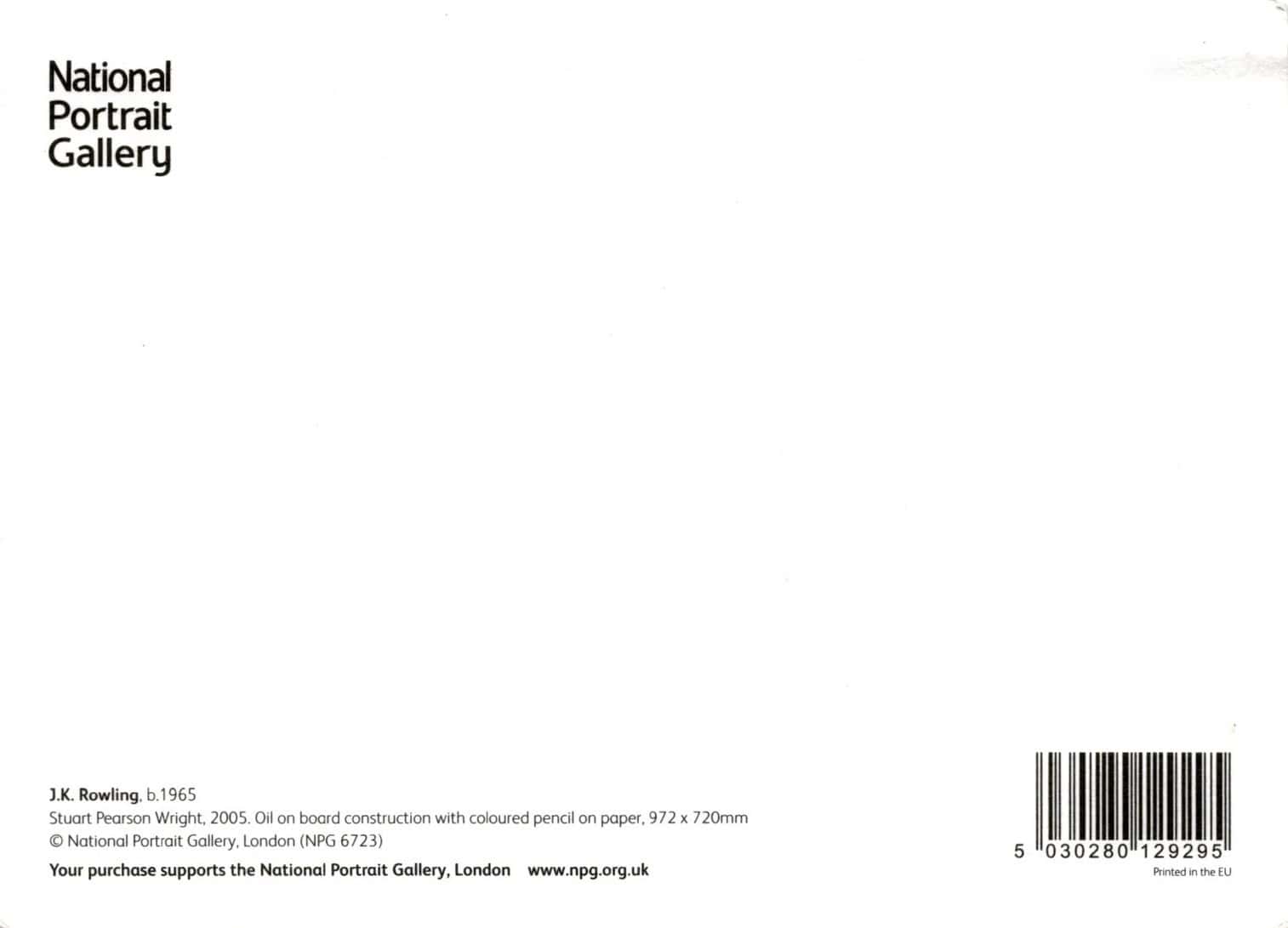
The two postcards featured in this post are museum postcards: one (showing Ms. Stein) is from the Metropolitan Museum of Art in New York City, the other from the British National Portrait Gallery in London. Ms. Rowlin’s image is a Stuart Wright painting completed in 2005.
Very interesting article. Thank you, Ray.
Very interesting, thank you, good comparison.