Alert! Warning!! Alert!!!
You can’t get to Boyce, Virginia, from where you are. You will find it necessary to go somewhere else first – like Pyletown or Berryville. Oh, yeah, if you drive through and don’t recognize Boyce, you can turn around at Lost Corner or Waterloo. Otherwise go to Harpers Ferry, West Virginia, and follow the signs to the National Historical Park. The park entrance is on U.S. Highway 340.
Route 340 in that part of Virginia is signed as Lord Fairfax Highway. The speed limit is just 45 miles per hour which is just right to watch the scenery go by. It is some of the most beautiful farmland and horse country in America. As you approach the intersection of Rt. 723, you will see the Baptist Church on the southwest corner and the fire department is a hundred yards or so further on the left.
Now that you’re there; stop at “The Old Chapel.”
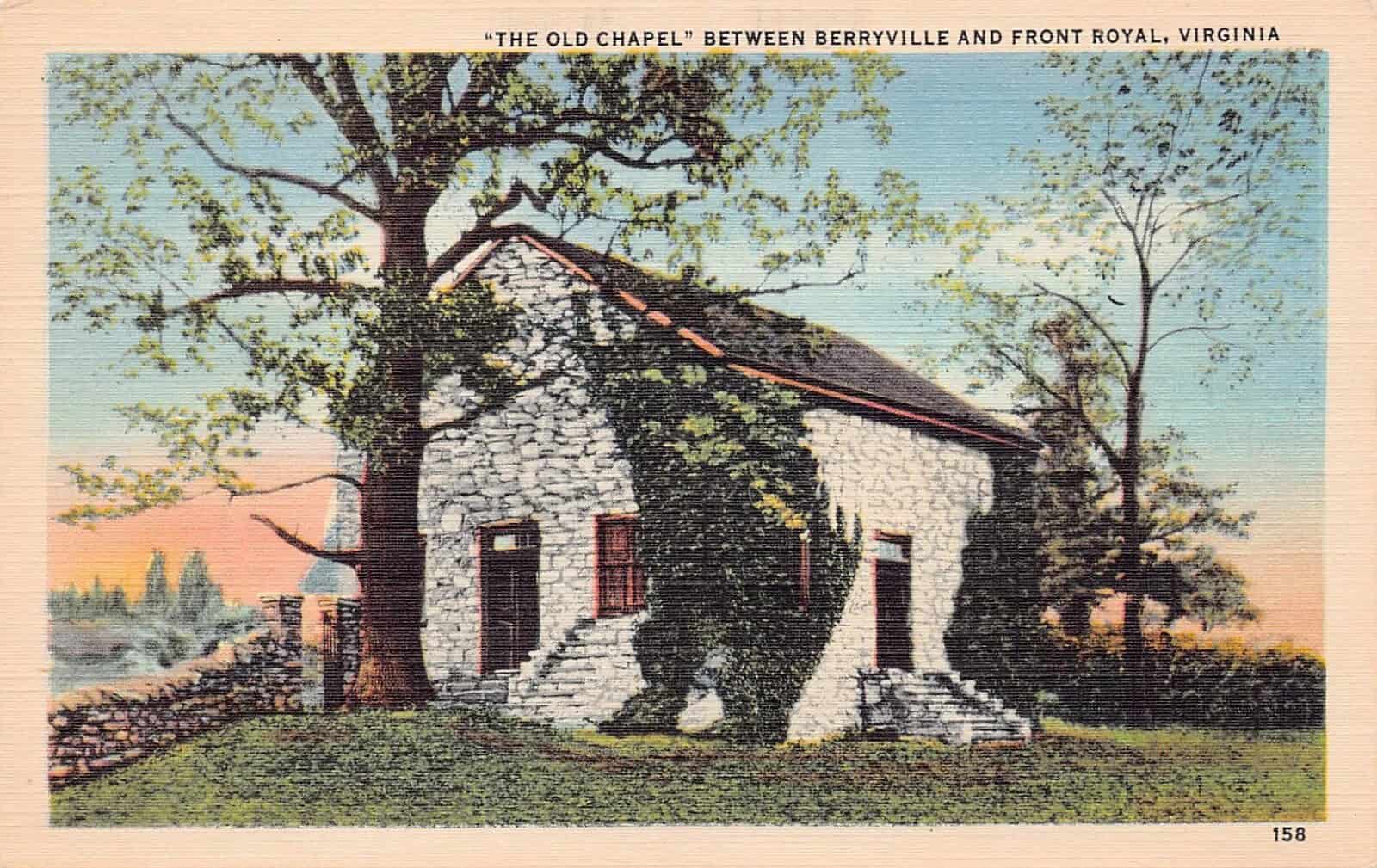
The Old Chapel is a historic Episcopal church located just outside Boyce in Clarke County, Virginia. It holds a special distinction: it is the oldest Episcopal church building still in use west of the Blue Ridge Mountains.
The site’s religious roots go back to around 1747, when a log sanctuary was first built for Frederick Parish. The current stone chapel replaced the log structure around 1793. It is a simple stone construction with an A‑frame roofline that reflects the modest architectural style of many rural Virginia churches.
One of the most influential figures associated with the chapel is Rev. William Meade, who served the congregation for about 25 years in the early 1800s. He later became the Episcopal Bishop of Virginia and helped found what is now the Virginia Theological Seminary.
One quite notable part of the Old Chapel’s grounds is the cemetery. Edmund Randolph is buried there; he was once the Governor of Virginia, first U.S. Attorney General, and U.S. Secretary of State. John Esten Cooke is there too; he was a member of the Richmond Howitzers at the First Battle of Bull Run and later served as an aid to Confederate General William N. Pendleton. The noted architect Nathaniel Burwell is also a permanent resident.
Point your GPS at 3605 Bishop Meade Road, Boyce, Virginia, just north of Millwood.
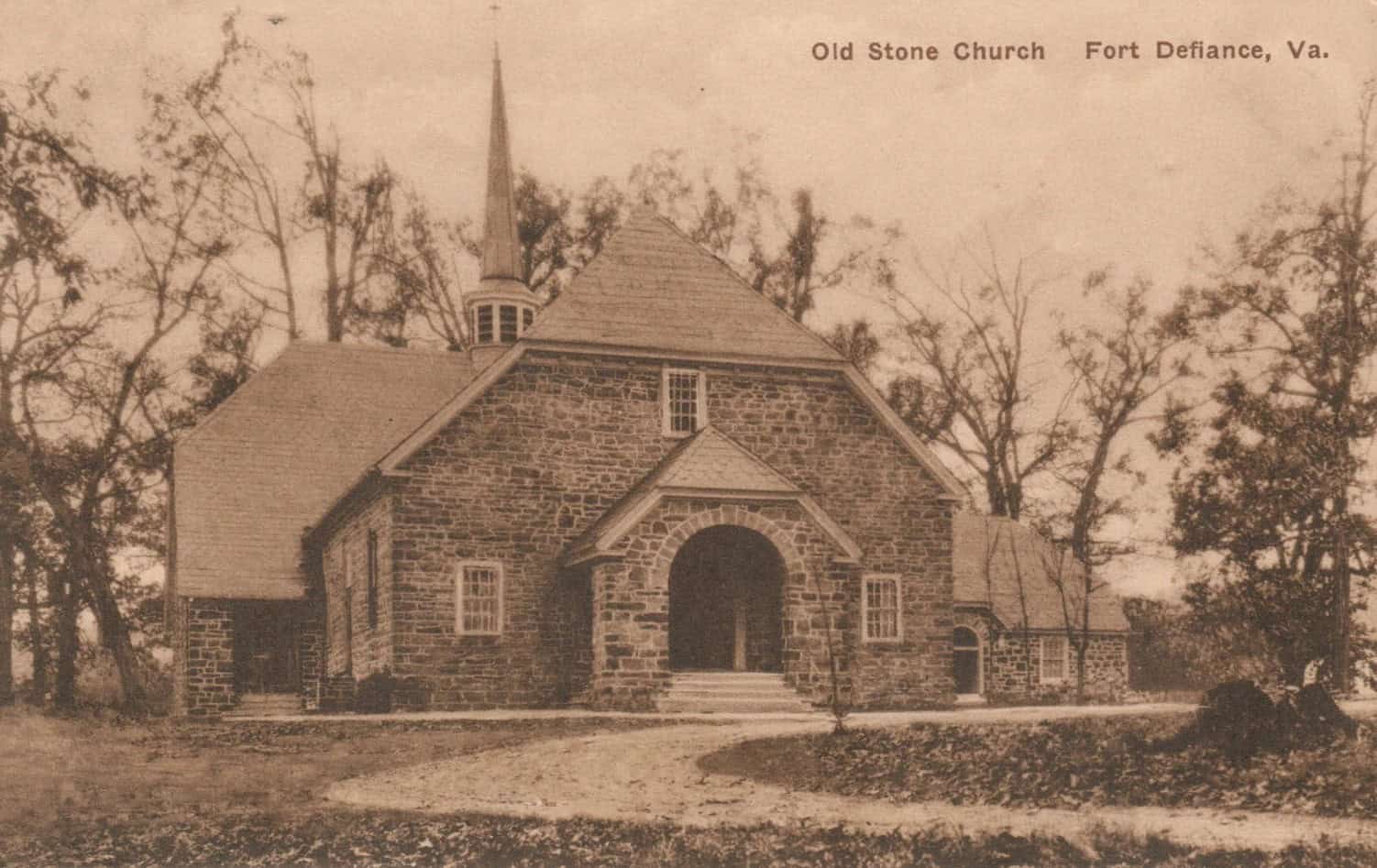
The Old Stone Church at Fort Defiance, Virginia, about halfway between Harrisonburg and Staunton, was first known as Augusta Stone Church. It is emblematic of Virginia’s most enduring Presbyterians, both their faith and resilience. Founded in 1740, it is the oldest Presbyterian church in continuous use in the state, raised up there by the Scotch‑Irish settlers in Augusta County. The congregation first gathered in a log meetinghouse before constructing the stone sanctuary that still stands today.
Central to its early history was Rev. John Craig, the first settled Presbyterian minister west of the Blue Ridge. Arriving from Northern Ireland in 1740, Craig oversaw rapid growth in the congregation, recording more than 200 baptisms in his first two years.
His leadership guided the decision to build the stone church, which was completed in 1749 and later served as a fortified refuge during periods of frontier conflict.
Among the church’s most influential early parishioners was Captain John Lewis, a leading figure in Augusta County’s civic and military life. Lewis, a patriarch of one of the Valley’s most prominent Scotch‑Irish families, helped establish the county court system and served as a militia captain during the turbulent mid‑eighteenth century. His family’s prominence and public service made them central contributors to the church community. Lewis’s sons—including surveyor Thomas Lewis, who helped map the region—extended the family’s influence across the Valley’s early political and cultural landscape.
Together, Rev. Craig, Captain Lewis, and the determined frontier families of Augusta County shaped Augusta Stone Church into a lasting testament to early American perseverance and faith.
If you want to visit, the GPS location is 28 Old Stone Church Lane, Fort Defiance, VA.
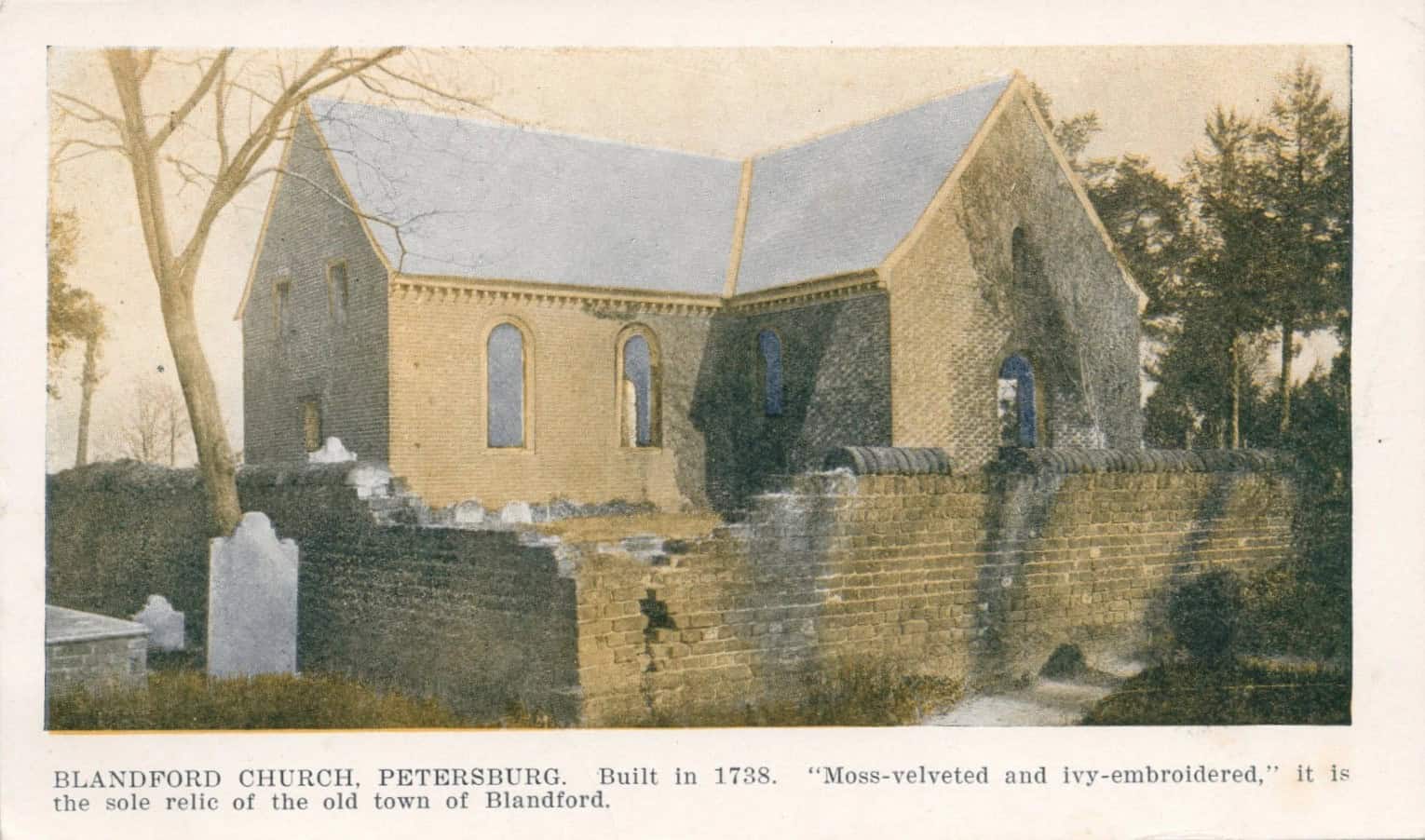
Blandford Church in Petersburg, Virginia, is an enduring landmark with a three century religious, social, and military history. Built between 1735 and 1737, it originally served as the principal church of Bristol Parish, a colonial parish established in the mid‑seventeenth century atop Well’s Hill, the highest point in Petersburg.
The early structure was a simple rectangular brick building, later expanded with a north wing and surrounding brick wall under the direction of Col. Richard Bland, a prominent colonial figure.
During its early years, Blandford Church was a center of Anglican worship. It hosted notable figures, including the celebrated evangelist George Whitefield, who preached there in 1737. The church also served as a gathering place for major civic moments; in 1799, a memorial service for George Washington was held within its walls.
By the early nineteenth century, the congregation moved to a newly built Episcopal church in downtown Petersburg and by 1806, Blandford Church was abandoned, and immediately fell into disrepair. The surrounding community of Blandford was eventually absorbed into the expanding city of Petersburg.
During the Civil War, the deteriorating church, on its hilltop made it a landmark seen from the nearby battlefield. Federal troops referred to the area as “Cemetery Hill,” and the church became a focal point during the Battle of the Crater on July 30, 1864, when Union forces attempted to seize the high ground after detonating a massive mine beneath Confederate lines.
Photographers such as Timothy O’Sullivan later documented the war‑scarred structure, capturing its haunting presence amid the surrounding cemetery.
In 1901, the Petersburg Ladies’ Memorial Association undertook the restoration of the ruined church, transforming it into a memorial to Confederate soldiers. Today, Blandford Church stands adjacent to Blandford Cemetery, one of Virginia’s oldest.
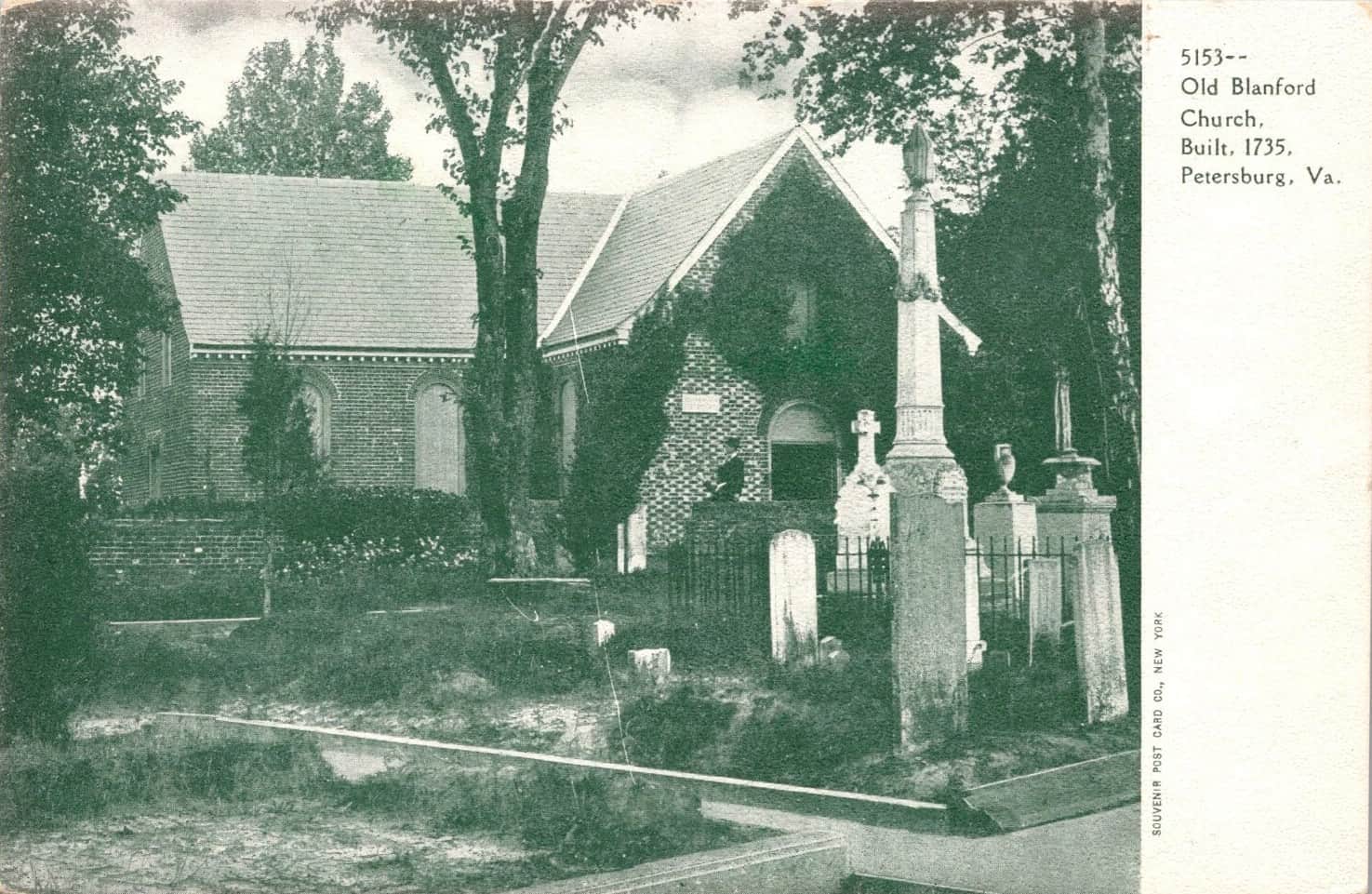
Go visit this stunning church. Plan your trip for when the church is open to the public so you can enjoy the stained-glass windows. Then walk through the adjacent cemetery. If a shiver runs up your spine when you walk through the arch of “Confederate Heroes” be sure to tell us about it. Set your GPS for 319 S. Crater Rd., Petersburg, Virginia.
Beautiful! I hope you find more postcards like these in VA,,, AND in the adjoining states to VA. Thank you for posting and providing the history.