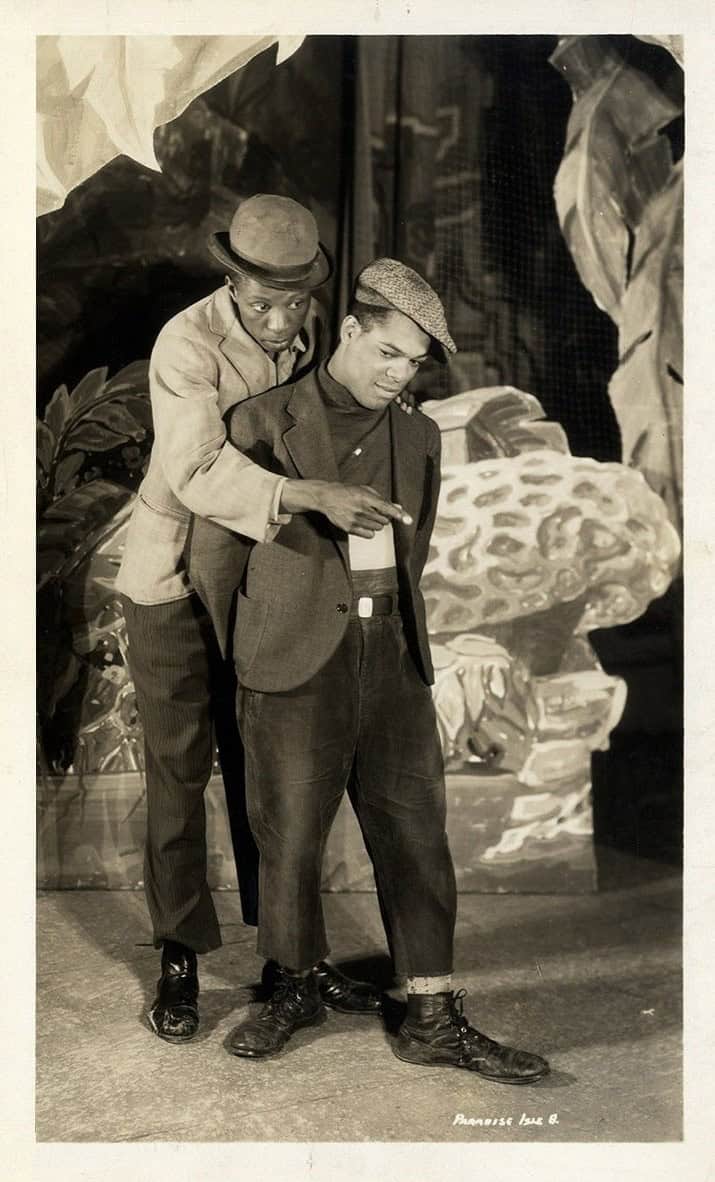
Ford Lee “Buck” Washington and John William “Bubbles” Sublett were a pioneering duo in performance history who blended musical virtuosity, comedic timing, and dance innovation into an act that reshaped the world for black entertainers in the early twentieth century.
Their partnership began in Indianapolis around 1919, when “Buck” Washington [on the right on the postcard seen here] and “Bubbles” Sublett [left] were still boys. They started performing as a singing duo, but they soon discovered a personal chemistry that propelled them to the top of vaudeville’s billboard.
Buck’s mastery of stride piano, smooth and confident, paired perfectly with Bubbles’s emerging talent as a tap dancer. When Bubbles’s voice changed, he shifted fully into dance, developing a style that would earn him the title “father of rhythm tap.”
By the early 1920s, Buck and Bubbles were headlining major vaudeville houses, including New York’s Palace Theatre, the pinnacle of the circuit. Their act was a study in contrast: Buck seated calmly at the piano, fingers gliding effortlessly across the keys, while Bubbles exploded into motion beside him, tapping with a syncopated intensity that mirrored the improvisational spirit of jazz. This interplay made them favorites in revues such as Broadway Frolics.
Their noteworthy appearances reached far beyond the stage. On November 2, 1936, Buck and Bubbles made history as the first black performers ever to appear on television, broadcasting live from Alexandra Palace in London for the BBC’s early high‑definition test transmissions. This milestone, achieved decades before television became a household medium, underscores their role as pioneers. They were also the first black artists to perform at Radio City Music Hall.
Bubbles’s individual achievements further cemented the duo’s legacy. In 1935, George Gershwin selected him to originate the role of Sportin’ Life in Porgy and Bess. Though Bubbles could not read music, Gershwin taught him the part by translating melodies into rhythmic patterns, allowing Bubbles to infuse the role with his distinctive dance phrasing. His interpretation became so iconic that he shaped the character for generations. Bubbles also influenced future stars like Fred Astaire who took lessons from him in the 1920s.
After Buck’s death in 1955, Bubbles continued performing in films and entertaining troops on USO tours during the Vietnam War and making history again as the first black performer on The Tonight Show. His final public appearance came in 1980 in the revue Black Broadway. He died in 1986.
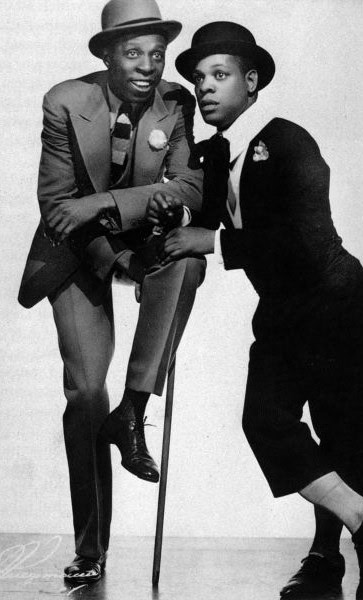
Buck Washington was born in Kentucky around 1900; he did not know his birthdate. (Remember in those years the birth of a black baby was seldom recorded in vital statistics.) He was a gifted stride pianist and singer with a strong and melodic tenor voice.
Buck Washington was much more an introvert than his partner. He seldom spoke on stage, he thought his piano playing spoke for itself. He often claimed that his marriage in 1927 to Amber Vincson (an elder sister to Bobbye Vincson) was the best decision he ever made.
As a pianist, Washington also did sessions with jazz musicians such as Louis Armstrong, Bessie Smith, and Coleman Hawkins.
Buck also played trumpet, though he only made home recordings on the instrument. He continued working with Bubbles until 1953.
He died on January 31, 1955, in New York City.
Today Buck and Bubbles are remembered as a duo who together expanded the boundaries of American entertainment.
Another fascinating article full of great details and history of this duo.
Great story. I really enjoyed reading about Buck and Bubbles, a duo I have never heard of. I’ve always been interested in black entertainment. When I was a kid we used to watch the Amos and Andy show on VHS. It was hilarious.
I first learned about them on TCM, and then looked up some videos on YouTube. Great to see some historical ephemera of this innovating team of artists!