Memphis entrepreneur Kemmons Wilson took his wife and five children on a road trip in 1951 to visit Washington, D.C. He was dismayed by the poor quality and high cost of the motels they encountered. Seeing a need for a clean and modern motel to serve travelers, particularly those with families, Wilson opened the first Holiday Inn with his partner Wallace E. Johnson on August 1, 1952, on Summer Avenue in Memphis, the main highway (U. S. Route 79) to Nashville.
Wilson’s motel took its name from the 1942 movie musical Holiday Inn, starring Bing Crosby and Fred Astaire. His first Memphis motel was quickly followed by three more in the city and its environs, capturing travelers from whatever direction on the compass they came.
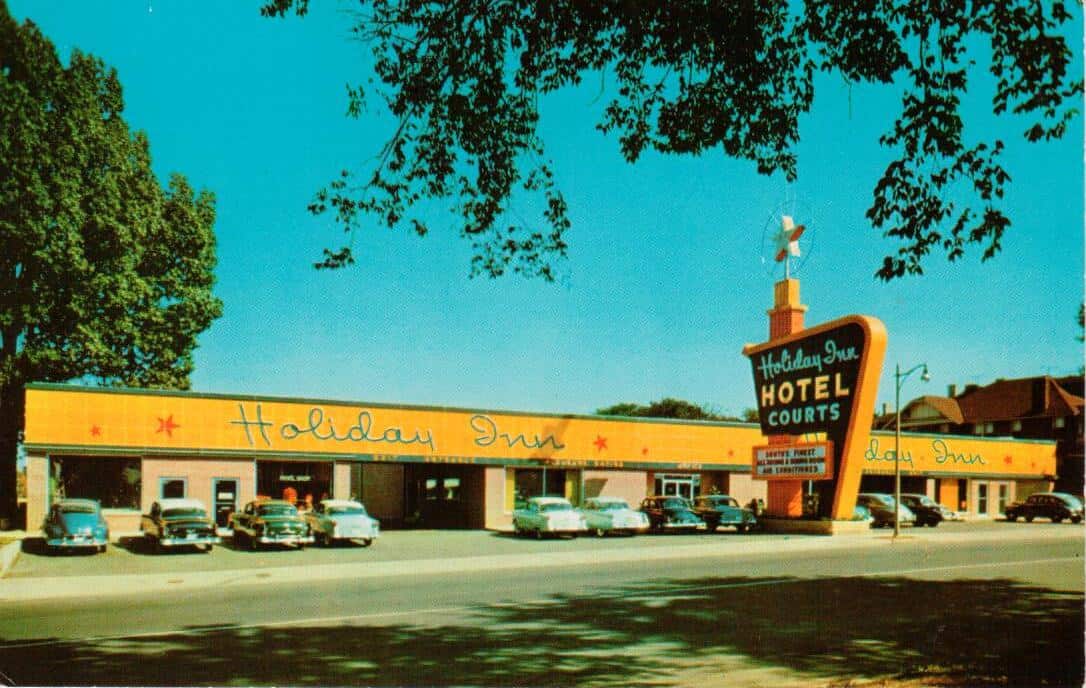
Travelers loved that there was a standardized, sanitary, and family friendly motel chain starting to spread across the United States. During the 1950s, most motels had about ten to twenty rooms. Early Holiday Inns had over seventy to eighty rooms ensuring travelers would find a room for the night. Wilson kept it simple, offering clean accommodation with free parking, an onsite restaurant, and a swimming pool. At the time, only a few hotels and resorts offered pools.
Being the first motel chain with a pool at all of its locations, elevated Holiday Inn above its competitors. The air conditioned rooms were equipped with telephones plus televisions at no extra charge. There was also a free ice machine on each floor. Children under twelve who shared rooms with parents stayed for free. The old image of a motel as a shabby group of cabins by the highway was changed by Wilson’s vision.
By the 1960s Holiday Inns also provided coffee in every room. Guests were provided with instant coffee packets, powdered creamer, and sugar. A wall mounted unit heated the water for a steaming cup of morning java.
To aid families traveling with children, Holiday Inn’s onsite restaurant offered a Sunday night fried chicken dinner served family-style for only $1.95 for adults and $1 for children under 12.
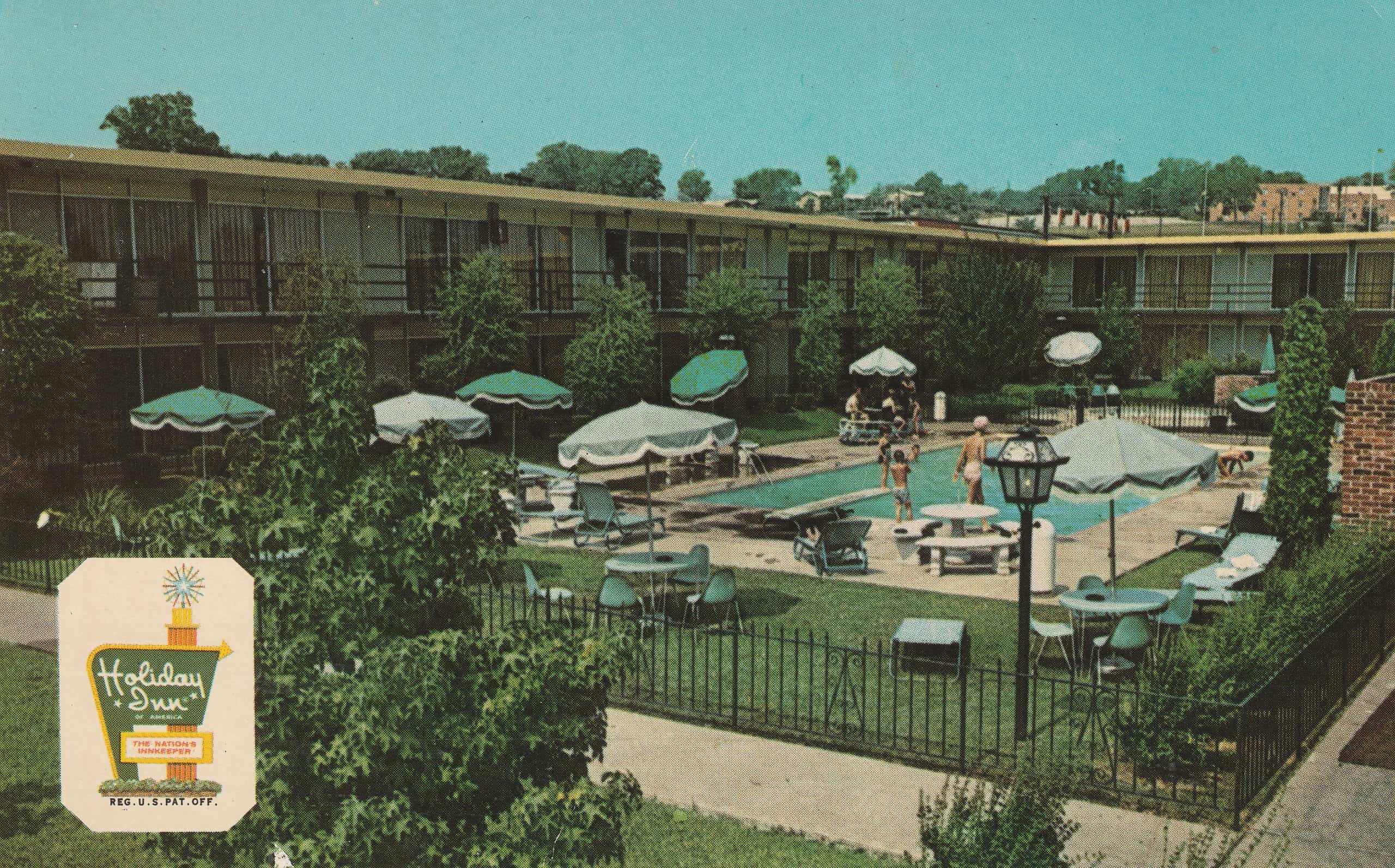
The pool with tables and umbrellas gave it a resort vibe.
The pool elevated a Holiday Inn into a resort. Some pools had shuffleboard courts.
Five years after his first motel was built Wilson developed the concept of franchising the chain. Franchise motels were inspected regularly to ensure compliance with the chain’s standards. Many of the Holiday Inns built during this early expansion period were located off the exits of the interstate highway system that was then under construction.
Holiday Inn soon spread across America like kudzu in the South. By 1958 there were 50 Holiday Inns, 100 by 1959, 500 by 1964, and 1,000 in 1968. In 1969, Holiday Inn surpassed Best Western (a referral chain rather than a franchise chain) as the nation’s largest lodging chain.
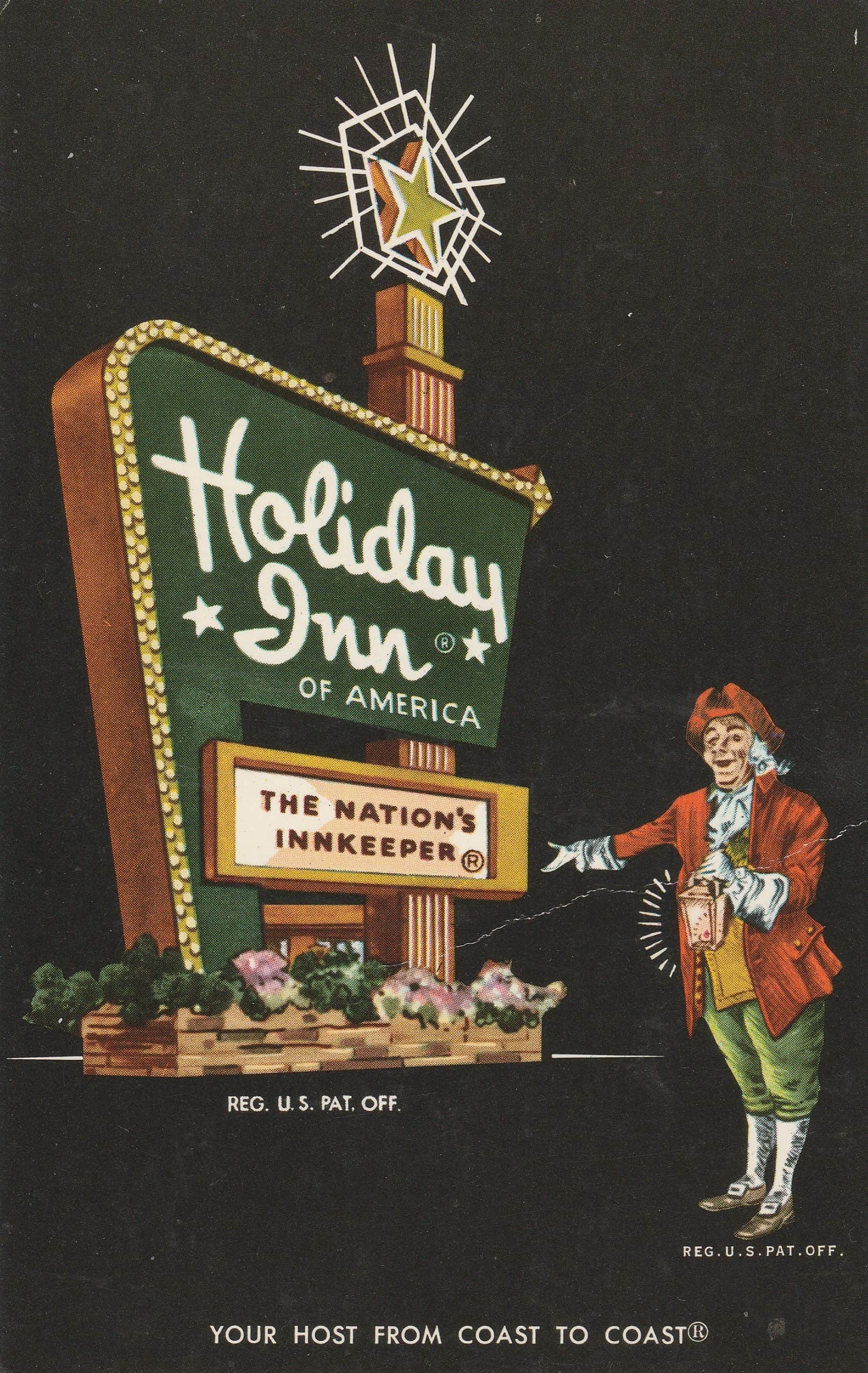
The “great sign” was the huge roadside sign used by Holiday Inn during their era of expansion in the 1950s into the ‘1970s. Large and striking, it soon became an icon of the great American road trip. Wilson decreed that the sign be at least fifty feet high and be seen from whichever direction the traveler was approaching. The great sign cost $13,000 to construct, which was equal to approximately $145,026 today. It weighed 14,000 pounds. Each great sign required 836 feet of neon tubing, 31 transformers, and 450 light bulbs. Annually, the power usage of a great sign was equivalent to that of five American homes.
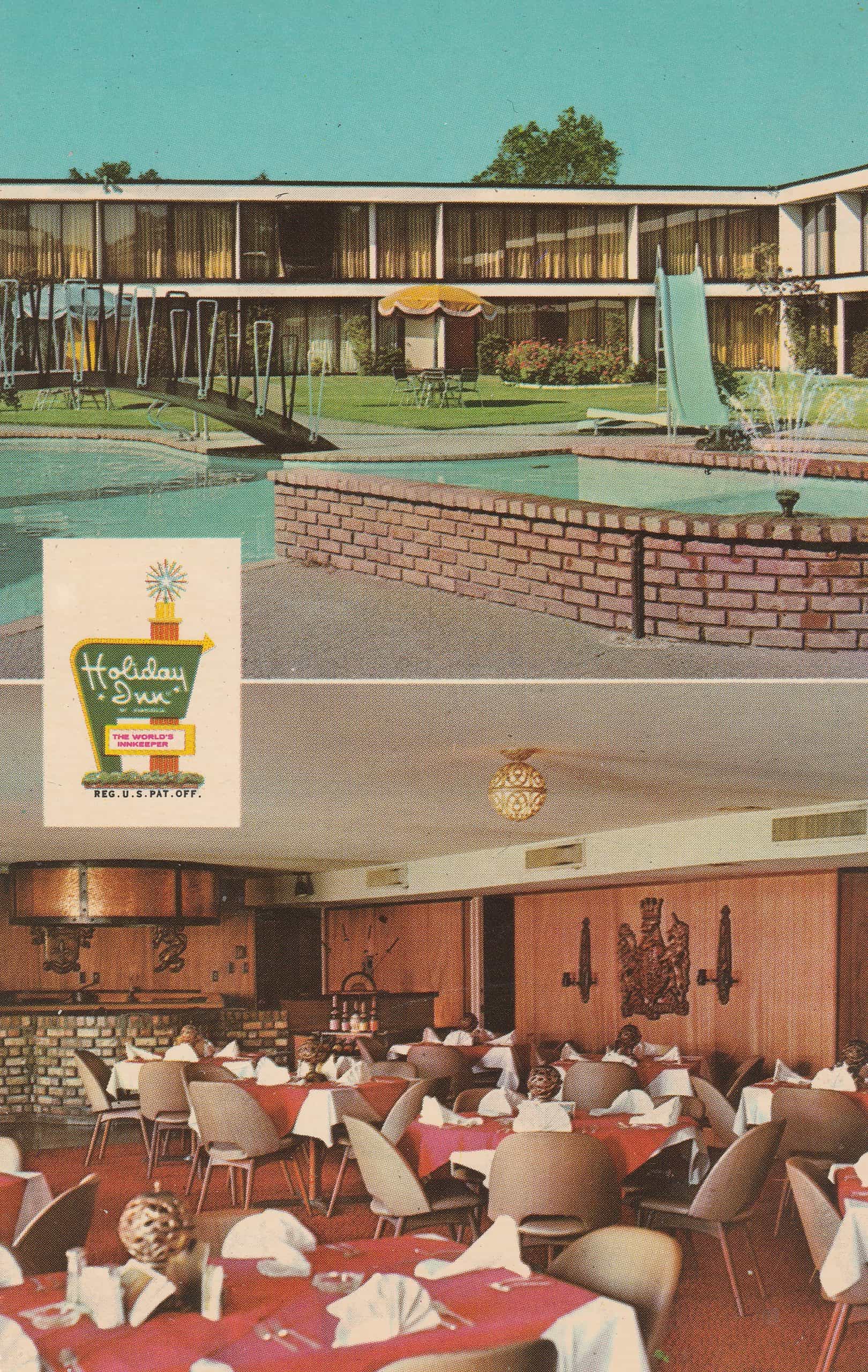
Mid-Century Modern Décor.
Holiday Inn – U. S. Route 1 and Interstate
95 – Fredericksburg, Virginia.
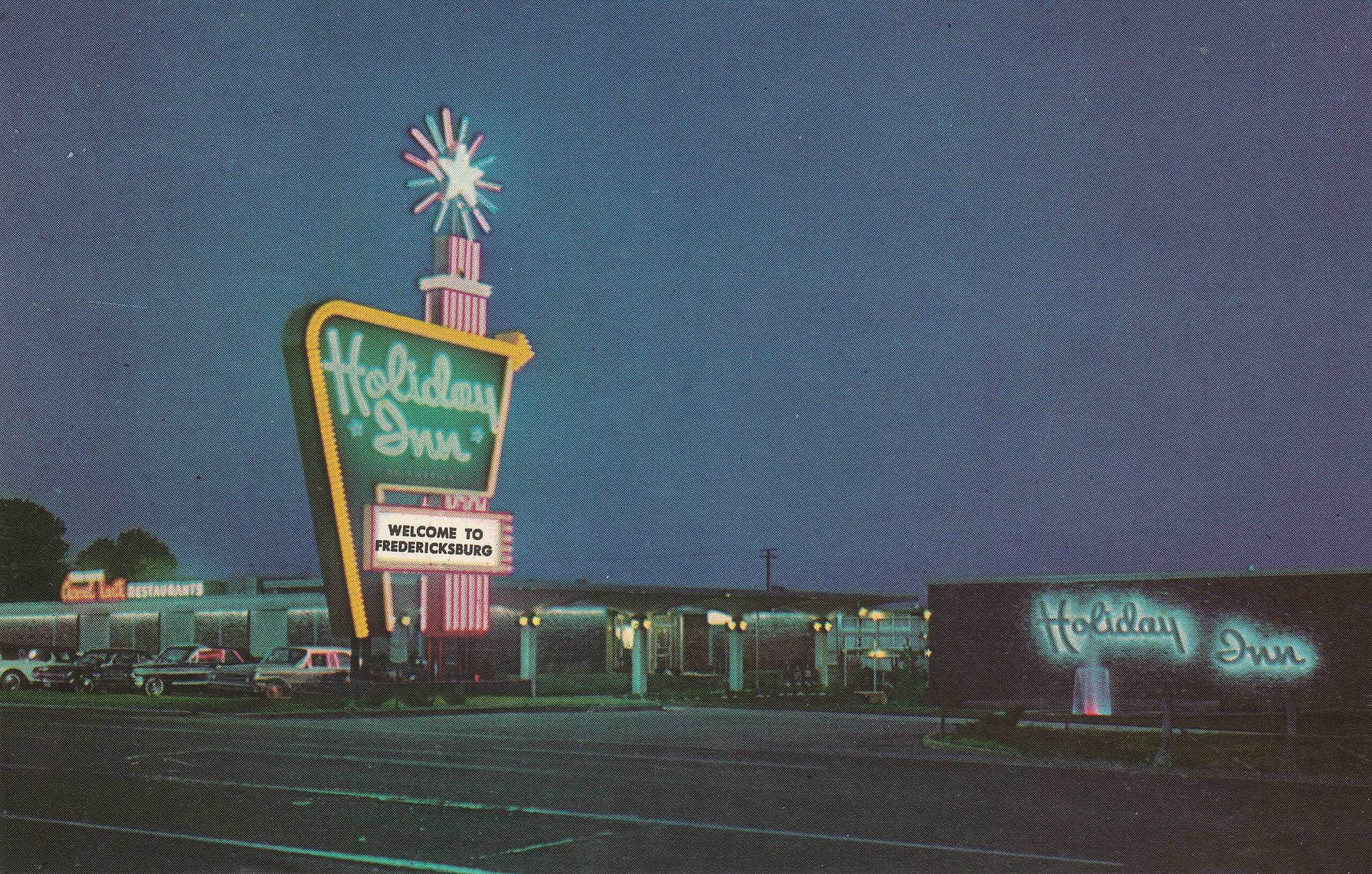
The great sign and all of its related branding were officially retired in 1982 when Holiday Inn switched to back-lit plastic signs, a more cost-effective alternative for installation, maintenance, and electrical usage. Kemmons Wilson later lamented the retirement of the great sign. Only three authentic working great signs remain today. One at the Henry Ford Museum in Dearborn, Michigan, one at the American Sign Museum in Cincinnati, and one owned by a private collector in Kentucky.
Also at the Henry Ford Museum is a recreation of a Holiday Inn room circa 1965. The standard Holiday Inn room was twelve by eighteen feet with wall to wall carpeting. Its walls were painted cinder block and there was a wall of windows next to the door. Rooms were furnished with two double beds with a nightstand between them. Wilson mandated that a Bible be placed on the nightstand. There was a desk and dresser combination and two armchairs with a reading lamp between them. The style of the decor and furnishings was Mid-Century Modern. In the 1960s there was a state of the art black and white television that was later changed to a color television in the early 1970s. Outside the bathroom containing a toilet and tub was a vanity and sink enabling multiple members of a family to prepare to turn in for the night.
Mid-Century Modern architecture and décor was a hallmark of the Holiday Inn chain during its early days. Many of its early inns were built along the lines of the architectural drawing below.
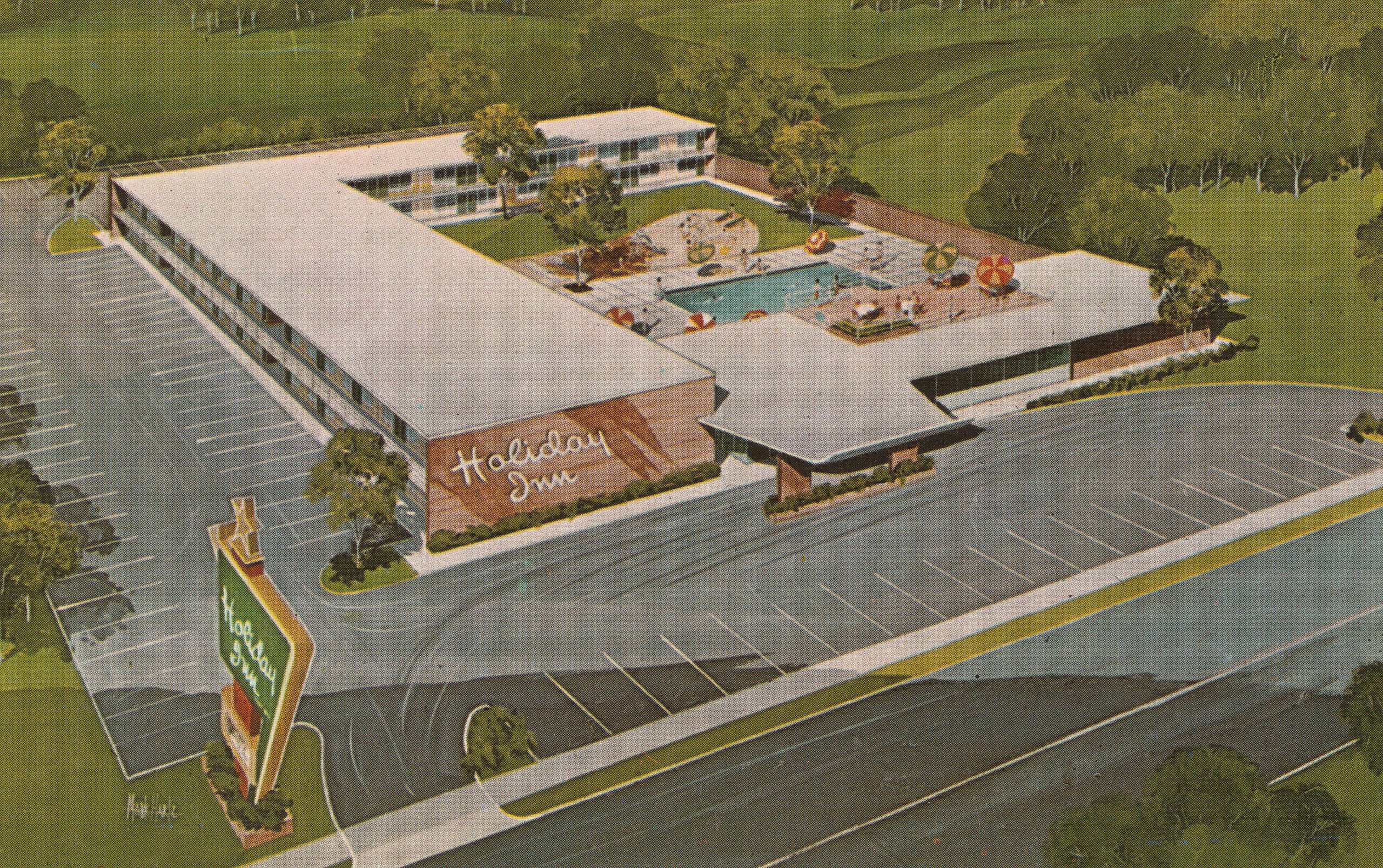
The one-story structure at the front contained the lobby, office, restaurant, and meeting rooms. Guest rooms were located in the L-shaped structure surrounding the pool.
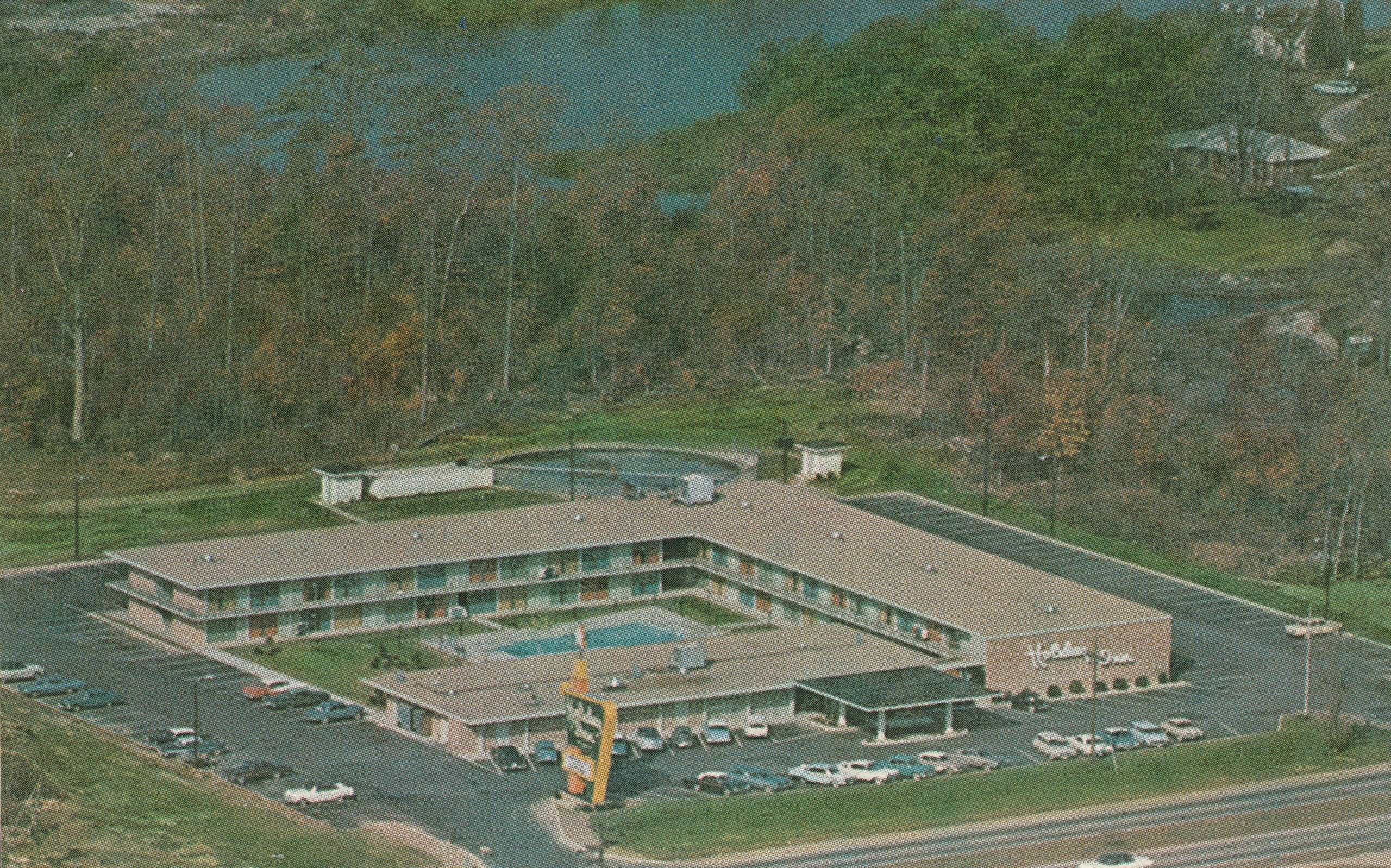
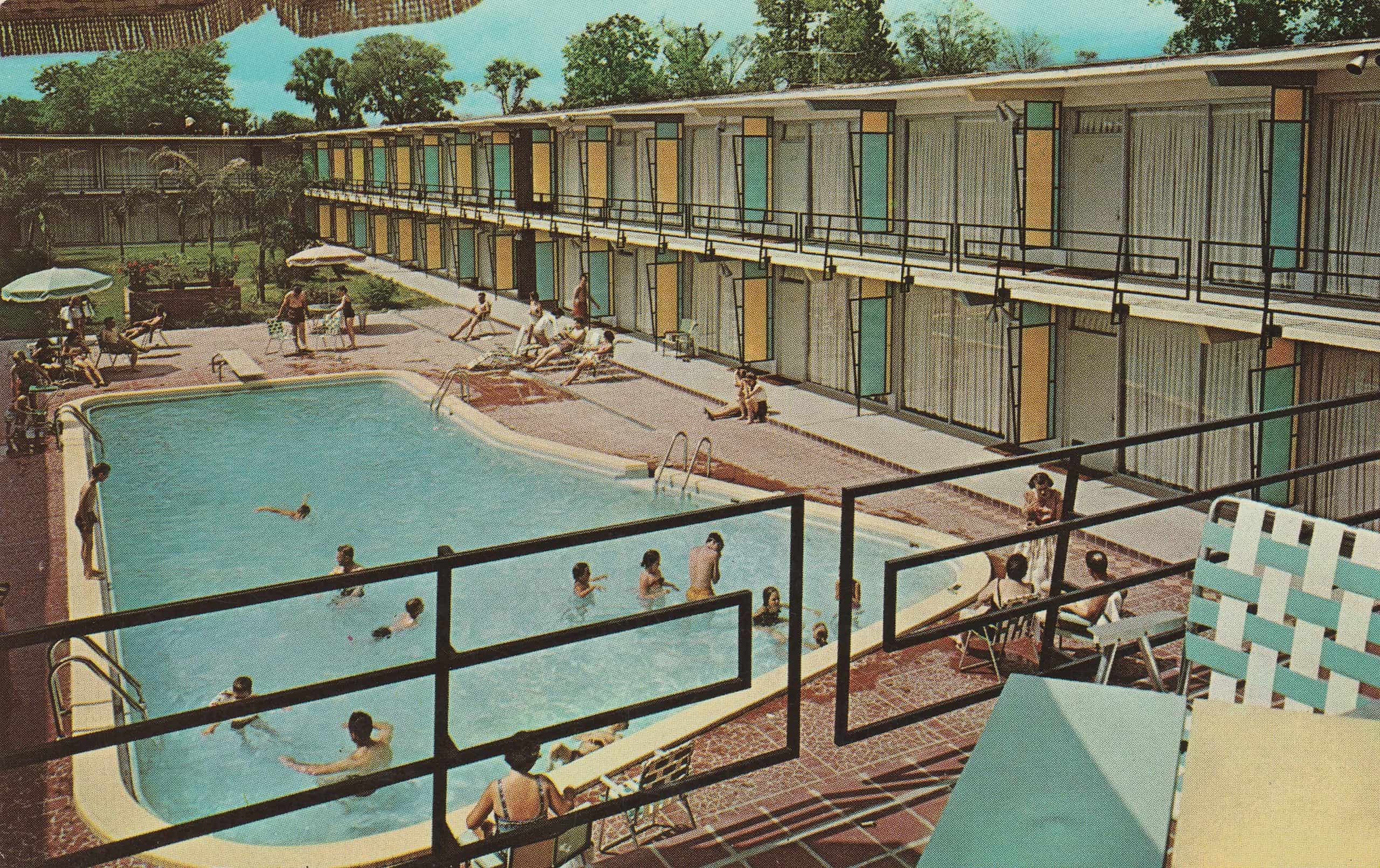
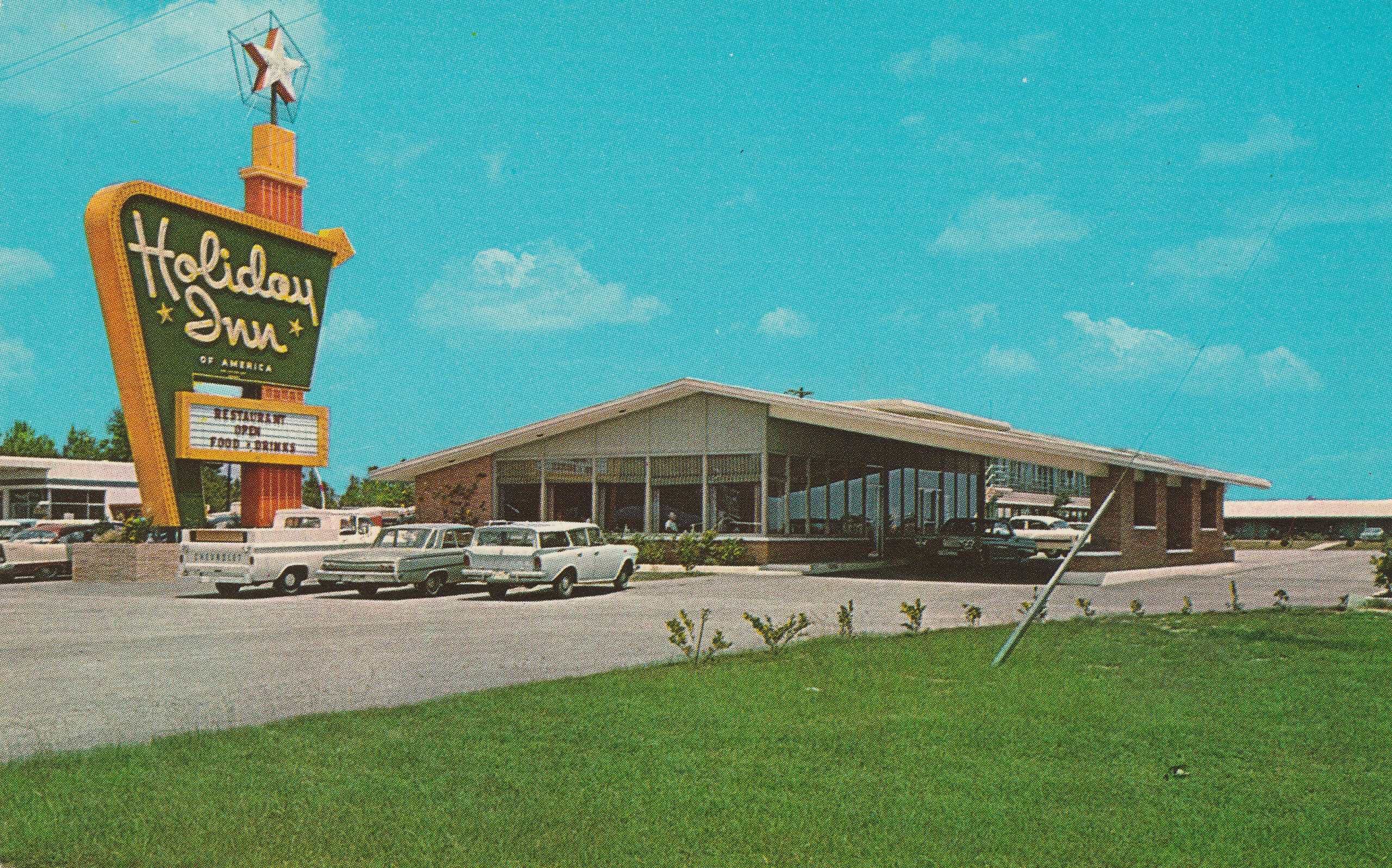
In 1963, Holiday Inn signed an agreement with Gulf Oil to accept Gulf credit cards to charge food and lodging at all its American and Canadian inns. This was a boon to middle class travelers in the early days of credit cards. In return, Gulf built service stations on many Holiday Inn properties, particularly those near interstate highway exits. The Gulf/Holiday Inn arrangement ended around 1982.
Another innovation by Holiday Inn was the Holidex reservation systems. Developed in a partnership with IBM, a guest staying at a Holiday Inn could instantly make a reservation for any Holiday Inn in the county. Holidex was an immediate success with travelers in the age before the internet and cellphones. It also centralized corporate data, streamlined operations, and set a new industry standard for reservation systems leapfrogging Holiday Inn over its competitors.
In 1959, the chain opened “Holiday Inn University,” to ensure the consistency of the company’s service. The university provided short-term, intensive seminars on several topics for its franchisees and managers. In 1972, Holiday Inn University moved to a college-like campus in Olive Branch, Mississippi, 26 miles from Memphis.
In 1967, Holiday Inn opened its first European hotel in Leiden, the Netherlands. Kemmons Wilson appeared on the June 12, 1972, edition of Time Magazine – under the headline: “The Man with 300,000 Beds.” In 1972, Holiday Inn operated 1,405 inns in all 50 states and 20 foreign countries including Hong Kong and Morocco.
In the 1970s, Holiday Inn began franchising large urban hotels that were a far cry from its inns of the 1950s and ‘60s. These hotels had hundreds of rooms, large convention facilities, and fashionable restaurants.
Kemmons Wilson retired from Holiday Inn in 1979. He passed away in 2003. He was honored by having the Holiday Inn great sign etched on the tombstone.
Today Holiday Inn is part of the InterContinental Hotel Group (IHG). There are over 2,800 Holiday Inn Express hotels with over 292,000 rooms worldwide.
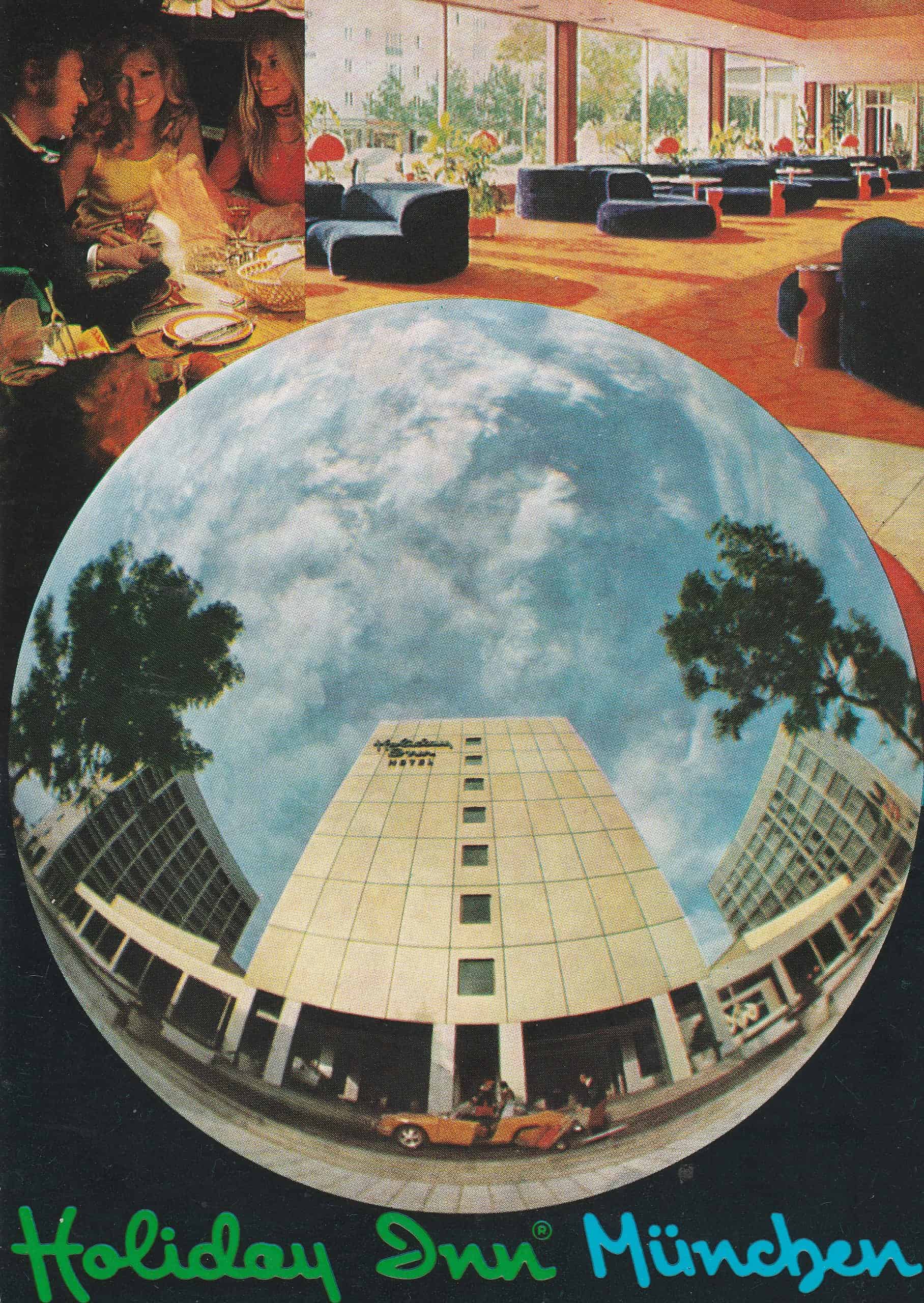
The Holiday Inn in Munich, Germany in the 1970s had 600 rooms with banquet and convention facilities for up to 600 attendees.
It had Europe’s first deep-sea nightclub, “Yellow Submarine” complete with live sharks.
The first Holiday Inn on Summer Avenue in Memphis was sold in 1973 and removed from the chain. It was demolished in 1994. A historical marker stands at the location today. Without Kemmons Wilson and Holiday Inn’s defining influence, the lodging industry would be far different today. Most of the Holiday Inns from Wilson’s era are gone. Occasionally you will spot a former Holiday Inn as you drive the highways of America. Looking forlorn and usually operating as a budget motel, the pool is filled in and the restaurant closed. Nothing remains of its former glory days when it served as a stop on the great American road trip.
Several chains used promotional photography services from the same individual. The identical dry haired female model is constantly seen emerging from the swimming pool. It is assumed it was the mans wife.
Great story and interesting item to collect.
I have many Holiday Inn postcards in my collection. Thank you for this interesting article.
I was a desk clerk at the Exit 8 Holiday Inn in Portland, Maine throughout my high school years, as well as a few college summers, roughly 1975-1980. I have 170 Holiday Inn postcards in my collection. My favorite is attached, since it’s the one that I worked at — the guy with the mustache was my first supervisor there! After 50 years I still remember our Holidex number (it was 056A). People tend to overuse the word “iconic,” but I would say that the Holiday Inn “great sign” is truly one of the most iconic items of 20th century… Read more »
Hi there! I’m researching an old Holiday Inn, the first in Minnesota. During your years as desk clerk, were you also in charge of the switchboard, or was there a separate worker for that?
I am surprised that this article did not mention the Holidome conversions in the 70’s and 80’s. A lot of the old L shaped Holiday Inns got covered. This was popular in northern regions in the winter with families on weekends.
I do not have a postcard of a Holidome in my collection. During my research, I came across the conversion of Holiday Inns to Holidomes. In my first draft of the article I had a section on Holidomes. It was almost 200 words long and I needed to prune the article to meet the editor’s suggested guidelines. Holidomes were an interesting lodging concept but were expensive to build and maintain. The pool would trap moisture throughout the Holidome area creating mold and decay issues. Another problem was the chlorine smell of the pool seeping throughout the hotel because the pool… Read more »
I enjoy learning about motels, and they are also my favorite subject to collect in postcards. Thanks for this interesting article.
The Motel In America, 340 page softcover, was published in 1996. It is constantly reviewed when I’m filing new arrivals. You may want to check it out.
Interesting article. Had a few of the Holiday Inns near where I grew up. Was always impressed by the huge sign. I stayed in a few during my earlier travel days. I can remember them being comfortable and clean. The pool area was a great place to chill while on extended stays.
Thanks for sharing.