When the Canadian Pacific Steamship Line’s Empress of Japan arrived in Yokohama, Japan on November 2, 1934, Babe Ruth, his wife Claire and his daughter Julia were greeted with wild enthusiasm. Local newspapers estimated that more than 5,000 people were at the dock and in a parade that met him in Tokyo. Even more watched the parade in Tokyo.
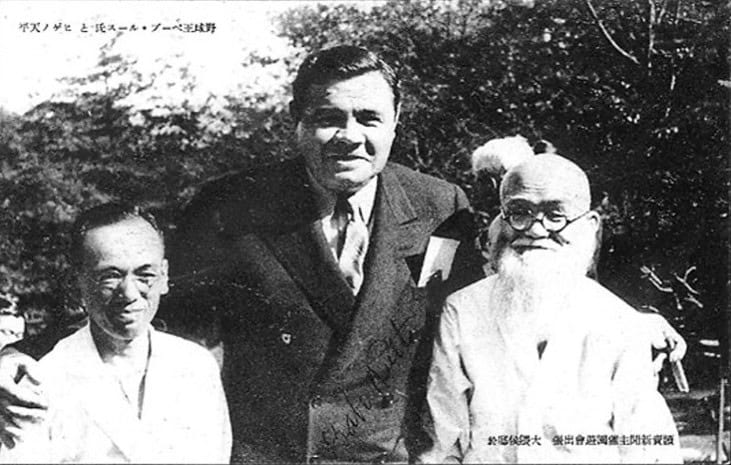
It was a hero’s welcome for the man and his American League All-Star team who were there for one reason: they came to play baseball against a Japanese all-star team.
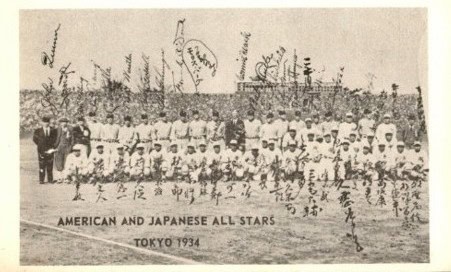
but in their day, they were standout players.
Ruth’s All-Stars included three Yankees (Ruth, Lou Gehrig, and Lefty Gomez), six Philadelphia Athletics (Jimmie Foxx, Eric McNair, Bing Miller, Frankie Hayes, Joe Cascarella, and Rabbit Warstler), two Cleveland Indians (Earl Averill and Clint Brown), two Washington Senators (Moe Berg and Earl Whitehill), and one Detroit Tiger (Charlie Gehringer). The fifteenth member was the manager, the Athletics’ Connie Mack, who recruited the team.
Mack had only American League players to choose from because the National League refused to allow its players to be part of the tour. However, there was one exception to the boycott. It was Lefty O’Doul, a New York Giant, who the Japanese organizer wanted because O’Doul had visited Japan several times on small-time baseball tours. He was there as an organizer and goodwill ambassador, not as a player.
It was not as though baseball was new to Japan. Horace Wilson, an American educator, was hired in 1872 during the Meiji Restoration as part of its drive to westernize Japan. Wilson taught his students English and introduced western-style physical education, which included the fundamentals of baseball. When he returned to the U.S. in 1877, other instructors continued teaching the sport. Wilson was posthumously inducted into the Japanese Baseball Hall of Fame by a special committee in 2003.

The tour was organized and financed by Japanese newspaper owner Matsutarō Shōriki, who sponsored a 1931 American baseball tour, but that team didn’t have the star power of Ruth’s team.
The All-Stars played 18 games in 13 cities: Tokyo, Yokohama, Nagoya, Osaka, Kobe, Sendai, Hakodate, Toyama, Shizuoka, Kokura, Kyoto, Omiya, Utsunomiya.
That Ruth’s team won every game was not the point as far as Shōriki and O’Doul were concerned. Of course there were admission fees, but the real purpose of the tour was to raise the Japanese public’s interest in the sport, not to make money.
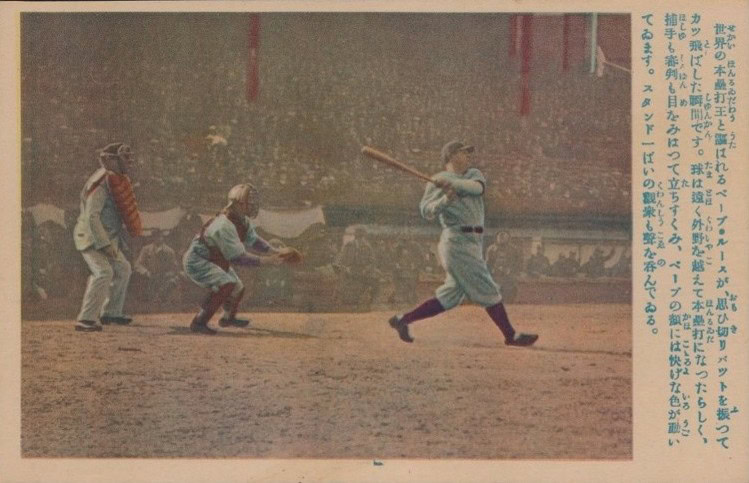
The games were played from November 20 to December 1, 1934. When those games were over, the team moved on to Shanghai and then Manila, playing in Shanghai on December 5 and several games in Manila on December 9 and 10.
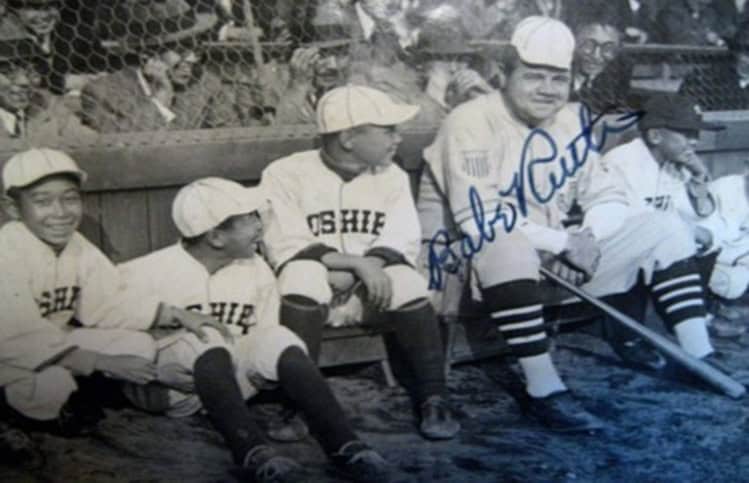
Ruth was paid $11,000 for the Japanese tour and almost $3,000 more for the additional games during the follow-up barnstorming appearances.
The 1934 Yankee season had been good but not good enough to get them into the World Series. They won 94 games, but the Detroit Tigers won 101 games and were in the World Series (which they lost 4-3 to the St. Louis Cardinals).
By this time, Ruth was at the end of his Yankee career. In 1930 he hit 49 homers but by 1934 he hit only 22. His health was declining and he was at loggerheads with Jacob Ruppert, the Yankees’ owner, over his ambition to become the team manager. Ruth’s carousing history was not what Ruppert wanted in a manager and besides, he was happy with Joe McCarthy, the current manager.
When Ruth returned from Japan, he was 39, overweight and unsure of his future in the sport. The team released him unceremoniously on February 26, 1935. He attempted one last season, this time with the National League Boston Braves, owned by Judge Emil Fuchs.
Fuchs signed Ruth to a multi-role contract as a player, an assistant manager, and a vice president of the team.
Fuchs’s interest in having Ruth on his team was simple: he wanted the still-famous Ruth as a marketing attraction to sell tickets to the Braves games. While the team was improving (they were 61-93 in 1932, then 83-71 in 1933 and 78-73 in 1934), business circumstances had not been kind; it was, after all, the midst of the Great Depression.
Ruth’s interest in the National League team was his drive to become a manager. He was angry at Jacob Ruppert and accepted Fuchs’s offer of an on-field and off-field position as a chance to continue in the game he loved, and a game that loved him back.
Alas, it was not to be. The $25,000 that his on-field position paid wasn’t the $80,000 that he’d earned in his last year with the Yankees (which was still the highest pay of any baseball player that year). The job as vice president came with a promise of a percentage of the team’s profits, but there were no profits. And Fuchs’s hint to Ruth about becoming the 1936 manager was as much a ruse as everything else.
Ruth retired from the Braves on June 2,1935. He didn’t go quietly, though. At Pittsburgh’s Forbes Field on May 25, 1935, he hit three homers, the last of which cleared the right-field roof. Fuchs had persuaded Ruth to stay until he played in every National League ballpark.
Before Babe Ruth, the home run was of little interest to fans or players. Ruth turned the game from the “small ball” era of singles, bunts, and stolen bases into the central point of the sport.
Before becoming a home-run outfielder, Ruth was one of baseball’s best left-handed pitchers, winning 89 games for the Boston Red Sox before he was traded to the Yankees. Ruth set a World Series consecutive scoreless‑innings record for the Red Sox in the 1916 and 1918 World Series and ultimately extended it to 29⅔ consecutive scoreless innings.
That record stood until Whitey Ford of the Yankees broke it on October 8, 1961, during Game 4 of the 1961 World Series. Ford ultimately extended that streak to 33⅔ scoreless innings.
Ruth had come to the Yankees not by trade but as an all-cash deal for $100,000 that was announced on January 5, 1920. “The Curse of the Bambino” was born.
Within two years the Yankees built their own stadium in the Bronx. Before then they had played in Hilltop Park and the Polo Grounds, both in Manhattan.
After Boston sold Ruth to the Yankees in 1920, Ruth led the team to seven pennants and four World Series titles, turning the franchise into a powerhouse and creating the mythology of “The House That Ruth Built.” Construction of Yankee Stadium began on May 5, 1922, and the stadium officially opened less than a year later, on April 18, 1923.
In all respects, Ruth’s charisma made him a national icon. On the radio and in the movies, he was a figure of positive energy and optimism at a time when these qualities were largely missing.
Great article. Although a lifetime baseball fan, this was all new to me. Thanks for sharing.
Great article. Really packed a broad range of interesting history and lore I would have never been aware of. Thanks for taking time to write this.