We’re back on another postcard tour visiting the homes of stars in the golden age of Hollywood.
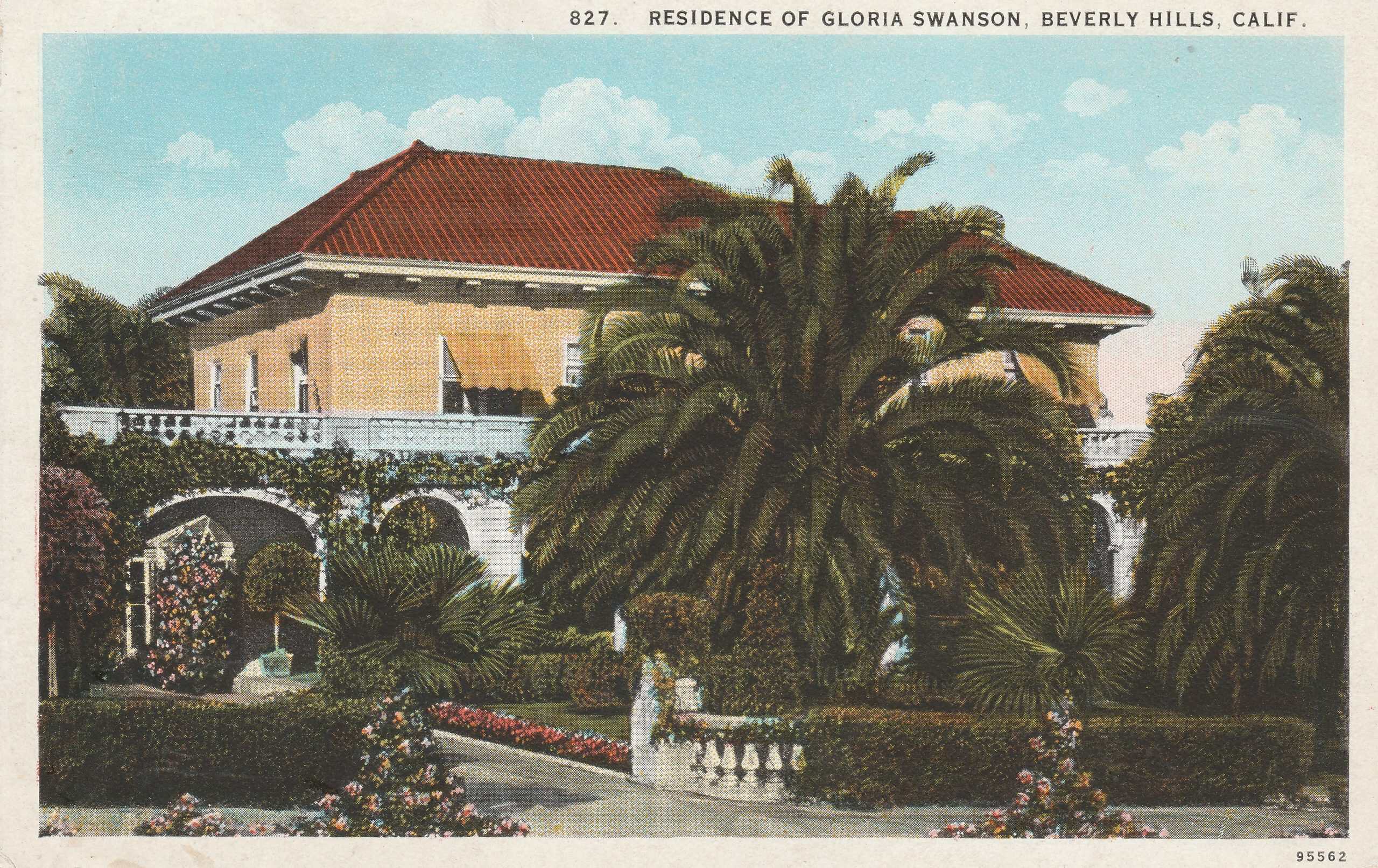
The Beverly Hills home of actress Gloria Swanson was located at 904 North Crescent Drive. She purchased the 22-room home with five bathrooms in 1922 from its original owner, King C. Gillette, the inventor of the double-edge safety razorblade. The house, built in an adapted Italian Renaissance style, had cream color stucco walls and a red tile roof. The two-story house when completed in the early 20th century was one of the largest residences in Beverly Hills. Miss Swanson’s former home was razed and replaced with another structure in the 1950s.
Gloria Swanson (1899–1983) began her silent film career as a teenager. By the early 1920s, Swanson was one of the top female stars in Hollywood. In 1928, she produced and starred in Sadie Thompson earning her an Oscar nomination for Best Actress in the first Academy Awards. Her first talkie, The Trespasser, earned her a second Academy Award nomination in 1929.
Swanson’s final silent movie, Queen Kelly, was directed by Erich Von Stroheim. It was only released in Europe and South America due to a contractual dispute and issues with U. S. censors but today is considered a silent film classic. By the mid-1930s, Swanson’s film career had waned.
In 1950, Swanson made a triumphant comeback in Billy Wilders’s Sunset Boulevard, a black comedy about the glamour and tragedy of Hollywood. Swanson and her co-star William Holden were nominated for Academy Awards for Best Actress and Best Actor, respectively. Although Sunset Boulevard failed to win the Academy Award for Best Picture, it is hailed as one of the greatest films ever made.
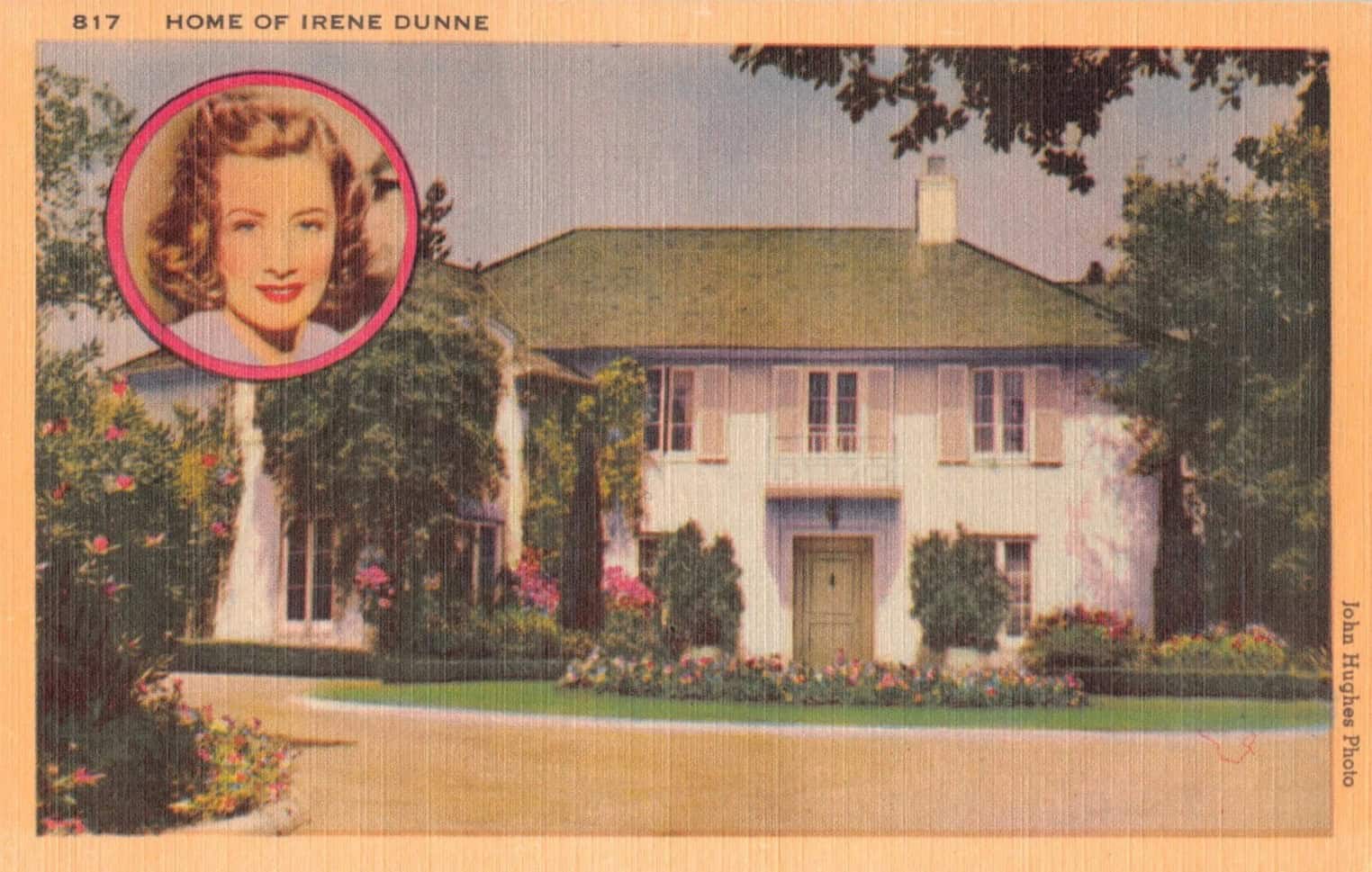
Irene Dunne (1898 – 1990), a leading lady of Hollywood’s Golden Age, starred in forty-two movies and was nominated five times for the Academy Award for Best Actress. Adept at both comedy and drama, her Oscar nominated roles were in Cimmaron (1931), Theodora Goes Wild (1936), The Awful Truth (1937), Love Affair (1939), and I Remember Mama (1948). Dunne starred with Cary Grant in The Awful Truth, My Favorite Wife, and Penny Serenade. She was teamed with Charles Boyer, her favorite co-star, in Love Affair, When Tomorrow Comes, and Together Again. During World War II, Dunne starred in the tearjerker, The White Cliffs of Dover, about a woman who loses her husband in World War I and her only son in World War II. In the late 1940s Dunne starred in Anna and the King of Siam with Rex Harrison and Life With Father with William Powell.
In 1930, Dunne and her dentist husband purchased a two-acre property in Holmby Hills for $10,000. With the aid of an architect, they designed and constructed a white brick English manor house. Construction cost $40,000. On the first floor was a small reception hall that lead to a drawing room, dining room, den, breakfast room, kitchen, and library. Upstairs were four bedroom suites, one for her, one for her husband, one for her daughter, and a guest suite. In a 1937 article, Dunne described the furnishings as an eclectic blend of styles. The house was considered modest by Hollywood standards since it lacked a pool and tennis court.
Dunne summed up her life to a friend, “I’ve had one husband, one daughter, one house, and no lovers.”
Loretta Young (1913–2000) had a storied career as a Hollywood actress. She started acting at age three in silent movies in unaccredited roles, and by the late 1920s Young, still a teenager, received billing in a couple of silent films before achieving stardom in the early 1930s.
Young was paired with all the Hollywood leading men of the 1930s, often portraying strong-willed heroines with solid priorities. She starred in 1934 with Cary Grant in the drama Born to be Bad. In 1935, she starred in Call of the Wild with Clark Gable and the Cecil B. DeMille epic, The Crusades. Tyrone Power and Young starred in Second Honeymoon (1937), Café Metropole (1937), and Suez (1938). Don Ameche starred with Young in Love is News (1937), Love Under Fire (1937), and The Story of Alexander Graham Bell (1939).
Young’s movie career hits it peak in the 1940s. She was paired in 1947 with both David Niven and Cary Grant in the Christmas comedy, The Bishop’s Wife. Also in 1947, Young won the Academy Award for Best Actress for starring in The Farmer’s Daughter playing opposite Joseph Cotten. She received a nomination for the Academy Award for Best Actress for her role in the 1949 comedy drama, Come to the Stable.
From 1953 to 1961, Young starred in the television anthology series, The Loretta Young Show, broadcast on NBC. Young’s iconic entrance at the beginning of each episode, twirling in glamorous gowns, became a signature moment of 1950s television. She was nominated for seven Emmy awards as Best Actress in a Dramatic Series and won three times.
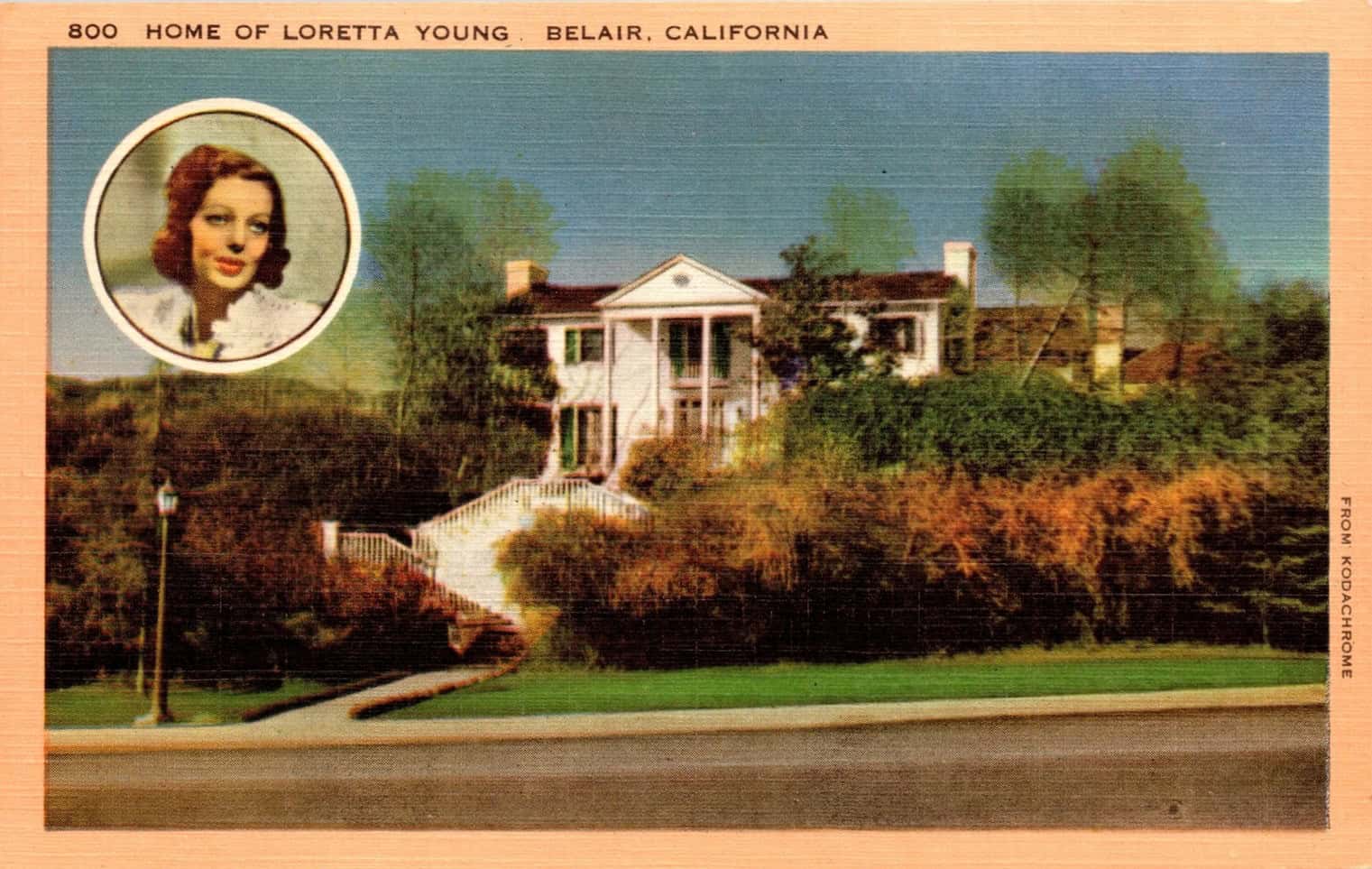
A postcard mailed in 1947 shows Loretta Young’s house in Bel Air. The house’s interior was decorated by Young’s mother Gladys Belzer, who was an interior designer responsible for a number of movie star homes. Young owned the house from the 1930s until 1952 when she and her husband Tom Lewis purchased a 6,000 square foot house on North Flores Street in Los Angeles. Maps of movie star homes today direct tourists to the North Flores Street house.
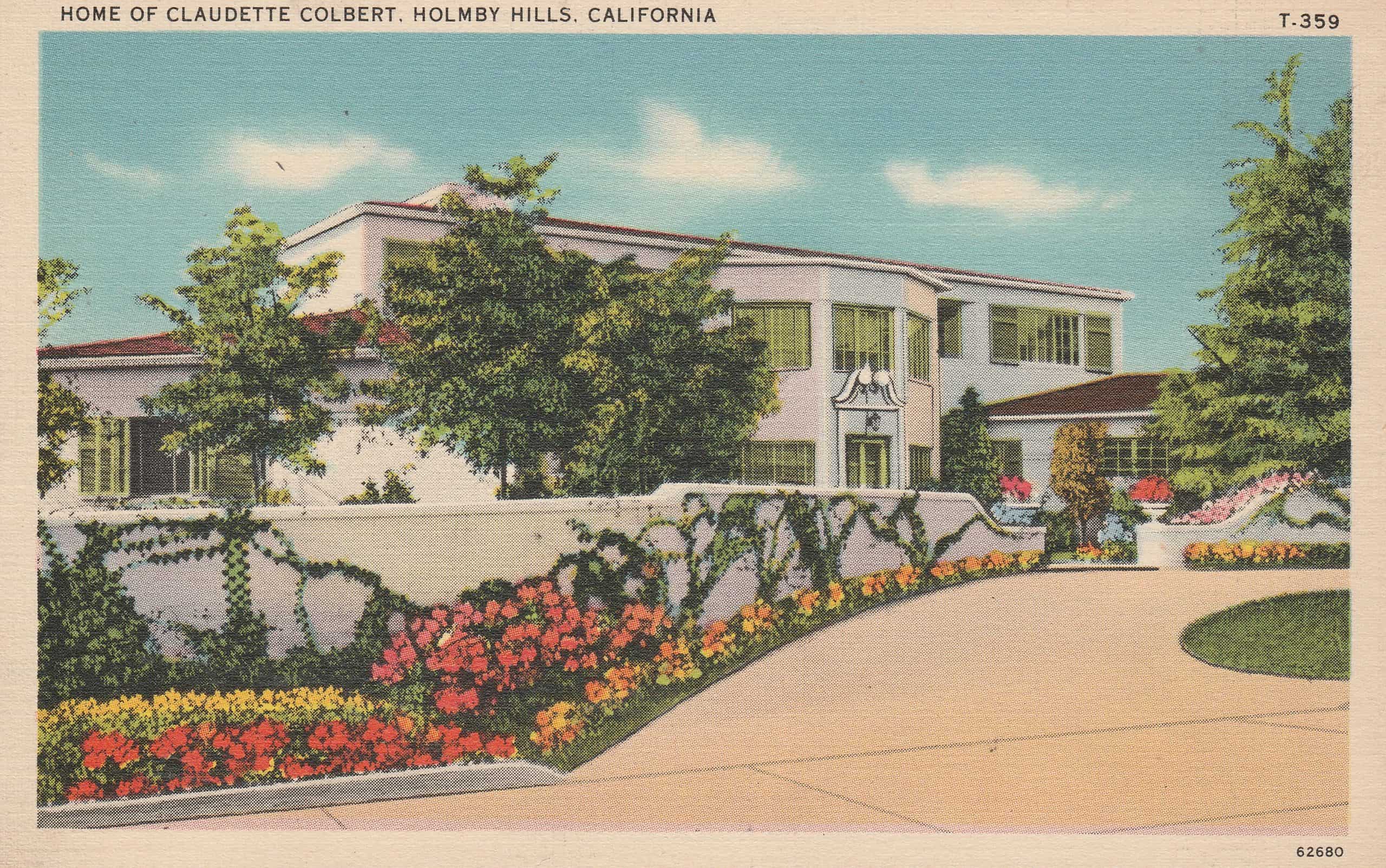
With her round apple-face, big eyes and charm, French-born Hollywood star Claudette Colbert (1903-1996) was the epitome of chic sophistication. In 1934, Colbert won the Academy Award for Best Actress, for her performance as female lead in the comedy It Happened One Night. Her costar Clark Gable won the Academy Award for Best Actor and the film won the Best Picture Oscar. It was the first time a film won the top three awards. That trifecta was not repeated until the 1970s. Many film critics consider It Happened One Night the greatest romantic comedy ever made. Colbert’s acting career skyrocketed overnight — she was making $500,000 year during the Great Depression, and for a time she was the highest-paid person in the movie industry.
Colbert starred in sixty movies during her career. Her frequent co-stars were Fred MacMurray in seven films between 1935 to 1949 and Frederic March in four films in the early 1930s. Her comedies Midnight (1939) and The Palm Beach Story (1942) rank among Hollywood’s greatest. In 1944, Colbert was nominated for an Academy Award for Best Actress for her role in the World War II home-front drama, Since You Went Away.
In the mid-1930s, Colbert commissioned Frank Lloyd Wright’s son Lloyd to design a striking Colonial-style mansion on a hilltop estate. Located on four-acres at 615 N. Faring Road in Holmby Hills, construction cost $200,000. While the property included tennis courts, it was missing the de rigueur Hollywood swimming pool. It was decorated in an eclectic mélange of periods and modes – English, Chinese, and high Hollywood Moderne. She moved in with her husband Dr. Joel Pressman, who was later head of the UCLA Neck & Hand Surgery Department.
The couple lived there until the early 1960s when they retired to a waterfront estate in Barbados. In 1963, Colbert sold her N. Faring Road property. A real estate developer razed Colbert’s home and subdivided the land into smaller lots.
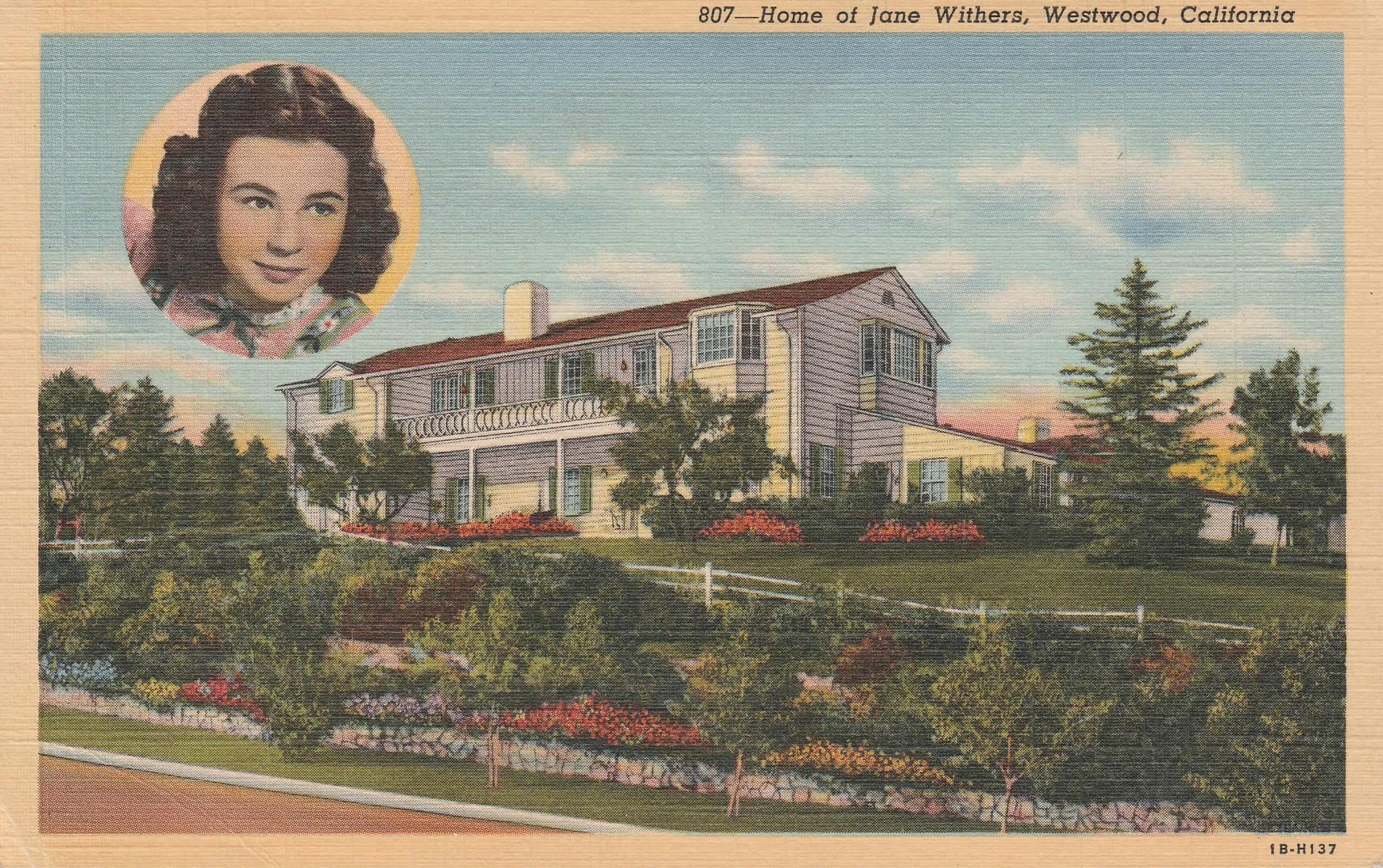
Baby Boomers will remember Jane Withers (1926–2021) for her portrayal of Josephine the Plumber in a series of one-minute television commercials for Comet cleanser that ran from 1963 through 1974. She only stopped doing the commercials to care for her mother who suffered from a brain tumor.
Withers began her career in Hollywood as a child working as an extra in the early 1930s. In 1934, she achieved stardom playing an obnoxious, spoiled brat opposite Shirley Temple who portrayed a sweet orphan in Bright Eyes. During the 1930s Withers made three to five films a year, starring in 38 films before she retired in 1947.
The postcard shows the traditional-style home in lower Bel-Air where Withers once lived. Built by a developer as a model home, the property was bought for the Depression-era child actor in 1936 by her parents, according to Los Angeles Times archives. The sale, which included furnishings and two adjoining lots, totaled $37,000. The 6,800-square-foot house has a living room with a fireplace, a sunroom, and an office-den. There were two master suites for a total of five bedrooms and 7.5 bathrooms. Withers lived in the home until her marriage in 1946 when she moved to Texas.
After divorcing her first husband, Withers returned to Hollywood in 1955 and purchased the Desilu ranch of Lucille Ball and Desi Arnaz in Chatsworth who had moved to Beverly Hills. Financially comfortable, Withers worked intermittently in films and television in order to raise her five children.
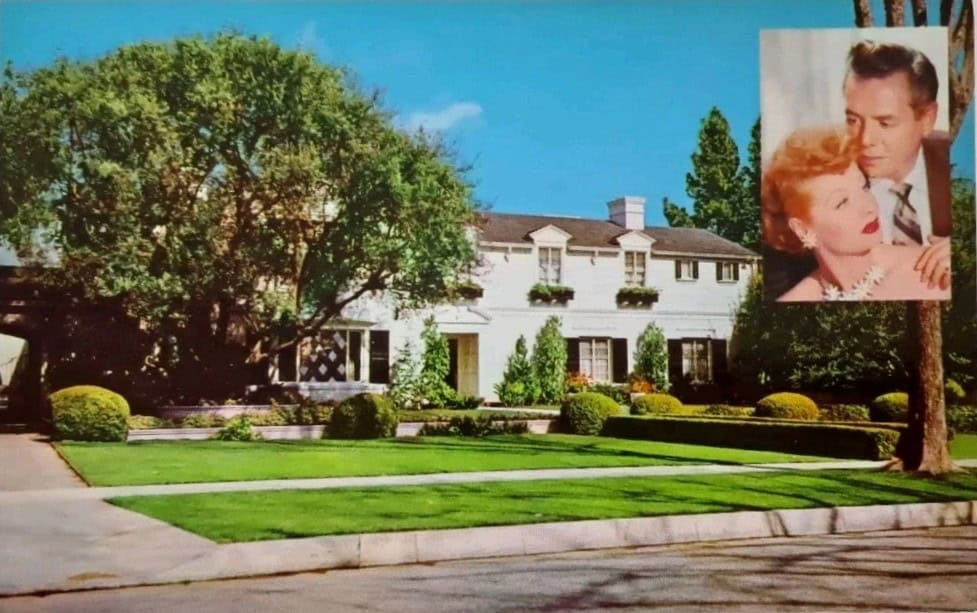
Chrome postcards depicting Hollywood homes are less common than linen and white-border postcards. The one above was mailed in 1960 and features the home of Lucille Ball and her husband, Desi Arnaz.
After their marriage in 1940 they bought a ranch in Chatsworth in the San Fernando Valley outside Los Angeles. Ball and Arnaz named the five-acre ranch “Desilu,” a portmanteau of their names that would later also serve as the name of their studio.
Due to the demands of filming, I Love Lucy, the couple made the difficult decision to sell their beloved ranch and move closer to the studio in Hollywood. In December 1954, they purchased a stately colonial-style house at 1000 North Roxbury Drive in Beverly Hills for $85,000. North Roxbury Drive was the most star studded streets in Hollywood. Jack Benny lived next door and Jimmy Stewart lived down the street. Built in 1936, this two-story structure spanned 7,499 square feet, boasting six bedrooms and eight bathrooms on nearly an acre. Its white stucco exterior, common for the period, projected an air of sophisticated grandeur, without being overtly ostentatious. It was a comfortable family home.
Their house was featured in an episode of I Love Lucy aired on May 30, 1955. In the Season 4 episode titled “The Tour,” Lucy and Ethel famously attempt to swipe a grapefruit from what was purported to be actor Richard Widmark’s yard. Widmark was uncomfortable with his home being featured, so the show’s producers, with Ball’s permission, used the exterior of her own residence instead.
After Ball and Arnaz divorced in 1960, Ball resided in the house until her death in 1989. Her second husband, comedian Gary Morton, later sold it. Current residents of the house claim it is haunted by Miss Ball’s indomitable spirit.