The Hamburg America Line (most commonly known as HAPAG) was founded in 1847 in Germany. Up to 1935 the company enjoyed a global presence with offices in Hamburg, Germany and at Charlotte Amalie on the U. S. Virgin Island of Saint Thomas. The also maintained terminals in Cuxhaven, Germany; New Orleans, Louisiana; Oslo, Norway; and Hoboken, New Jersey.
In the late nineteenth century and early twentieth century HAPAG sailed a wide network of routes (mostly “rotations” or “roundtrips” to America, Canada, the Caribbean Islands, Central America, South America, and most of the far-east.
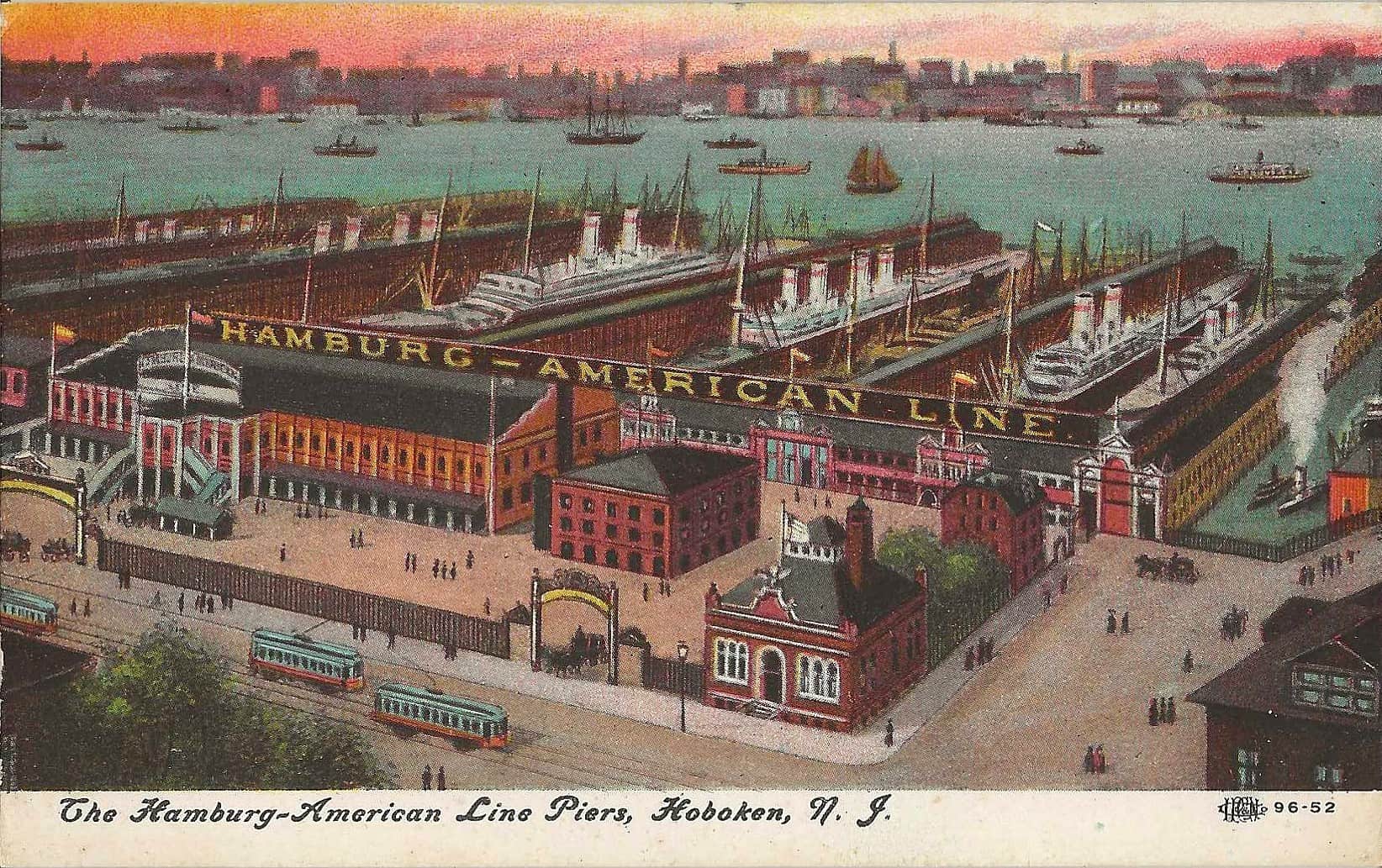
One primary rotation to North America originated in Hamburg, Germany, and sailed to Hoboken, New Jersey. The postcard below shows the Hoboken docking facility that has the capacity to “hold” six to ten ships.
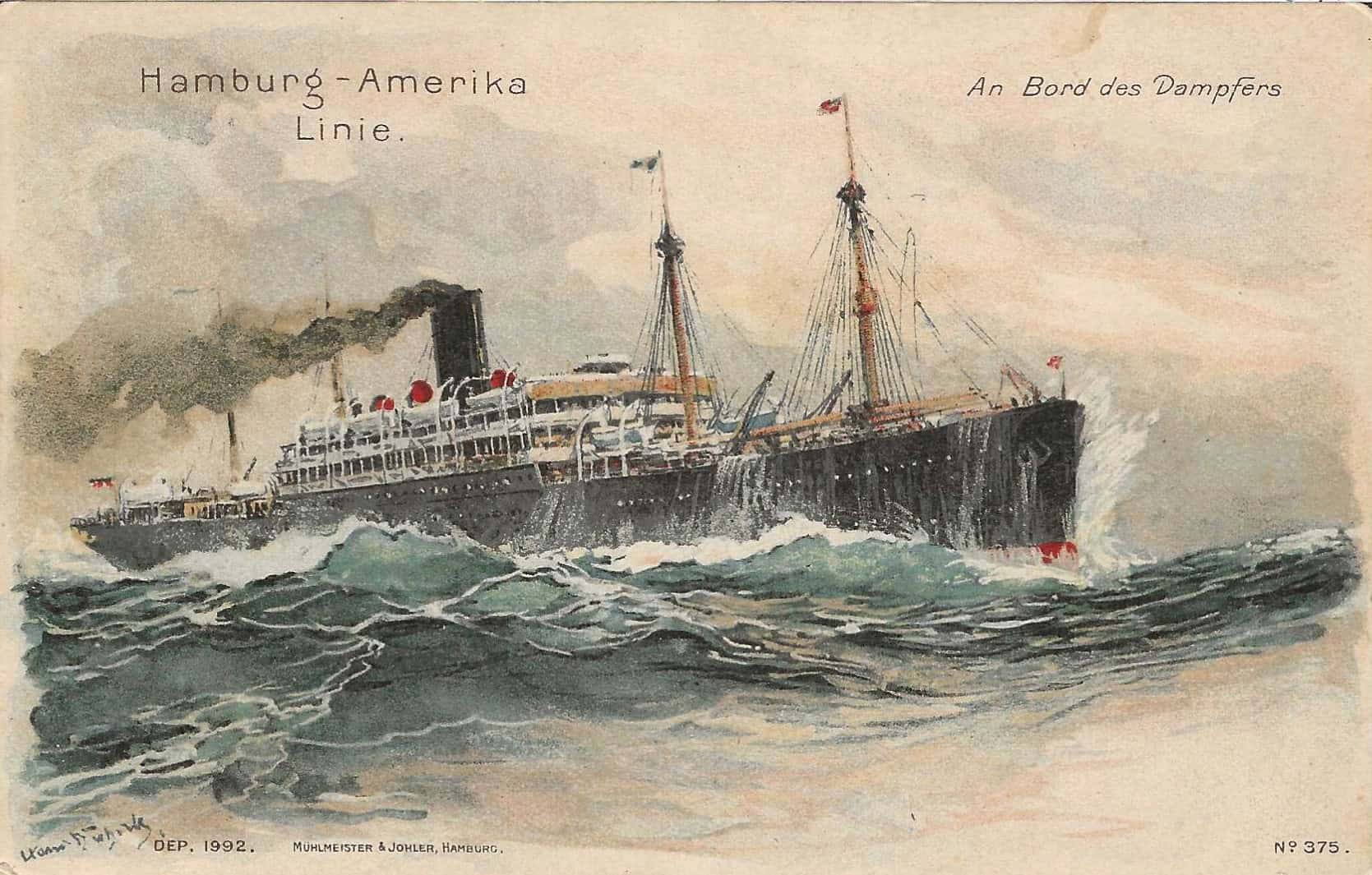
The Hamburg America Line was an awesomely popular shipping and transportation service to destinations around the globe, but most particularly to North America. The company was among the top six of the trans-Atlantic passenger services that made use of postcards as favors for their passengers and in advertising. The best of the cards were artistic renditions of the corporate vessels that sailed the oceans from the 1830s to the 1970s.
This Postcard History lesson is aimed at the devoted collector of HAPAG postcards. It is meant to help collectors organize the cards they have in chronological order. Currently there are no less than six (sets or styles) of postcards that show the company’s vessels in almost equal amounts of vertical and horizontal formats. The following is not meant to be an authority nor is it promised to be error free.
The following cards have been selected as representative of the different eras of postcards created for HAPAG clients and perhaps for use in advertising.
The cards are arranged in order that the ships were put into service and attempts have been made to find thumb nail histories of the ships – mostly for the curious.
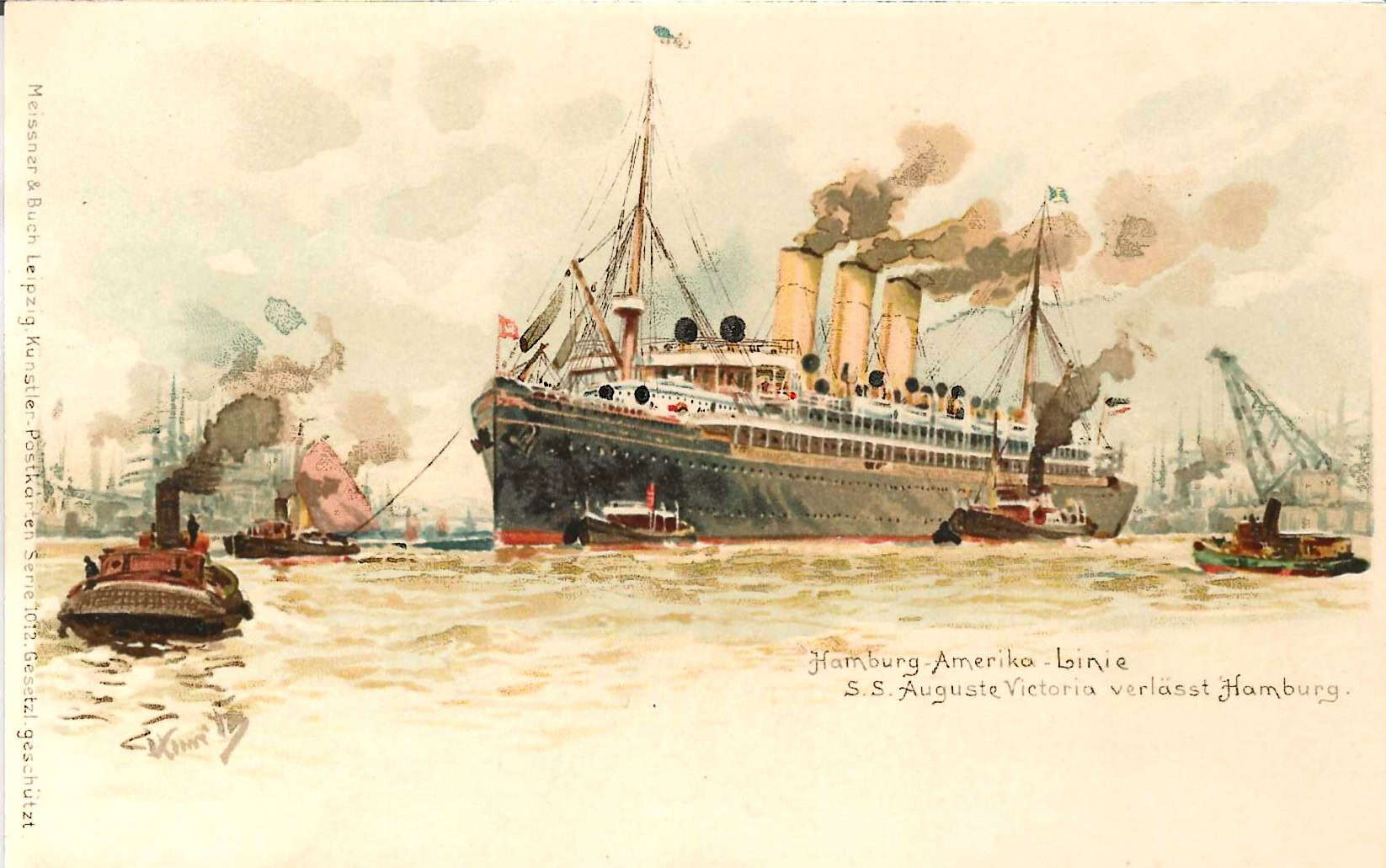
Augusta Victoria wasnamed for the wife of the then German Emperor, Wilhem II. It was the first of a new generation of luxury ocean liners. She was the first liner built in continental Europe with twin propellers and when first placed in service, the fastest liner in the Atlantic trade. After just eight years of service the ship was rebuilt and lengthened. In 1904 she was sold to the Russian Navy and renamed Kuban.
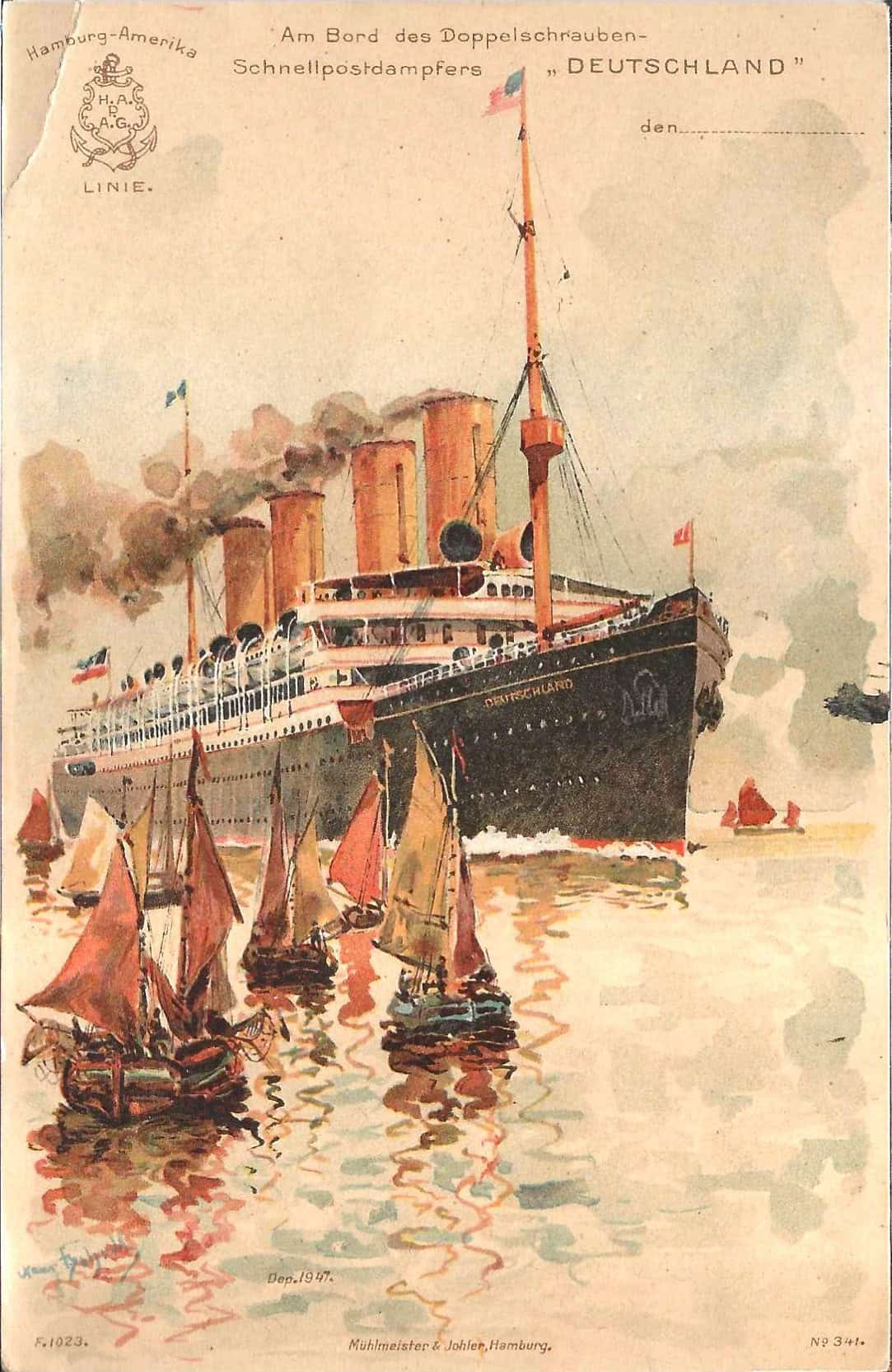
In June 1900, HAPAG took possession of the SS Deutschland. The ship served the company for more than 25 years, but its identity was frequently in question because from 1900 to 1910 she was the Deutschland, then from 1910 to 1920 she was the Viktoria Luise (representing the German Empire); and from 1921 to 1925 she was the Hansa. [In the history of ships named Hansa there are eight: one Bremen (a then autonomous city in Northwest Germany), five German, one British and one Swedish. Deutschland was the sixth.]
She was officially the second ocean liner to have four funnels on the transatlantic route, the first being Kaiser Wilhelm der Grosse of 1897, also a HAPAG ship.
Deutschland won the coveted Blue Riband for the fastest Atlantic crossing on her maiden voyage.
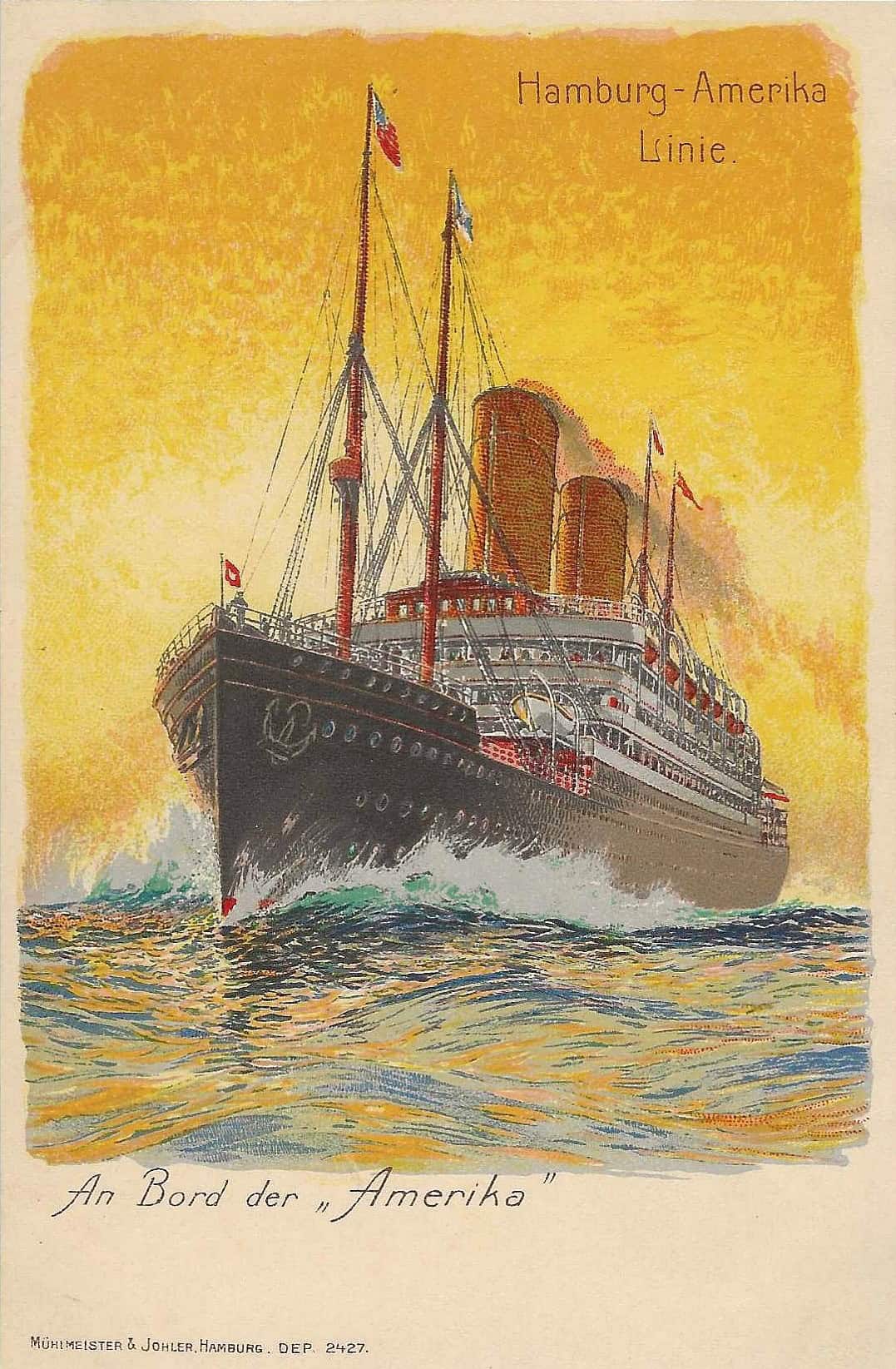
Many HAPAG ships made memorable voyages across the Atlantic. SS Amerika was one of those ships. From its launch in 1905 she served as an ocean liner and during both world wars Amerika was used as a troop transport for the United States. Built by Harland & Wolff in Belfast for HAPAG as a passenger liner she sailed primarily on the Hamburg and New York rotation.
On 14 April 1912, Amerika transmitted messages concerning icebergs near the area where RMS Titanic struck one and sank less than three hours later.
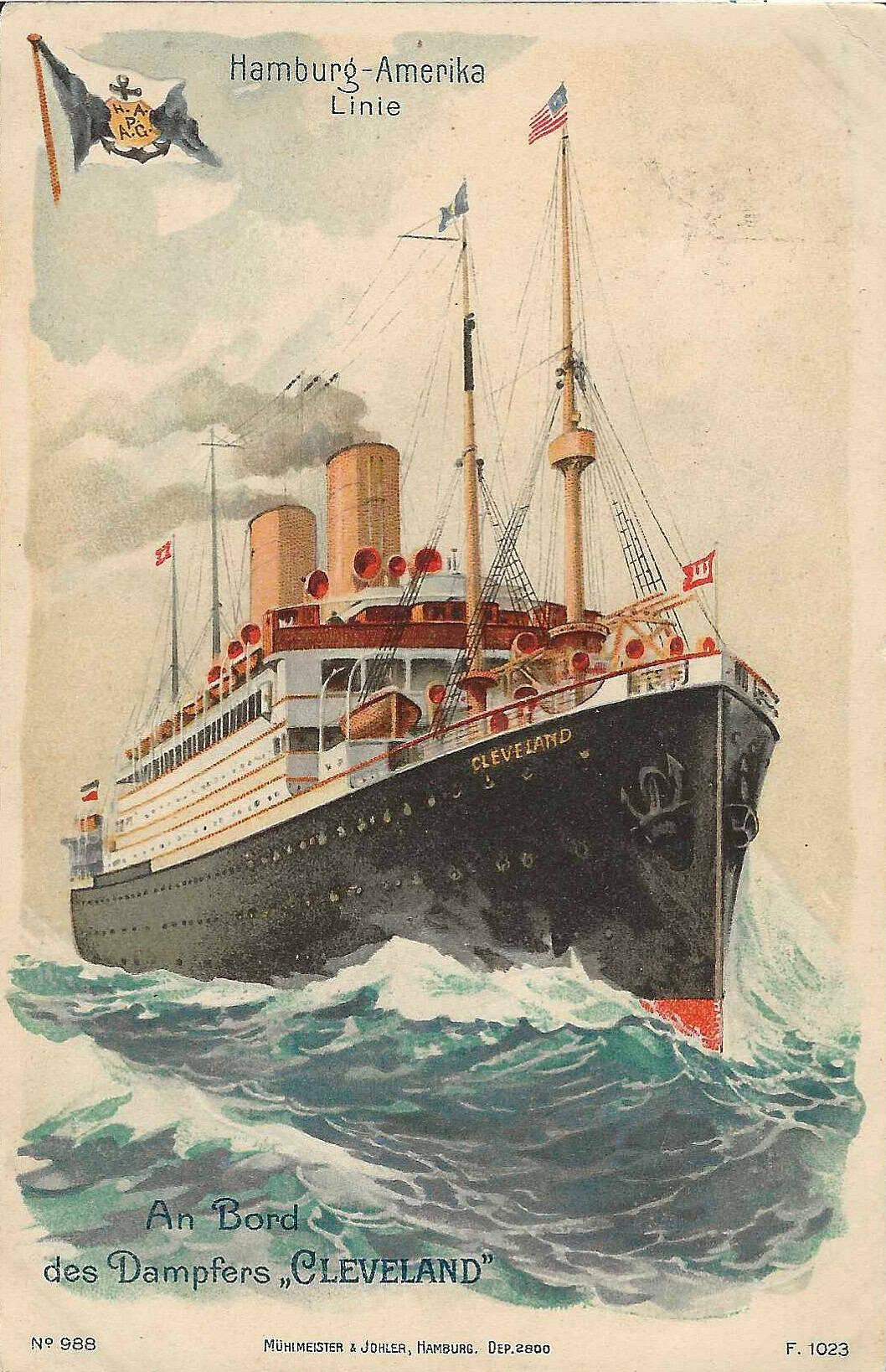
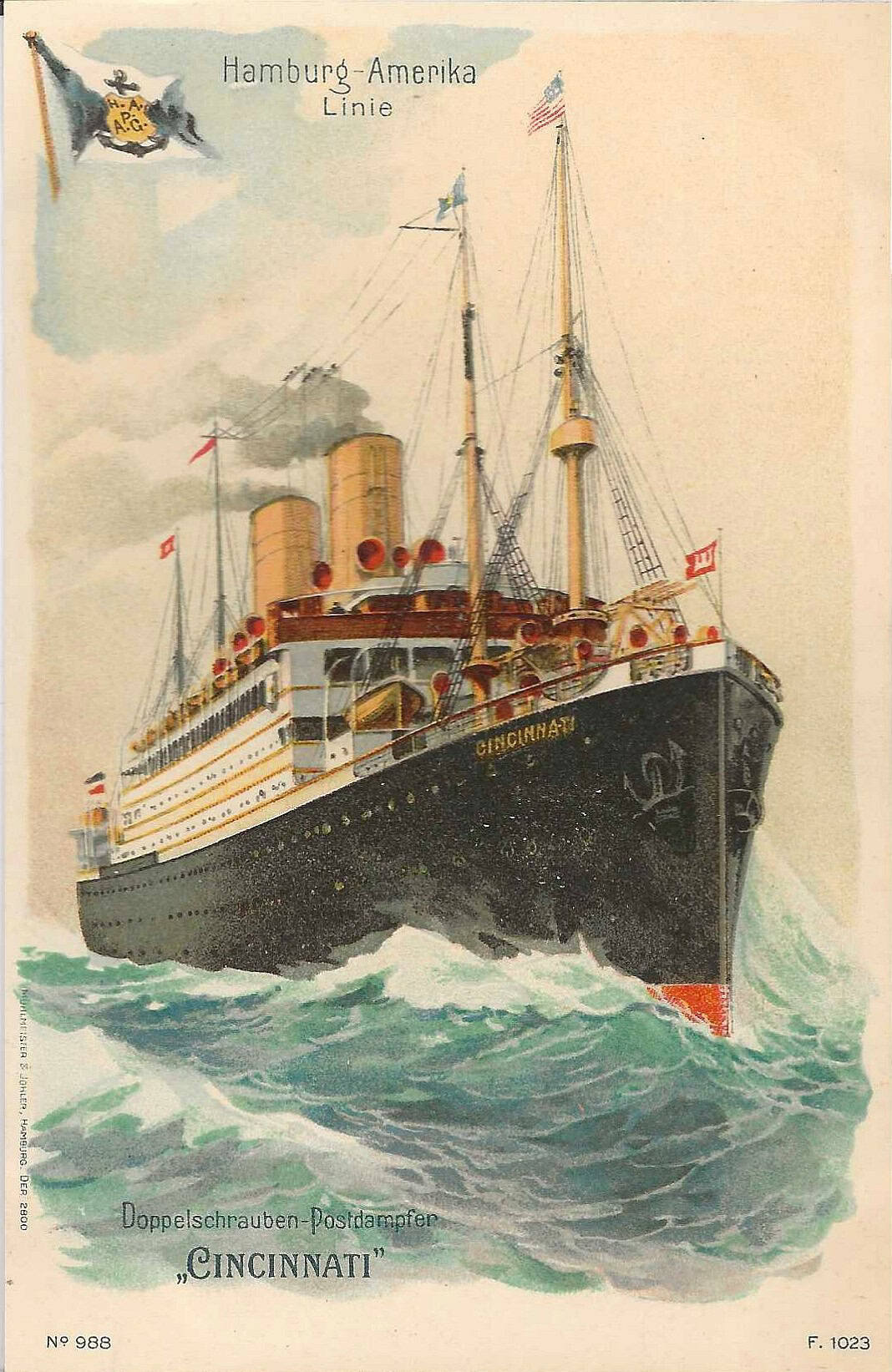
SS Cleveland and her sister ship SS Cincinnati were both launched in 1908 and scrapped in 1933. In 1919 Cleveland became the troop ship USS Mobile, but in 1920 it returned to civilian service under the British flag as the liner King Alexander. The use of the ship by the British was short lived, and in 1923 the ship was bought by an American firm that refurbished it and restored its original name. In the end HAPAG bought Cleveland back in 1926 and she again served the Hamburg – Hoboken rotation. The ship was laid up in 1931 and scrapped in 1933.
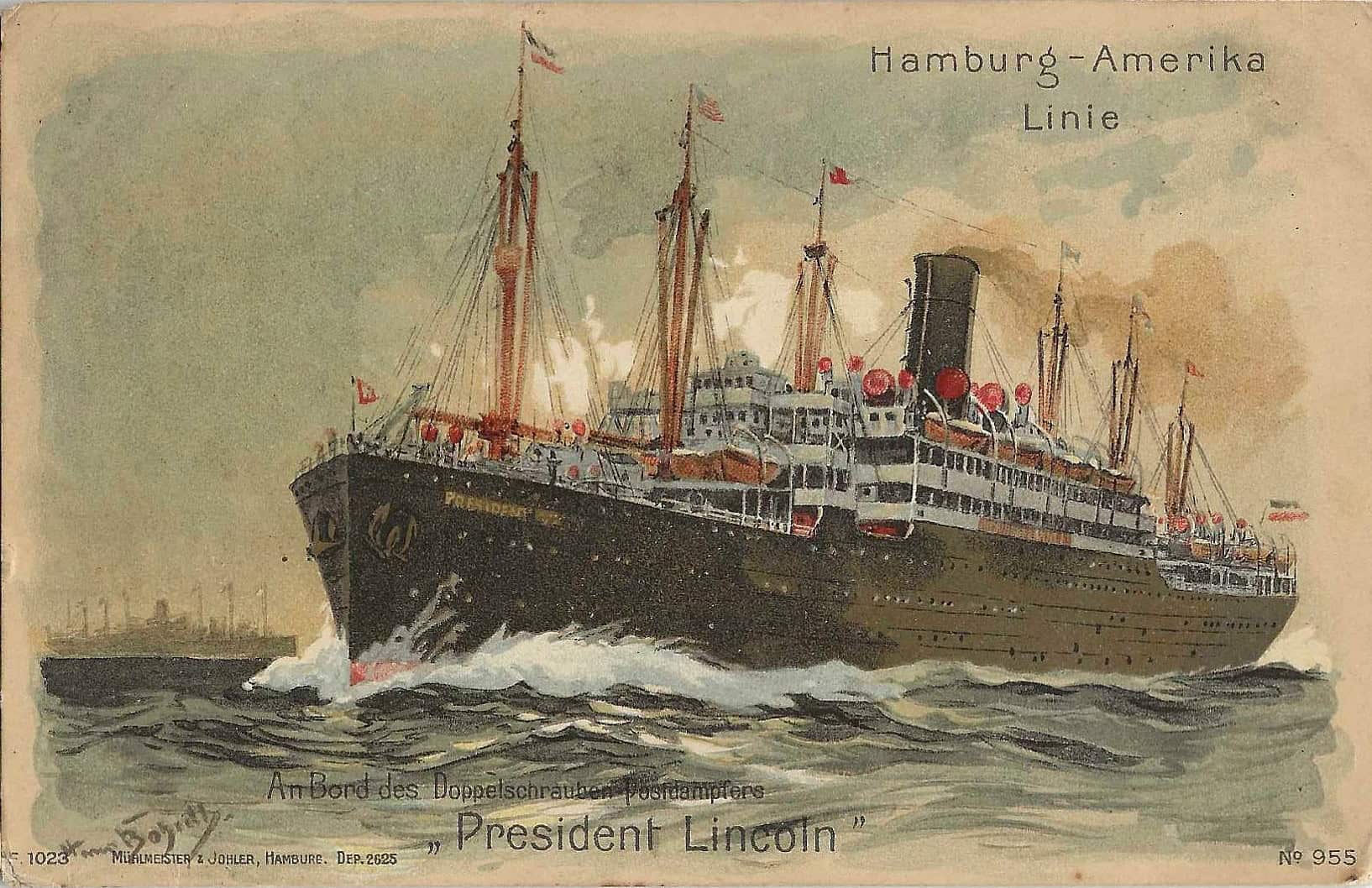
SS President Lincoln was built at Harland & Wolff in 1903. It was seized by the US Navy in May 1917. While in US service the President Lincoln made four successful voyages from New York to France. On May 10, 1918, she sailed again for France and arrived on May 23rd. On her return trip to New York on May 30, she was torpedoed by a German submarine and sank twenty-minutes later. Of the 715 aboard, all were rescued except 26. The ship took over 23,000 American troops to France.
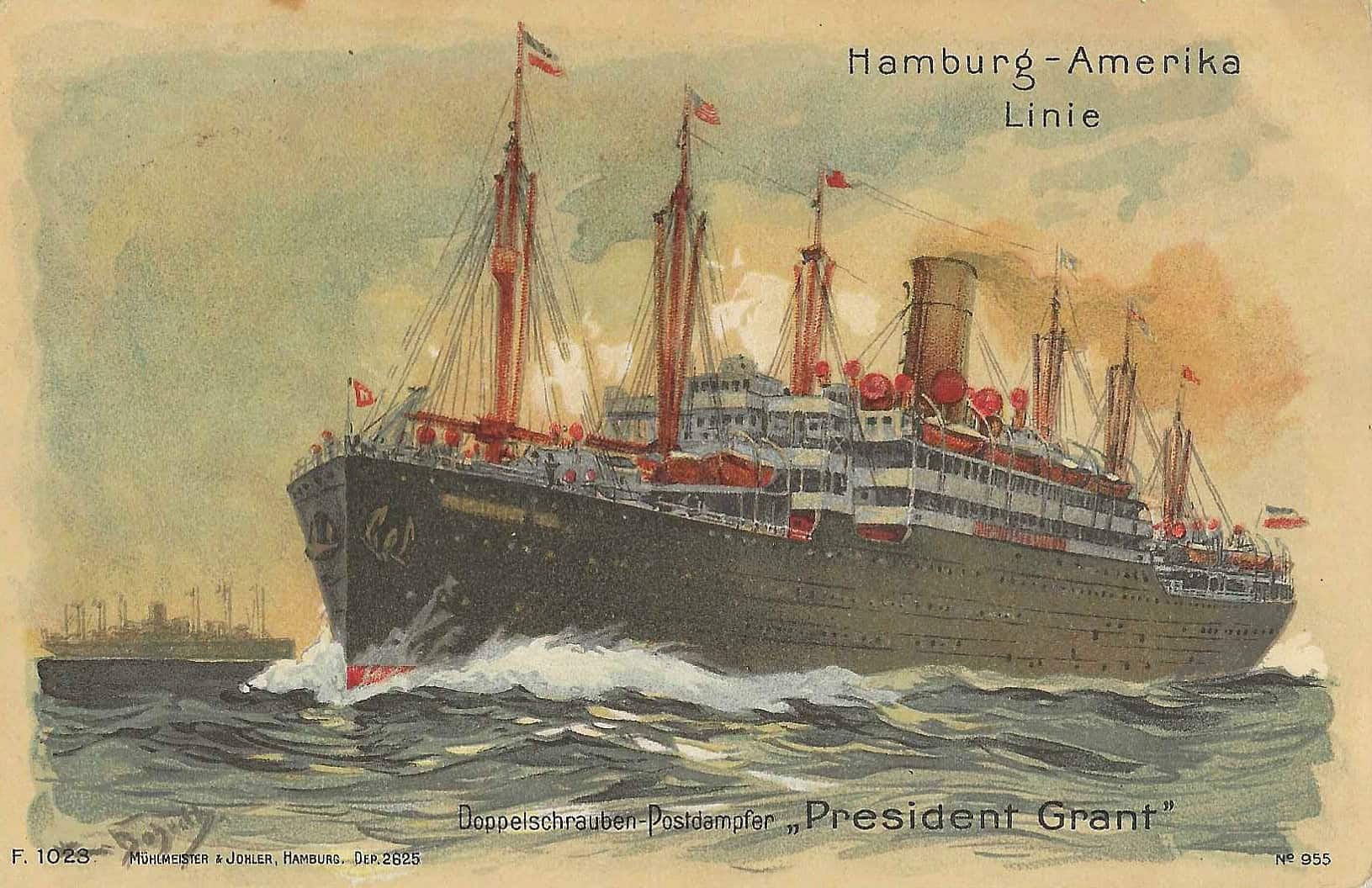
SS President Grant was launched in 1907 with the name Konig Wilhem II. Like the President Lincoln it was seized by the US Navy in April 1917 and renamed USS Madawaska. In 1922 she was renamed USS U. S. Grant. The Grant remained in service until November 1948.
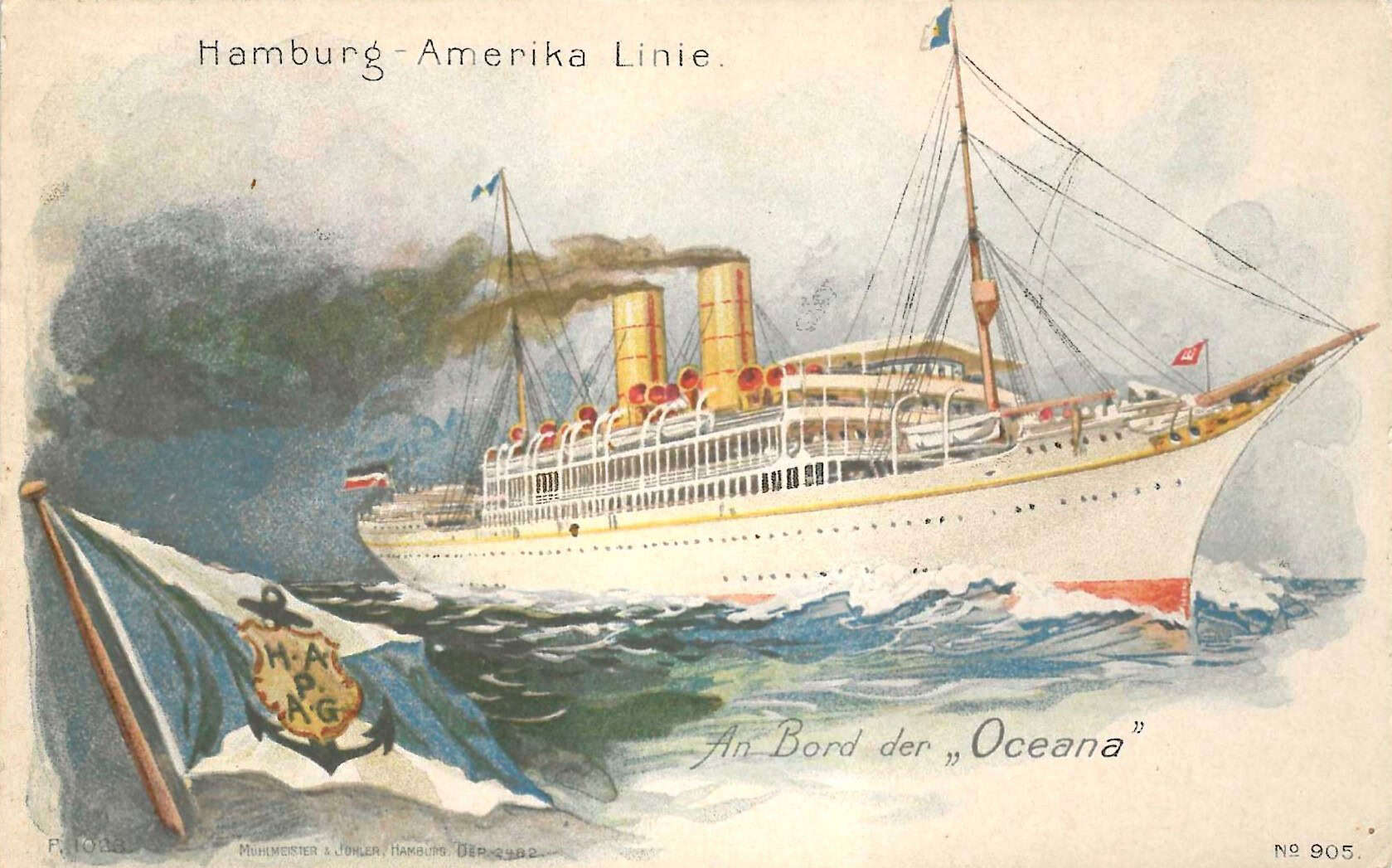
The final three cards below are Hamburg-Amerika Line postcards that may have been manufactured between 1900 and 1906. This assumption is based on their undivided backs.
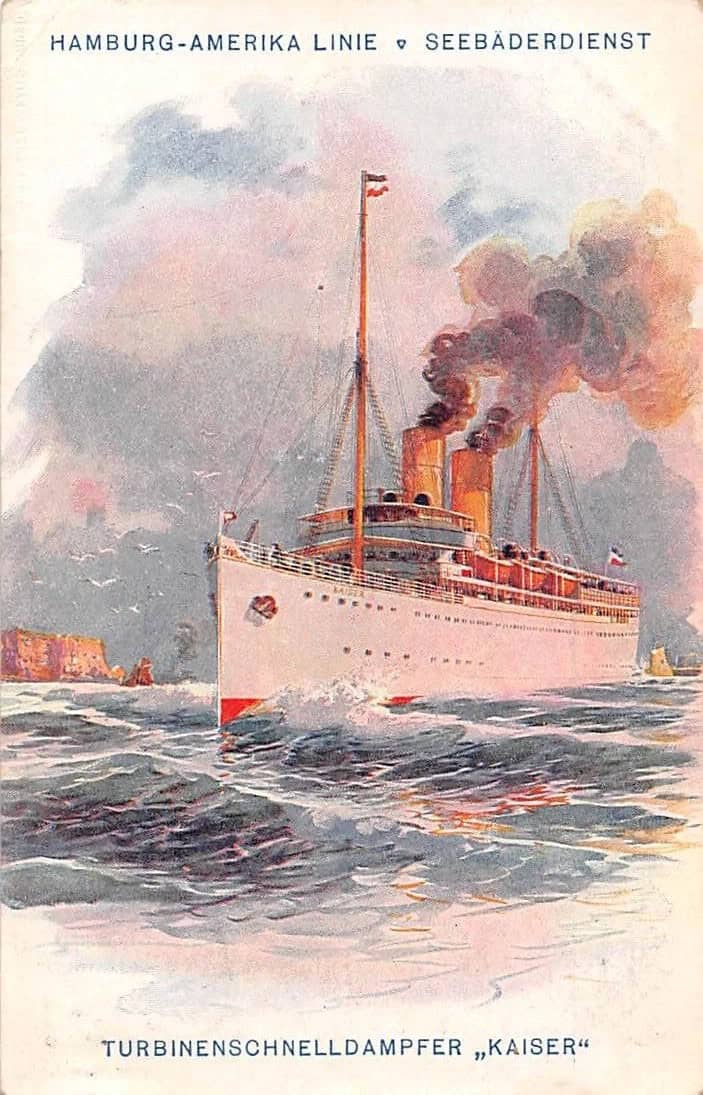
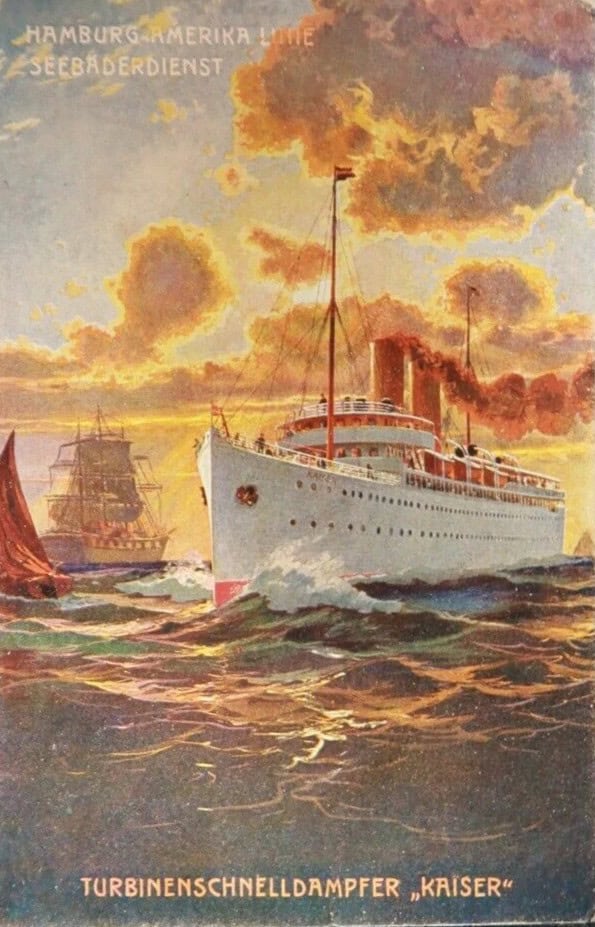
Both show, presumably the same ship. Both are captioned in German as “Turbine Express Steamer “Kaiser”. The German word “seebäderdienst” translates to Seaside Service.
Regrettably, no information about these cards is known.
Thanks for sharing the color-illustrated postcards of the different liners. Beautiful!
I’m looking for an image of the North German Lolyd steamship Herman in service in 1883. The voyage of particular interestto me, departed Bremen, Germany, and landed Dec. 21, 1883, at the port of Baltimore, MD. Hugo Baur was the ship’s captain.
Thanks for sharing the color-illustrated cards for the Hamburg-America Line, especially as my great-great-grandparents left Hamburg for New York on that line’s Herder on April 2, 1879; they settled in Manistee, Michigan, where they already had relatives living. Concerning the last three cards, Oceana may represent a ship that either wasn’t built, or was completed under another name; Hamburg-America was the first to operate cruise ships. Seebaederdienst ships sailed between seaside resort ports and coastal islands like Sylt or Heligoland.
Thank you for these lovely postcards.
Great article and great maritime postcards.