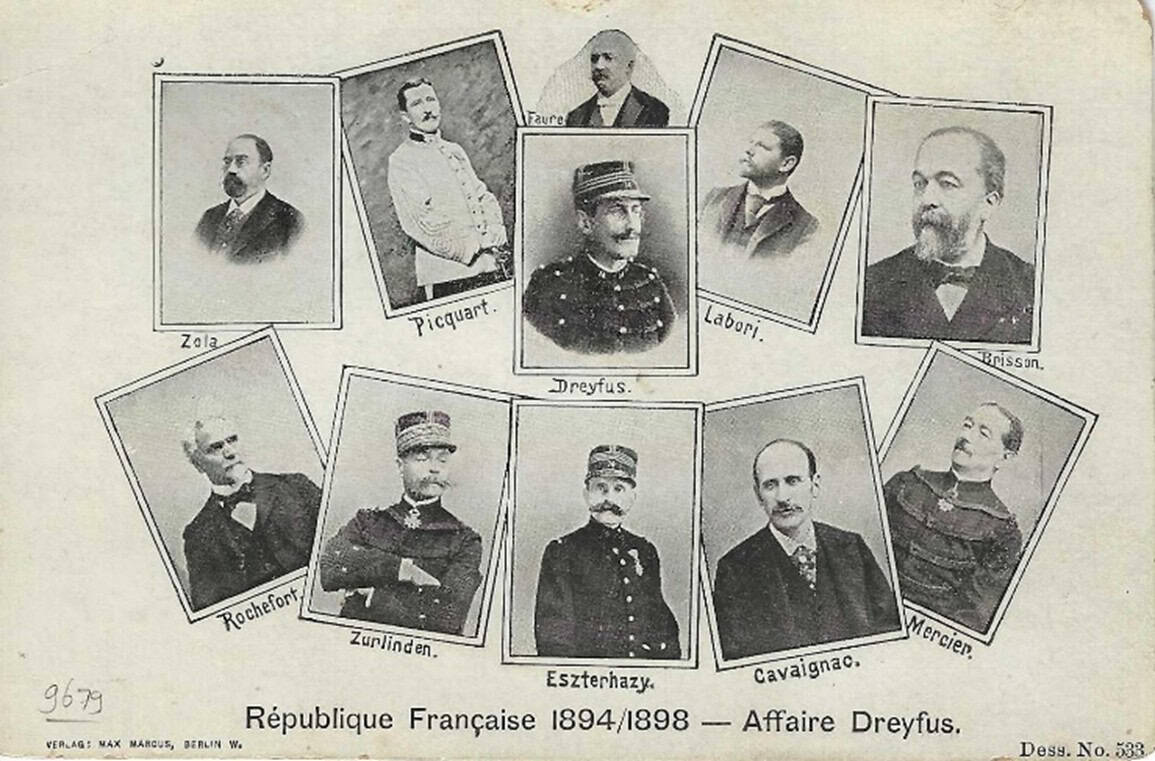
this never-mailed 1898 French postcard
In January 1895, Captain Alfred Dreyfus, a Jewish artillery officer in the French Army, was brought before assembled troops in the courtyard of the École Militaire in Paris. As his military insignia and buttons were torn from his uniform and his sword broken in two, crowds jeered and shouted taunts such as “Death to Jews!” From this public degradation, Dreyfus was sent directly to Devil’s Island, where he had been sentenced to life in solitary confinement.
Dreyfus was arrested the previous October and convicted of high treason. The accusations were false, but long-standing anti-Jewish and nationalist attitudes made him a convenient scapegoat. His conviction served to protect the perceived “honor” of the French Army and to reassure a divided public that justice had been done.
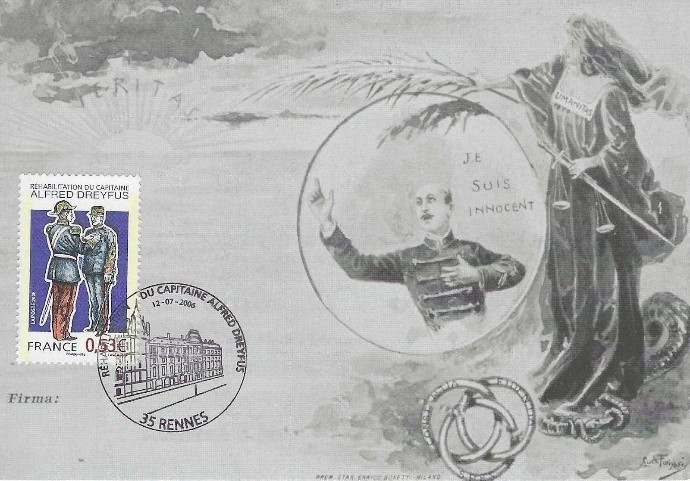
features the officer rightfully declaring his innocence during his sentencing
The Dreyfus Affair occurred more than forty years before the Nazi occupation of France, and historians now recognize it as a warning of how prejudice can distort justice and institutions can defend exclusion in the name of national unity. Those distortions would resurface with devastating consequences during World War II.
What Was the Dreyfus Affair?
Dreyfus was arrested in October 1894 after French intelligence discovered a handwritten document, known as the bordereau, containing military information allegedly offered to Germany, in a wastebasket at the German embassy in Paris. Although handwriting analyses linking the note to Dreyfus were inconclusive and no direct evidence tied him to espionage, he was charged and brought before a military court.
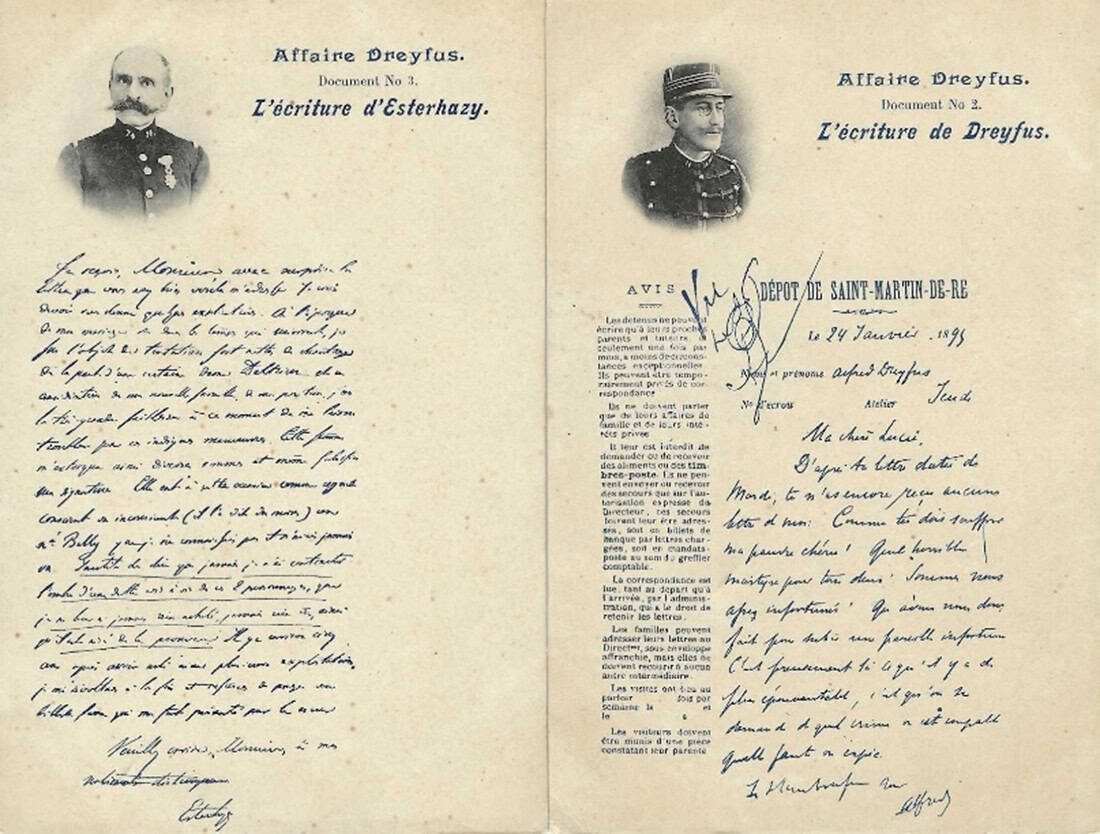
both Esterhazy, the true criminal, and Dreyfus, the scapegoat
The court-martial that followed was deeply flawed. Judges were shown a secret dossier, unknown to the defense, containing forged and misleading documents that falsely implicated Dreyfus. Despite serious judicial misconduct and the absence of credible evidence presented in open court, Dreyfus was convicted in December 1894 and sentenced to life imprisonment on Devil’s Island, a remote penal colony off the coast of French Guiana.
Two years later, Lieutenant Colonel Georges Picquart uncovered evidence that Major Ferdinand Walsin Esterhazy was the true author of the bordereau. Rather than reopen the case, the military high command suppressed Picquart’s findings and acquitted Esterhazy in a sham trial, prioritizing institutional reputation over justice.
A History of Prejudice: Why Dreyfus Was an Easy Target
We know anti-Jewish prejudices did not originate with the Nazi Party.
Long before the twentieth century, these attitudes were widespread across Europe and the United States, including in nineteenth-century France. Jews were often depicted as outsiders, disloyal citizens, or corrupting influences on “true” national culture, and popular newspapers, caricatures, and postcards reflected and reinforced these stereotypes.
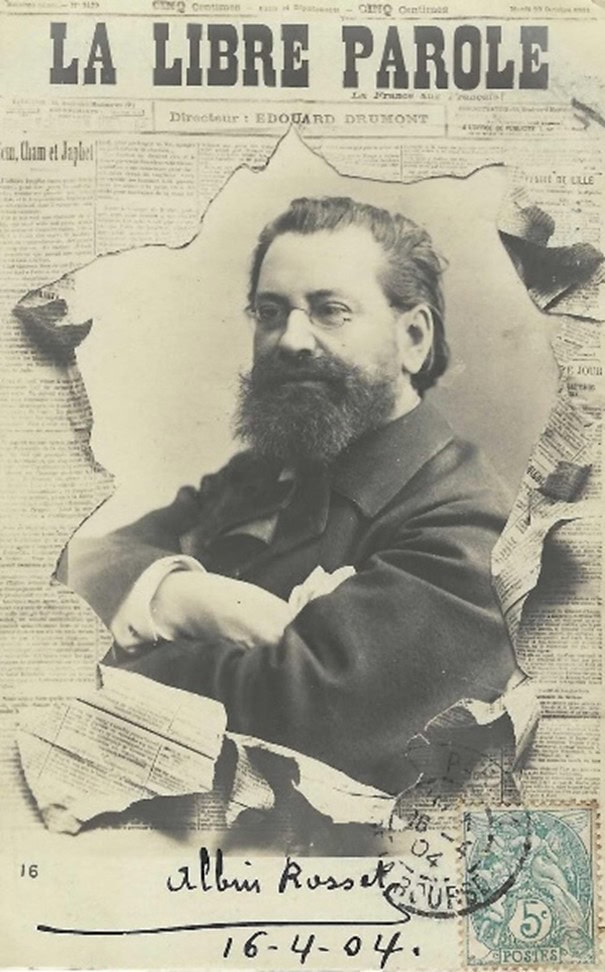
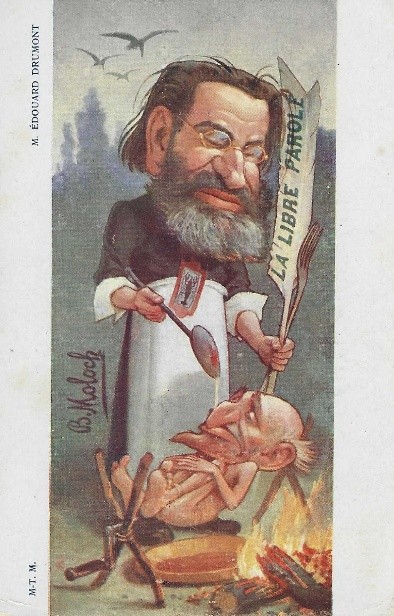
Drumont and his anti-Jewish newspaper, La Libre Parole
Figures such as journalist Édouard Drumont, whose newspaper La Libre Parole promoted virulent anti-Jewish views, helped paint anti-Judaism as patriotic.
In this climate, Dreyfus’s Jewish identity profoundly shaped how the evidence—or lack thereof—against him was interpreted. Ultimately, Dreyfus was convicted not despite his Jewishness, but largely because of it.
A Nation Divided
In January 1898, following Esterhazy’s acquittal, novelist Émile Zola published an open letter to the French president in the newspaper L’Aurore.
The letter, which accused military and judicial authorities of knowingly convicting an innocent man, transformed the affair from a legal controversy into a national crisis.
France soon split into opposing camps. Dreyfusards called for reopening the case, emphasizing truth, due process, and the republican principle that justice should apply equally to all citizens. Anti-Dreyfusards insisted questioning the verdict threatened the authority and honor of the army. Within this camp, anti-Jewish beliefs were frequently reframed as patriotism, and Jews were cast as outsiders whose loyalty to France was suspect.
Demonstrations, pamphlets, caricatures, and protests intensified hostility between the two sides, turning the affair into a cultural reckoning. A stark opposition emerged between the pursuit of justice and the defense of falsehood in the name of national unity.
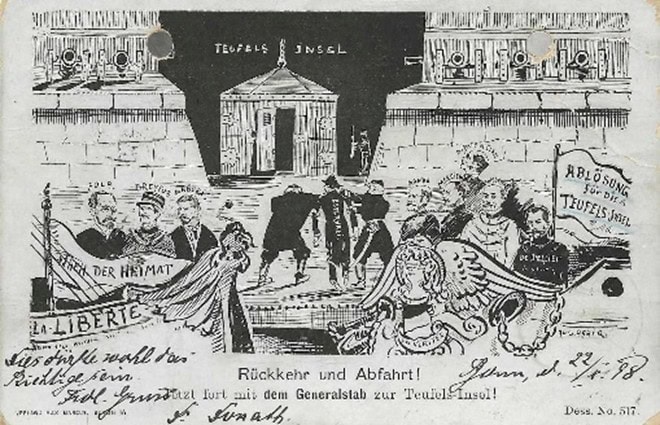
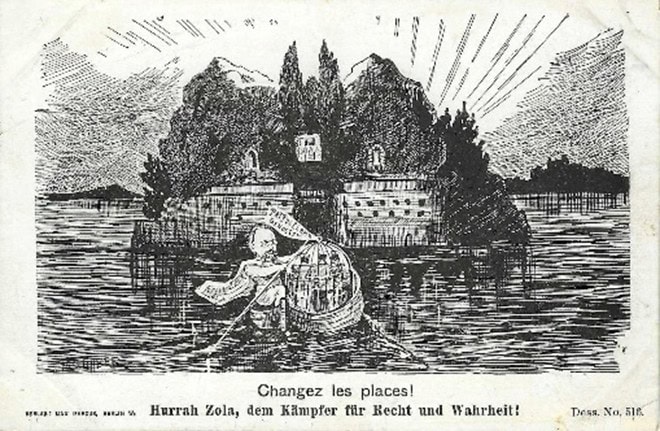
Two postcards, both produced in Berlin during the height of the Dreyfus Affair, featuring pro-Dreyfus imagery of Esterhazy (left) being sent to Devil’s island while Dreyfus looks on from the side of the “La Liberte,” and Emile Zola (right) escorting Dreyfus from Devil’s Island.
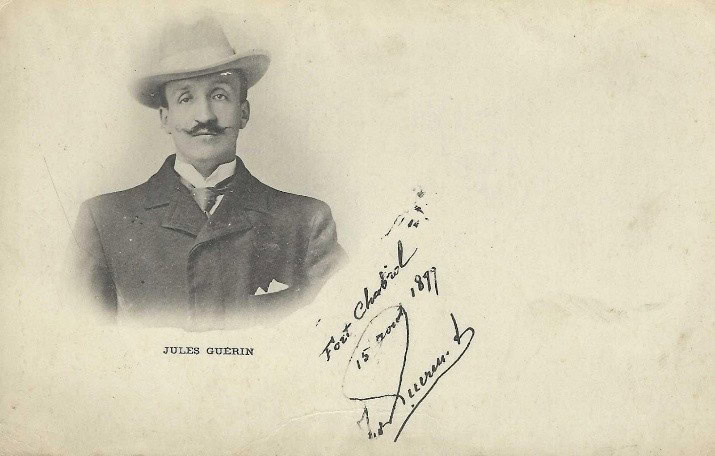
Under mounting pressure, Dreyfus was brought back to France in 1899 for a second court-martial. Despite the exposure of forged evidence and widespread acknowledgment of misconduct, he was again found guilty. To settle the public unrest, the French president, Émile Loubet, issued Dreyfus a pardon, but France’s highest court did not fully exonerate him until 1906. Legally, the affair ended. Culturally and institutionally, not so much.
Few officials who had fabricated evidence or suppressed the truth were held accountable, including Esterhazy, who fled to England. He later admitted his guilt yet faced no consequences. Furthermore, the anti-Jewish attitudes that made Dreyfus an easy target continued to circulate in public discourse, unresolved and largely unchallenged.
From the Dreyfus Affair to Vichy France
In 1940, following France’s defeat by Germany, the Vichy regime assumed control over the country’s unoccupied southern zone. During this period, the regime enacted a series of anti-Jewish statutes on its own initiative, systematically excluding Jews from public life, barring them from professions, and stripping legal protections.
It’s worth emphasizing that these measures were not handed down from Germany; rather, they were drafted and enforced by the same French institutions that had condemned Dreyfus decades earlier.
Of course, German control and influence would intensify. Ultimately, 75,000 Jews were deported from France during the Holocaust, most murdered in extermination camps. While of course it was the Germans at the helm of the genocide, many of these arrests were carried out by French authorities. Anti-Judaism had already been woven into French bureaucracy, and the country’s earlier failures to confront prejudices made it all too easy to re-activate them under German occupation, with devastating results.
What the Dreyfus Affair Teaches Us
The Dreyfus Affair is a clear demonstration of how prejudice can distort justice, even within a society committed to democratic ideals. It shows how institutions can choose self-protection over truth and defend exclusion as national security. Postcards and other visual artifacts from the period reveal how these ideas circulated beyond courtrooms and into everyday life. Remembering Alfred Dreyfus is not only about correcting historical mistakes, but about recognizing what happens when hate is tolerated, normalized, and left unchallenged.
It is no surprise how much late-nineteenth century history is found on postcards. Millions of cards were made showing events, personalities, and products for sale. This was true worldwide and the Dreyfus Affair in France was one of the most spectacular.
Thank you Greg for such a clear historical run-down on the Dreyfus Affair.
I thought that I was abreast of most of the issues; but your wonderful article has educated me further in so many ways about this awful situation. With Gratitude.
wonderful article and so Germain tour times.
It’s a horrific story, well told and illustrated through the postcards and words in this article. Postcards are such a great teaching tool, and we learn (and sometimes teach!) through our collections. Thank you for the education, Mr. Philipson. And we’re neighbors of a sort. Howdy from San Antonio.