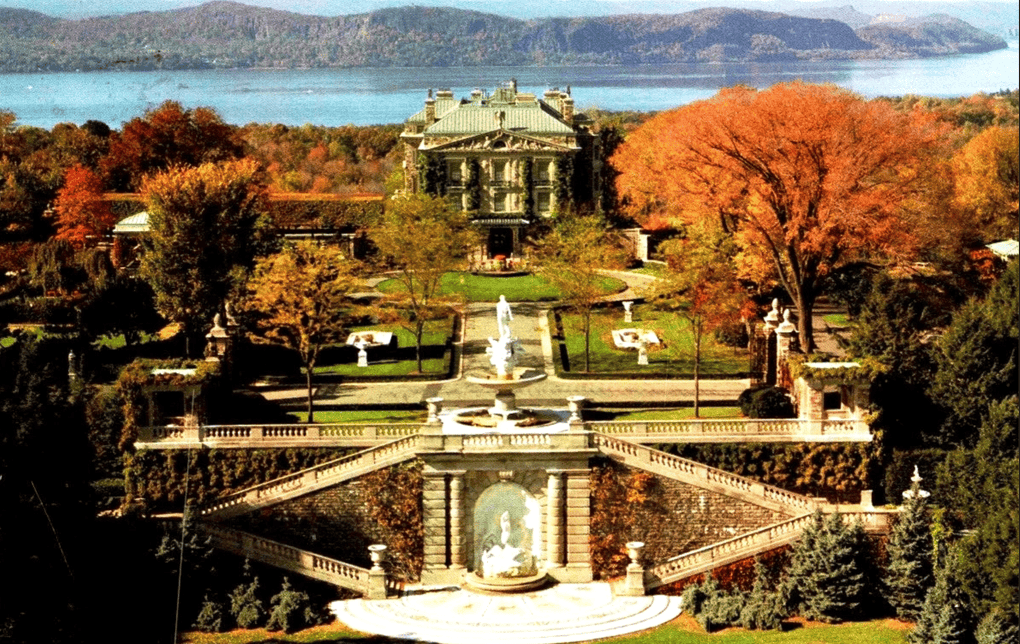
Westchester County, just north of New York City, has always served as the summer retreat for wealthy New Yorkers. In the Gilded Era, at the end of the Nineteenth Century, many of those merchant princes who had amassed wealth as a result of the enormous industrial growth that occurred in the United States after the Civil War, assembled estates there near the Hudson River not only to cater to their whims, but often to display their wealth as well. Today some of these imposing edifices are preserved as historic homes offering insight into that bygone era. Kykuit located in Pocantico Hills, New York – the home of the Rockefellers for three generations – is among these mansions, although it stands apart from most of these structures because of its relative modesty and simplicity.
Kykuit’s comparative modesty was shaped by the principles of the founder of the Rockefeller dynasty, John D. Rockefeller (1839-1937). He was born in Richford, New York, located between Ithaca and Binghamton, the oldest of five children. His father, William Rockefeller, Sr. (1810-1906) dabbled in many businesses and often affected the name and role of a doctor to pedal patent medicines to settlers on the frontier. He periodically moved his family gradually west from one small town to another, eventually settling them in Cleveland, Ohio. An inconsistent provider, usually turning up flush and leaving when he became destitute, William finally abandoned his family to take up residence with a second wife under an assumed name, although he maintained intermittent contact with his sons until the end of his life.
Because of William Sr.’s inconsistency, John, as the oldest son, became the man of the house and formed a tight bond with his mother, Eliza (1813-1889). She had been raised in western New York State, right at the epicenter of the Second Great Awakening, a religious revival which occurred during the first half of the Nineteenth Century. The fervor of that religious ardor caused later historians to refer to the region as the Burned Over District. Her upbringing made her a Baptist of the most puritanical kind, eschewing any show of wealth, pride or vanity and abhorring many common pleasures such as dancing, alcohol and tobacco. Eliza inculcated John with these beliefs and he lived by them all his life. Since his austere religious beliefs were among the core tenets of his life, he sought society in church life wherever he was. Through his church in Cleveland, he met and married a like-minded woman, Laura (Cettie) Spelman (1839-1915). (Spelman College, a historically black college for women in Atlanta, Georgia, later took its name from her family in recognition of the Rockefellers’ charitable support of the institution).
Along with his other austere religious principles, however, Rockefeller also imbibed the belief that wealth was a sign of God’s favor. Beginning his business career in Cleveland in 1855 as a commodities broker, he showed a keen attention to detail that quickly set him apart from his peers. He chose to invest in oil, which was just then becoming available in quantity for the first time because of discoveries in Western Pennsylvania. Refined into kerosene, it quickly became the medium of choice for both home and public lighting. By his shrewd dealings, Rockefeller had become a millionaire by 1869. In 1870, he formed Standard Oil through which he multiplied his wealth until he was widely regarded as the richest man in America, but whose tactics were often criticized as being morally or legally questionable. Finally relocating to New York City in 1884, he settled his family into a house built for the mistress of the railroad baron Collis Huntington (whom he tried to pass as his niece). With characteristic modesty, Rockefeller left the master bedroom as he found it.
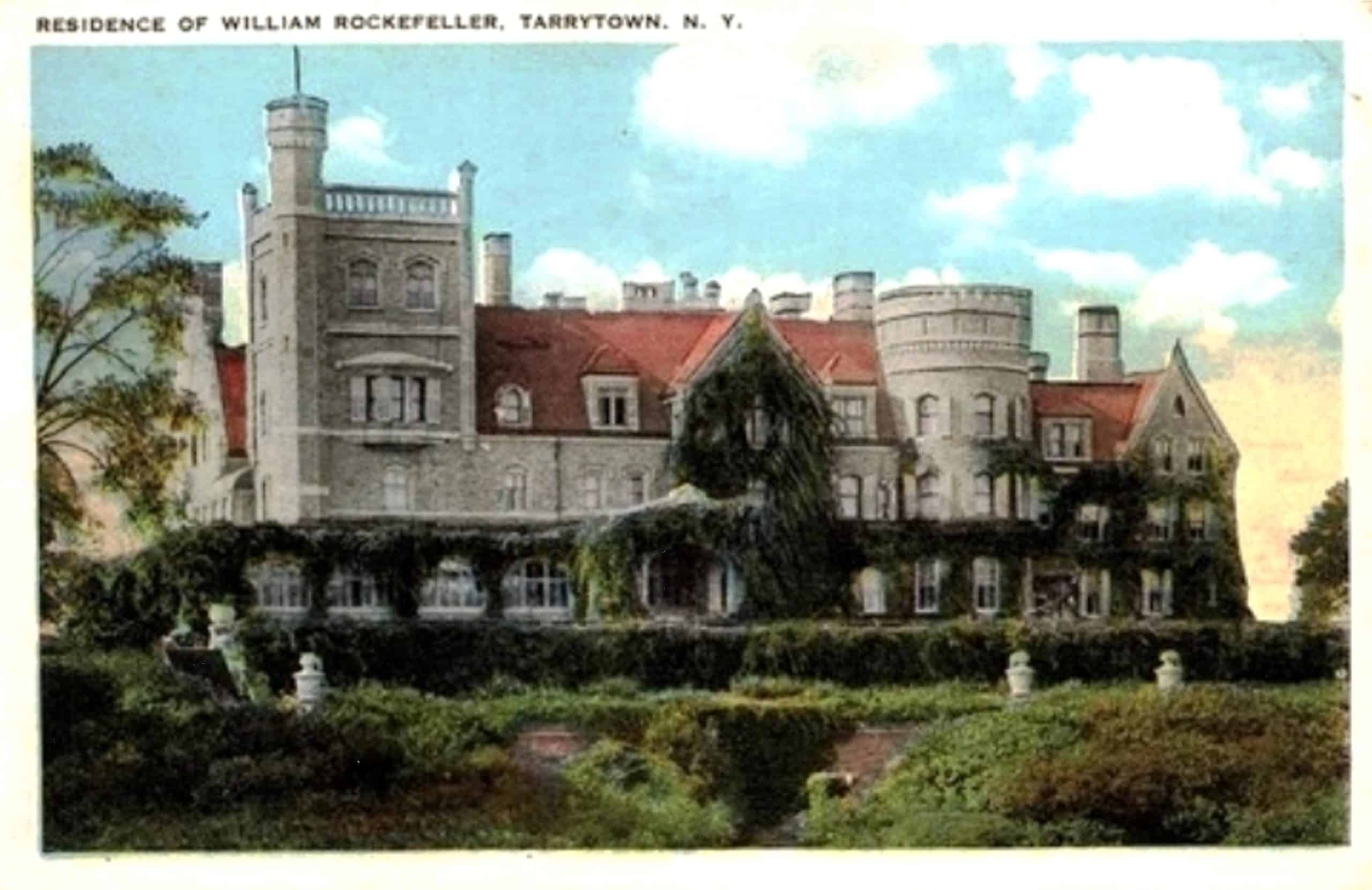
After the panic of 1893, Rockefeller took advantage of depressed land prices to purchase a tract of land in Pocantico, New York. He was drawn to this location because his younger brother William Jr. (1841-1922), a participant in the wealth generated by Standard Oil, had already purchased land in the vicinity and erected his own mansion, Rockwood Hall, the largest home in the United States between 1890, when it was built, and 1895 when George Vanderbuilt open Biltmore in Ashville, North Carolina. William, who had not espoused his mother’s austerity nearly to the same degree as John, created a castle of towers and turrets. Sadly, it became a white elephant after William’s death. After attempts to convert it to some other use, including a country club, John D.’s son, John Jr. (1874-1960), frugally ordered the estate demolished in the winter of 1941 to reduce the tax liability on the property. All that remains of William’s castle are its terraced foundations which can be viewed now in a state park. After World War II some members of the Rockefeller family proposed building the headquarters for the newly formed United Nations on this tract of land.
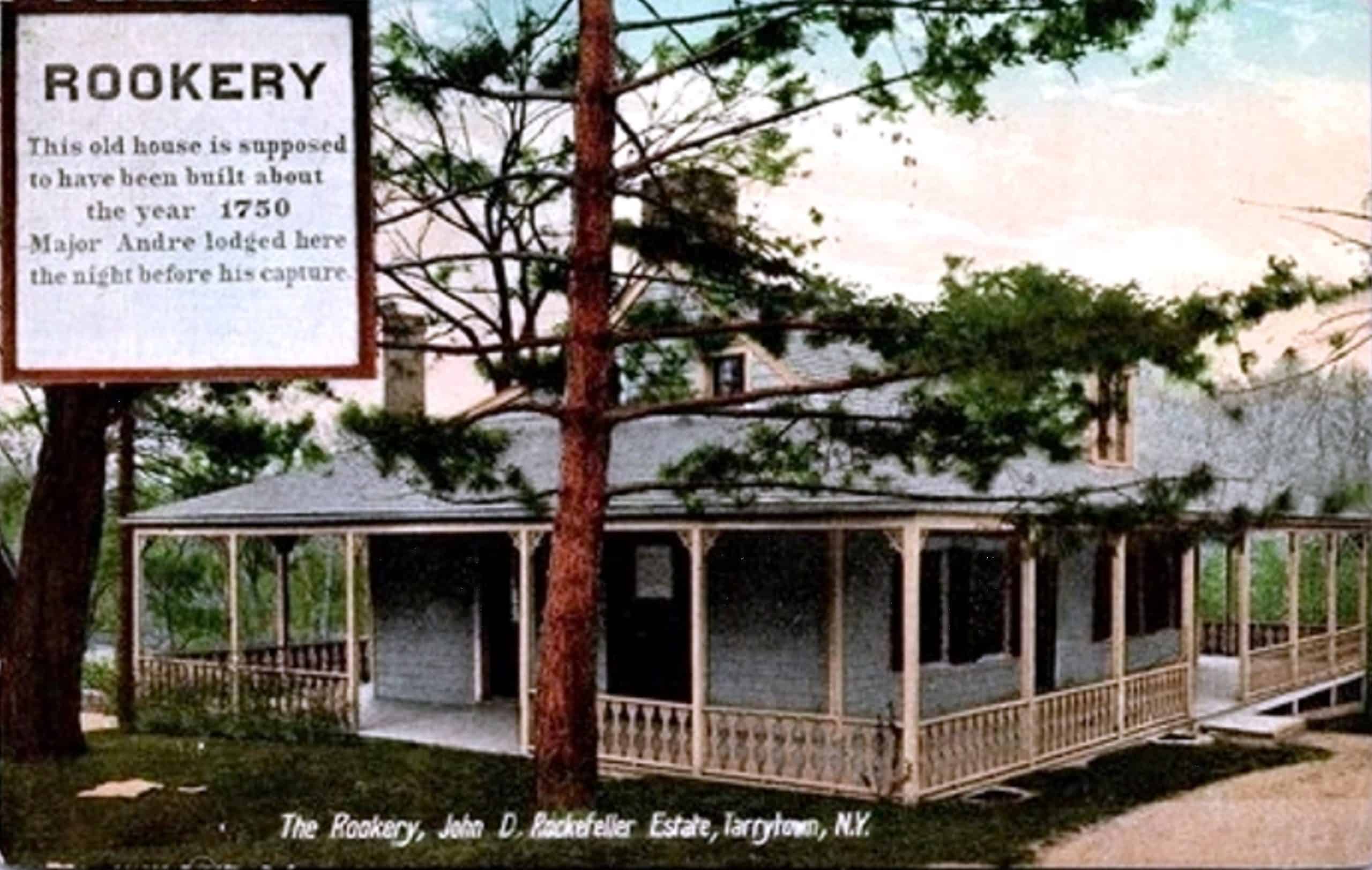
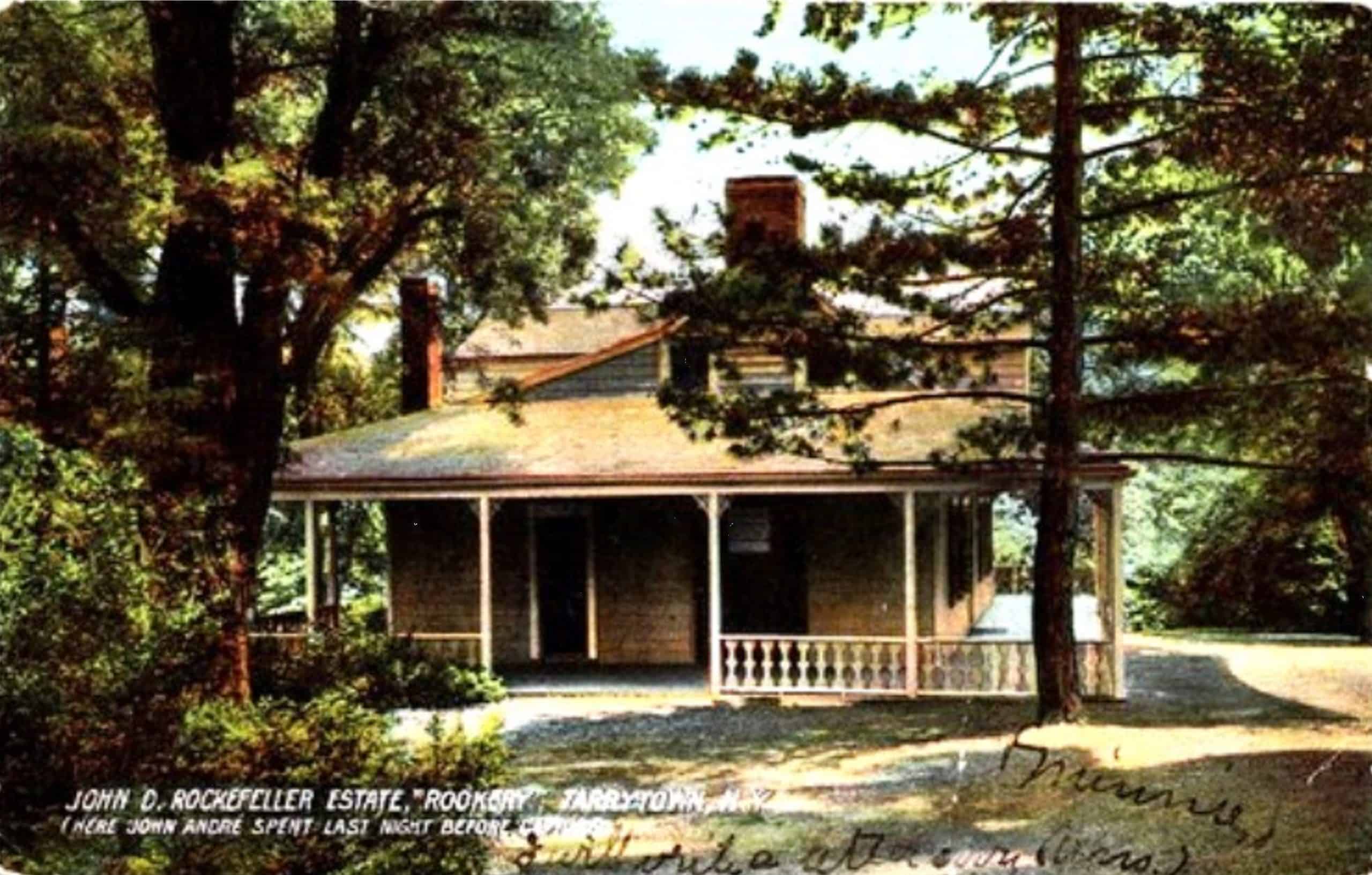
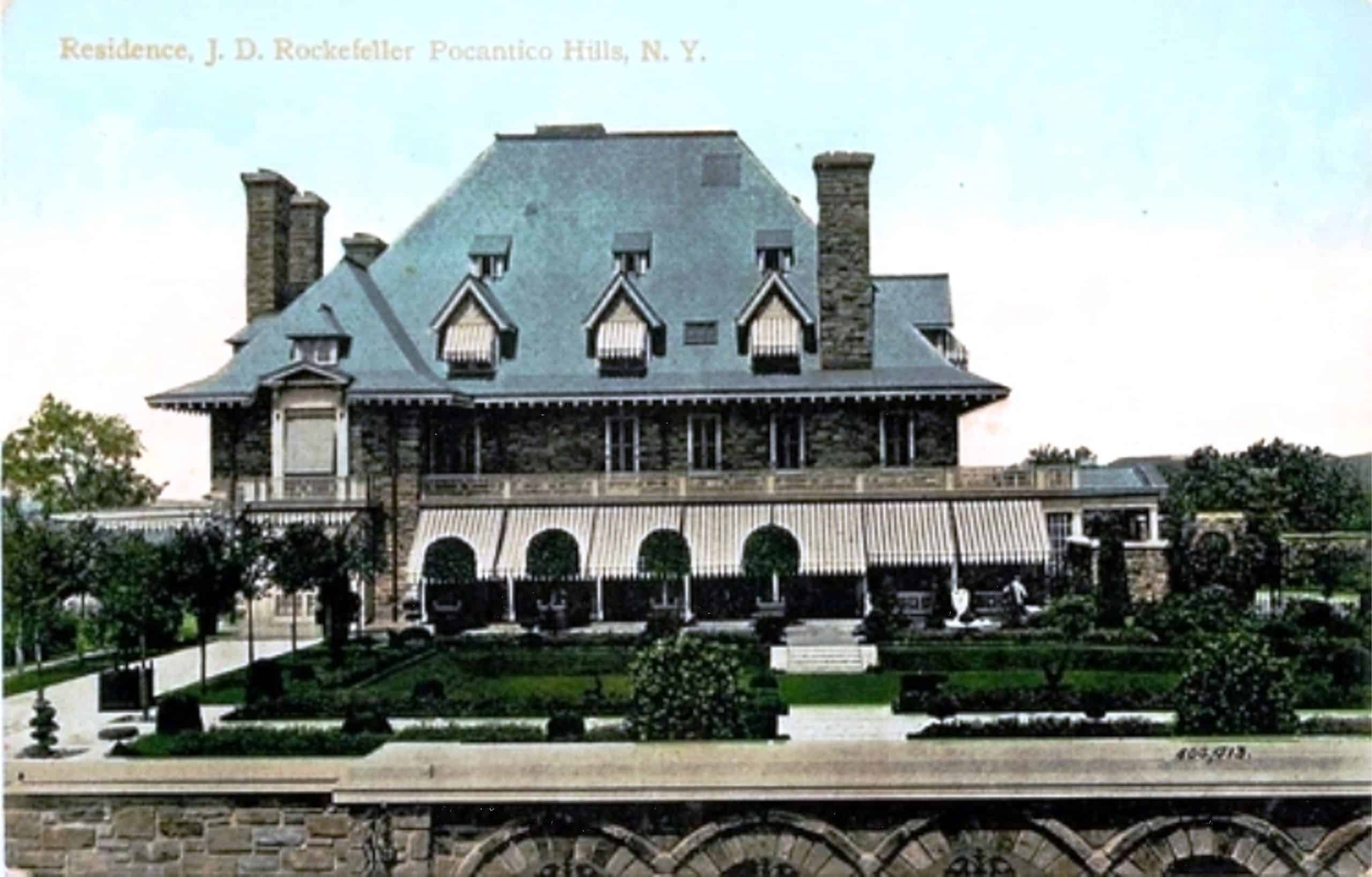
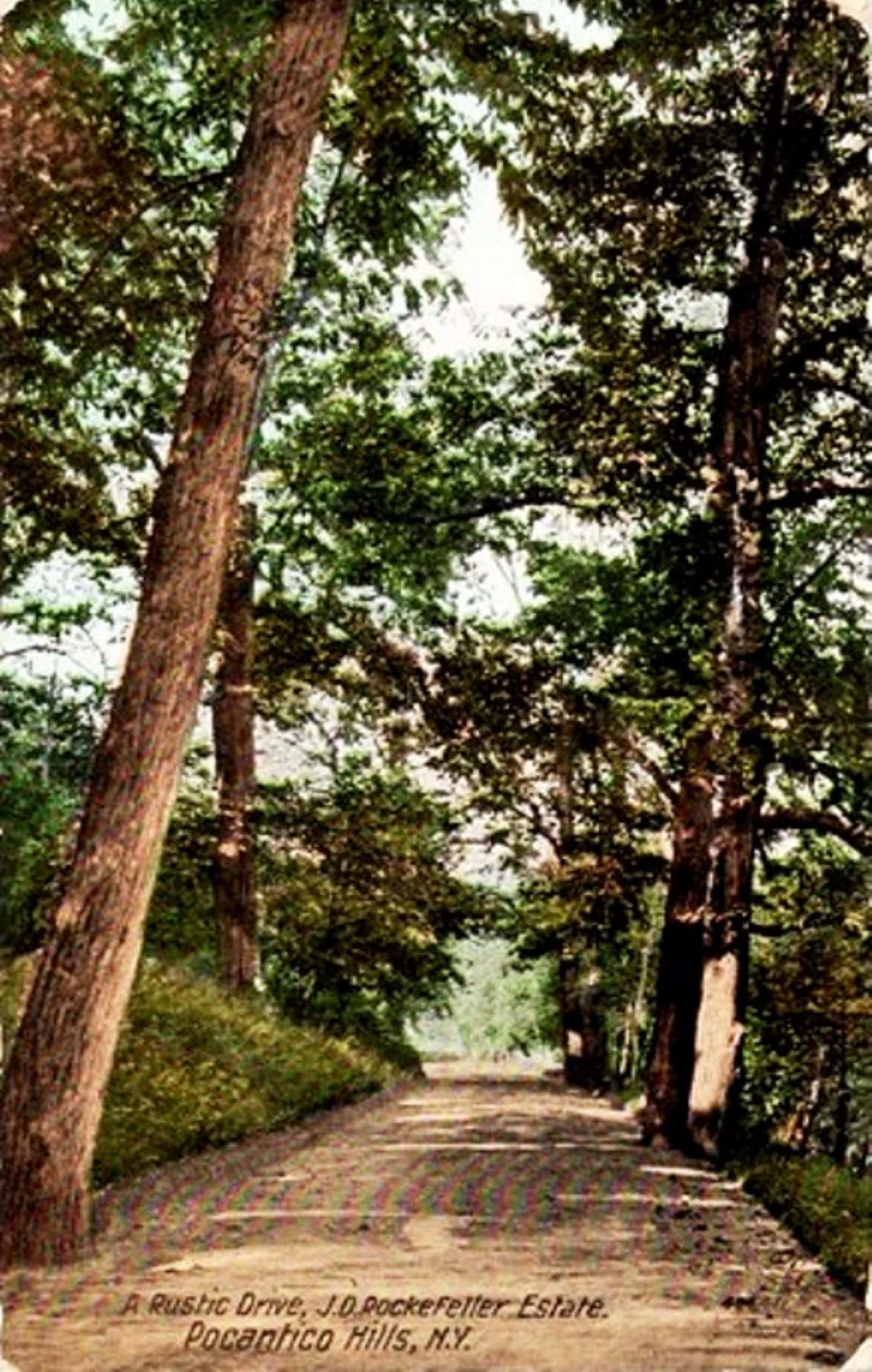
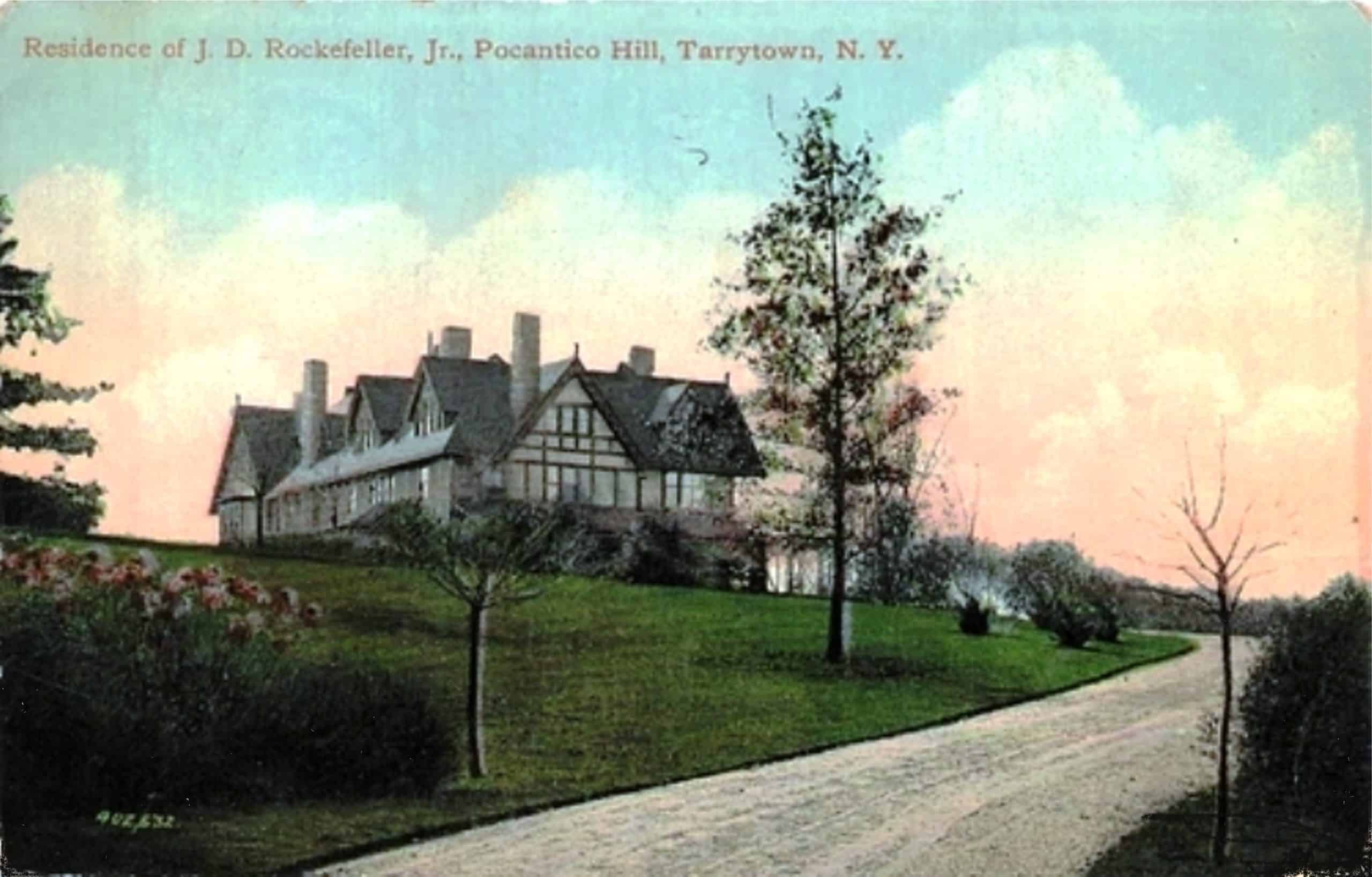
John D. Rockefeller began to use his property almost immediately by simply moving into one of the existing homes which already stood on it. While ceaselessly acquiring property, and although forced for security reasons to cordon off the area in use by the immediate family, he left much of the land open to the public for hiking and riding, although prohibiting cars. For this reason, contemporary postcards from the era, used to illustrate this article, abound. After developing an enthusiasm for the sport of golf, Rockefeller soon had a twelve-hole course designed for the property. His biographer, Ron Chernow, recounts how in 1904, his desire to play golf immediately following a four-inch snow was so great that he had the course cleared by workman.
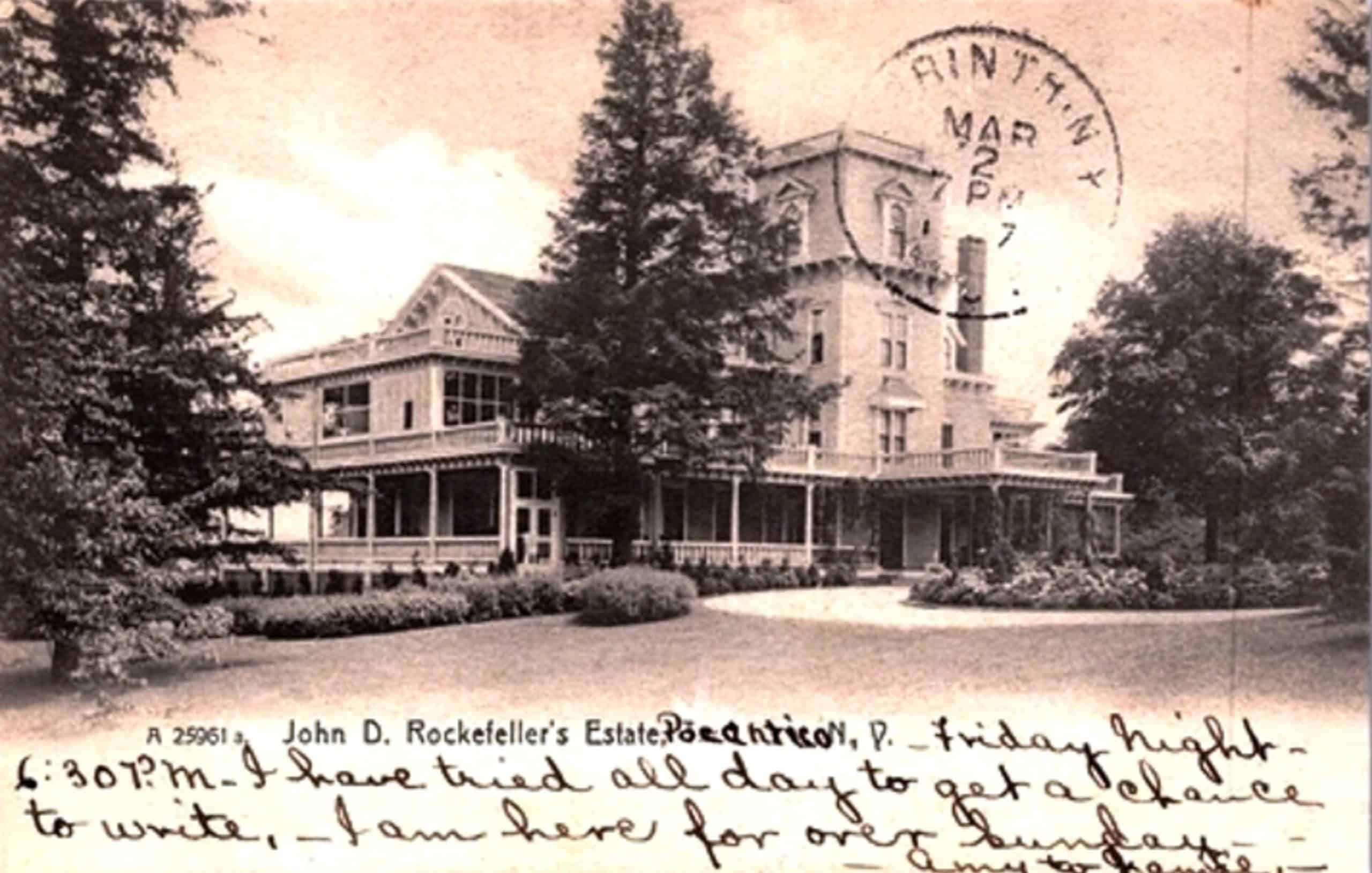
Kykuit only emerged because the quarters John D. was occupying burned down, and he was forced to move to another home. He placed John Jr. in charge of building new quarters at the top of a ridge on the property known as Kykuit, derived from the Dutch word meaning lookout. John Jr. and his new wife, Abby Aldrich Rockefeller, plunged into the task of designing the house. Abby was the daughter of Senator Nelson Aldrich of Rhode Island, one of the Republican leaders of the Senate. His portrait is prominently displayed in one of the main rooms of Kykuit.
The interior was designed by Ogden Codman, who had become well-known through his connection with the author Edith Wharton with whom he had authored a book on interior design. In keeping with the family’s desire to avoid ostentation, the rooms are neither overly large nor grand in any way. Because of John D.’s belief that dancing was inappropriate, there is no ballroom, although the home does feature an organ which John D.’s wife, Cettie, and her sister, Lucy enjoyed playing. The interior’s most intriguing feature is the oculus in the ceiling of the music room which rises through the house to allow light to enter.
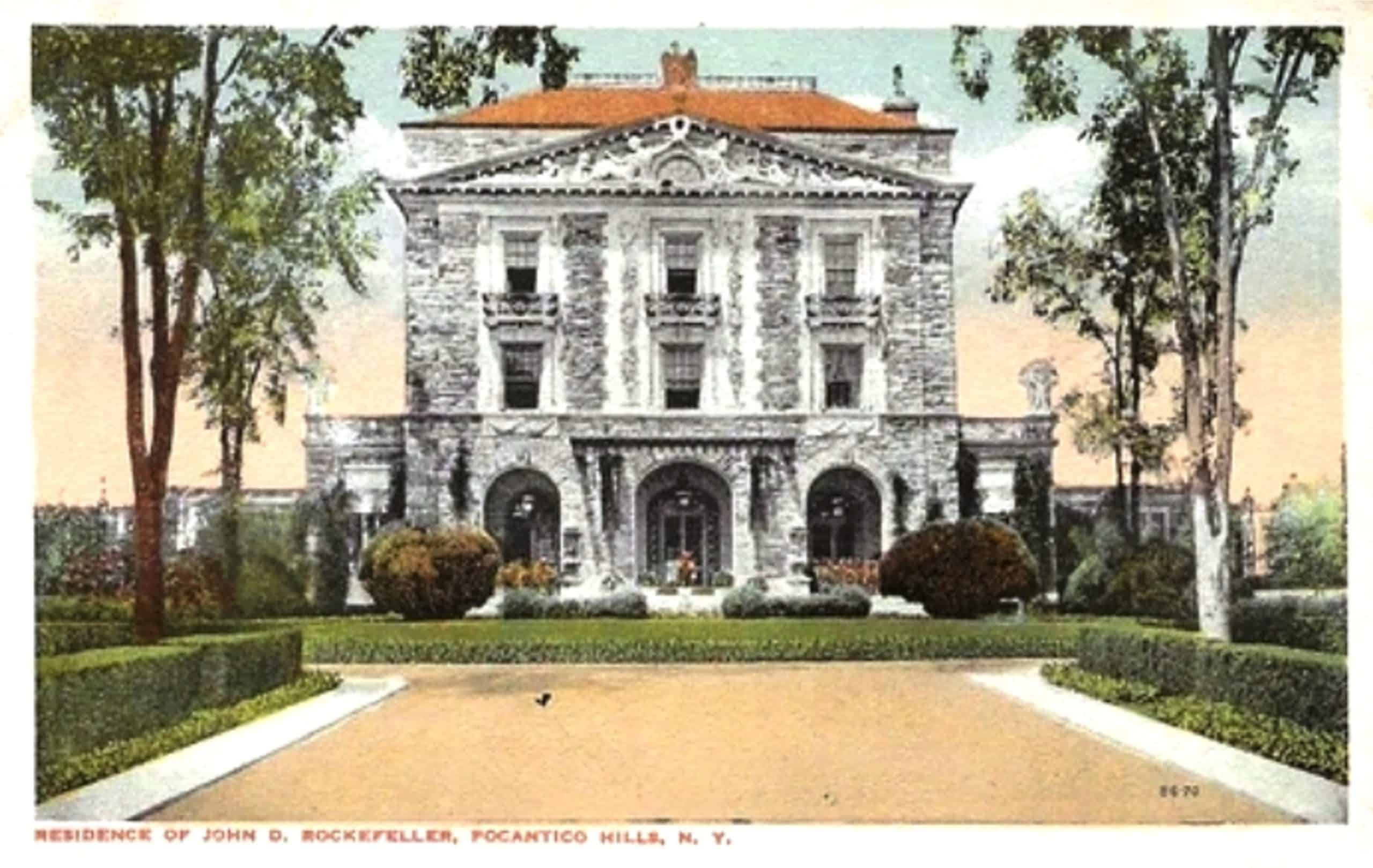
The exterior of the house was designed by the architectural firm of Delano & Aldrich (a distant relative of Abby’s). It proved more of a challenge. Originally built as three story stone building, it did not satisfy John D. once he and Cettie occupied it in 1908. The third-floor guest rooms had small windows which made them stuffy and close. The elevator clanked and the plumbing banged. Since Cettie’s health was already delicate, these defects had to be remedied. Rockefeller also redesigned the approach to the estate grounds so that deliveries could be made underground in order not to disturb him or his wife in their bedroom. John D. had his landscape architect, William Welles Bosworth, undertake the renovations. These modifications were begun in 1911 and finished in 1913, bringing about the house as it now appears: a four-story classical Beaux-Arts structure, complete with a pediment. So desirous of privacy and quiet was John D. that in 1928, he and his son paid $1.5 million not only to purchase the nearby tract of a Catholic institution, St. Joseph’s Normal College, but to relocate it and build it new facilities. Moreover, in 1929, he bought the entire village of Eastview, New York to be able to move the tracks of the New York Central’s local commuter rail branch further east away from Kykuit.
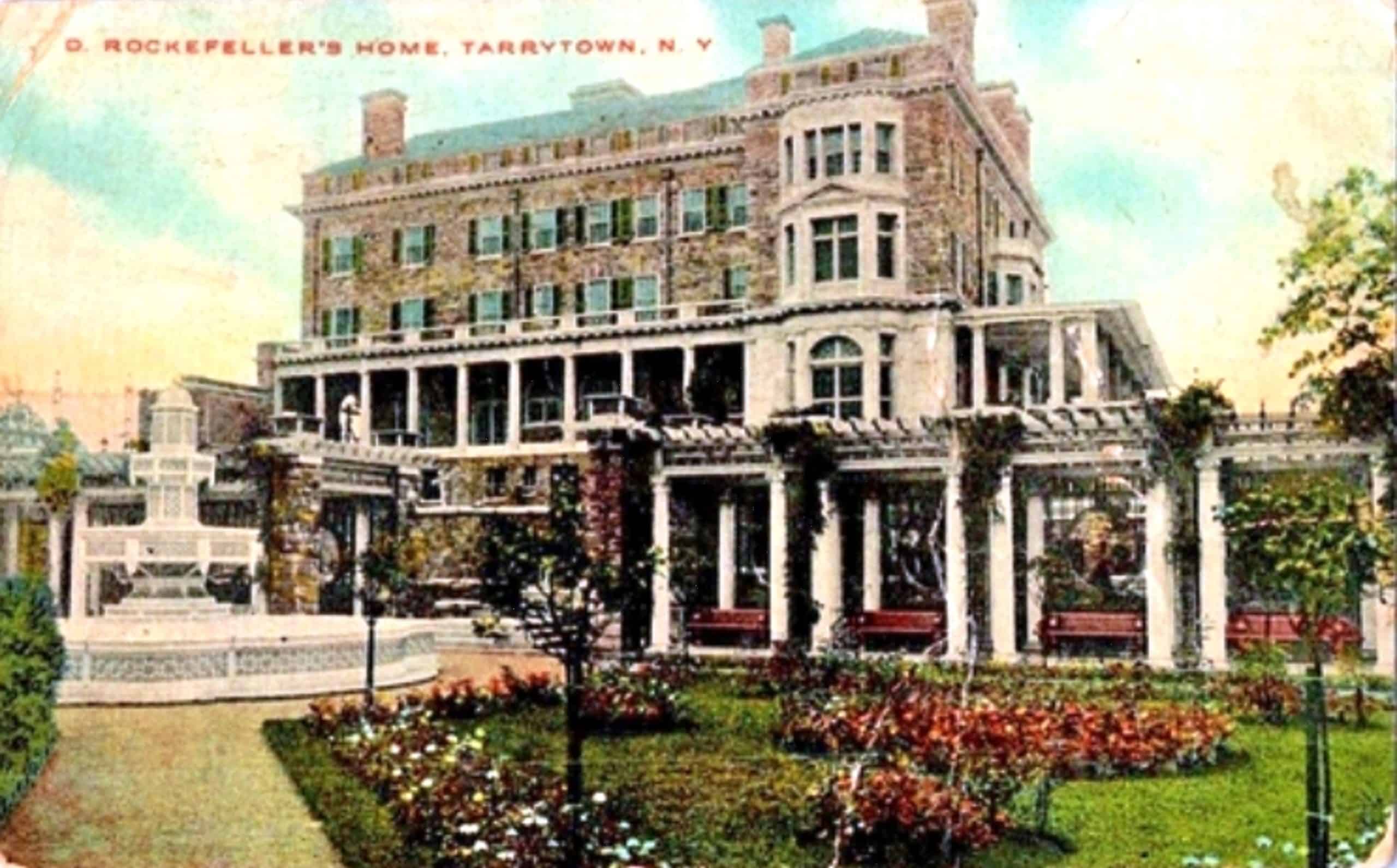
Later generations of the Rockefellers who occupied the home after John D., namely John Jr. and his son Nelson, four term governor of New York State and Vice-President of the United States under President Gerald Ford, have left their imprint on the house. John Jr. graced the home with a collection of Chinese porcelains and Nelson’s modern art collection is on display, especially in galleries located in the former basement and throughout the estate gardens. Kykuit is now maintained as an historic property by a foundation funded by the Rockefellers and is open to visitors between April and November.
Nice article, very informative! I have collected a number of Tarrytown cards featuring Lyndhurst. I often come across Rockefeller estate ones while postcard shopping.
Very informative, nice selection of cards. This guy should e a guide or docent at the estate.