For many years, ferry boats were mainstays in the California highway and railroad systems. Without ferry boat service, getting around in places like San Francisco Bay, San Diego Bay, and other areas would have taken hours longer!
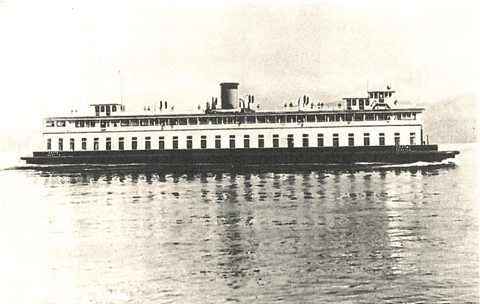
Exploring the history of many of these boats is a large part of my collection of postcards. Here are a few examples of boats from a bye-gone era, some of which I was privileged to ride before they disappeared or were replaced by modern boats designed only to carry people.
By far, the largest number of California ferry boats, were operated in the San Francisco Bay area. Those that did included the “Santa Rosa,” “El Capitan,” “Berkeley,” “Eureka,” and “Solano.” All these served the bay area long before and even after, San Francisco’s famous bridges were constructed.
The “Santa Rosa” was a Steel Electric class ferry. She was built by General Engineering and Dry Dock Company at Alameda, California in 1927. Serving San Francisco Bay commuters through 1940 when she was purchased by Puget Sound Navigation Company, moved to Puget Sound, Washington, and renamed “Enetai.” In 1951, she became a part of the Washington State Ferries System.
In 1968, “Enetai” returned to her home port of San Francisco; but sat largely unused until she was purchased by Hornblower Cruises 1989. Hornblower changed her name back to the original “Santa Rosa” and uses her as their corporate office located at Pier 3 in San Francisco. “Santa Rosa” is included in the National Register of Historic Places.
**
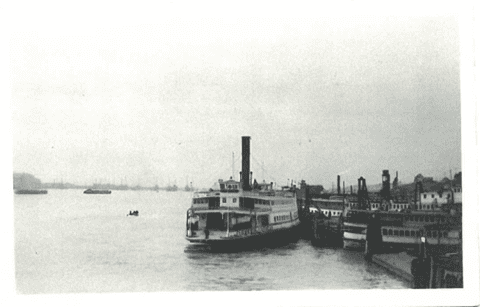
Navy Yard, California, on May 19, 1921.
“El Capitan” was a side wheel steam powered passenger ferry built by the Patrick Tiernan Company of San Francisco in 1868. The Central Pacific Railroad Company in anticipation of the completion of the first transcontinental railroad, offered “El Capitan” as ferry service for passengers arriving by train in Oakland and continuing to San Francisco.
In February of 1879, “El Capitan” had a collision with the Central Pacific ferry “Alameda” in a dense fog. The damage to “El Capitan” caused her to sink into a mud bar. She was, soon thereafter, towed to a local shipyard for repair and was brought back into service where she spent her last decade of service crossing the Carquinez Strait between Crocket and Vallejo, California, before retiring in 1925.
**
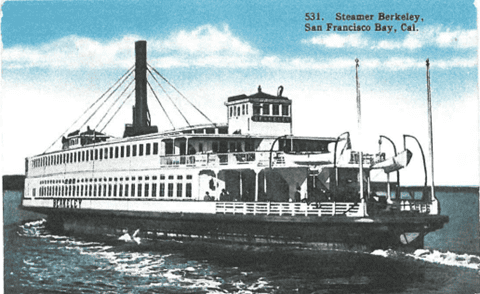
“Berkeley” was one of several ferryboats owned by the Southern Pacific Railroad Company that operated between the Oakland Pier and the San Francisco Ferry Building. She was built in 1898 by Union Iron Works of San Francisco.
On October 3, 1900, “Berkeley” collided with the coastal passenger ship “Columbia” due to a misunderstanding of signals between the two vessels. While being repaired the ferry “Newark” replaced “Berkeley” but she was soon back in service and notably, served as one of the main vehicles in ferrying refugees across the bay to Oakland after the San Francisco earthquake in 1906.
In 1958, “Berkeley” was taken out of service for repairs. She never returned to service, as Southern Pacific decided to end all ferry service on July 29, 1958. Eventually she was purchased by Bill Conover, a ferry boat enthusiast and businessman, who had her moved to the small bay side town of Sausalito. There, she was converted into a gift shop called “Trade Fair.” The next twelve years took a destructive toll on the old ferry boat!
Finally, in 1973, “Berkeley” was purchased by the Maritime Museum of San Diego and was towed to San Diego where she was restored and currently serves as the main “building” of the Maritime Museum of San Diego. In 1990, she was declared a National Historical Landmark.
**
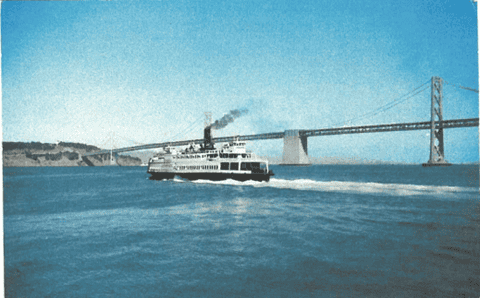
“Eureka” is a wooden hulled, double-ended, side wheel paddle steamboat that was built in 1890 by the San Francisco and North Pacific Railroad Company in Tiburon, California. She was originally named “Ukiah” to commemorate the railway’s recent extension into the city of Ukiah, California. She retained the name “Ukiah” through 1922 when her name was changed to “Eureka.”
Originally this ship carried commuters between San Francisco and Tiburon during the day and hauled railroad freight cars at night. In 1907 “Ukiah” was rerouted to the Sausalito-San Francisco Ferry Building route by its new owners, Northwestern Pacific Railroad.
From 1922, “Eureka” was primarily used as a passenger boat. Today she is located at the San Francisco Maritime Historical Park. Her walking beam engine was built in 1890 by Fulton Iron Works in San Francisco and is the only walking beam engine in the United States preserved on a floating vessel. “Eureka” also is the largest wooden passenger ferry boat ever built. She was certified to carry 3,500 people.
**
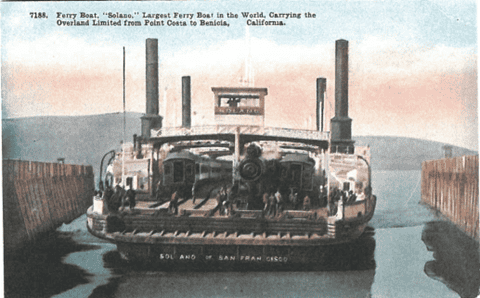
“Solano” was the largest railroad ferry ever built. She was a reinforced paddle steamer with independently powered side wheels. Built for the Central Pacific Railroad Company, she went into service on November 24, 1879.
Her sister ship “Contra Costa,” built in 1914, were the largest railroad ferry boats in the world.
“Solano” began regular service across the one-mile-wide strait between Benicia and Port Costa, California in December of 1879. She ran 24 hours a day with two crews consisting of sixteen men each. In 1904, she was making between 36 to 46 crossings per day transporting around 115,000 freight cars and 56,000 passenger cars each year. Even with the help of “Contra Costa,” “Solano” worked hard for 51 years.
With the completion of the new Benicia-Martinez Railroad Bridge, crossing over the Carquinez Strait, completed on October 15, 1930; both boats were dismantled and sold for scrap.
What remains of “Solano” can still be seen where she was scuttled to create a breakwater in the San Joaquin River near Antioch, California. “Contra Costa” was towed to a cove near Vallejo, adjacent to the California Maritime Academy, and sunk to serve as a breakwater.
**
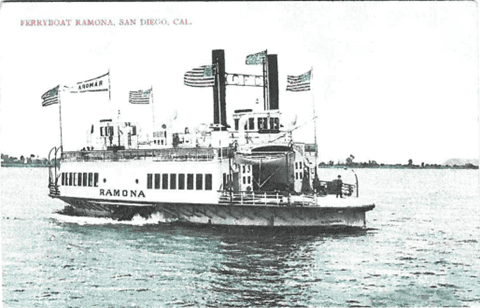
“Ramona” served the people of San Diego for 25 years. This steam powered, side paddle propelled ferry was built in 1903 by the Risdon Iron Works Company in Alameda. She ran regular service between San Diego and Coronado Island through 1928. After her retirement as a ferry boat “Ramona” became a floating dine and dance club anchored off Shelter Island. On a stormy night in January 1937, “Ramona” sank and was eventually scrapped.
**
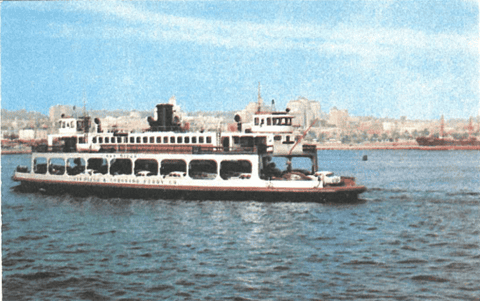
“San Diego” was built in 1931 by the More Drydock Company in Oakland, California. We were fortunate to be passengers on “San Diego” in 1963. On the way to Coronado, a sail boat cut across the bow of our ferry causing the crew to hard reverse her engines to avoid hitting her. The poor old thing felt like she was going to come apart, and I can only imagine the words that were being said in her wheelhouse!
When in 1969, the Coronado Bridge put “San Diego” and her and her contemporaries out of business; she was sold to Olympic Ferries Incorporated of Townsend, Washington for service between Whidbey Island and Port Townsend.
From 1971 to 1973 “San Diego” worked this run but her independent auto ferry company was losing money fast. In the fall of 1973, unable to keep operating, Olympic Ferries Incorporated shut down after twenty-six years of service.
The then Governor of Washington, Daniel J. Evans, ordered Washington State Ferries to take over the old company route. They acquired the docking facilities but passed on keeping the old “San Diego.” Washington Ferries assigned the ferry boat “Olympic” to the old route.
The “San Diego” ended up in Vancouver, British Columbia for many years. In desperate need for ferries after the Hood Canal bridge sank in a storm in 1979, Washington State Ferries went to Vancouver to inspect the old ferry boat for possible use on the Canal. By that time, though, having been neglected for years, the State determined that saving the boat would be too costly.
In 1987 “San Diego” was towed back to California ending up the Sacramento River to Antioch, California. She was bought to be converted into a restaurant, but the plans never materialized.
After being tied up at Antioch for years the “San Diego” was towed upriver and moored just off Decker Island. Abandoned, she fell into decay and was gutted by a fire that burned her interior. Eventually, in 2011, she was towed to Mare Island for asbestos removal and scrapping.
**
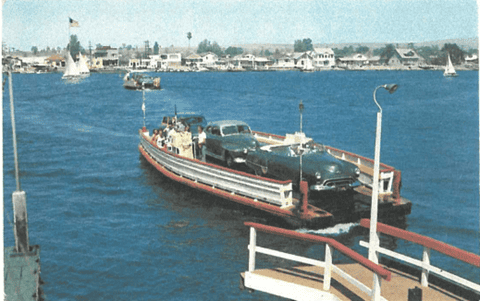
“Balboa Island Ferry,” since 1919, has provided service between Balboa, California (a suburb of Newport Beach) across to Balboa Island. These small ferry boats carry both cars and passengers across the roughly 800-foot waterway saving travelers an added six-mile drive to cross over by bridge.
As a young boy, my family would spend many happy times on Balboa Island. The ferry crossing was the beginning of a fun week or so of ocean side living and traveling the island by water taxis! One of the thrills of these trips, to me, was getting to know the water taxi drivers who would, at times, allow me to take over the helm of their boat.
A large state like California with its many lakes, reservoirs, rivers, and inlets, I am sure has many other ferry boats, especially in the San Francisco Bay and San Diego Bay. The stories here are boats on cards in collection and I’m always looking for more.
Shav, many thanks for the comprehensive history of our area’s ferry boat service. A great read!
Shav, thanks for this article. How nice that many of the ferry boats you write about have had additional lives — as office, gift shop, museum, dance club, or even a breakwater. I checked my cards to see if I had any CA ferry postcards. No luck, but I’ll keep my eye out for you.
Shav, outstanding overview of the states many ferries and their demise.
Great article Shav, thank you! We also live in a ferry area, Puget Sound, so know well the rich history and interesting lives these workhorses of inland waters had and have. I remember as a little kid crossing on the Bremerton run with my Mom, it was pouring. There were several buckets strategically placed on the floor of the ferry, catching the drips from the various leaks in the ceiling. Those old ferries were amazing.
Love the old postcard images of the ferries, you have some great ones, thanks for sharing.