The early twentieth century lumber industry in the vast forests of Oregon, Idaho, and northern California supplied the lumber that built America’s cities. In those logging camps lived the lumbermen who were renowned for their ability to handle brutal working conditions and still accomplish the job with astonishing feats of strength and endurance. They were rough, isolated communities of men who lived in bunkhouses, worked ten‑ to twelve‑hour days, and relied on skill, strength, and teamwork to bring down some of the largest trees on Earth.
The first time I saw the giant trees in California I was 42 years old. At the time I thought the sight of those trees was the most magnificent site I had ever seen. That says quite a lot since by that time I had traveled at least 60 thousand miles to places like the pyramids in Egypt, Mount Etna in Italy, the Aztec ruins in Mexico and the edges of the polar icecap in Alaska.
Today as I approach an age nearly double what I was in 1986, I would still enjoy seeing sites such as are seen on Raphael Tuck & Sons’ “California – Giant Trees” series #2005 published in 1908 with undivided backs. The set must have been very popular because it was republished in 1911 with the same title but with the new number of 7045.
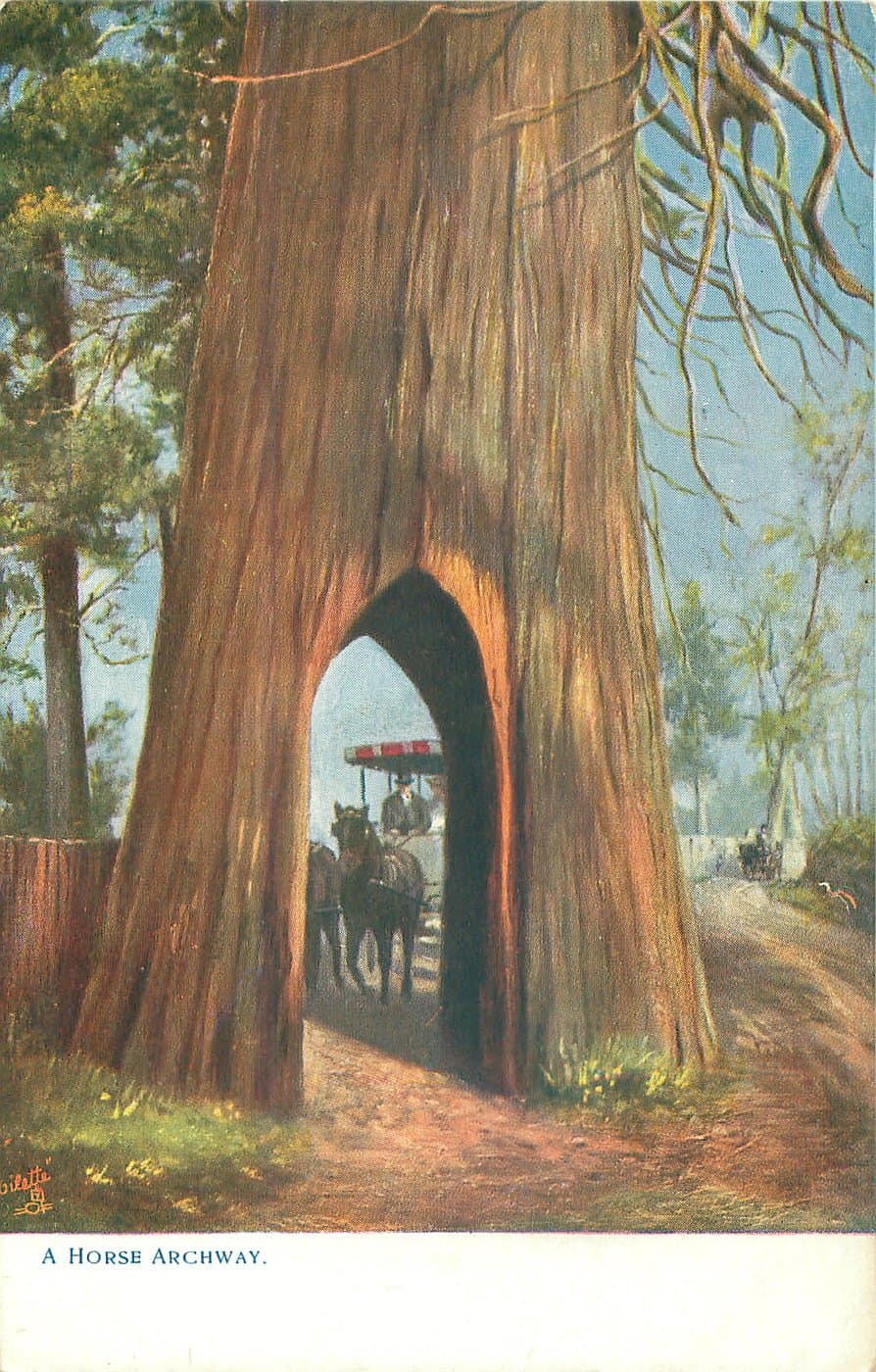
A Horse Archway.
The giant trees of the Pacific Coast of the United states constitute one of the world’s greatest natural curiosities. They occur in the states of Oregon, Washington and California. Many of the forest monarchs are from 300 to 400 feet tall and from 70 to 90 feet in circumference. One recently discovered (1909) measured 109 feet around the trunk at the base. Some of these trees have no branches nearer the ground than 100 feet, and many of the branches are fully 6 feet in diameter.
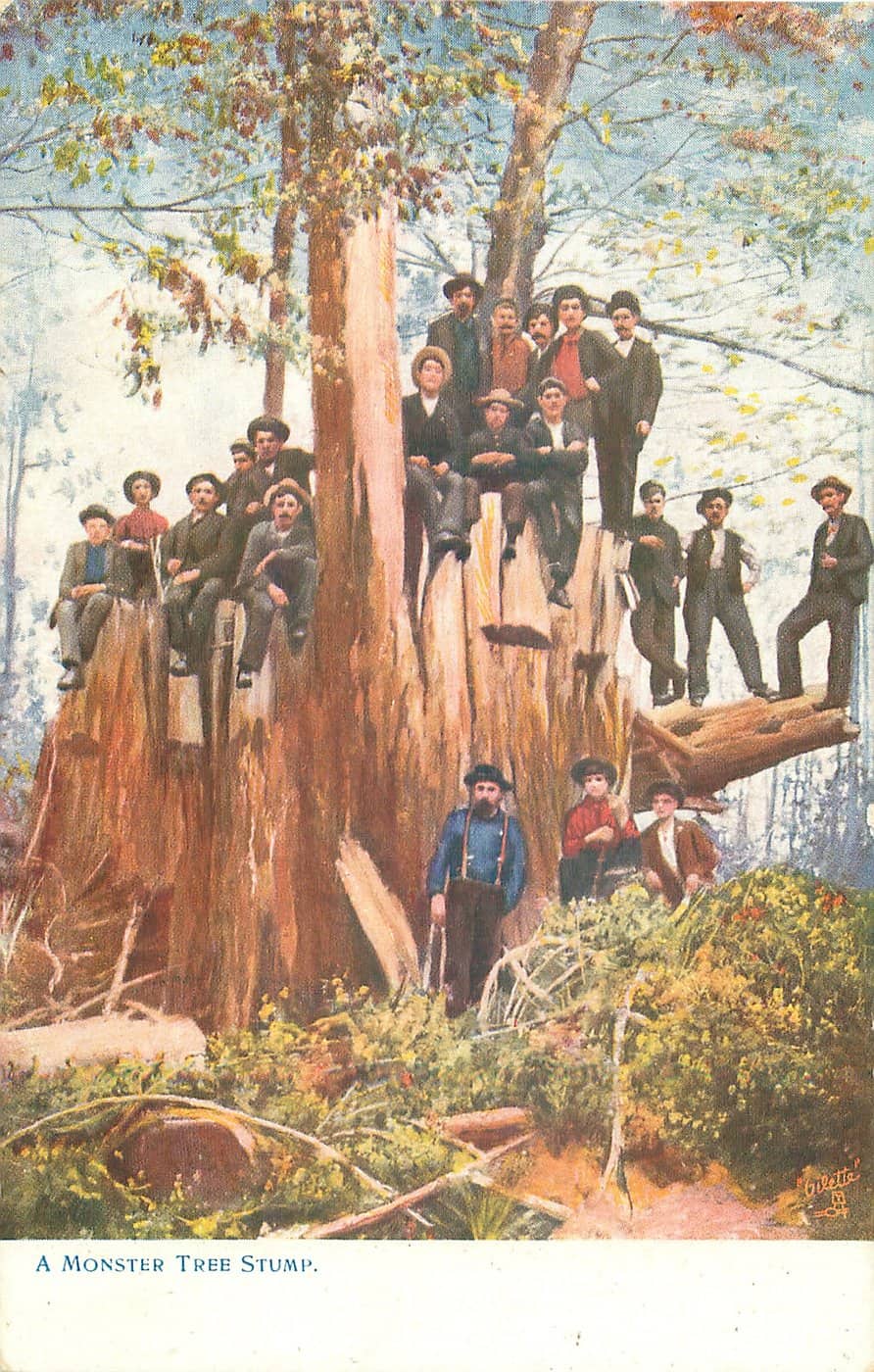
A Monster Tree Stump. Count them, there are 17 men standing upon the ragged and splintered stump of a giant tree. And by no means do they occupy all the space. On the Pacific Coast, these monster tree stumps are often put to odd uses. At one point in California, dances were frequently held with a huge tree stump as the dancing floor, and there were several instances in which the stump of one of the big trees had been made to serve as the foundation of a good-sized house.
Many companies vied for the stands of Douglas fir, western red cedar, and hemlock stretched across Washington, Oregon, and Idaho, drawing thousands of workers into logging camps that became small, rough communities. The camps were isolated, muddy, and loud with the constant clangor of axes, crosscut saws, and steam donkeys—early mechanical winches that revolutionized the speed of timber extraction.
Lumbering Scene
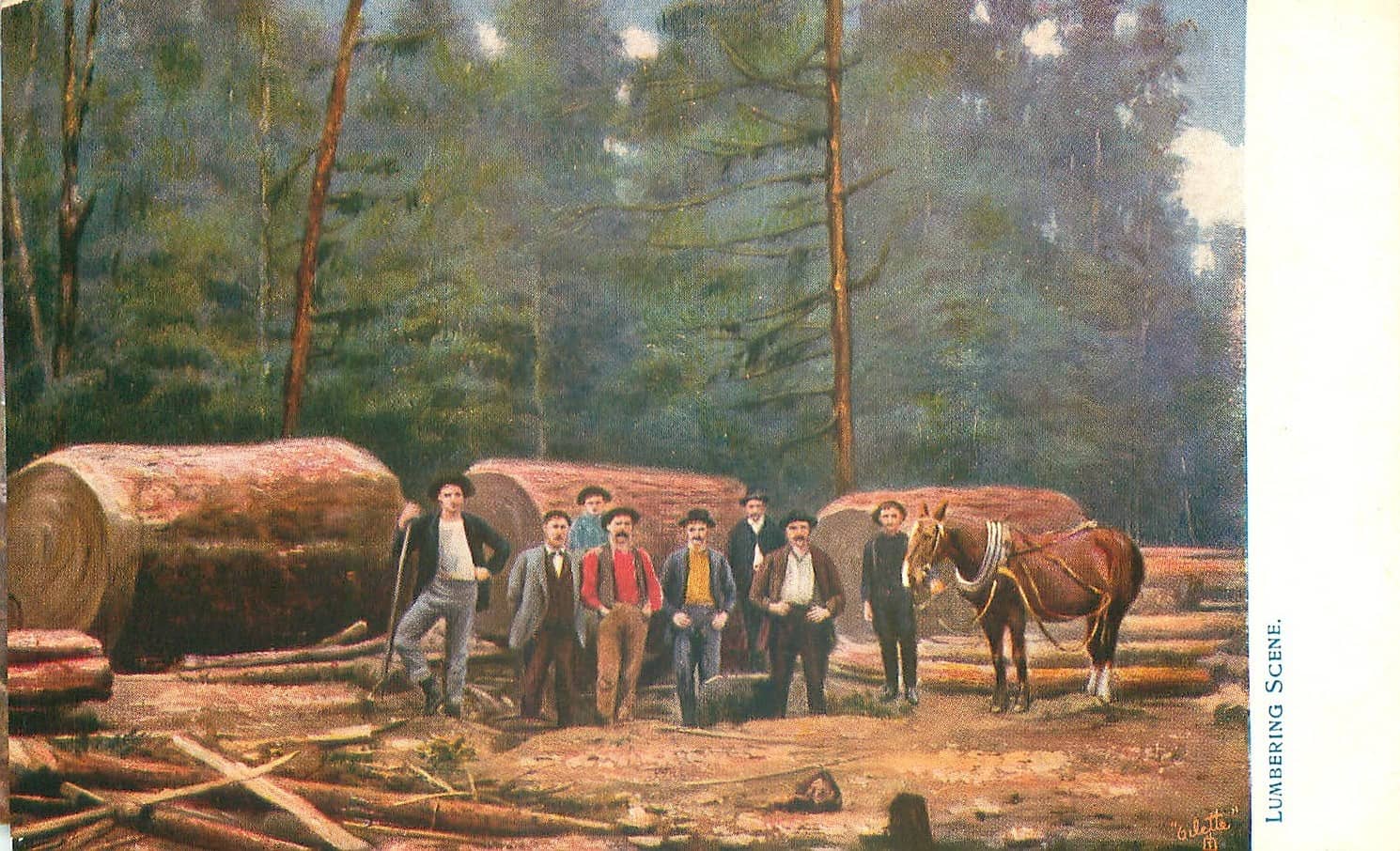
As soon as a giant tree has been laid flat in the forest, it is cut up into log lengths by sawyers who use eight-foot saws. These logs lengths are to be dragged through the forest over a route where no preparatory work has been done save the cleaning away of the debris, and so the long sections are “snubbed” or beveled at the forward end, in order to enable them to travel over slight obstacles with the least possible strain on the wire ropes which are drawing them.
The most preferred prey was the Douglas firs that routinely exceeded 200 feet in height. Steam donkeys revolutionized the industry by hauling multi‑ton logs up hillsides and through dense forest to rail spurs that were snaked deep into the woods. Yet despite mechanization, the work remained intensely dangerous due to falling snags, rolling logs, and cable failures.
A Prostrate Giant.
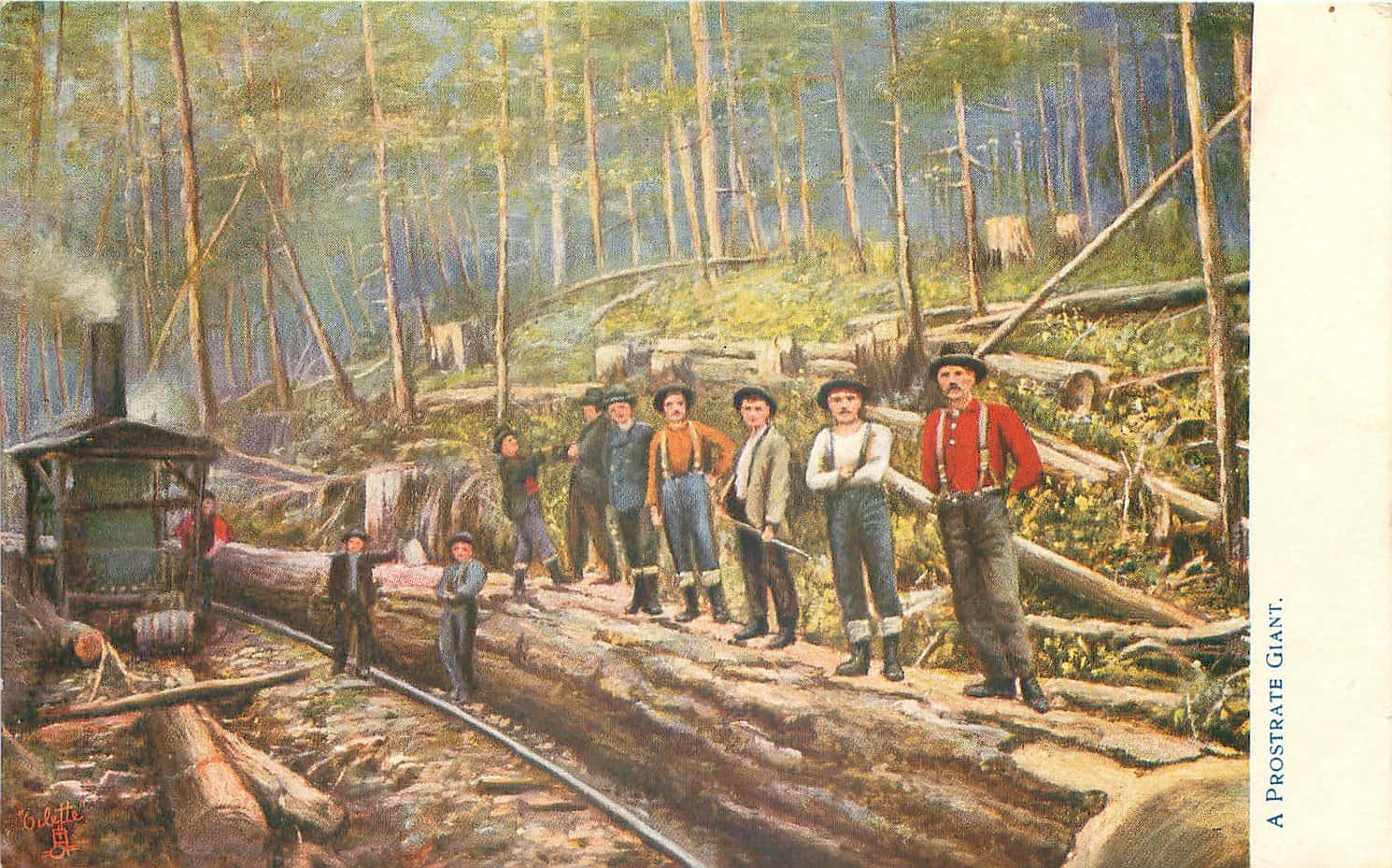
The lumbering of the big trees of the Pacific Coast is an altogether unique industry. Where the old-time lumberman in other localities depended upon conveying his logs by ice roads in winter or floating them down streams at spring, the Pacific Coast lumberman has to get along without any such aid, for though the latitude in which the big trees are found is the same as that of Labrador, snow and ice are almost unknown.
Steam Lumbering.
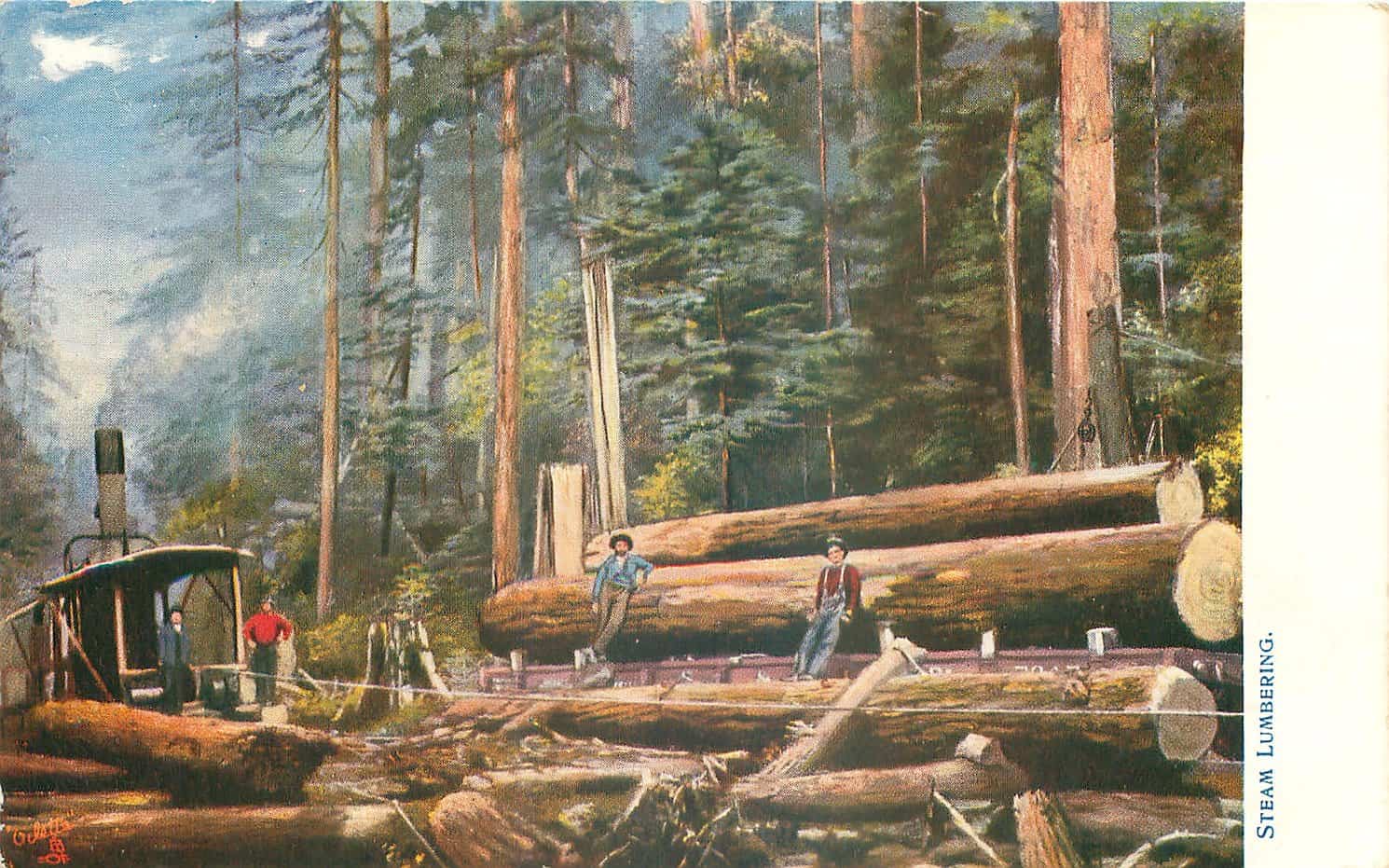
The twentieth-century industry of logging by steam reached its highest development in the big tree country of western America. The logs are dragged out of the forest and to the end of the “skid road,” where they are loaded on railroad trucks by means of powerful wire rope cableways. The cables are nearly an inch thick and one-thousand or more feet in length, and they wind on drums operated by powerful engines which drag the logs over the roughest kind of road at surprising speed.
Log Section on Cars.
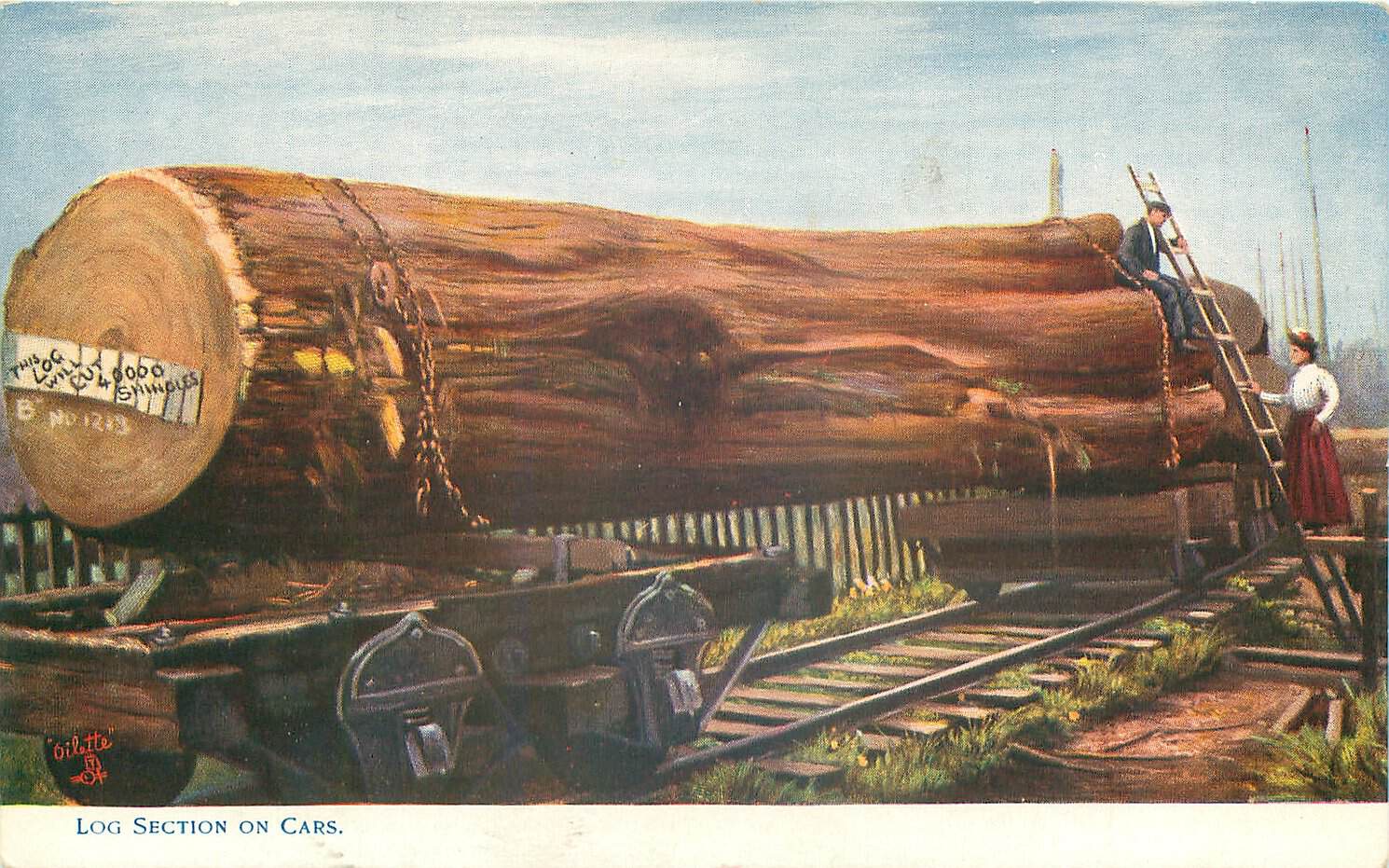
A “log length,” generally 30 to 40 feet, was how a big tree would be cut so it could be taken to a mill on special railroad trucks. The log shone in this picture, when cut up could be made into 40,000 shingles. The loading of these logs onto the railroad trucks was a delicate and dangerous task. By means of chains a log is drawn up an inclined pathway formed of dressed logs and finally landed in place when it is secured to the trucks.
Before chainsaws, loggers used double‑bit axes and crosscut saws to fell the trees. One of the most remarkable real‑life figures of this era was John R. “Johnny” Johnson, a Swedish‑American logger who became famous in the Pacific Northwest for his extraordinary precision and speed with a crosscut saw.
Johnson gained national attention in 1915, when he felled a 12‑foot‑diameter Douglas fir near Grays Harbor, Washington, using only hand tools — a feat documented in regional newspapers of the time. The tree was so large that it required three undercuts and a specially built springboard platform more than 15 feet above the ground. Johnson and his partner completed the cut in under two hours, a time considered astonishing even by professionals.
Johnson’s accomplishment symbolized the physical mastery demanded by the industry. Loggers were expected not only to bring down massive trees but to do so with accuracy, ensuring the trunk fell in a safe and usable direction. Their work shaped the region’s economy, accelerated the growth of cities like Seattle and Portland, and left a cultural legacy of toughness and ingenuity.
This look at logging shows how the world was built by real men performing real feats — forget Paul Bunyan – no tall tales required.
A look back at early logging in the American northwest begs the question, how much has changed – the answer is everything but the wood. Cross-cut handsaws have been replaced by gasoline powered chainsaws. Helicopters drag the logs from the forest, and a Global Positioning System is employed to find the trees deep in hardwood forests.
Being a carpenter and coming from a family of engineers we love the smell of saw dust in the morning – great post – thank you
I have a collection of giant tree postcards including tunnel trees. My earliest tunnel tree postcard is 1897. The stories on line about harvesting these giant trees back then is disheartening somewhat as so much waste occurred. Dams were made on high ground and sloughs to carry logs to the nearest river or train track or even lumber yard. Thanks for the article – well done. bob toal.
An informative and well researched article. Great read!
A great article and from it can flow so many more articles, redwood house in California, flues that were also used in the PNW to move logs to sawmill, origin of term ‘Skid Row’ and its use today, etc. So keep writing Graham, I for one, am looking forward to more articles.