The Duarte, California, Star Tribune called Chuckawalla Slim “one of the West’s stellar connoisseurs of gems and minerals.” He was famous enough for author Earl Stanley Gardner and others to recognize Slim as a “collector, philanthropist, humorist, and humanist.”[1]
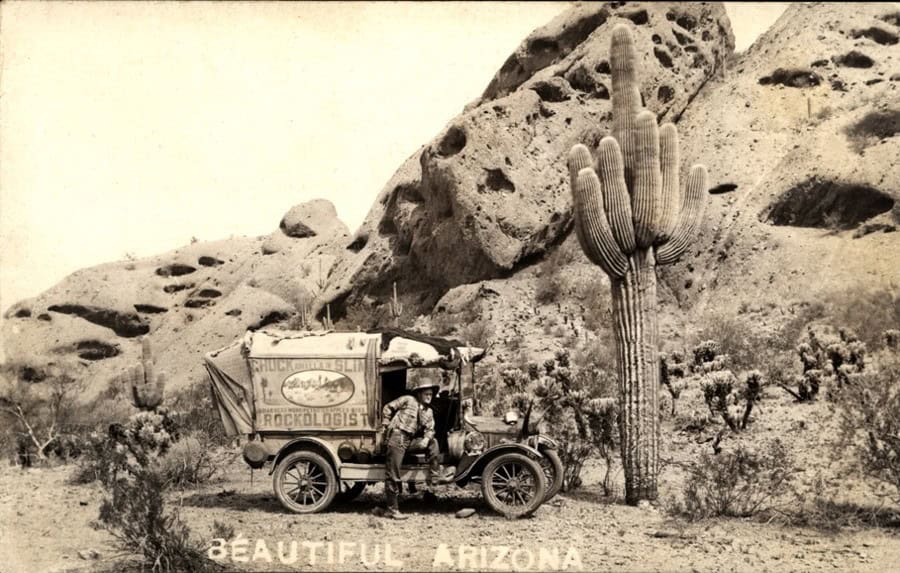
Model T truck near Phoenix in what is now Papago Park.
Born in Hyde Park, Massachusetts, on February 27, 1902, Edwin Howard Vose II created the character “Chuckawalla Slim” after he was discharged from the Navy in 1921, then moved west to Washington state. Adopting his Navy nickname “Slim,” he began collecting mineral specimens and curios in Oregon, California, Arizona, and in old Mexico.
Slim initially traveled the southwest in a 1920s Model T truck, with a diorama made of “porcelain, bead, fabric and feather,” and an elaborately painted canvas-cover decorated with skins, curios, and big horned sheep and cattle horns.
As he traveled, Slim slept in the back of his truck as he sold “Querose” as he called them on his business card, along with Navajo rugs, pottery, baskets, petrified wood, and minerals. Enticements he used to lure potential customers included his diorama (a western scene) on the back of his truck, his western prospector clothing, and assorted relics and animal skins.
One skin he was particularly fond of was a black and white monkey skin. It was purported to have been an escapee from a circus trainwreck, then was later captured by Indians who went “big game hunting” and brought him the pelt to add to his collection.
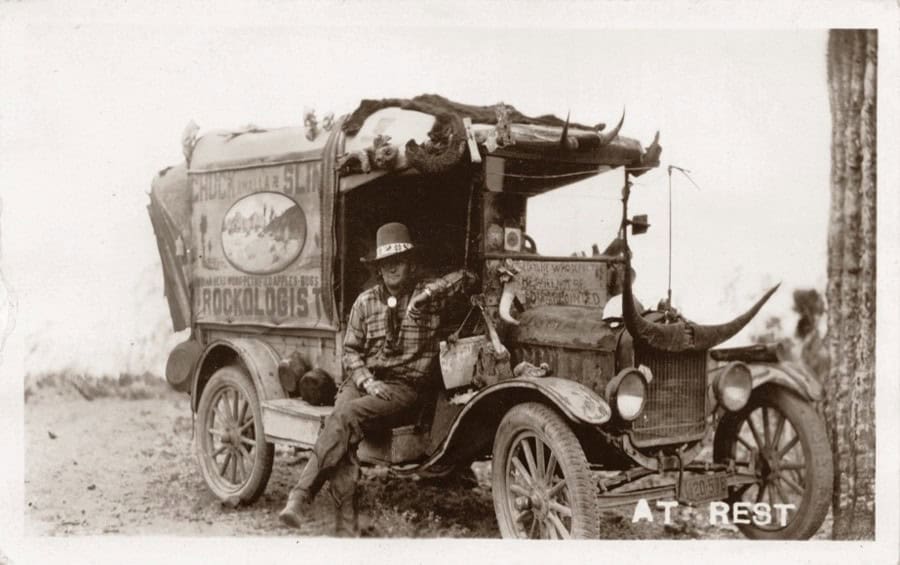
Slim’s route in the 1920s included trips to southern California, including Palm Springs, and east into Arizona. In Phoenix, Arizona, he was photographed at the base of the buttes between Phoenix and Tempe that is now Papago Park. Several real photograph postcards were made of Slim while in Arizona, likely for future promotional use, but those cards are rare today. Each card carries a rubber-stamped caption on the negative which appears in white on the postcards.
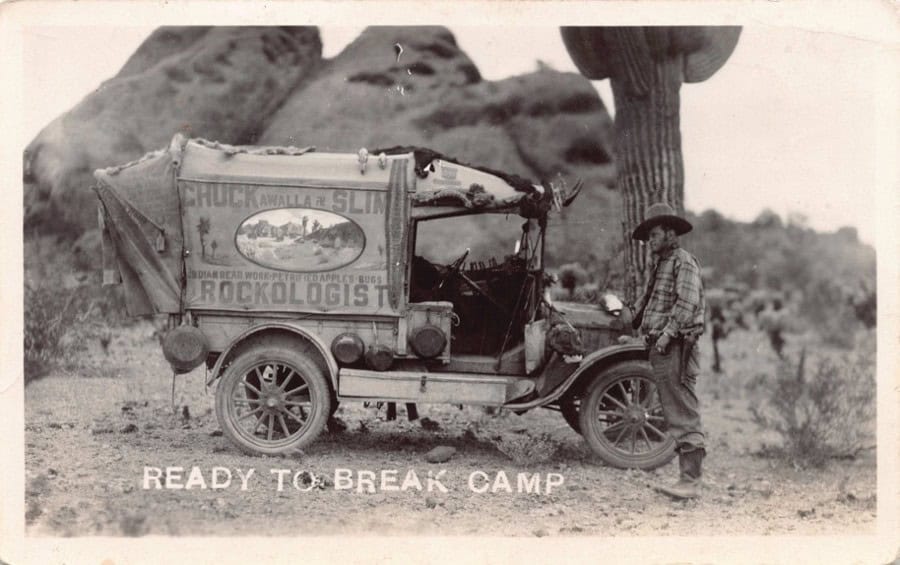
The three real photographic postcards identified to date show Slim in boots and cowboy hat with a six-shooter on his belt posed in front of his truck with the craggy Papago Buttes and a saguaro cactus in the background. One titled “Beautiful Arizona” is a broadside showing Slim’s truck in the classic western setting. A second, titled “At Rest” provides a casual portrait of Slim seated on the running board of his truck now in a ¾ view facing the camera. The third, titled “Ready to Break Camp” is a closeup of the side of Slim’s truck focused on the signage, artwork, and the relics that decorate the back of his truck.
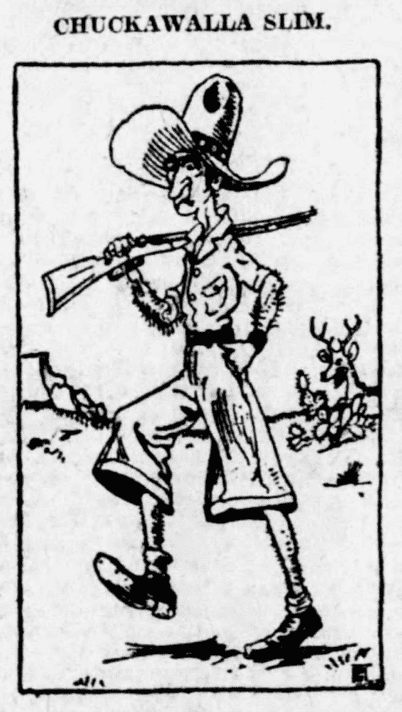
the Buffalo Times, Jan 10, 1926.
Vose as Chuckawalla Slim was popular enough to be recognized nationally. In 1926, the Buffalo, New York, Times carried a humorous parody article about Slim and a mistake by a Phoenix laundry that had shrunk his pants before a big dance. The article included a caricature cartoon titled Chuckawalla Slim.[2]
By 1929, when Slim posed for a photo destined for the Pasadena Post he was quoted as having traveled “450,000 miles in quest of curios.”[3]
Slim eventually established a fixed “Trading Post” in Monrovia, California, in 1933.[4]
For his road trips Slim traded up from his Model T truck to a 1923 Studebaker “Big Six” sedan and replaced the small sleeping area in the back of his truck with a long travel trailer in which he could both display his wares and live while on the road. He used postcards of his car and trailer with its large “The Rockologist” inscribed on the side, and “The Rockologist” and “Chuckawalla Slim” on the back to promote his stops on the road.
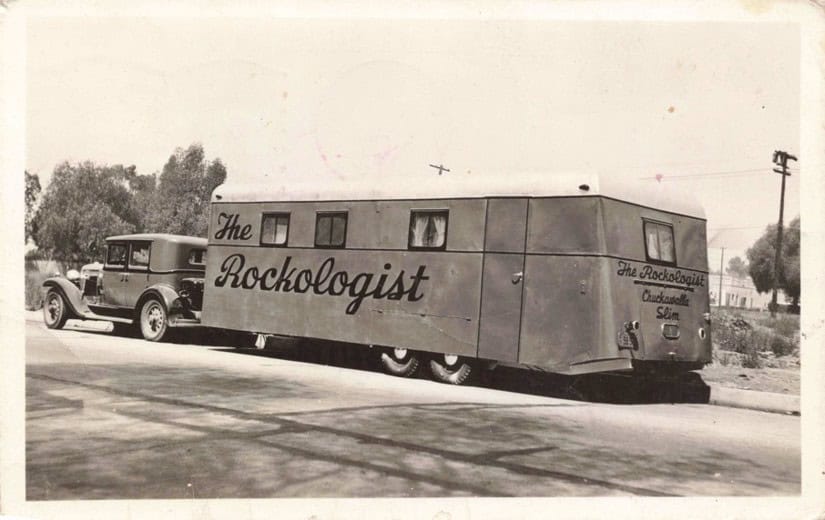
and living quarters. Likely along the road to Santa Cruz, California, c. 1940.
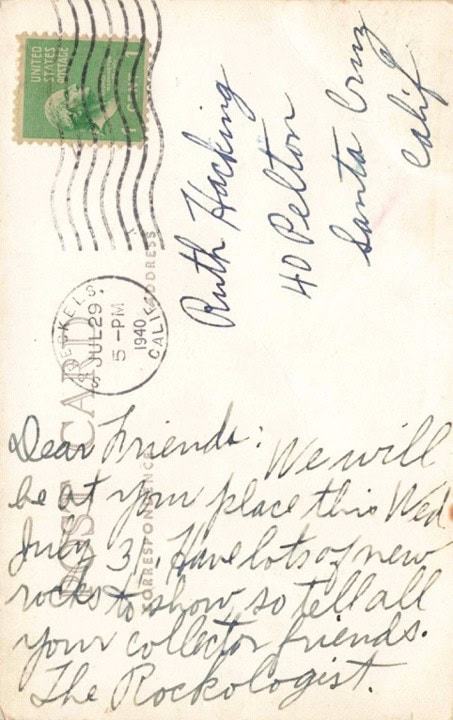
In the 1940s, Slim lived in the Los Angeles area. He carried the “Chuckawalla Slim” persona so far that when Edwin Howard Vose II filled out his WW II draft card, it listed his business as “Minerologist at Large.” He served in the war effort at Lockheed in Los Angeles but still had time to dedicate to his Rockologist role. The Palm Springs Limelight News carried his advertisements that encouraged rock collectors to visit him in the trailer park in Cathedral City in 1942 and 1943.[5]
After WWII, Chuckawalla Slim lived in the Los Angeles area and maintained his role as the Rockologist. By then he had traded his Studebaker for a 1950s Willys Jeep pickup and continued collecting, selling, and donating specimens as an ambassador for the minerals and cultures of the West.
Edwin Howard Vose II passed away in Los Angeles, California, April 29, 1975.
***
NOTES:
1The Star-Tribune (Duarte, California) · Wed, Mar 25, 1970 · Page 9
2The Buffalo Times (Buffalo, New York) · Sun, Jan 10, 1926 · Page 56
3The Pasadena Post (Pasadena, California) · Mon, Sep 16, 1929 · Page 9
4Monrovia News-Post (Monrovia, California) · Wed, Apr 12, 1933 · Page 1
5The Palm Springs Limelight News, November 14, 1942 – Jan 1, 1943
Fun article about a character I have never heard of before. Love the term “rockologist”.
A 15 minute walk from my driveway the city has made questionable enhancements to Papago Park since WWII. Research and rppc examples are exceptional. Thank you.
Jeremy,
Thank you, this article is worth a free lunch in Chinatown.
Rock on,
Michael Langenstein