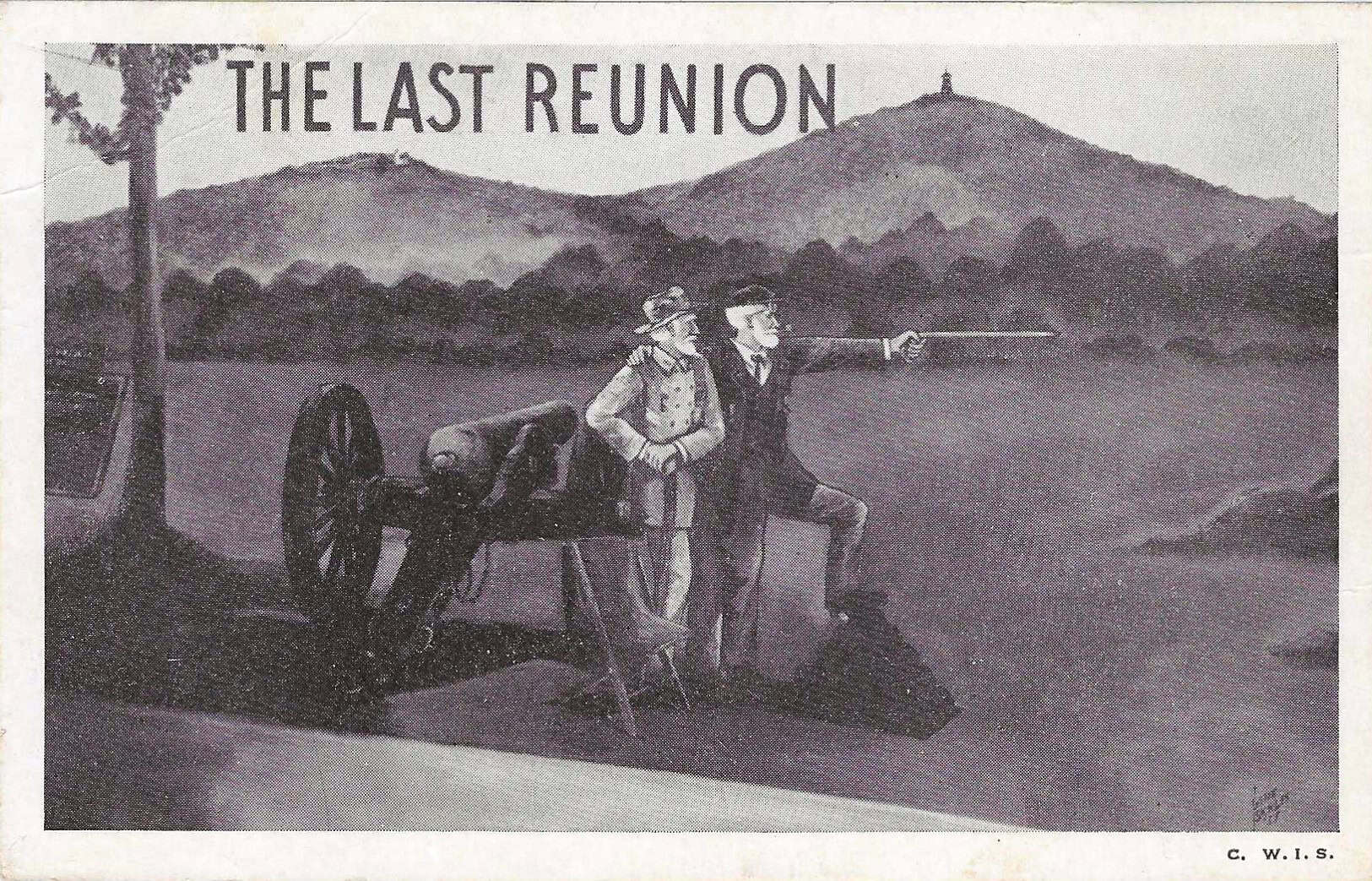
The final great gathering of the surviving veterans of the Battle at Gettysburg took place in the summer of 1938—seventy‑five years after the guns fell silent on those Pennsylvania fields. It was, in every sense, a last reunion: a final opportunity for the dwindling ranks of Union and Confederate soldiers to return to the ground where they had once fought, and to stand together not as enemies but as old men bound by a shared memory. The event, held from June 29 to July 6, brought together 1,359 Union veterans and 486 Confederate veterans. All 1,845 of them were almost ninety-four years old.
They came from every corner of the country, transported at federal expense, many accompanied by attendants to help them navigate the vast encampment built specially for the occasion. The logistical effort was immense: more than 3,000 U.S. Army personnel, along with hundreds of police officers and medical staff, were deployed to support the gathering. A “regular army camp” displayed modern weapons, a striking contrast to the muzzle‑loading rifles and artillery the veterans once carried.
The idea for this final reunion had been planted decades earlier. At the 1913 fiftieth‑anniversary gathering, Pennsylvania’s governor issued an invitation for the veterans to return in twenty‑five years. Many doubted such a reunion could ever occur—after all, the veterans were already elderly in 1913. Over the next quarter‑century, the First World War, the influenza pandemic, the deaths of the last Civil War generals, and the Great Depression all threatened to ruin the plan.
Even when preparations resumed in the 1930s, controversy erupted over whether Confederate flags would be permitted at the event. The commander of the United Confederate Veterans, Harry R. Lee, was so angered by the initial refusal that he told the organizers they could “go to Hell.” Yet negotiations eventually succeeded, and the reunion moved forward, but the happenings occurred without Commander Lee.
Harry Rene Lee, served as a Sergeant during the war in Co. K of the 34th Mississippi Infantry and then in 1935 became the first Adjutant General and Commander-in-Chief of the United Confederate Veterans Association, died in Tennessee in March 1938 at the age of 92.
For the veterans who made the journey, the reunion was both solemn and celebratory. They walked — some were wheeled — across the same ridges and fields where they had once fought. Some visited the Angle, the site of Pickett’s Charge, where Union and Confederate veterans shook hands across the stone wall in a symbolic gesture of reconciliation.
One attendee, Wilson Polk Wallace of Arkansas, embodied the emotional weight of the event. Ninety‑four years old and attending Gettysburg for the first time, Wallace served in the 17th Arkansas Infantry and had been captured at Port Hudson in 1863. He insisted on making the trip, accompanied by his son and a fellow veteran. A reporter noted that the sight of a Confederate flag or the sound of “Dixie” still stirred his spirit. Wallace fell ill on the journey home and died shortly afterward in a St. Louis hospital.
The emotional climax of the reunion came on July 3, when President Franklin D. Roosevelt addressed the assembled veterans before dedicating the Eternal Light Peace Memorial. Before a crowd of 150,000 people, Roosevelt praised the spirit of unity embodied by the gathering and lit the memorial’s flame, intended to burn forever as a symbol of national reconciliation. A recording of his speech was later placed in the Westinghouse Time Capsule for the 1939 New York World’s Fair.
By the time the veterans departed Gettysburg on July 6, they knew, and so did the nation, that such a gathering would never happen again. Only about 8,000 Civil War veterans were still alive in 1938, and fewer than two dozen were veterans of Gettysburg. The reunion was indeed a farewell to the most divisive years in the country’s history.
***
A personal note: more than six decades later, I learned that my great-grandfather served in Gettysburg – but after the war. He enlisted when “his mother permitted” in the fall of 1863. He was a proud member of a U.S. Army Quartermaster detachment from Pennsylvania that performed much of the “clean-up duty” in the months following the battle.
Thank you, Professor Cleveland, for a very interesting and historical article. My wife and I had the opportunity to visit Gettysburg a few years ago, and it seemed to us that much of the history of that war can still be felt just walking through the place. I can only imagine the emotions of those soldiers who attended the reunion.
Very moving article. I had the same reaction as Shav and his wife when I visited in 1972. At the time, I was serving as a Navy Hospital Corpman (woman in my case) at the Naval hospital in Bethesda, MD. In my work, I was treating men and women returning from Vietnam.
Then to be in the presence of the spot where so many Americans fought and died, was very overwhelming. The energy is palpable. Thank you for this piece.
ER – fantastic post – a time in American history never to be forgotten – thank you and have a great 21st century 4th –
I am a member of the North Shore Civil War Roundtable and have been to Gettysburg several times
including, the most memorable 150th anniversary. It is truly sacred ground. I only wish today people
who have opposing views could reach across and shake hands as these old warriors did many
years ago. Thank You Professor Cleveland for the article.
I have two postcards related to this topic that were issued by the Post Card Collectors Club of America. One is the the GAR Final Encampment, Indianapolis, Indiana, August 29, 1949. The other is the 61st and Final Reunion, Final Encampment of the United Confederate Veterans, held in Norfolk, Virginia, May 30 to June 2, 1951.
I have extras of both of these post cards. If you would like them, let me know.
Just love the deck chair
Great article. Being I live 10 miles from the Gettysburg battlefield I enjoy driving through it on occasion always seeing something new. It’s a beautiful place each of the four seasons. The reenactment held each July 4th weekend on a farm outside the battlefield perimeter is a great experience.