The story of the 25th Infantry Bicycle Corps is a remarkable and underrated episode in American military history. It is disturbing that so few people know of it, but there are some profound reasons why it is still unknown. Just read on!
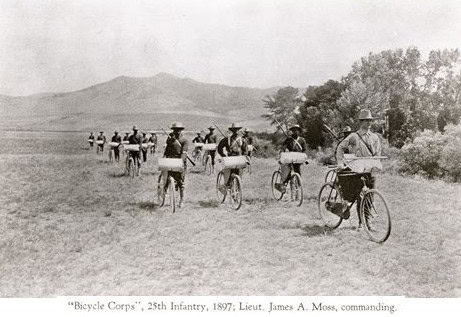
Long before jeeps and motorcycles, back when George S. Patton was twelve years old and when Dwight Eisenhower was seven, those who commanded the United States Army wondered whether the bicycle might offer a cheaper and faster alternative to the horse. To find out, they turned to a group of men whose determination was already legendary: the Buffalo Soldiers of the 25th Infantry Regiment.
The Buffalo Soldiers were African American soldiers who served in the U.S. Army after the Civil War. In 1866, Congress created several segregated Army regiments for black soldiers, including the 9th and 10th Cavalry and later the 24th and 25th Infantry. They served primarily on the western frontier, where they built roads, protected settlers and mail routes, and fought in conflicts with Native American tribes. The nickname “Buffalo Soldiers” was supposedly given to them by Native Americans, possibly because their dark, curly hair resembled a buffalo’s coat or because of their courage and determination in battle. Despite facing discrimination and unequal treatment, the Buffalo Soldiers earned an outstanding reputation for discipline and bravery.
In 1896 James A. Moss was a 24-year-old U.S. Army Second Lieutenant stationed at Fort Missoula, Montana. He was determined to make a name for himself and volunteered for a duty he had only heard about. After his graduation from West Point in 1894 he learned that the Army was about to consider replacing the horse-soldier with a bicycle-soldier. He was eager to be part of such a program and volunteered for an assignment out west.
Moss did make a name for himself. He is credited for organizing and leading the famous 25th Infantry Bicycle Corps, a unit of Buffalo Soldiers. Many of his colleagues thought his assignment as folly, but he developed a strong respect for the men under his command and advocated, even in Washington, D. C., for programs intended to test the military potential of bicycles.
In 1896 and 1897, Moss led a series of remarkable long-distance bicycle expeditions. The one most publicized was a nearly 2,000-mile ride from Fort Missoula to St. Louis, undertaken to determine whether bicycles could serve as an efficient military transportation system. The expedition left Fort Missoula on June 14, 1897. Twenty black enlisted soldiers volunteered for the journey, accompanied by Moss, Army surgeon James Kennedy, and newspaper reporter Edward Boos. The route followed railroad corridors through Montana, Wyoming, South Dakota, Nebraska, and Missouri, exposing the riders to mountains, plains, mud, deserts, and extreme weather.
The bicycles themselves were not lightweight machines. Made by the Spalding Company, each one weighed about 32 pounds and roughly 59 pounds when loaded with military equipment. Each rider carried a rifle, ammunition, clothing, shelter half, blanket, and rations. Often the roads were so terrible that the men had to push their bicycles for miles just to make progress.
The soldiers endured conditions that would challenge even modern cyclists. They faced snow, sleet, hail, heavy rain, intense summer heat, food shortages, contaminated water, mechanical breakdowns, and frequent racial prejudice along the route. Yet they averaged impressive distances, sometimes exceeding 50 miles in a day. Their endurance earned them the nickname “Iron Riders.”
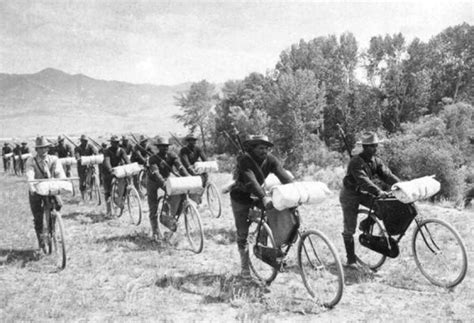
After 41 days the Bicycle Corps reached St. Louis on July 24, 1897. Their arrival was celebrated by local cyclists who escorted them into Forest Park.
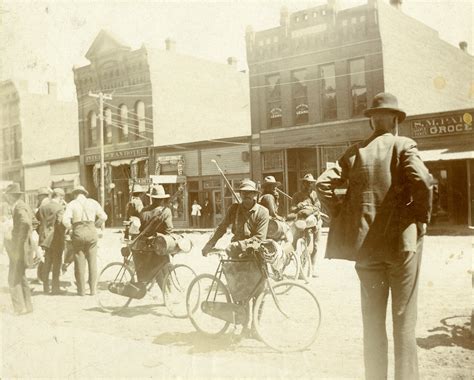
Although the Army ultimately decided that bicycles could not replace horses for most military purposes, the experiment succeeded in proving both the strengths and weaknesses of military bicycles. On good roads they were faster and cheaper than horses and required no feed. But America in the 1890s had few good roads outside cities. Soon afterward, the Spanish-American War and the rapid development of automobiles shifted military attention elsewhere. The Army ultimately abandoned the idea of bicycle infantry.
Moss himself became a noted military author and later wrote several instructional books for soldiers.
***
Among Lieutenant Moss’s day-by-day travel journals are fascinating records concerning road conditions, weather, and the soldiers’ experiences in remarkable detail. One such document is a map showing the path of the expedition.
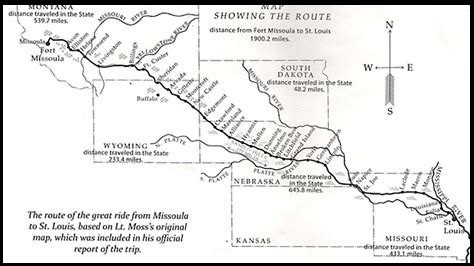
The Bicycle Corps followed railroad corridors because they often provided the most reliable routes across the West. This original 1897 map drawn under the direction of Lieutenant James Moss appeared in contemporary newspapers (and later published as a postcard by the Dispatch) after the corps reached St. Louis.