Postcards of every genre document the importance of Indian boarding school bands during the “golden era” from 1905 to the end of World War One. This article focuses on images of territorial Arizona Indian boarding school bands.
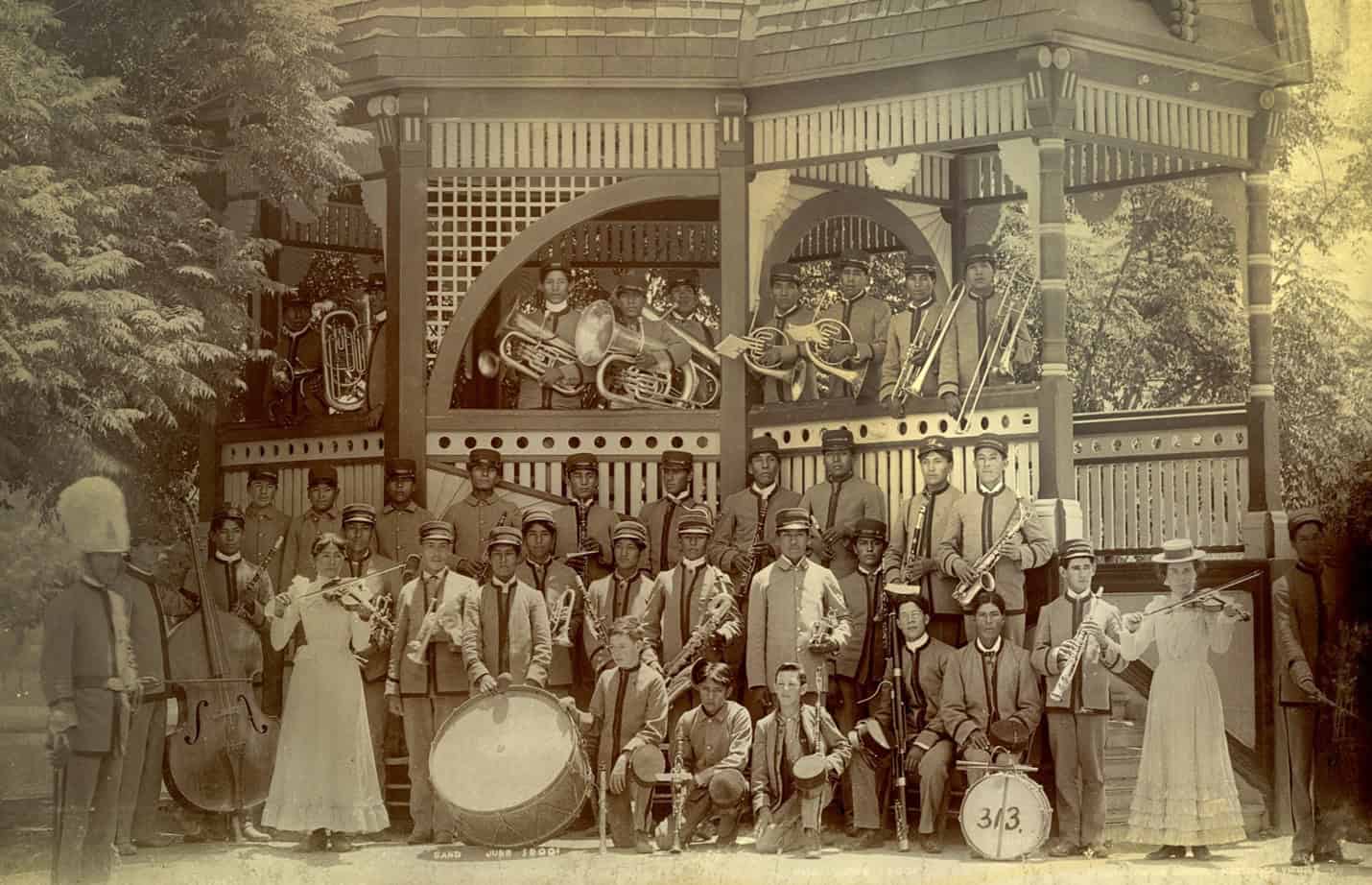
In the late nineteenth and early twentieth centuries, bands and orchestras were used in musical education as assimilation tools to separate Native students from their cultures. Music classes minimized drums and indigenous ceremonial songs, replacing them with marches, polkas, and patriotic music. The goal was to facilitate the transition and to “civilize” Native students.
Bands were almost exclusively male. A roster from the Phoenix Indian School from that era reflects another assimilation tool – anglicized names. Included were drum major Oscar Norton and cornetist Grover Cleveland.
The formal attire for band members often imitated military style uniforms. Discipline and drills using western music and harmonies replaced ancestral songs and dances. Some schools carried the military metaphor even further, using bugle calls to regiment time, noting morning reveille, announcing meals, and calling for “lights out” at night. At the Phoenix Indian School, band leader (and night watchman) Carlo Contrado, composed the “Indian School March” for his students to perform.
The bands often provided the soundtrack for marching drills and events where students stood or traveled in formation. In addition to marching and drilling, Indian School bands performed in bandstands and gazebos offering concerts both on the school grounds, and in adjacent communities.
The bands provided promotional opportunities and were showcased during visits by inspectors and dignitaries. For example, the Phoenix Indian School band performed for President William McKinley when he stopped in Phoenix during his 1901 cross country tour.
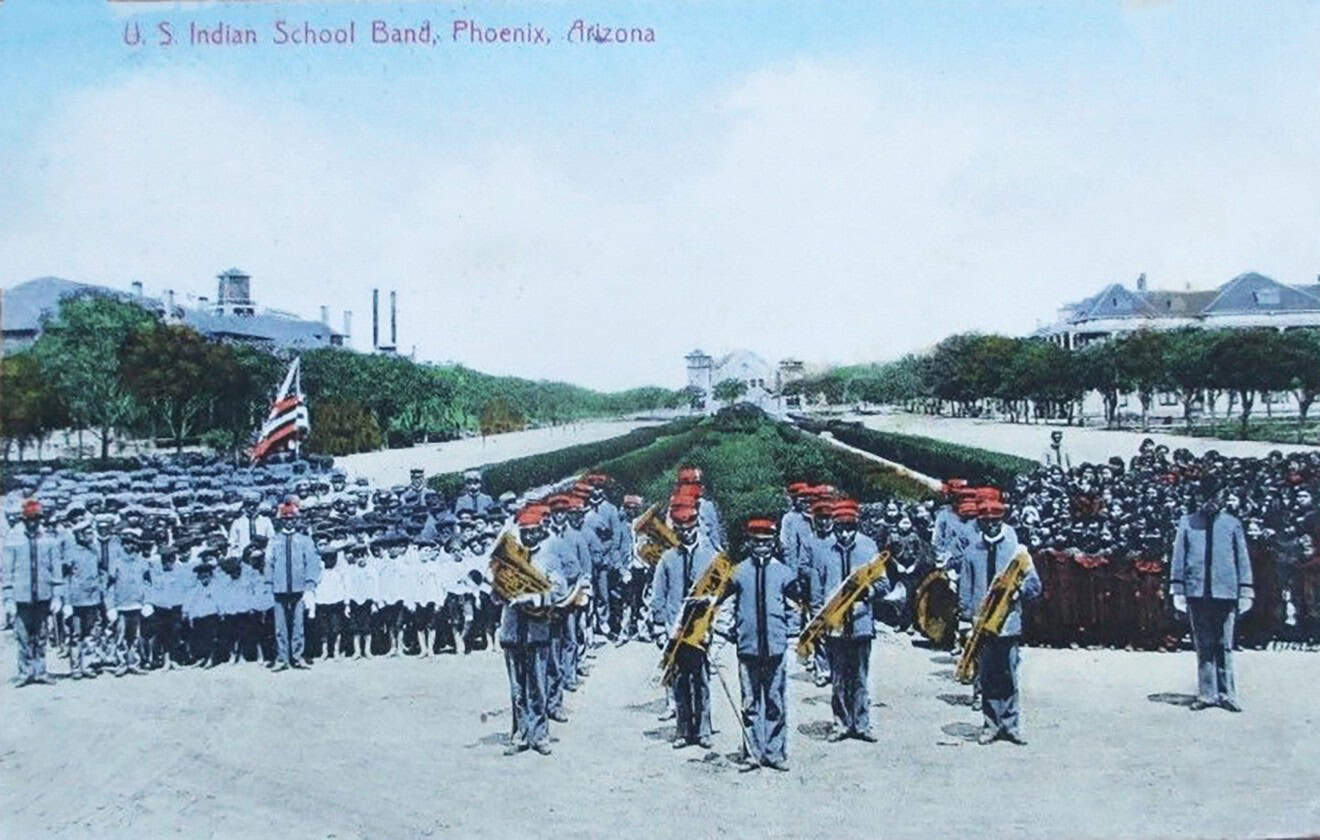
Indian School bands also appeared in local and regional parades. Larger schools, like Phoenix with about 700 residential students, used travel as an enticement and as a reward for students to join and perform in the bands. The Phoenix band performed at the Rose Bowl in California and toured nationally.
Even the smaller schools of the time incorporated music and marching bands in their curricula. A fine example is seen on this real photo card at the small Navajo‑Country school at Fort Defiance in northeastern Arizona. You can see an unidentified band leader posed with two young children and twenty student musicians – an impressive number of musicians, given the small student population.
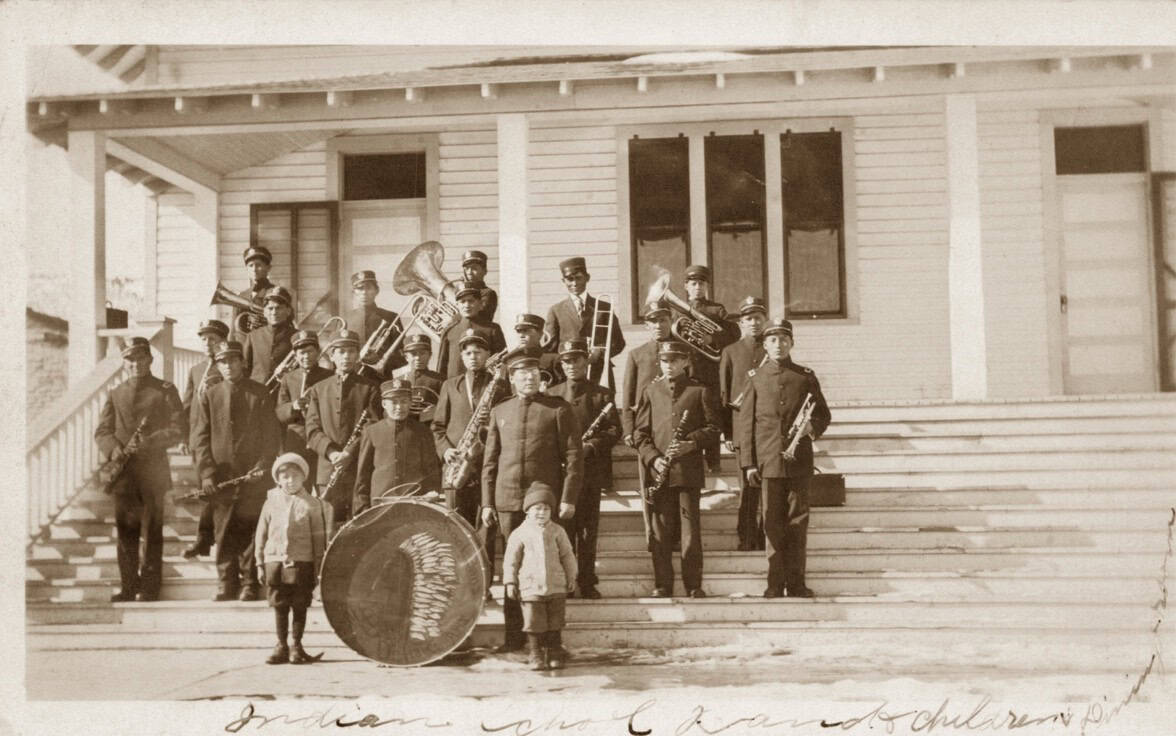
Though no photographs have been located to date that document the event, the Phoenix Indian School Band performed at the Fort Defiance school during their Arizona and New Mexico tour in 1904.
My collection focuses on “golden era” real photo postcards. I enjoy assembling groups of related cards, like these of the Indian boarding schools, and researching and writing about them.
Interesting and sad.
Wonderful article Jeremy. A very important slice of student “assimilation” activities throughout Indian Boarding Schools in North America.
Doug,
Thank you for the kind comments.
I hope well is well with you.
Best regards,
Jeremy
Great article! I collect Native American Indian schools, hospitals, etc. but have rarely seen postcards of the bands. Real treasures!
Bonnie,
Thank you. Please let me know if you have Arizona related Indian school photographs or real photo postcards in your collection as this is one of my ongoing interests.
Best regards,
Jeremy
je*********@*su.edu
vintagephoto.com
As a collector of school and Native American RP postcards I, too, highly agree with previous comments regarding the high quality of these images and the well written story. Look forward to reading more about your collection and interests. Thank you and congratulations.
Tedd,
Thank you. Please let me know if you have Arizona related Indian school photographs or real photo postcards in your collection as this is one of my ongoing interests.
Best regards,
Jeremy
je*********@*su.edu
vintagephoto.com
Wonderful subject and so timely as now people know of some of the cruel methods used to assimilate Indian Children. What a shame there are not more postcards for Mr.Rowe.
Thank you so much for the fascinating article and amazing images. What a great job describing a little known aspect of the Indian Boarding Schools. I learned a lot.
I would recommend to readers to go back and either reread or read for the first time all of the articles written by Jeremy Rowe. You will find them equally interesting and well worth your time.
Colleen,
Thank you for the kind comments.
Best regards,
Jeremy