The Arctic and to a lesser degree, the Antarctic, have always invited the imagination to wander—toward undefined horizons, drifting ice, and the quiet persistence of life at the edges of the world.
Among the many ways people have tried to capture these distant regions, postcards hold a special kind of intimacy. They are small, deliberate gestures: a rectangle of paper carrying a frozen moment, a brief message, and the sender’s desire to make the faraway feel close.
In the images on postcards, polar bears pose against fields of snow, villages tucked into snow, ships pressing through ice, we glimpse not only the regions, but the stories people have told about it.
Studying the Tuck’s Arctic postcards teaches us how we imagine the North, how we frame it, and how those frames have shifted with exploration, tourism, climate anxiety, and nostalgia. They are souvenirs, yes, but also cultural artifacts—tiny archives of longing, mythmaking, and the human urge to map meaning onto the cold.
Tuck produced three six-card sets of Arctic region postcards: Set # 7339 – The Arctic Regions, illustrated by Albert Operti, a 6-card set, circa 1905; Set #7484 – In the Arctic Regions II, illustrated by Maud Scrivener, a 6-card set, circa 1907; and Set #9187 – In the Arctic Regions III, illustrated by Albert Operti, a 6-card set, circa 1907. Tuck also issued two individual postcards showing Dr. Frederick Cook and Commander Robert E. Peary in arctic style clothing, both signed by Albert Operti.
***
This contribution is far afield from my previous presentations, yet it retains the established principle that my contributions to Postcard History are on Tuck & Sons postcards.
Most “Would Be” explorers see the Arctic as a magical place: endless ice, majestic wildlife, and temperatures so low they make your freezer look like a tropical resort. It is also one place on Earth where archaeologists can say with confidence, “Yes, that object is definitely well‑preserved since the climate is basically nature’s walk‑in refrigerator.”
We’ll explore people, animals, weather, and clothing.
THE EXPLORERS AND NATIVES
So, set your thermostat on “freeze” and join me as we go down the path to cold. If you read to the end, you’ll know enough about the Arctic to impress your friends, confuse your enemies, and possibly survive a mild snowstorm.
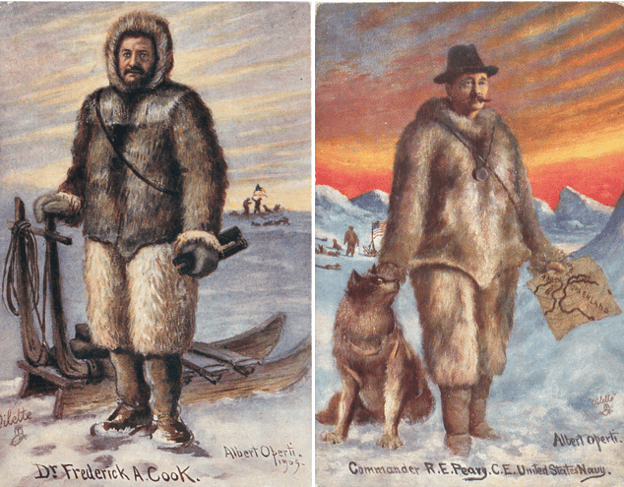
Dr. Frederick Albert Cook was an American physician and polar explorer whose ambitious claims made him one of the most controversial figures in exploration history. He asserted that he reached the North Pole in 1908, a claim later deemed unproven by the University of Copenhagen after reviewing his limited records. Cook also claimed the first ascent of Denali, though this too was discredited. Despite disputes, Cook played a crucial role as surgeon on the Belgian Antarctic Expedition (1897–1899), where his medical insight helped save the crew during the first Antarctic wintering. His expeditions contributed significantly to early polar exploration, even as debates over his achievements persisted.
Commander Robert E. Peary was a U.S. Navy officer and Arctic explorer best known for his 1909 claim of reaching the North Pole, a milestone still debated by historians. Born in 1856, he conducted multiple expeditions across Greenland and the High Arctic, proving Greenland was an island and setting several “Farthest North” records. Peary relied heavily on Inuit knowledge and the skill of his assistant Matthew Henson. His final 1908–1909 expedition, traveling by dogsled from Ellesmere Island, brought him close—if not exactly—to the Pole. Despite controversy, Peary was celebrated in his time and became a central figure of the Heroic Age of polar exploration.
Cook and Peary stand as the two most contentious figures in the race for the North Pole, their rivalry shaping one of exploration’s greatest controversies. Cook claimed to have reached the Pole in April 1908, while Peary asserted he arrived in April 1909—and each accused the other of fraud.
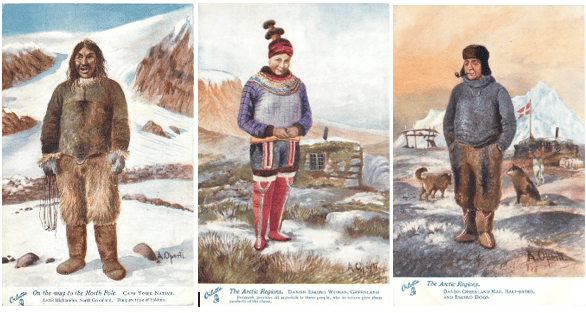
In Set #7339, Tuck’s The Arctic Regions, illustrator Albert Operti depicts three Indigenous people: A Cape York Native of Northern Greenland (below left), A Danish Eskimo woman, also from Greenland (center), and a Danish Greenland man.
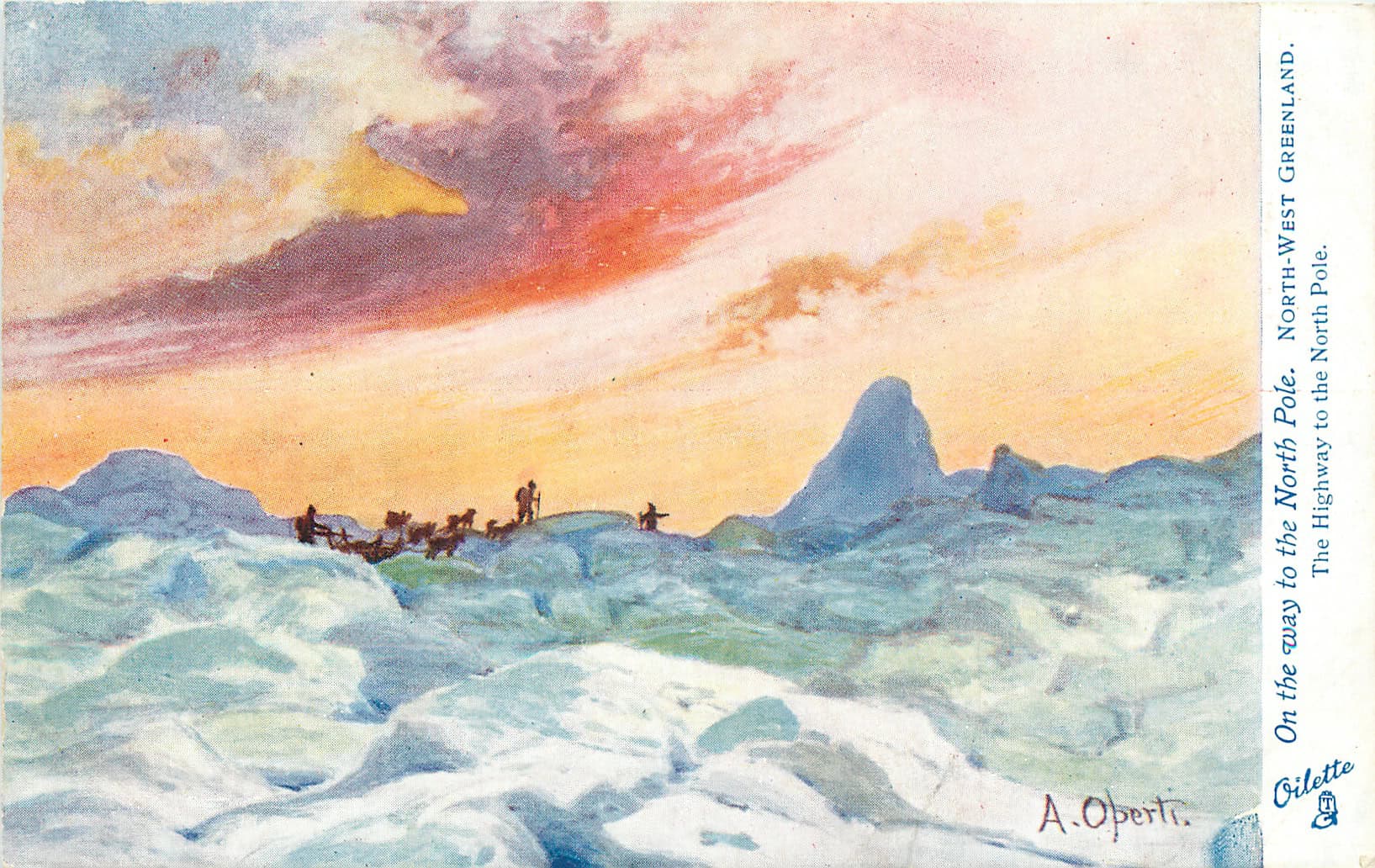
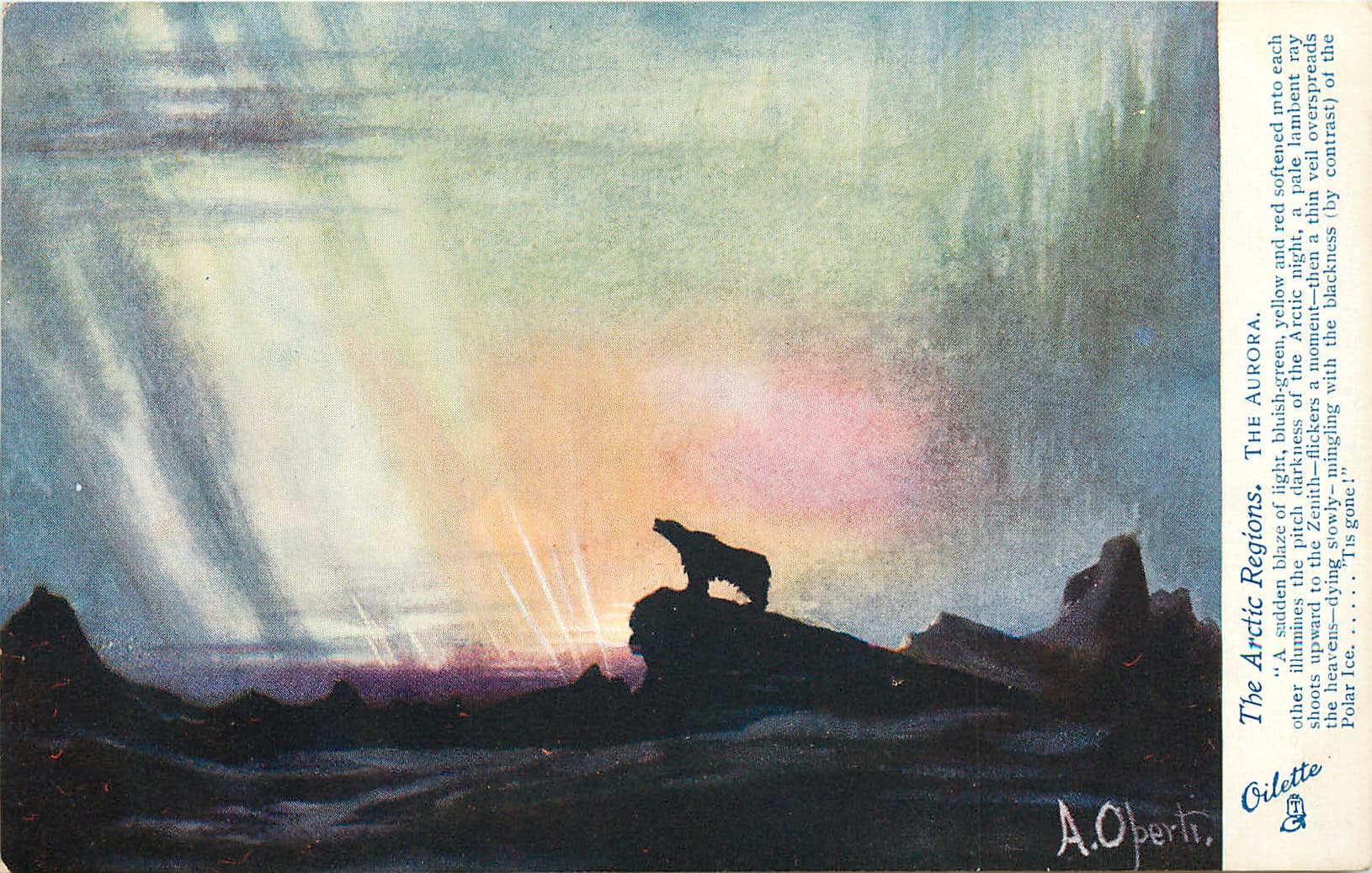
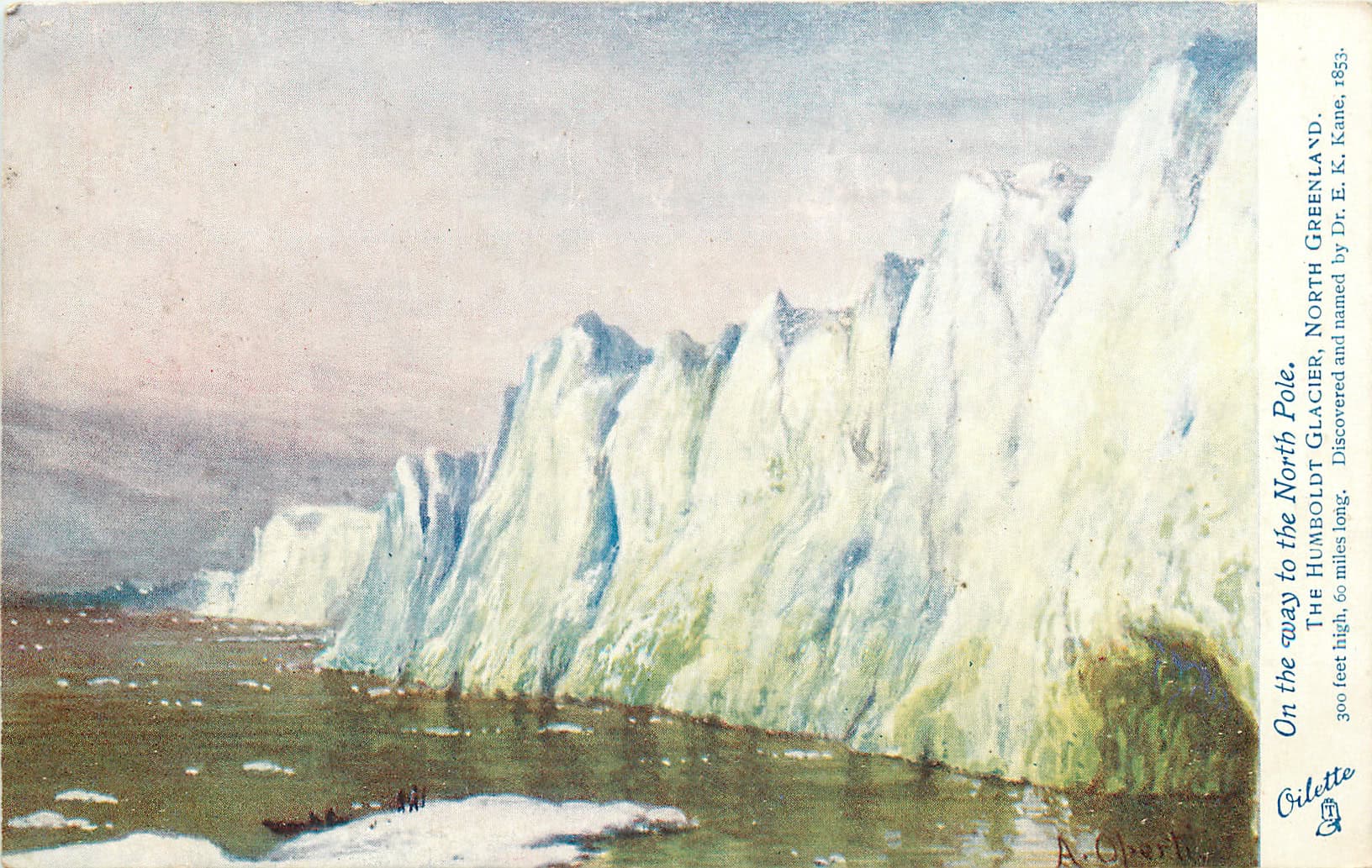
The other three cards show scenes of ice: a team of explorers on their way to the pole from Western Greenland, a scene of the Aurora with a polar bear in profile, and a view of the Humboldt Glacier.
WILDLIFE
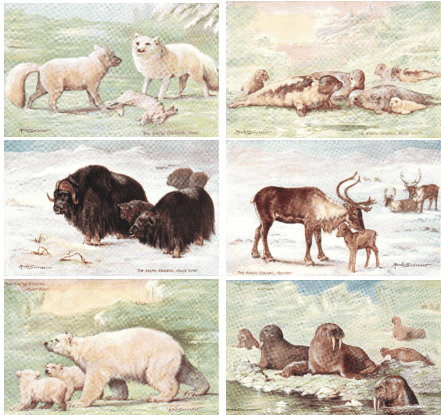
In Set #7484 – In the Arctic Regions II, artist Maud Scrivener portrays the wildlife of the Artic. Included are Artic Foxes, Harp Seals, Musk Oxen, Reindeer, Polar Bears, and Walruses.
PLACES
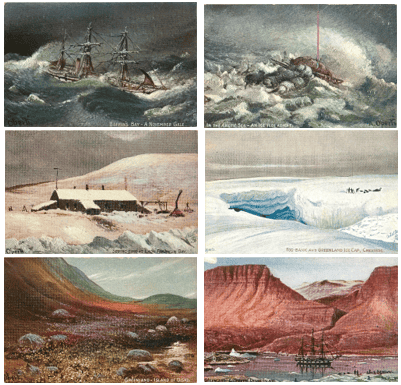
In Set #9187 – In the Arctic Regions III, Albert Operti, again depicts scenes of polar regions where study, learning, and observation are the main activities. The first shows a November storm on Baffin Bay, the second shows An Ice Floe Adrift in the Arctic Ocean. Weather in the Arctic is difficult to define, the third card in this set shows Springtime at Lady Franklin Bay. (No doubt that this place was named for the wife of Sir John Franklin who was a British naval officer and polar explorer famed for his ambitious but tragic Arctic expeditions. Born in 1786, he mapped large stretches of the Canadian Arctic during the Coppermine and Mackenzie River expeditions. His final 1845 voyage, commanding HMS Erebus and HMS Terror in search of the Northwest Passage, ended in disaster when both ships became icebound near King William Island. Franklin died in 1847, and his entire crew was lost to starvation, hypothermia, and scurvy. His legacy endures as one of exploration’s most haunting mysteries.) The fourth card in this set shows a Fog Bank and Greenland Ice Cape, [near] Crevasse. The last two cards show the Greenland Island of Disko and the harbor at Godhaven, Disko Island.
These cards mean a lot to me. It took me near thirty years to visit more than thirty-five countries, but despite my desire to visit the Arctic, I never managed to see it. I hope that those of you who are curious can ‘one-up’ me this time.
Adventure travel can ‘cruise’ you to this ice-olated destination. Specialty agencies have created escape tours to see the polar shoreline, iceburg graveyards, a museum and walking among penguins. Make this a legacy passage.
What great postcards about an intriguing topic. They really spark the imagination, especially since I don’t think I’ll visit the Arctic *except* in my imagination. And I didn’t know that Peary’s claim was subject for debate. Thanks for the lesson and virtual trip!
Fascinating area of study! Thanks for sharing your collection and knowledge with us.