Saint Mark’s bell tower is the most visible landmark in Venice, Italy.
Here is the story of its collapse and reconstruction.
A miracle in many ways.
It began on an April morning in 1902, but first, the tower is located in Piazza San Marco. It looks impressive and seems quite historic in these modern photochrome postcards.
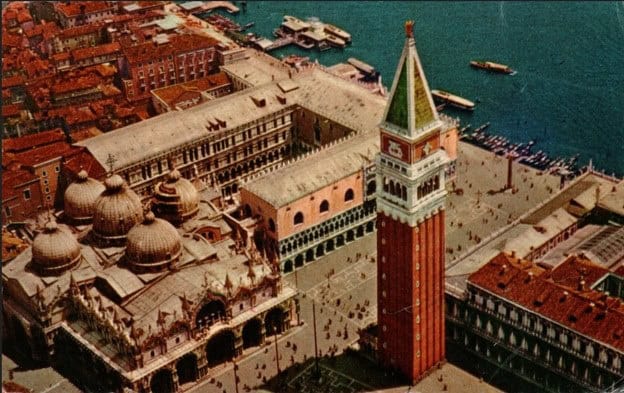
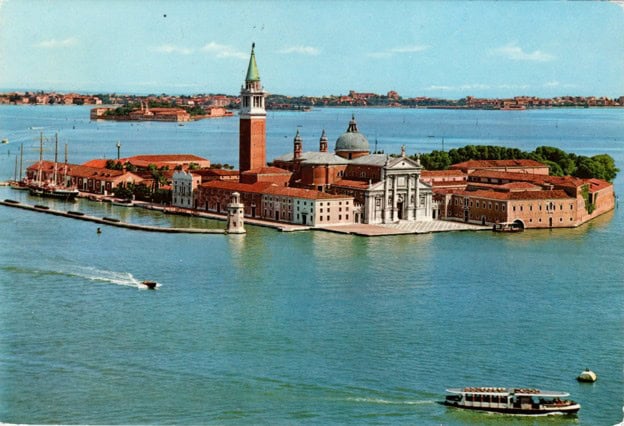
But some older postcards and some research uncover a more dramatic and interesting story.
The construction of the original tower is believed to have been initiated in the tenth century. The height of the tower gradually increased and in the twelfth century bells were installed and the spire was constructed. In the fourteenth century, the spire was golden. The final height was reached in 1514 at 323.5 feet.
The bells and the tower were not ornamental, they played an essential role in the life of the city. The bells served as alerts for threats and calls for mass; they also announced the start and finish of a workday.
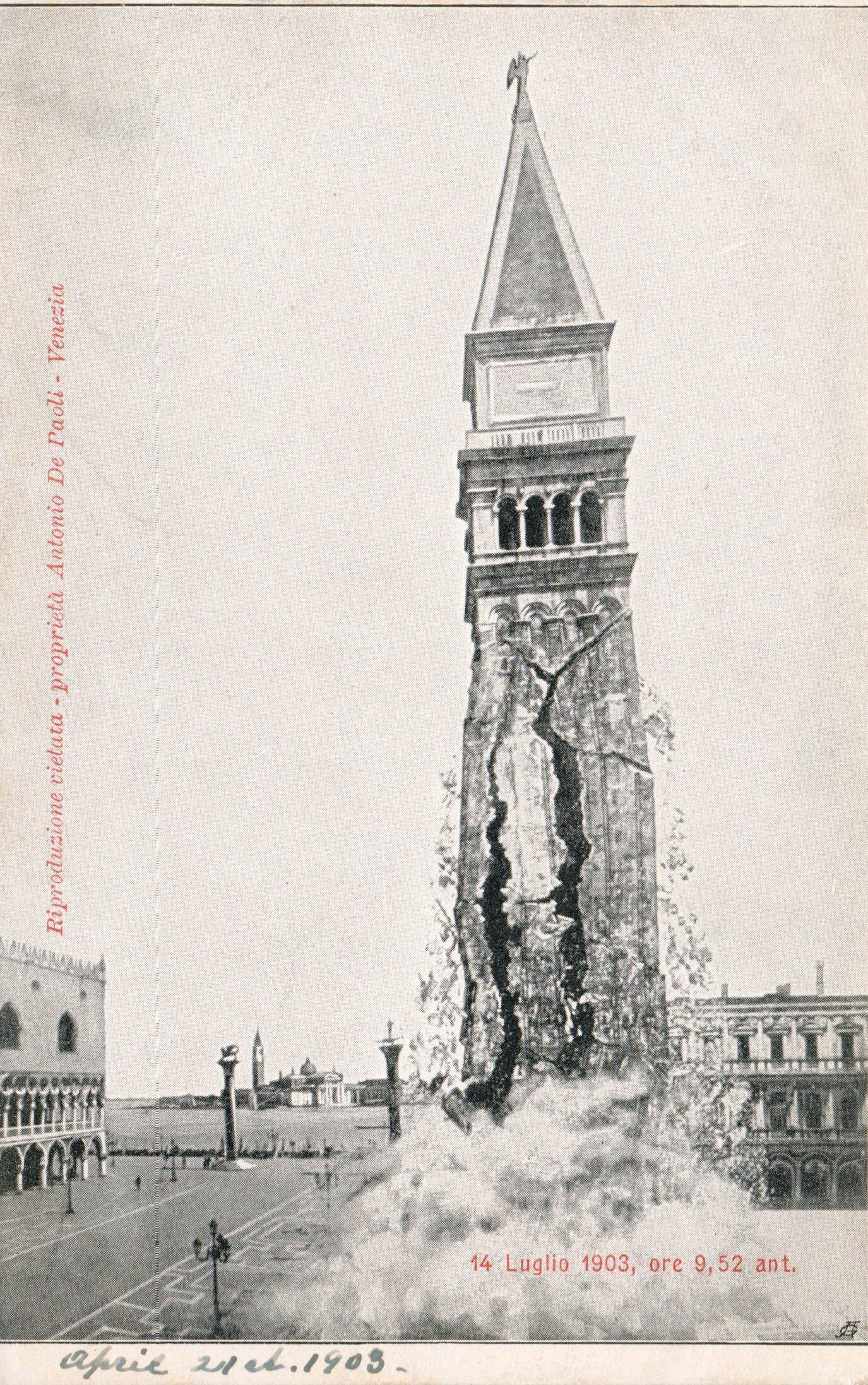
In the spring of 1902, cracks appeared in the structure. Thus, on July 12, 1902, engineers started monitoring the tower and fenced it off from the public. Even a concert to be held on the Piazza in the evening of July 13th was cancelled as an extra precaution.
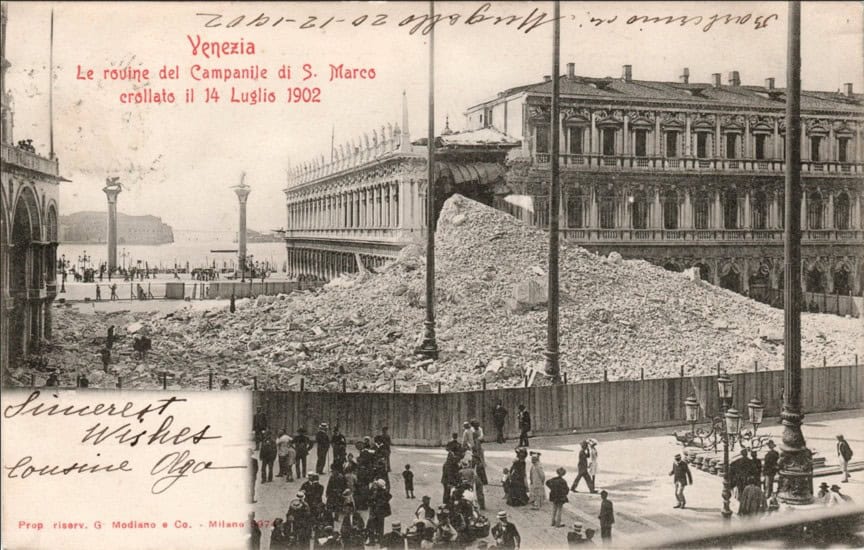
On July 14th, around 9:45 AM, the tower collapsed.
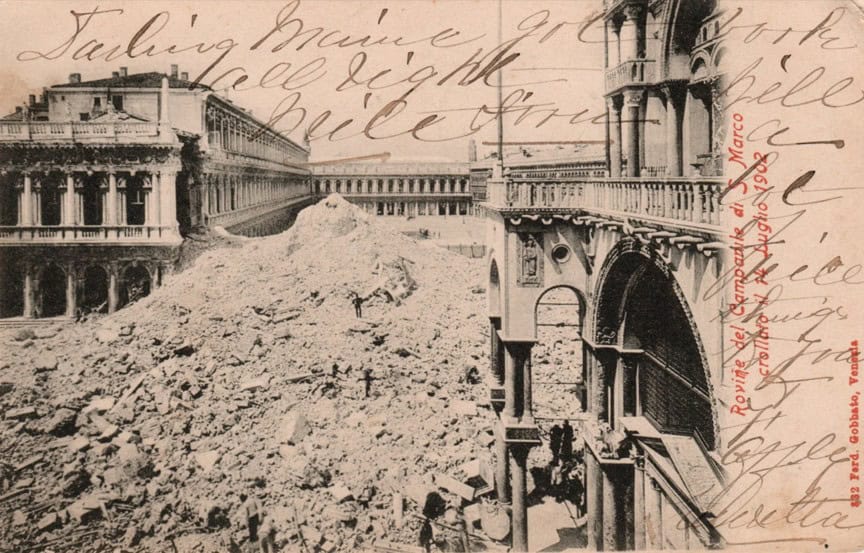
Notice that the caption on this postcard has the incorrect year: 1903, handwritten and even printed. Was this photo taken at the right moment? We do not know if this photo, and the one below, were pictures of the event or artistic renditions since there is no information on the cards.
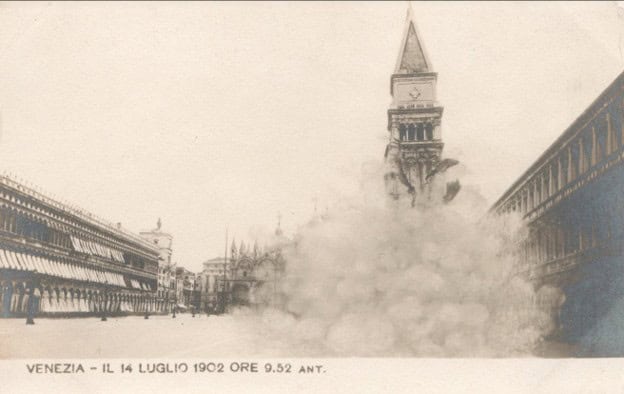
As the piazza was evacuated prior to the event, maybe there was a photographer on standby. The images seem too dramatic to be realistic. We can only speculate!
Luckily, there were no victims other than the guardian’s cat, so the legend says, but the whole tower was very quickly reduced to rubble.
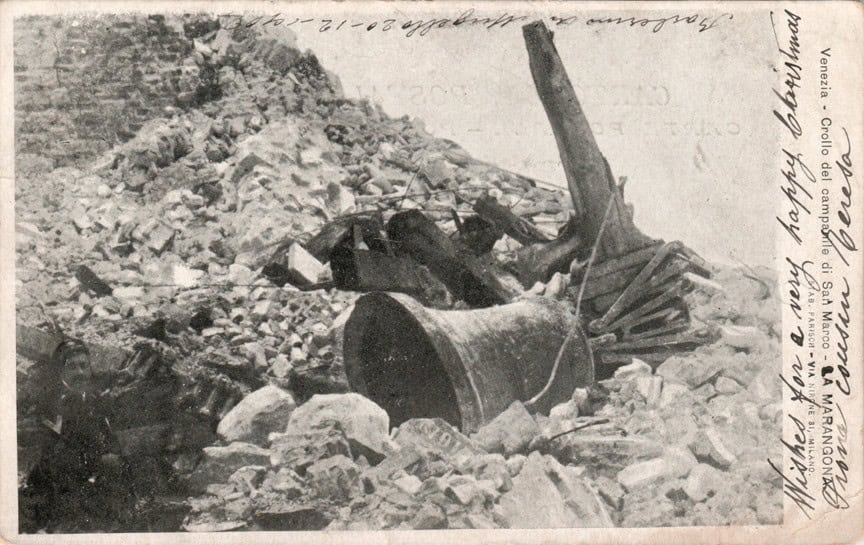
The card below shows the “Marangona,” the only bell that survived the disaster. When the bells were new and installed (in 1820), there were five, but after the collapse the other bells were found in pieces. Happily, the pieces of metal were melted to build four new ones.
On the same evening as the collapse the city council voted to rebuild the tower exactly as it was! The mayor uttered the famous words: “Dov’era, Com’era” (Where it was, how it was). And so, it was, the new tower looks the same as it was before the collapse, which makes dating the postcards somewhat difficult!
Nevertheless, the supporting structure is very different. Several architects and engineers were involved in the reconstruction: two architects, Luca Beltrami and Gaetano Moretti, from Milan were put in charge of the reconstruction; Georg Leib from Germany donated the scaffolding; the engineers Daniele Donghi and Giovanni Antonio Porcheddu were in charge of the structural integrity of the tower.
Donghi was an employee of the city of Venice and an ex-employee of Porcheddu. Both were very enthusiastic over a new technology called “concrete.” Porcheddu had an exclusive license for the Hennebique system since 1894 for northern Italy and for the rest of the country (excluding Sicily) by 1914.
This system, patented by François Hennebique from France in 1892, consisted of concrete that was reinforced with iron sections arranged and tied together with stirrups. It is now commonly called reinforced concrete. Thus, the two engineers decided to use the Hennebique system for an enlarged foundation and the core structure of the tower. Making it more structurally sound and lighter.
The exterior had to be built with bricks to ensure that the new tower looked exactly as the old one. Thus, the exterior was built using, as much as possible, the original bricks. To build faster and make it safer for the workers, an innovative scaffolding that slides upwards as the construction progresses was used.
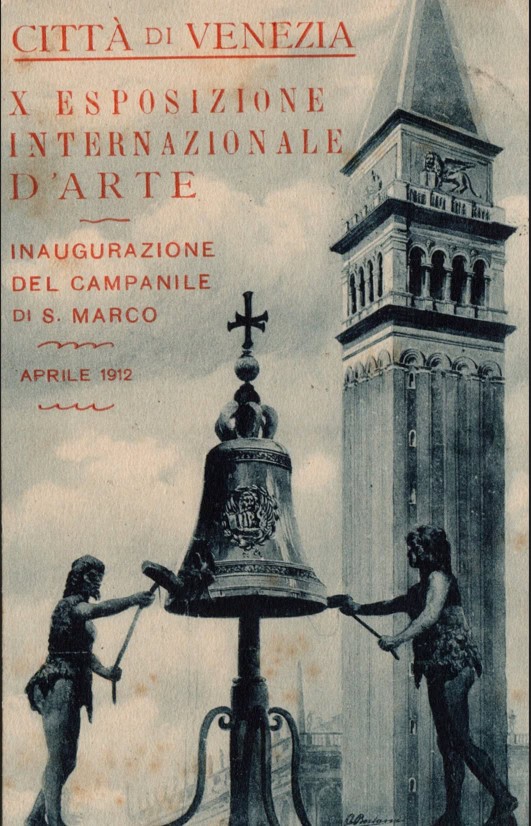
The reconstruction was completed in April 1912.
Another part of the tower that was destroyed was the Loggetta.
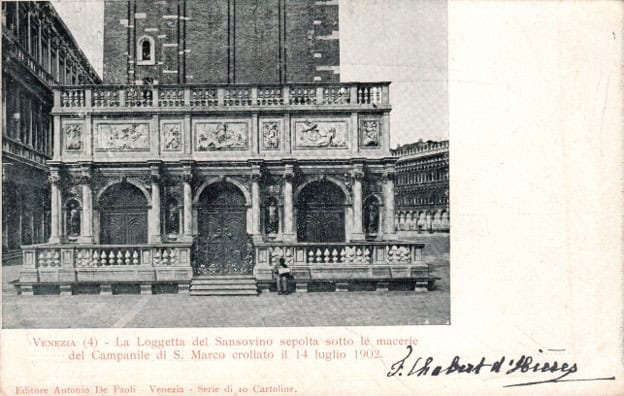
This building was an add on to the tower, as it was conceived in the fifteenth century as a covered exterior gallery where the noblemen could meet. It was severely damaged in the earthquake of 1537 and thus, by 1546 it was completely rebuilt under the direction of the architect Jacopo Sansovino. It is often called the Sansovino Loggetta.
After the 1902 collapse, it was rebuilt using about 50% of its original elements. It too was completed in 1912 – again “where it was, as it was”!
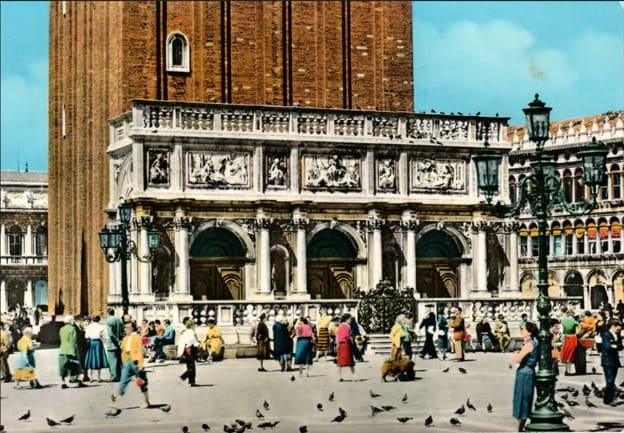
When you travel to Venice, you can see the tower dominating the landscape, but it is only 114 years old instead of centuries old and it has a solid concrete core to keep it there for centuries to come.
Before it fell, from my own collection.
Very informative!
A great article, I have several chrome postcards of Venice and never realized the tower was a reconstruction.