In my mind, to call the early eighteenth century the Golden Age of Piracy is simply wrong. How can anything so evil, terrorizing, and mean spirited have a Golden Age? But some historians use the term to describe America’s most notorious pirate, Blackbeard, as a symbol of adventure, fear, and rebellion.
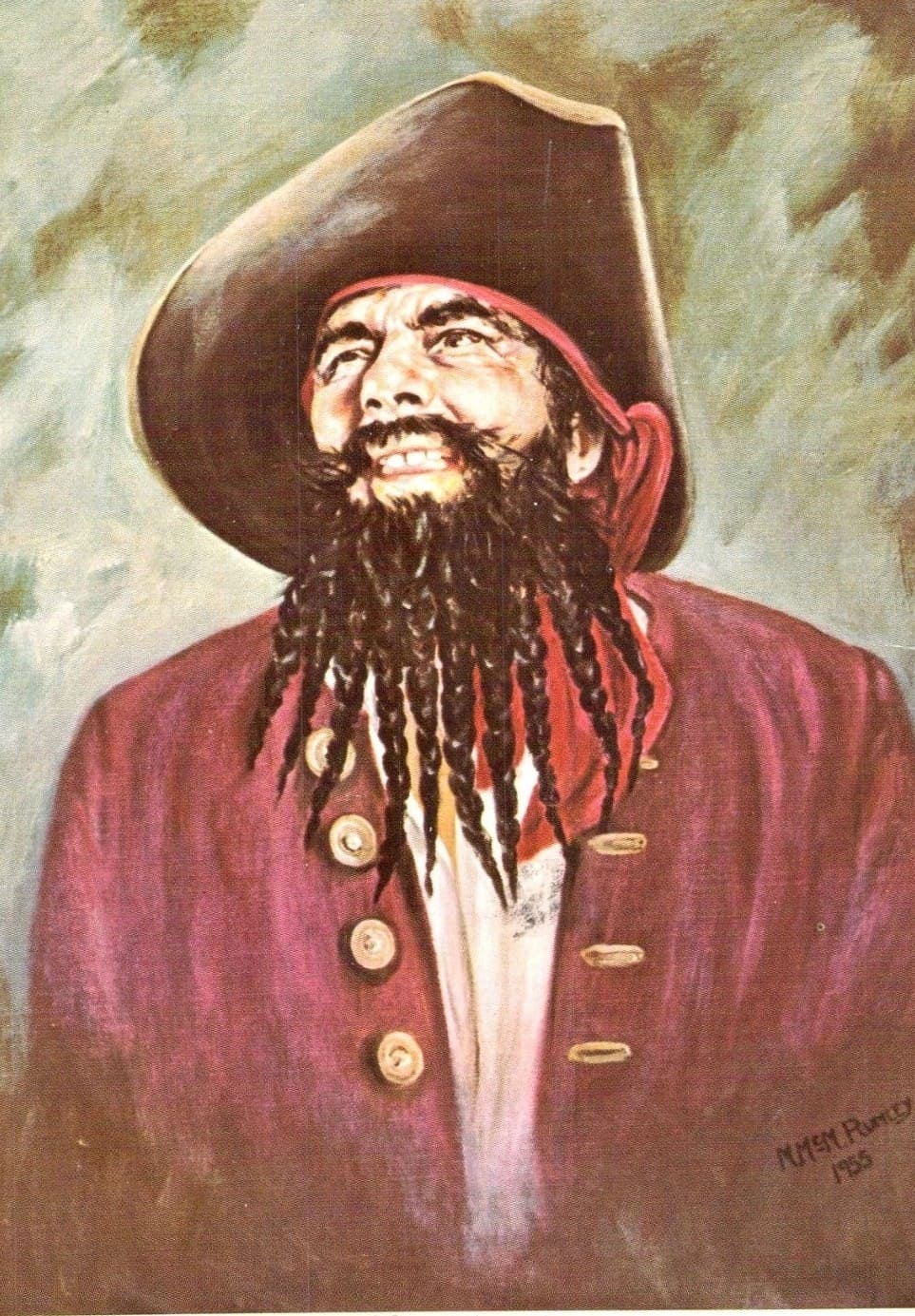
Known for his fierce appearance and cunning tactics, Blackbeard commanded one of the most powerful pirate ships of the era, the Queen Anne’s Revenge. Together, the pirate and his vessel became legend whose stories continue to fascinate nearly everyone.
Blackbeard’s given name was Edward Teach, though historians still debate the proper spelling. Some records also spell it Thatch or Thache.
Little is known about his early life, but most historians believe he was born in Bristol, England, around 1680.
During the War of the Spanish Succession, Teach likely served as a privateer, a sailor authorized by the British government to attack enemy ships. When the war ended in 1713, many privateers found themselves unemployed. Some, including Teach, turned to piracy as an occupation.
Teach rose to prominence in 1716 while serving under the pirate captain Benjamin Hornigold. His intelligence, leadership, and daring quickly earned him respect among his fellows. By 1717, he had become a captain in his own right and began building a reputation throughout the Caribbean and the Atlantic coast of North America.
The event that transformed Teach into the legendary Blackbeard occurred in late 1717. Near the island of Martinique, he captured a large French slave ship called La Concorde.
The vessel was sturdy, fast, and heavily armed, making it an ideal flagship. Blackbeard renamed it Queen Anne’s Revenge, a title that may have reflected loyalty to supporters of the former Queen Anne and the Stuart dynasty.
Blackbeard dramatically expanded the ship’s firepower, equipping it with added cannons. Now renamed Queen Anne’s Revenge, it became one of the most formidable pirate ships ever to sail. Its impressive size and weaponry allowed Blackbeard to dominate shipping lanes throughout the Caribbean and along the American coastline.
Merchant captains often surrendered without resistance when they saw Queen Anne’s Revenge approaching. Equally important was Blackbeard’s skill in psychological warfare. He fostered the intimidating image that others designed to terrify enemies before a battle even began. Contemporary accounts describe him as a tall, imposing man with a thick black beard.
Before obvious engagements, Teach created a costume of fear. He combined swords with pistols strapped across his chest and developed a fierce expression that was so dramatic that many believed him to be the devil himself. This fearsome reputation often enabled Blackbeard to capture ships without firing a shot.
One of Blackbeard’s most famous exploits aboard Queen Anne’s Revenge occurred in May 1718 near Charleston, South Carolina. He and his fleet blockaded the harbor, effectively trapping ships and disrupting commerce. During the blockade, Blackbeard captured several vessels and took prominent citizens hostage. Rather than demanding gold, he requested a chest of medical supplies as ransom. After receiving the supplies, he released the hostages unharmed. The incident demonstrated both his boldness and his ability to use intimidation strategically.
Despite its success, Queen Anne’s Revenge had a surprisingly short career. In June 1718, while navigating near Beaufort Inlet off the coast of present-day North Carolina, the ship ran aground on a sandbar. Historians continue to debate whether the grounding was accidental or deliberate. Some believe Blackbeard intentionally wrecked the vessel to reduce the number of crew members with whom he would have to share treasure.
Whatever his reason, the ship could not be recovered and was abandoned after Teach gave the order to, “Sink Her.”
After the loss of his flagship, Blackbeard accepted a royal pardon offered to pirates by the British government and settled into a home known as the Old Brick House, just five miles north of Elizabeth City, North Carolina.
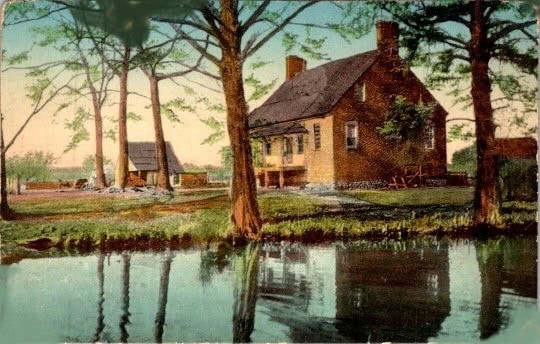
However, his retirement was brief. He soon returned to piracy and sailed mostly along the North Carolina coast. Colonial authorities grew increasingly concerned about his activities, and Virginia Governor Alexander Spotswood authorized a military expedition to capture him.
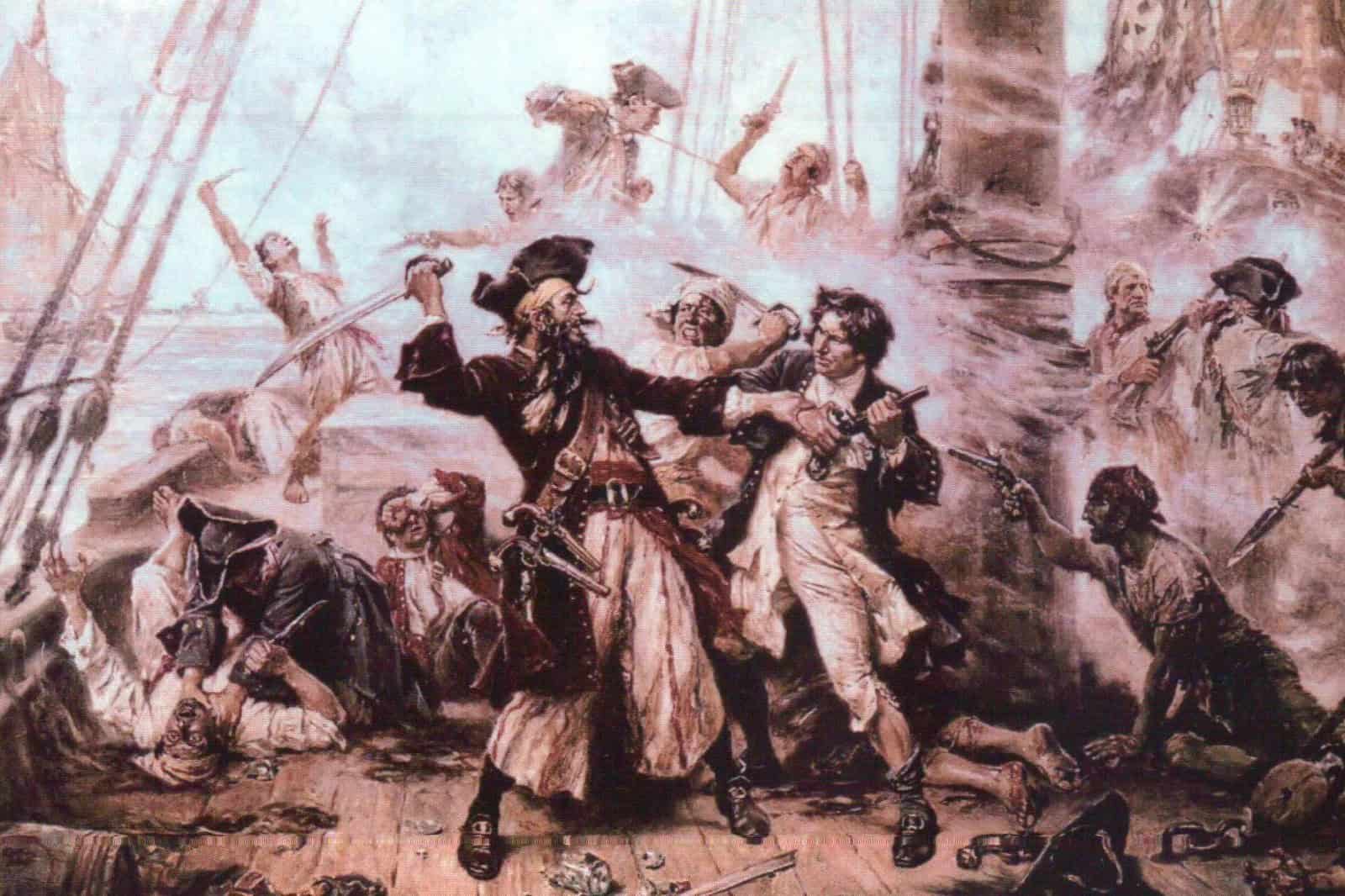
November 1718 by Jean Leon Gerome Ferris
The final confrontation took place on November 22, 1718, near Ocracoke Island. Lieutenant Robert Maynard of the Royal Navy led a force against Blackbeard. During a fierce battle, Blackbeard fought hand-to-hand with extraordinary determination. According to contemporary reports, he suffered twenty-five cuts and gunshot wounds before he collapsed at Maynard’s feet.
When all fell silent, Lieutenant Maynard ordered that Blackbeard’s head be cut off and hung from his ship’s bowsprit by its hair. There were many willing to follow his order.
For more than two centuries, Queen Anne’s Revenge rested beneath the waters off North Carolina. In 1996, archaeologists identified a shipwreck believed to be Blackbeard’s ship and excavations recovered thousands of artifacts, including cannons, anchors, medical instruments, navigational tools, and personal items.
These discoveries have provided valuable insights into pirate life and confirmed many aspects of historical accounts, but they still provide little evidence that these relics come from a Golden Age of Piracy.