Phrases in language are used because they do much more than simply convey information. They add color, emotion, imagery, rhythm, and shared cultural meaning to communication. Here are some of the main reasons they work so well:
- They Paint Mind Pictures – human brains remember images more easily than abstract ideas, so phrases stick in our minds.
- They Compress Complex Ideas – short phrases communicate a large amount of meaning. Fewer words instantly communicate what is familiar.
- They Add Emotional Force – phrases often carry emotional weight that plain language lacks.
- They Connect People Through Shared Culture – phrases come from history, literature, religion, sports, sailing, farming, and even Shakespeare.
- They Improve Rhythm and Sound in many ways – alliteration, repetition, and balance.
- And, they Reflect Centuries of Experience – phrases survive because generations have found them useful to describe places, things, and people in new ways.
With these facts in mind, we realize that humans think in terms of stories, images, and metaphors. Rather than merely stating facts, they transform ideas into something visual and memorable. That makes communication faster, richer, and often more persuasive.
But most English speakers use a phrase regularly without knowledge of its source, origin, or true meaning, i.e., What does it really mean when we say, “He got cold feet,” or “”She was on cloud nine.”
Let’s set the record straight on the original meaning of five frequently used phrases. The decision is left to the reader as to whether they continue to use any of the following knowing their historic or current meanings.
Deadline
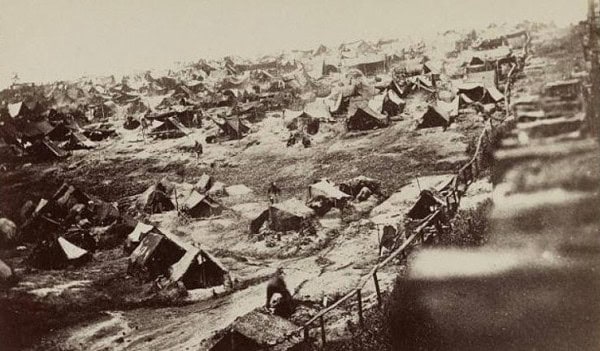
The phrase “deadline” has a very grim origin. During the American Civil War, prisoner-of-war camps such as Andersonville Prison in Georgia used a “dead line” inside the stockade. This was a boundary, often marked by a simple rail, fence, or trench, set some distance inside the prison walls. Prisoners were warned that if they crossed this line, guards were instructed to shoot-to-kill.
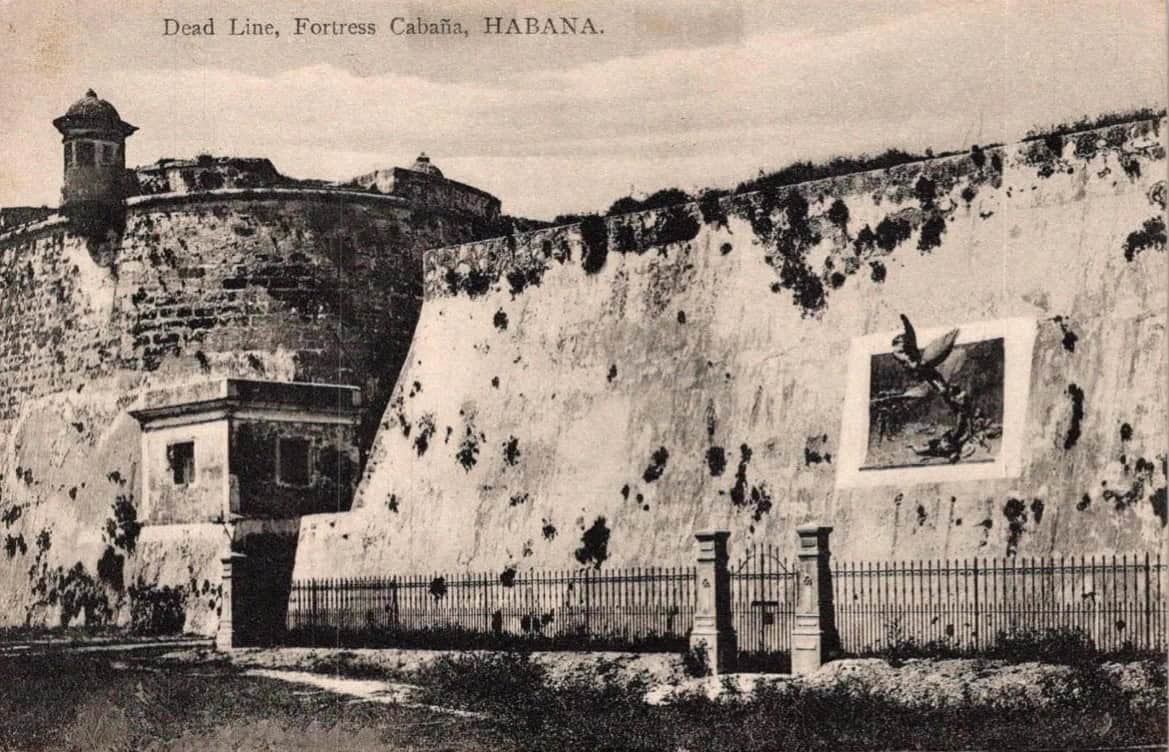
Later uses of the phrase continued when the practice was renewed in places like Cuba and other countries where it was commonplace to “rid society of the unwanted.”
The modern meaning developed about 1919 when American newspaper publishers used “deadline” to mean the final time by which copy had to reach the printer. From there it broadened into today’s sense: a fixed time limit for completing a task.
Out in the Boondocks
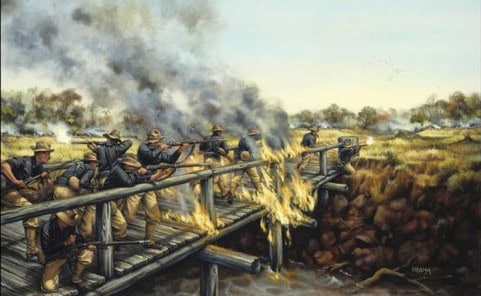
Other than collegiate historians few Americans today know about the Philippine-American War of 1899. It was an armed conflict between the United States and Filipino revolutionaries that lasted from February 4, 1899, to July 2, 1902.
The major entities involved were the U.S. Army and Navy, the Philippine Army and Navy, the U.S. Marine Corp, the Babalanes (a community of Filipino shamans), Macabebe Scouts (a Filipino militia backed by the U.S. Army), and the Pulajanes (a group from a religious sect who fought for national freedom).
Battle summaries and casualty records from all combat actions often included the word, “boondocks.” The word was unfamiliar with those at home who were responsible for supplying manpower, munitions, and acquisitions such as food, shelter, and personal necessities for the troops.
It was soon discovered that “boondocks” was a mispronunciation, mostly by Americans of the Tagalog word for mountain, “bundók.” The word was used to refer to the difficult terrain where they fought in Luzon’s rugged interior.
By the mid-20th century, boondocks had entered the American lexicon. It came to mean any rough or isolated countryside where it was difficult to work and accomplish any task with ease or the benefit of heavy equipment.
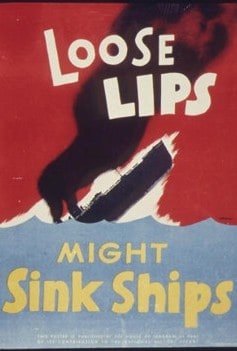
Loose Lips Might Sink Ships . . . is
one of the most famous slogans of the Second World War. During the war, the government worried that conversations in bars, factories, trains, or other public places where discussions of military actions might be overheard by spies.
Posters, radio messages, and advertisements urged civilians and service members not to discuss troop movements, ship departures, weapons production, or other sensitive information. It warned people that careless talk could reveal military information to the enemy and potentially lead to the loss of ships, troops, and lives.
The campaign, designed by artist Seymour Goff for Seagram Distillers, originated early in 1942, in cooperation with the U.S. War Advertising Council and the Office of War Information.
The poster cautioned Americans against gossiping about military movements (since careless talk could reveal valuable information to the enemy). Over time, the phrase became the more familiar “Loose Lips Sink Ships.”
The slogan became so well known that it survived long after the war. Today, people use it figuratively to mean, “Be careful what you say,” “Don’t reveal confidential information,” or “Careless gossip may have serious consequences.”
Interestingly, our British cousins used a similar wartime slogan: “Careless Talk Costs Lives.” Today their “Careless Talk” slogan has morphed into, “Keep Calm and Carry On.”
The “Keep Calm” actually pre-dated “Loose Lips.” It was first a British government poster produced in 1939. The slogan was intended to boost public morale in the event of air raids. Not surprisingly the phrase became enormously popular decades later and has since inspired countless variations, such as: “Keep Calm and Drink Tea,” “Keep Calm and Carry a Towel,” or “Keep Calm and Carry On Gardening.”
Over The Top Meant Straight Into Machine Gun Fire
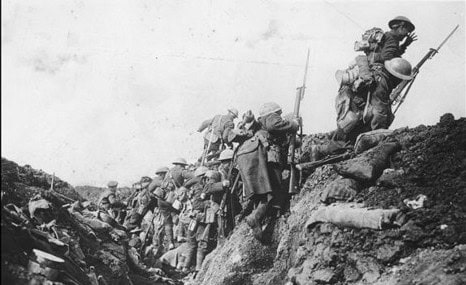
On the Western Front during World War I, armies faced off from trenches across No Man’s Land. “Over the top” referred to scaling the trench wall under enemy fire once a charge was ordered; soldiers would attach bayonets to their weapons and climb the parapet using ladders or piles of sandbags.
The phrase appeared in soldiers’ diaries and correspondence by 1915 and became known to civilians as a metaphor for anything extreme by the late 1920s.
SNAFU
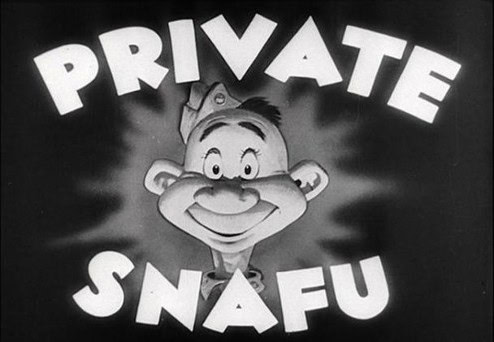
Started As An Army Joke About Chaos
Troops coined the acronym in 1941 to describe the inevitable absurdity of army life. SNAFU officially stood for “Situation Normal: All Fouled Up,” although the troops likely used a rougher profanity in place of the word spelled with an initial “F.”
The story of SNAFU is a good example of how the U.S. military often adopts soldiers’ slang when it proves useful. SNAFU originated this way as enlisted men’s cynical shorthand for: “Situation Normal: All F**ed Up.”
The phrase reflected the belief that confusion, paperwork errors, supply problems, contradictory orders, and bureaucratic mistakes were not unusual wartime crises but the normal state of affairs. Soldiers used it humorously to vent frustration and cope with military life.
What is especially interesting is that the Army did not simply suppress the expression. Instead, it recognized that the term was widely understood by troops and repurposed it for training. From 1943 to 1945, the Army Signal Corps produced a series of training short films entitled “Private Snafu”which were animated by Chuck Jones and written by Theodor Geisel, better known as Dr. Seuss.
Geisels’s, “Private” was an incompetent soldier who constantly made mistakes, was used to teach military lessons about security, sanitation, and proper procedures. The popularity of the Private Snafu films helped carry the term into civilian life, where “snafu” is still used today to mean a major mix-up or administrative mess.
One side note, WWII soldiers (and others) created a whole family of similar acronyms, including FUBAR- (Fed Up Beyond All Recognition) and SUSFU (Situation Unchanged: Still Fouled Up).
***
Caution: do not confuse the American military acronym “SNAFU” with the recent Asian teenage mania that includes graphic novels, young men wearing all black, and teen-girls lingerie.