Texas is dotted with grand hotels from other eras. Some are still operating, others have been converted to other uses, and sadly some have been shuttered for decades or torn down. Let’s visit some of these Lone Star State once magnificent hotels on postcards.
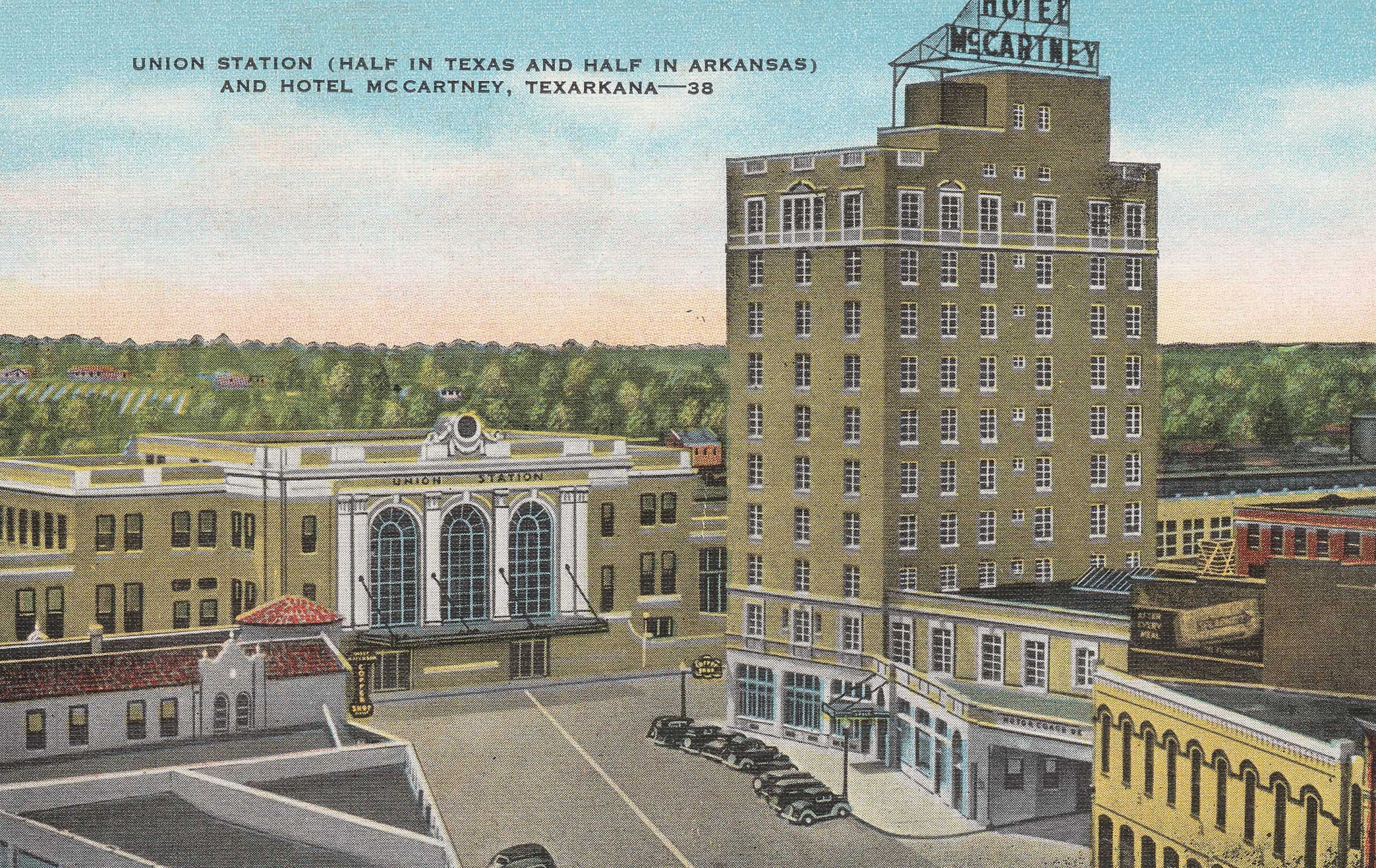
The ten-story McCartney Hotel sits across from former Union Station in Texarkana, Texas/Arkansas. The line that divides the states goes through the station and is painted in the center of State Line Avenue. There were entrances to the station from each state.
The McCartney Hotel opened in 1931 a year after the station was completed. Constructed at the height of the Art Deco period, the lobby, mezzanine and ballroom are outstanding examples of that architectural style. It prospered, due to its location across the street from the main entrance to the station and its ballroom was the center of social life in Texarkana. As passenger rail traffic declined, the hotel also began a slow decline. Union Station closed in 1971, and the hotel closed its doors in 1974. The building is still the tallest in Texarkana and is still in a slow state of decay. All plans to redevelop Union Station and the McCartney Hotel have failed.
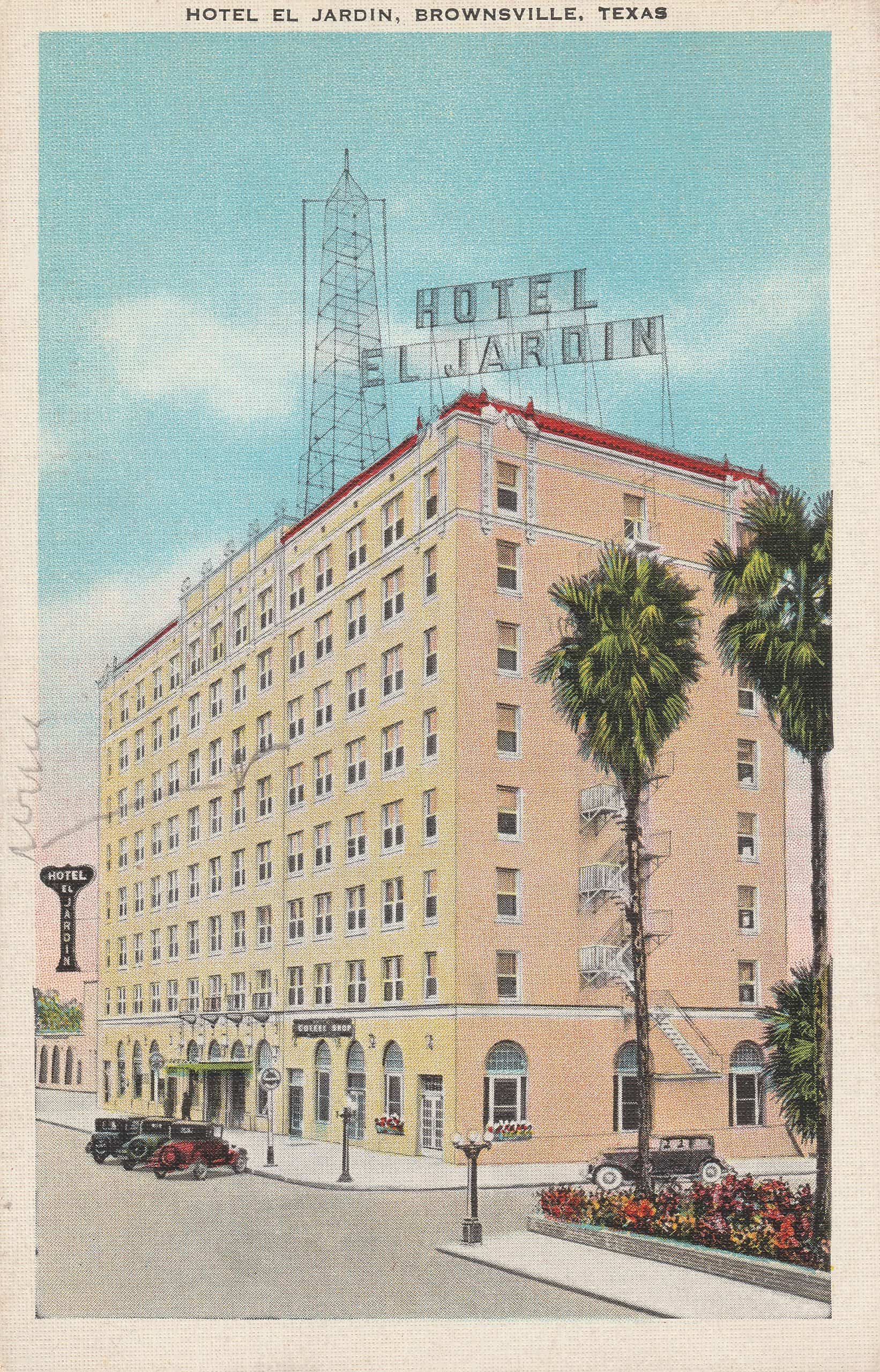
Due to its sub-tropical climate, Brownsville, Texas, was a popular destination for those wanting to escape winter in northern states. During Prohibition, Americans could easily cross into Matamoros, Mexico, to quench their thirst.
Once known as “the finest hotel in the Rio Grande Valley,” the eight-story, 200-room Hotel El Jardin in Brownsville opened in 1927 near the Missouri Pacific Railroad Station. All rooms had private baths. Built in the Spanish Mediterranean Revival style, the hotel’s roof had a Spanish revival cornice to complement its name. It served as the region’s social hub and celebrities often stayed in it top floor suites.
El Jardin fell on hard times in the mid-1980s and closed. After sitting vacant for almost four decades, El Jardin underwent a $31.7 million renovation into 44 units of affordable housing that opened in February 2026 saving it from demolition. The renovation preserved the hotel’s exterior as well as its expansive lobby.
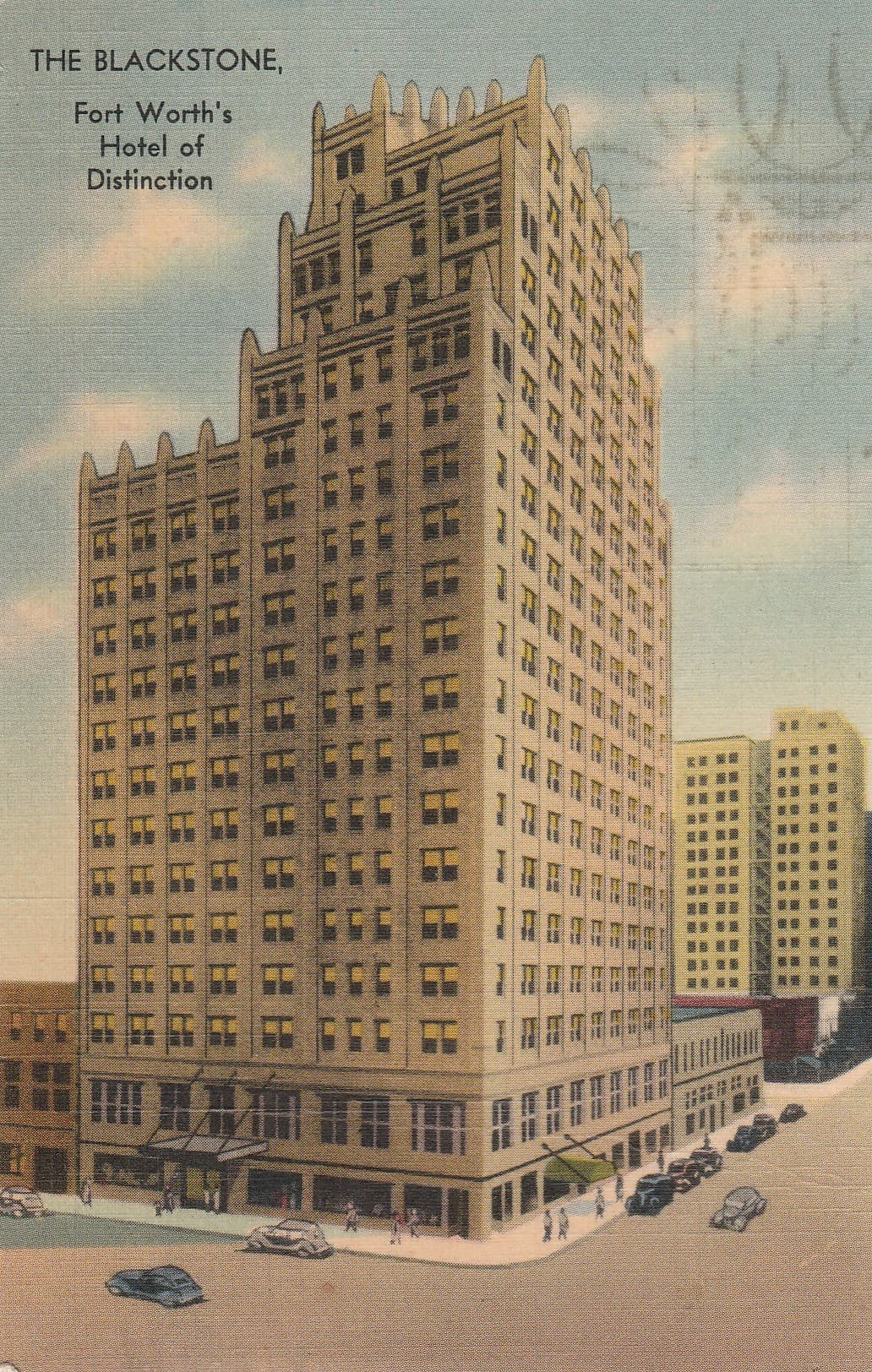
The Blackstone Hotel in Fort Worth billed itself as the city’s hotel of distinction. Built by cattleman Gus O’Keefe, the Blackstone opened in October 1929. Noted for its Art Deco architecture, the hotel had 23 stories and was the tallest hotel in Fort Worth. The hotel was noted for its lavish marble lobby and the opulent Venetian ballroom. Rooms on the upper floors had outdoor terraces due to their being set back from the lower floors.
The caption of this 1940s postcard notes that the hotel is “properly air conditioned” and all rooms are equipped with radios. In 1952, Conrad Hilton purchased the hotel, and it operated as the Fort Worth Hilton until 1962. The hotel was sold to new owners, and the name was once again the Blackstone.
It began a period of sad decline, the final ignominy was the Venetian ballroom being converted to an X-rated theater.
Closed due to bankruptcy in 1982, it remained shuttered until 1999. New ownership found the Blackstone in total disrepair; its basement was flooded, windows were broken, and the lower floor windows were boarded up. The hotel was restored and now operates as the Courtyard by Marriott/Fort Worth Blackstone.
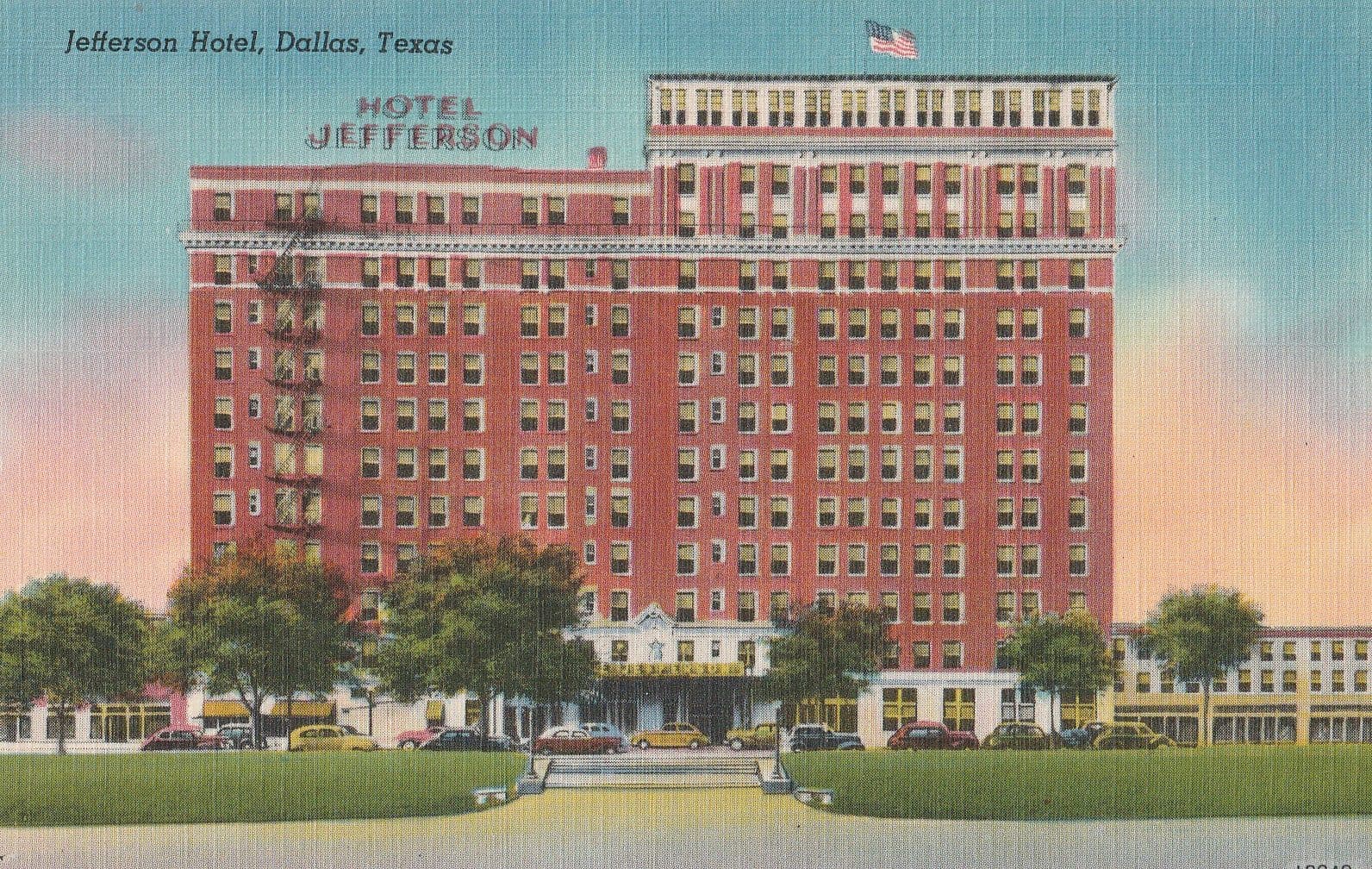
Opened in October 1917, the Jefferson Hotel was the largest hotel in Dallas for many years. The original hotel was the section of the building where the hotel’s large sign stood. In 1921, the hotel was enlarged with the addition of the tower with the flag flying on top. Located at Ferris Square across from Dallas’s Union Station on S. Houston Street, the Jefferson boasted the largest hotel lobby in Dallas.
A huge neon sign promoting Dr. Pepper was erected atop the hotel in the late 1920s or early 1930s could be seen for miles by travelers approaching Dallas from the southwest. The Dr. Pepper sign was torn down in 1953.
In April 1953, the hotel was leased to Alsonett Hotels, and the name changed to Hotel Dallas later that year. The new management added air conditioning, a motor entrance, and a “new lobby featuring high speed automatic elevators.”
In the early 1970s, the Jefferson failed to meet new fire safety standards and was condemned. Its owners were forced to declare bankruptcy and the hotel was purchased by the city of Dallas for $385,000. Located in an area slated for redevelopment, it was demolished in 1975. A Courtyard by Marriott now occupies the site.
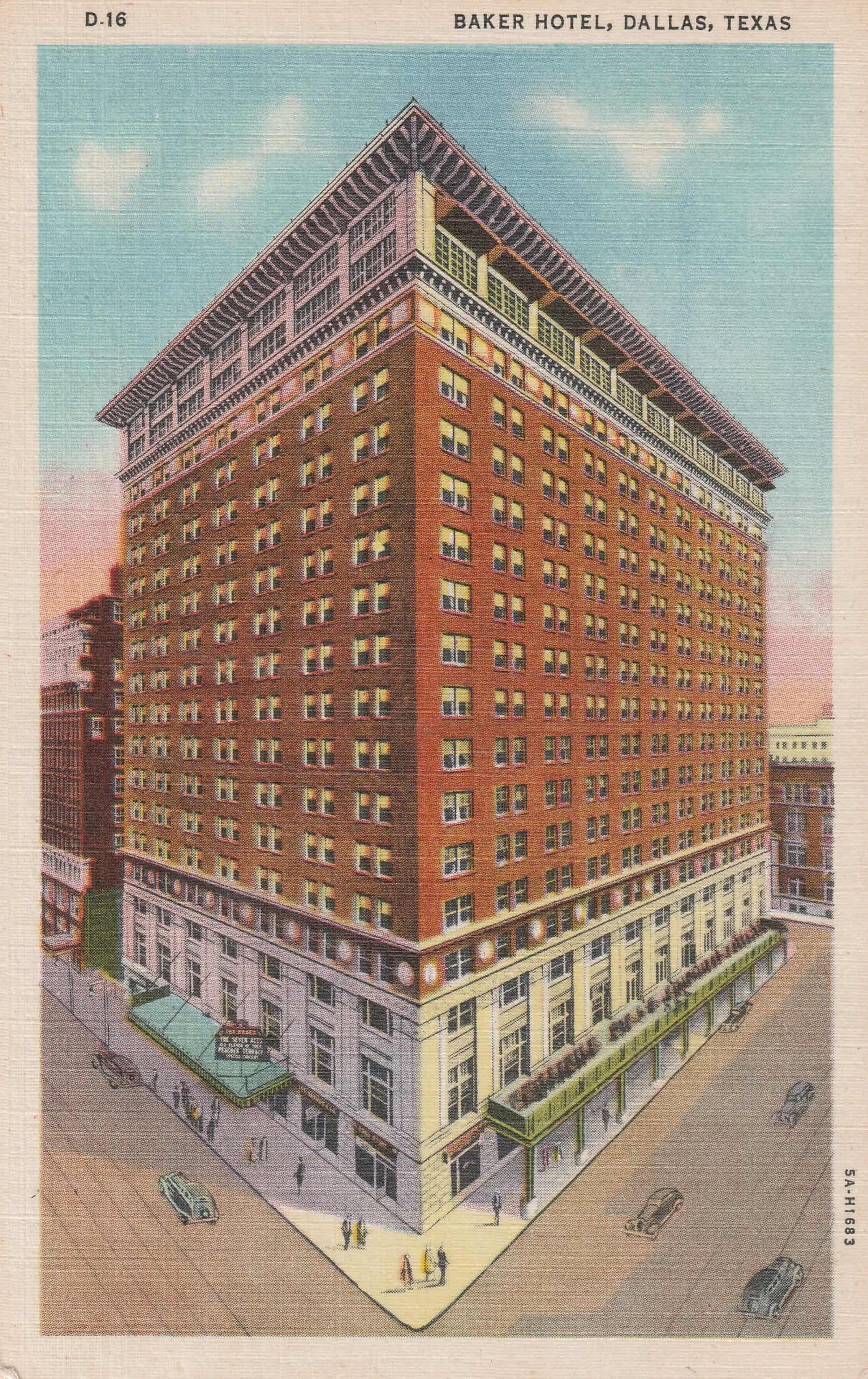
Hotelier T. B. Baker built the Baker Hotel in downtown Dallas. Baker also owned the Baker Hotel in Mineral Wells, the Gunter Hotel in San Antonio, and the Hotel Texas in Fort Worth. His eponymous Dallas hotel opened on October 25, 1925, with a gala dinner-dance. In its heyday, the Baker was one of the finest hotels in the Southern United States. The Baker was the home‐away‐from‐home for any West Texas oilman spending a weekend in “Big D.” The 19‐story hotel housed 585‐rooms. It was located at the southeast corner of Commerce and Akard Streets, catty-corner from the Adolphus Hotel, its major competitor.
T. B. Baker brought six majestic crystal chandeliers from Czechoslovakia and made the second floor ballroom the setting for most of the city’s social events and debutante balls. The most popular public room was seventeenth floor Peacock Terrace, with greenery hanging from the ceiling, a lily pond with ducks, and regular Neiman‐Marcus fashion shows. Nearly all the major big bands played at the Peacock Terrace during its heyday.
A 1971 fire damaged the upper floors, and the building was remodeled. Southwestern Bell Telephone purchased the Baker Hotel and decided it could not be economically converted for its needs. A sale of the hotel’s furnishings took place in September 1979. The Baker Hotel, along with two adjacent office buildings were imploded on June 29, 1980. A 37-story office building, the Whitacre Tower also known as One AT&T Plaza, opened in 1984.
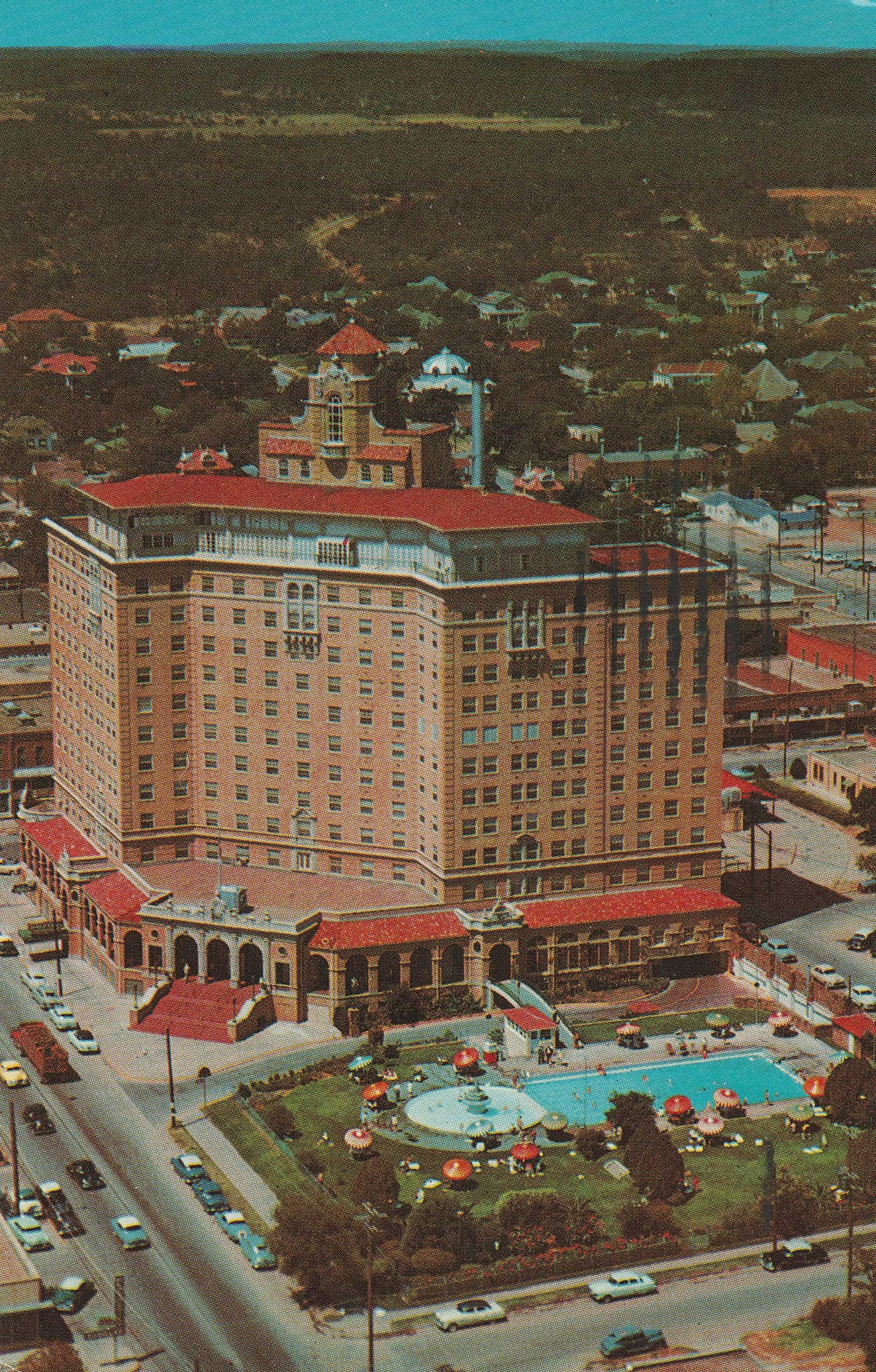
One hour west of Fort Worth, people had flocked to Mineral Wells since the end of the nineteenth century to bathe in the mineral rich water that supposedly cured arthritis, skin diseases, fatigue, and other ailments.
T. B. Baker opened his Spanish Colonial Revival Baker Hotel in Mineral Well in November 1929. Modeled after the Arlington Hotel in Hot Springs, Arkansas, its fourteen stories loomed over Mineral Wells’s population of 5,986 in the 1930 census.
During the 1930s, it was a posh spa for the well-heeled. There were 450 guest rooms equipped with circulating ice water, fans, and room lights that turned on when the guest unlocked the door. Rooms featured servidors, two-way cabinets where items like shined shoes, clean laundry, and pressed suits could be returned without disturbing the guest.
Other amenities included a bowling alley, beauty salon, gymnasium, and an outdoor Olympic size swimming pool filled with mineral water. When built, it was the largest outdoor pool in Texas. There were two ballrooms that could accommodate up to 2,500 attendees. The Cloud Room on the hotel’s roof hosted weddings, dances, and other events. By the 1940s, all rooms were air conditioned.
Like many hoteliers, Baker suffered financial difficulties during the Depression and declared bankruptcy in 1934. His nephew Earl took on the operation of his hotels. The Baker prospered during World War II when the Army opened Camp Wolters in 1940, increasing Mineral Wells population to over 30,000. In the 1950s, after the curative properties of mineral water had been debunked and the army base closed, the Baker began a slow decline that ended when Earl Baker closed it in 1963. A group of local investors reopened it in 1965, but it shut down again in 1972 and remains shuttered until this day.
A Dallas–Fort Worth area developer began a $65 million renovation in 2019. It will remake the present 450 rooms into 157 spacious suites and make the Baker a premier wedding destination. Its spa will be reopened, and the hotel will also serve as a corporate retreat center. The Baker Hotel is tentatively projected to reopen in 2028.
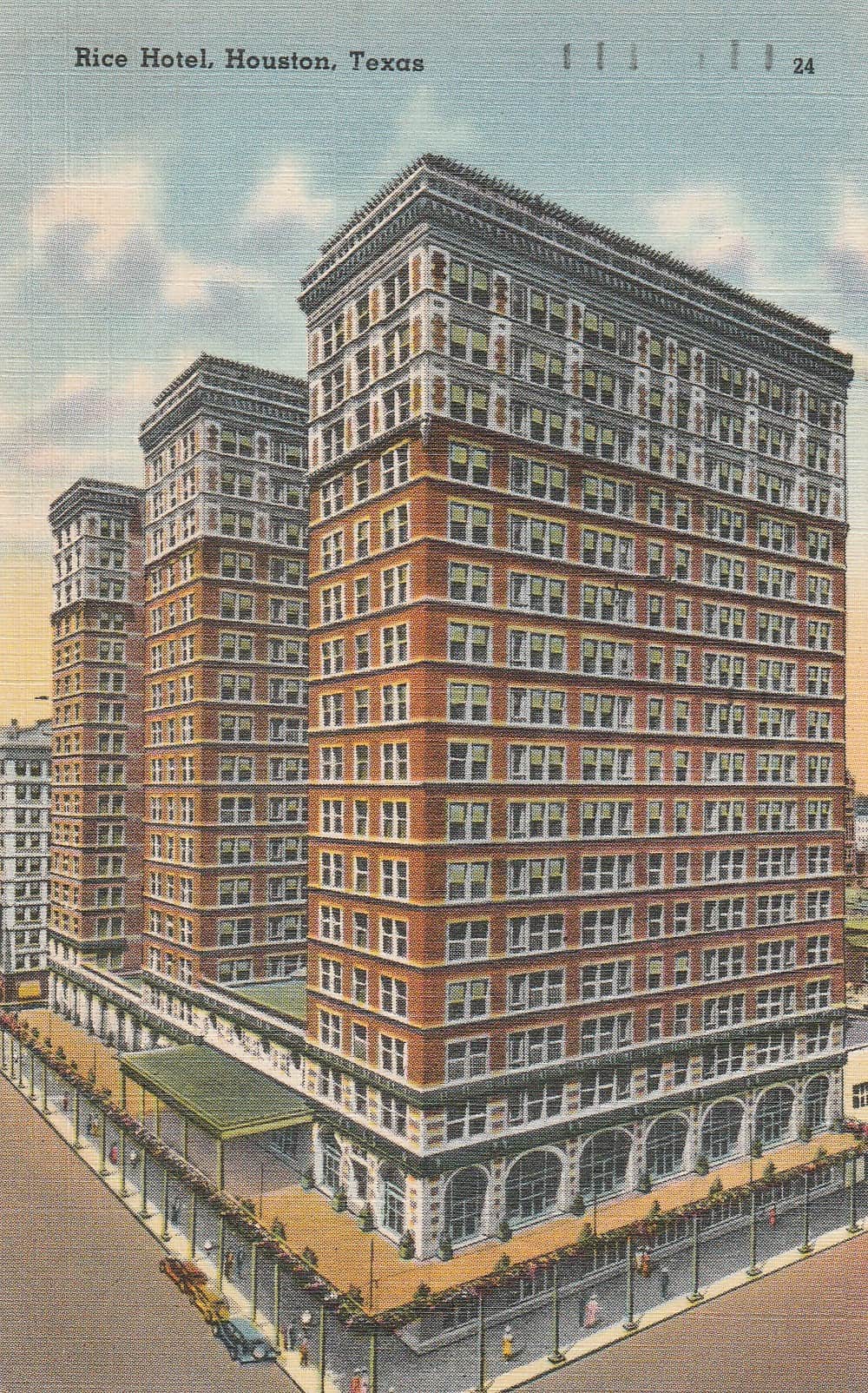
The Rice Hotel was built in 1913 by Jesse H. Jones, a Houston entrepreneur and political powerbroker. Jones served as Secretary of Commerce in Franklin Roosevelt’s administration during World War II. Originally there were two wings. A third wing was added in 1925 giving the building its distinctive E shape. An eighteenth floor was added in 1951. The Rice had over a thousand rooms.
Jones operated the Rice until his death in 1956. Ownership passed to the Houston Endowment founded by Jones. The hotel continued operating until the 1970s although ownership had passed to Rice University. Rice owned the land underneath the hotel and had leased it to Jones. The hotel operated until 1977 when it was shuttered due to stringent new fire codes.
The vacant hotel changed hands several times as owners presented plans to reopen it as a hotel or apartments. The Rice reopened in 2014 after being renovated into 312 luxury apartments.
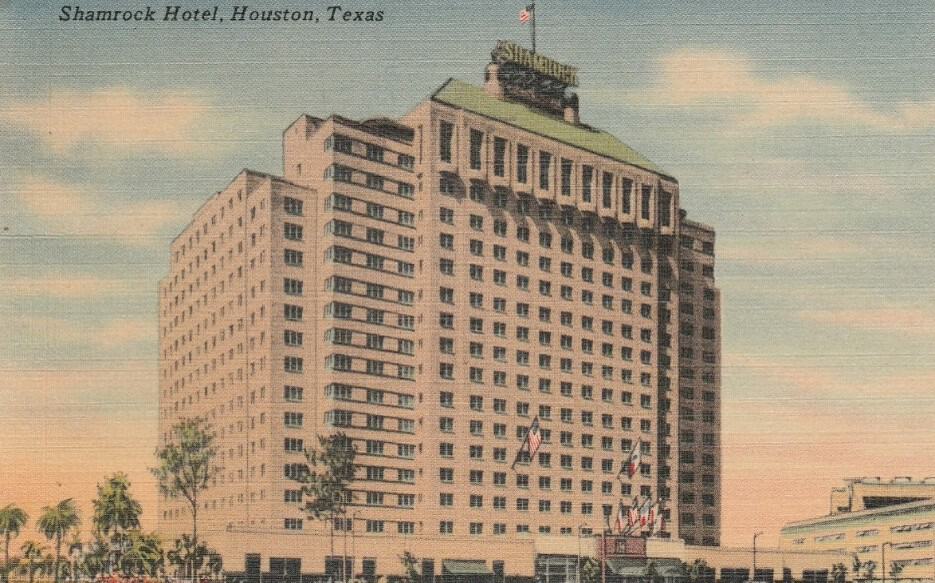
The Shamrock Hotel in Houston opened in 1949 and was constructed by oil wildcatter Glenn McCarthy who named it in honor of his Irish heritage. Eighteen stories tall, it had 1,100 rooms. It was the largest hotel constructed in the United States during the 1940s. The second largest hotel in Houston, the Shamrock was three miles southwest of downtown Houston in what was then countryside. Next to the hotel was a 5-story parking garage and a 25,000 square foot exhibition hall. Outside, the Shamrock featured an immense swimming pool claimed to be the largest in the U.S. An inhouse radio system piped music to every room.
The hotel’s grand opening on Saint Patrick’s Day featured a number of Hollywood stars and is remembered as the biggest social event in Houston’s history. Bellhops wore green uniforms and guests signed the register in green ink. Rooms were painted in various shades of green. The Shamrock’s night club, the Emerald Room, was a center of Houston social life.
McCarthy had been warned that the hotel was too far from downtown Houston to attract business travelers and a smaller property would be more financially viable. After he defaulted on the loan in 1952, the Equitable Life Insurance Company acquired the Shamrock. Hilton Hotels purchased it in 1954 and operated it as the Shamrock Hilton, but the hotel continued to struggle financially.
It closed in 1985, and the building was donated to the adjacent Texas Medical Center. The Shamrock was demolished in 1986; only the parking garage remains.