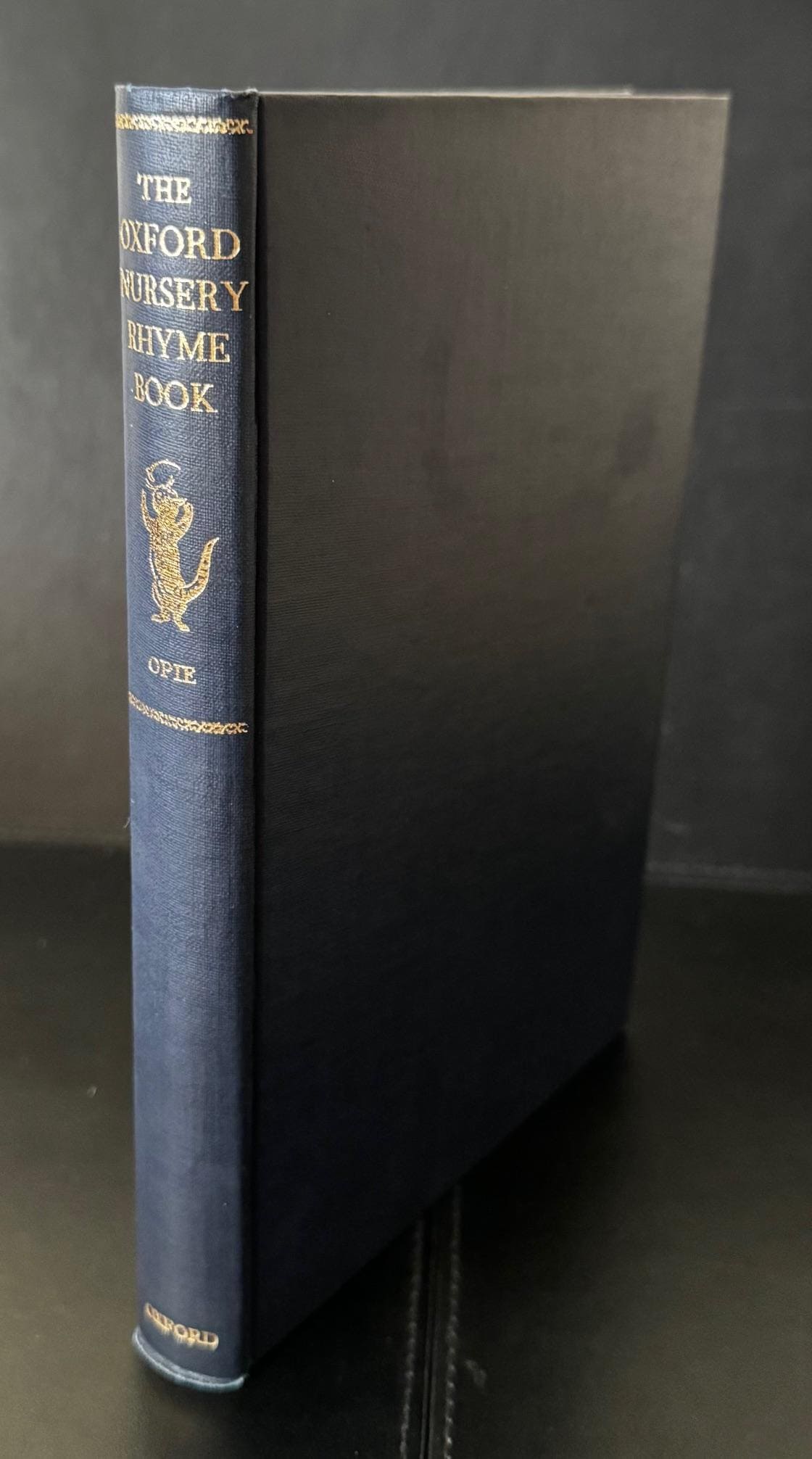
Seventy-five years ago (1951) the Oxford University Press published the first edition of The Oxford Nursery Rhyme Book. Historically that isn’t a long time, but one rhyme found in the “rhymes dictionary” pre-dates the publication by 476 years.
The work in question is a counting-out game, played by English, Welsch, Dutch, and Irish children as early as 1475 and reported in a William Caxton list of children’s games. Those early children used different words, but the idea was very similar. It goes, Tinker, Tailor, Soldier, Sailor, Rich Man, Poor Man, Beggar Man, Thief.
The children of early new American settlers brought their games with them and soon after their arrival in North America the lyrics changed to: Rich Man, Poor Man, Beggar Man, Thief, Doctor, Lawyer, Indian Chief.
It may surprise no one that estimates of how many versions exist range from “a few” to more than fifty. Considering that there are at least three modern versions and between fifteen and forty documented historic variants, plus an unknown number of regional, oral, and game‑specific adaptations perhaps fifty is a conservative number.

Why the number of variations is hard to pin down depends on who is answering. If language historians are being asked, they will suggest that whenever a new profession is added to the original list of eight (Tinker, Tailor, Soldier, Sailor, Rich Man, Poor Man, Beggar Man, and Thief) that creates a new version. Therefore, from the first recorded list that appeared in the fifteenth century to today (with the endpoint being with the 1970s “Skipping‑Rope” rendition) the numbered versions reach to sixty-plus.
The rhyme originated as a counting and fortune‑telling chant, so children freely modified it depending on the game or region. Early precursors from the 1475 Caxton text listed entirely different professions, showing that the idea of enumerating roles predates even the modern form and it wasn’t until the late seventeenth century that print versions, rather than oral ones, produced “standard” verses.
The one individual most responsible for standardizing nursery rhymes (and it could be that he was the only person who ever thought it was important) was none other than A. A. Milne – sometimes referred to as Whinnie the Pooh’s dad.
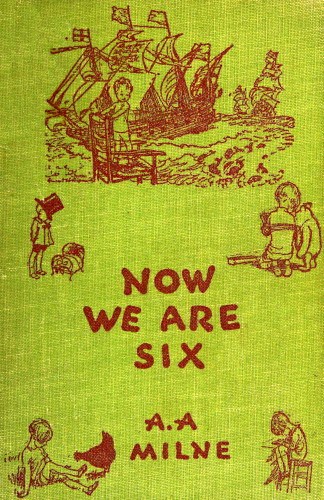
In 1927 Milne published Now We Are Six, an anthology of 35 poems. Milne collaborated with Ernest H. Shepard, who did the “decorations.” Someday I would like to know why “decoration” was used instead of “illustration.”
[Aside: I enjoy a sense of pride in knowing a little about books. After completing an MLS in the late 1960s, I worked as a school librarian and taught the history of books and libraries in a local university’s Media Science Department. With my experience I can state without hesitation that there is a fact about Now We Are Six that no other book in history has managed. It achieved ninety-five printings from the same publisher (E. P. Dutton & Company, New York) in less than a decade! Yes, 95! That is amazing. And after the 100th printing in September 1935, the book was reprinted from all new plates and engravings, and type entirely reset for the 164th printing in 1952. I have now lost count.]
The “Tinker, Tailor…” rhyme at one point or another was dubbed “Cherry Stones” (it appears as #6 of the 35) as a counting game for children who were often given a standard serving of eight fresh cherries as a breakfast meal.
Milne remembered it as follows:
Tinker, tailor, soldier, sailor, rich man, poor man, beggar man, thief,
Or what about a cowboy, policeman, jailer, engine driver, or a pirate chief?
Or what about a ploughman or a keeper at the zoo,
Or what about a circus man who lets the people through?
Or the man who takes the pennies on the roundabouts and swings,
Or the man who plays the organ or the other man who sings?
Or what about the rabbit man with rabbits in his pockets
And what about a rocket man who’s always making rockets?
Oh it’s such a lot of things there are and such a lot to be
That there’s always lots of cherries on my little cherry tree.
The “tinker, tailor” rhyme is one part of a longer counting or foretelling game, played by young girls to foretell their futures, similar thematically to MASH (Mansion, Apartment, Shack, or House). It runs as follows:
When shall I marry?
This year, next year, sometime, never.
What will my husband be?
Tinker, tailor, soldier, sailor, rich-man, poor-man, beggarman, thief.
What will I be?
Lady, baby, gypsy, queen.
What shall I wear?
Silk, satin, cotton, lace
How shall I get it?
Given, borrowed, bought, stolen.
How shall I get to church?
Coach, carriage, wheelbarrow, cart.
Where shall I live?
Big house, little house, pigsty, barn.
As the prediction progresses, the child will ask a question and then count out a series of actions or objects by reciting the rhyme. The rhyme is repeated until the last of the series of objects or actions is reached. The last recited term or word is that which will come true. Buttons on a dress, petals on a flower, bounces of a ball, number of jumps over a rope, or anything else, may be counted.
***
The Now We Are Six postcards are all new to me. The feature card with this post was the inspiration to find more and learn about the rhyme and its history.
It may be safe to assume that at least two sets of cards exist: first, the set represented by the feature card, and second, another set done by an unknown publisher showing the Shepherd “decorations.” Sadly, only three cards have been found.
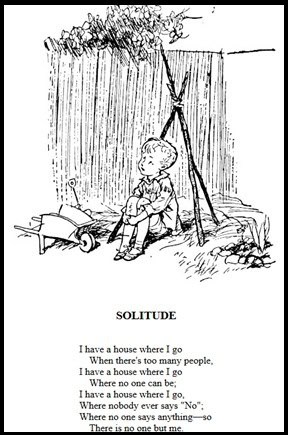
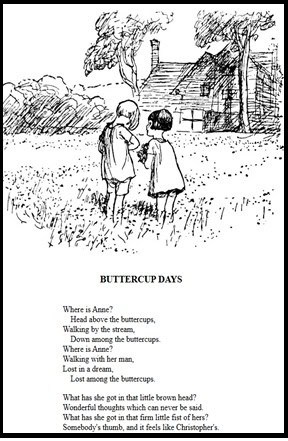
The first and second, are drawings of a lonely little boy, from the first poem in the book, Solitude; and a sketch of a boy and a girl in a field of flowers, from the eighth poem in the book entitled Buttercup Days, both found at the Old Dominion show in Virginia.
The third is a card, found in Lancaster, Pennsylvania, is a drawing of a boy on a swing, from the 25th poem, entitled Swing Song.
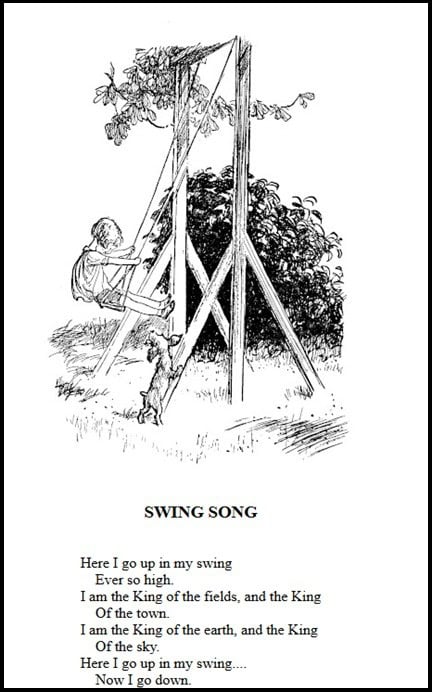
If you know of additional cards from these sets or similar cards depicting the rhyme, please tell us about them in the comments section below. Thank you, RLH
***
It is always an education to read a Ray Hahn article. I doubt that I ever try to track down any of these postcards, but it was full to learn of their existence. Thank you!
Sorry to be this person, but “Winnie the Pooh” is spelled incorrectly. No “h.” But regardless, I really enjoyed reading this!!!
Attached is an image of the book jacket of a very early edition of the A. A. Milne book, with “Pooh” in the title.
What a charming article on a charming topic. Thank you. I think I need to learn Milne’s poems so that I’ll recognize one of these cards if I ever am lucky enough to come across one.