The early twentieth century brought rapid changes to transportation, and with the rise of the automobile came an urgent need for better roads. Dirt and gravel routes that had sufficed for horse‑drawn travel quickly proved inadequate once cars became common. Rain turned unpaved roads into deep mud, and dust clouds plagued travelers in dry weather. It was in this context that Tarvia, a coal‑tar–based road treatment, emerged as an important transitional technology in modern road building.
Before Tarvia, road construction had evolved through centuries of experimentation. The Romans had pioneered layered stone roads with carefully engineered foundations, and later innovators such as Thomas Telford refined these methods by emphasizing shaped paving blocks and proper cambering to shed water.
In 1820, Scottish engineer John Loudon McAdam revolutionized road building by proposing a shallower foundation topped with compacted layers of small stones, creating what became known as “macadam” roads. This method was simpler and more economical, but it still struggled under the demands of motor vehicles, whose rubber tires and higher speeds required smoother, more durable surfaces.
Understanding Tarvia requires looking at the people who developed it, the conditions that made it necessary, and the places where it was used. Even the name itself was an invention, blending “tar” with the Latin word via, meaning “road.”
Tarvia was developed by the Barrett Manufacturing Company, founded by Samuel E. Barrett, who originally operated a roofing business in Chicago beginning in 1854. As American cities expanded, Barrett recognized the need for better road surfaces and began experimenting with roofing tar as a treatment for brick, stone, and wooden pavements. These experiments eventually led to the creation of Tarvia.
The earliest experiments that led to Tarvia began around 1903 in Jackson, Tennessee. This was a pivotal moment in American transportation: automobiles were becoming more common, and dirt roads were no longer adequate. Tarvia offered a cost‑effective way to improve road durability and driving conditions. By the 1910s and 1920s, Tarvia was widely used across the United States.
A notable example is Water Street in Torrington, Connecticut, which was paved with “Tarvia‑X” in 1909 and reportedly required no maintenance for three years, demonstrating the material’s durability.
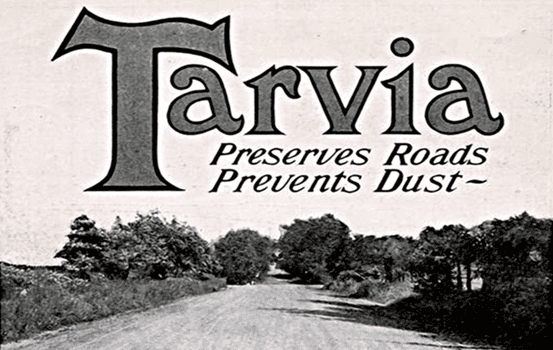
Tarvia entered this landscape as a trademarked product designed to stabilize and protect macadam and gravel roads. Coal tar, a byproduct of gas and coke production, had long been known for its waterproofing properties. Tarvia’s innovation lay in its formulation and its application method, which allowed it to bind loose road materials, reduce dust, and create a more resilient surface. It was marketed aggressively in newspapers, magazines such as McClure’s, and on postcards found in restaurants, hotels, and gasoline stations. The advertisements emphasized its ability to transform muddy, rutted roads into smooth, dependable routes suitable for automobiles.
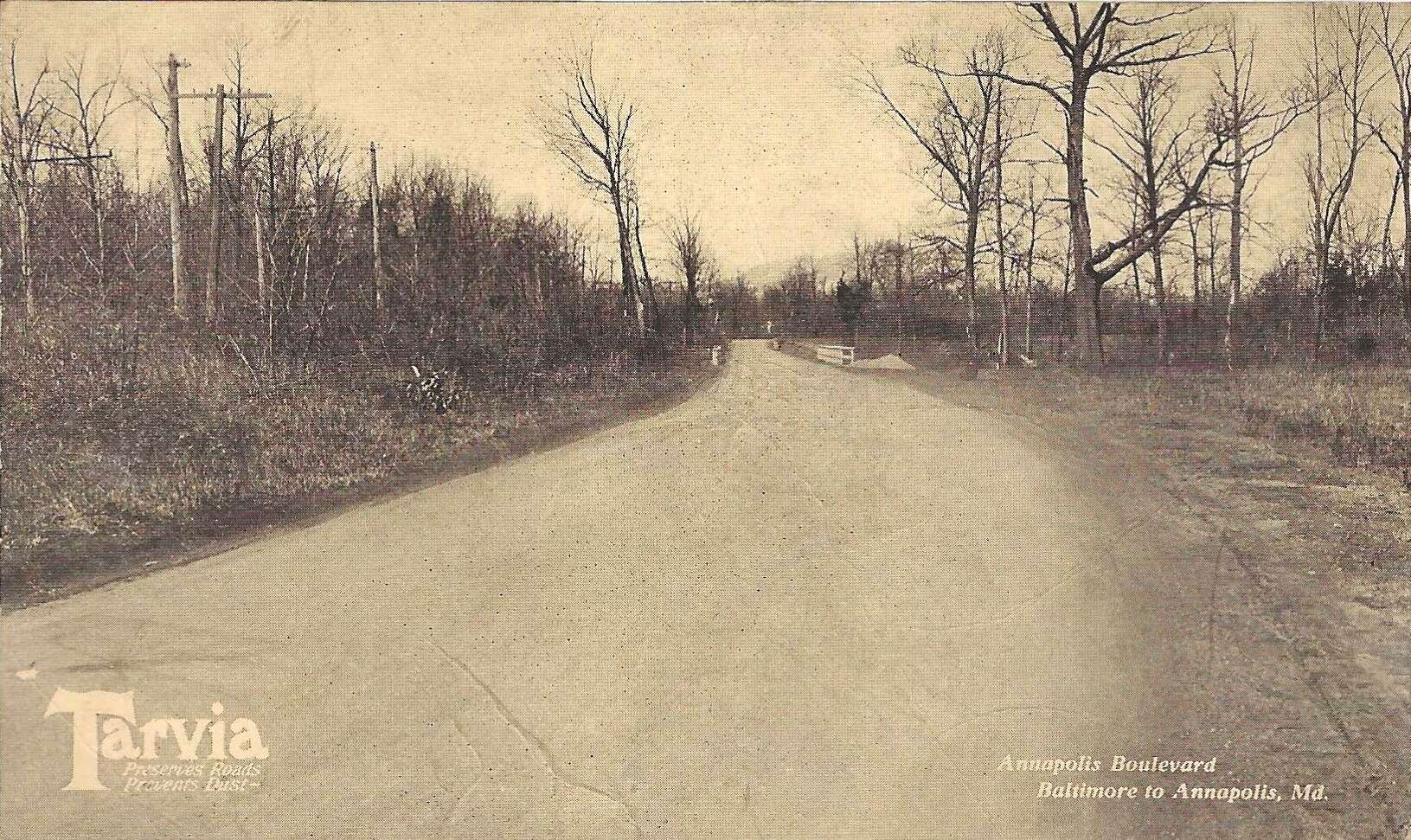
Another notable example of an early application of Tarvia came when the State of Maryland chose to use it on Annapolis Boulevard – the primary and most direct route between Baltimore and the Maryland state capital in Annapolis. Annapolis was also the home of the United States Naval Academy – a destination for millions of dollars’ worth of trade and commerce.
The use of Tarvia was a significant step toward modern paving. It was applied as a liquid, and as it soaked into the upper layers of gravel or crushed stone, it formed a crust that resisted erosion and moisture. This process was an early precursor to today’s asphalt pavement. Although Tarvia pre‑dated widespread asphalt use, it served a similar purpose: creating a sealed, dust‑free surface that could withstand weather and traffic.
The adoption by county governments and local municipalities for road improvement made it popular in rural areas where budgets were limited and road networks were expanding rapidly.
Tarvia’s success also reflected broader industrial trends. As coal gasification and coke production increased, coal tar became more readily available, making products like Tarvia economically viable. At the same time, the automobile industry was booming, and public pressure for better roads grew. Tarvia thus occupied a crucial niche—bridging the gap between traditional macadam roads and the asphalt‑paved highways that would dominate later in the century.
Over time, Tarvia and similar coal‑tar binders were gradually replaced by petroleum‑based asphalt, which proved more durable, less brittle, and easier to produce in large quantities.
In retrospect, Tarvia can be seen as both a technological innovation and a prominent reminder of the early automobile age. It symbolized the transition from rural, horse‑drawn pathways to engineered roadways designed for speed and mobility. Its legacy lives along the paved surfaces that became our national network of roads and the creation of the Dwight D. Eisenhower National System of Interstate Highways, the 46,000 mile-network of roadways that makes travel in America the envy of every country in the world.
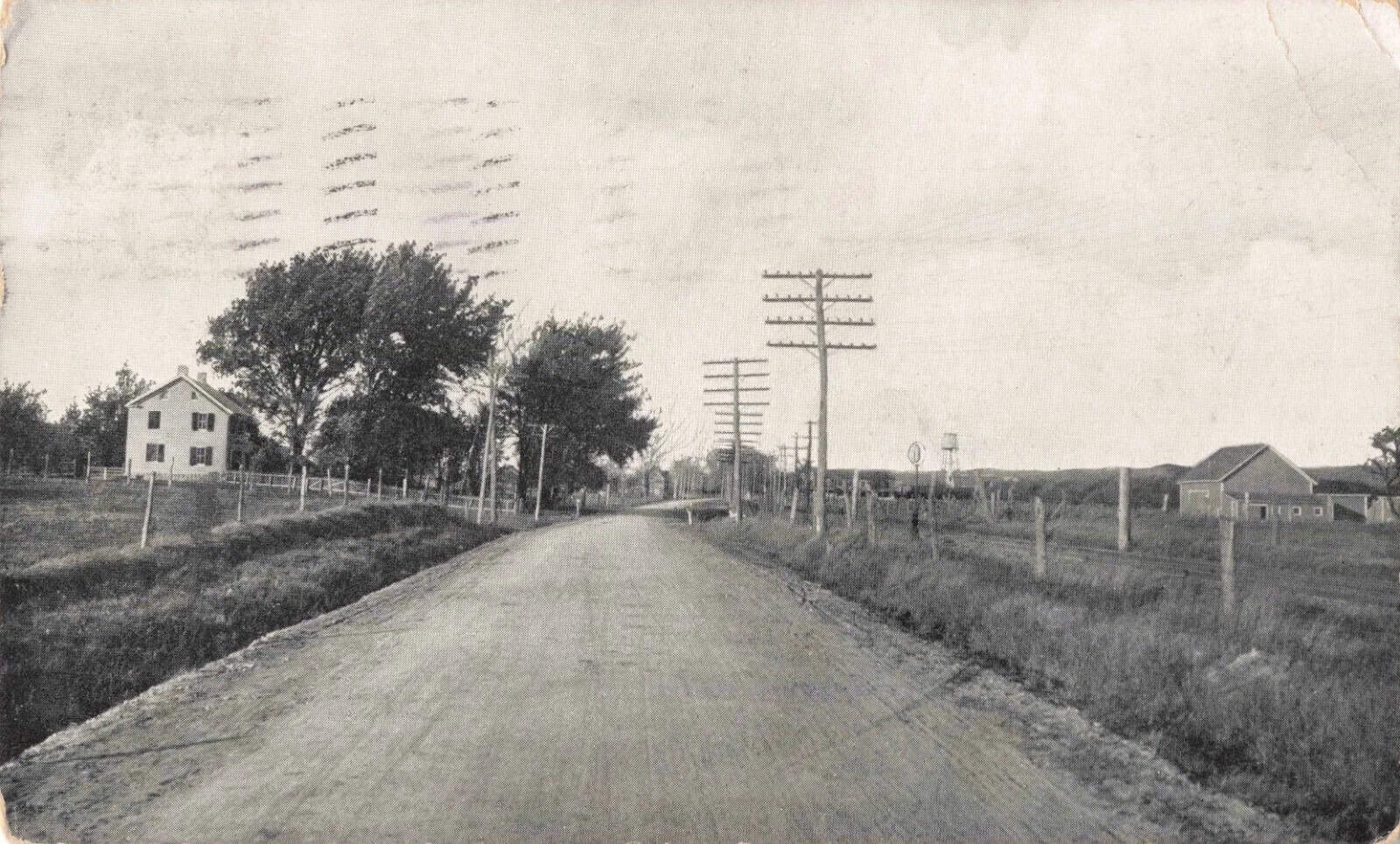
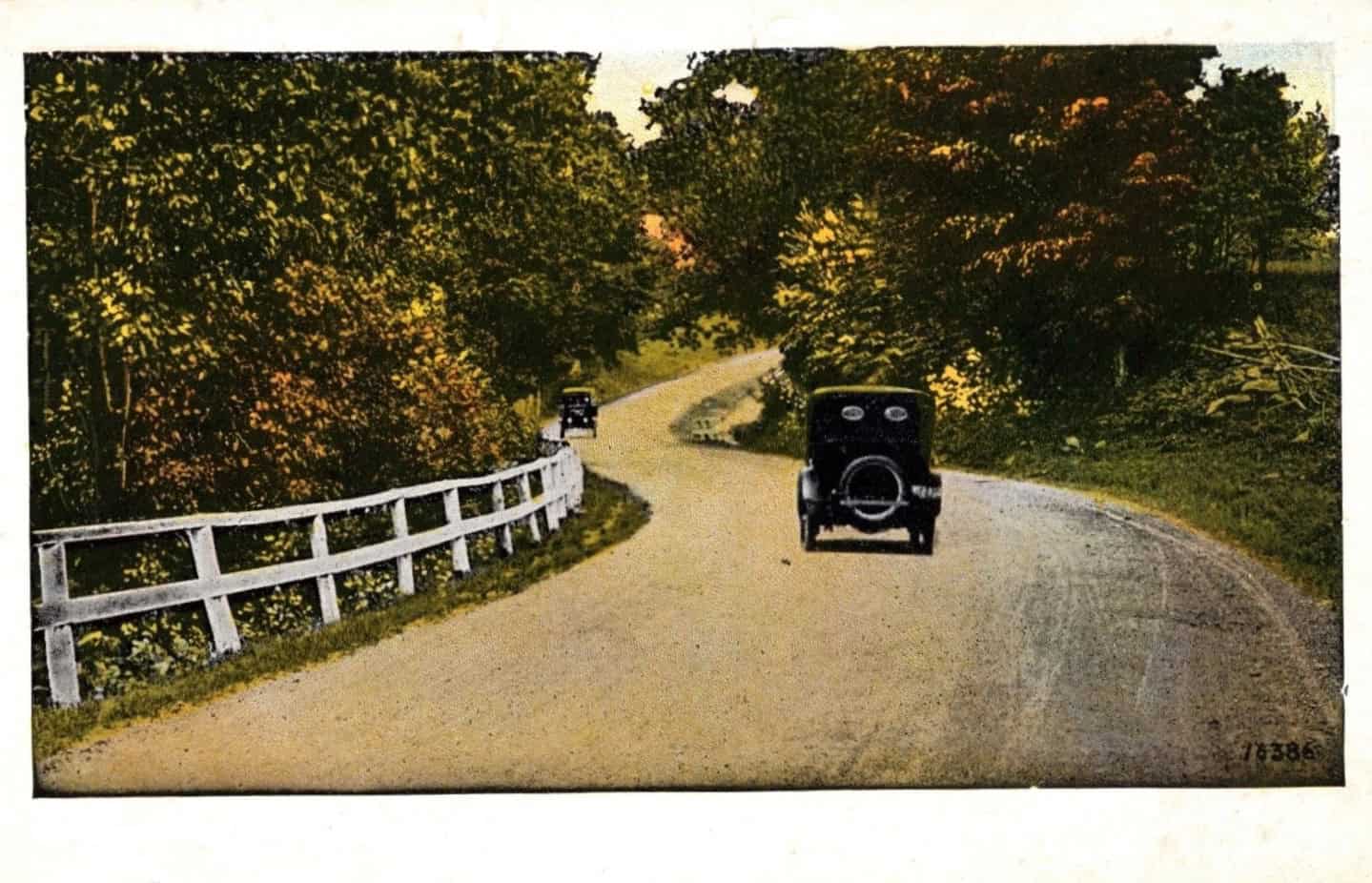
The thousands of miles of roads treated with Tarvia could be identified easily. They were mostly smooth with a minor “crown” center. Some had slightly raised “curbs” to mark the edge of the road.
Tarvia treated roads, never, looked like the one below.
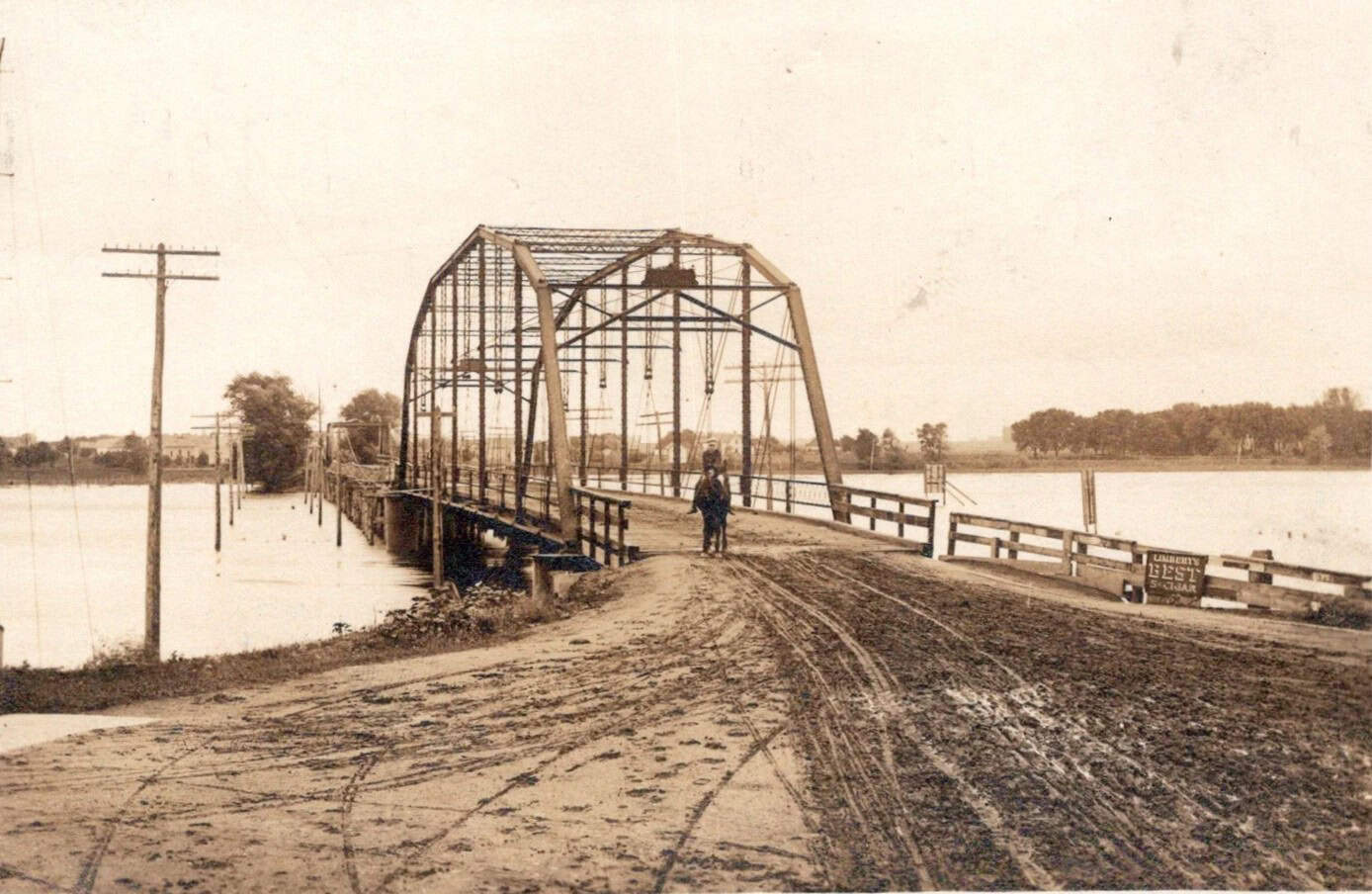
As the Triple A, the “American Automobile Association” once said, “Happy Motoring.”
Always interesting!!!!!!
Walt
Good Article. I hope AARP Safe Driving writers have read this article. Thanks
Wonderful to read about. I have a small group of pinback buttons that were. used to promote GOOD ROADS, Some of these pins were used to support a bond issue, to raise public awareness and to help solve some of these problems
Mr. Hahn,
This is Karen Whitaker with the Historical Vintage Car Club of DE again. We would like to present/reference your article in our newsletter, the Stovebolt. Would you have any objections to the editor synopsizing your article, giving you full credit and providing the web address to read the full article?
Please let me know and Thank You for any consideration given.