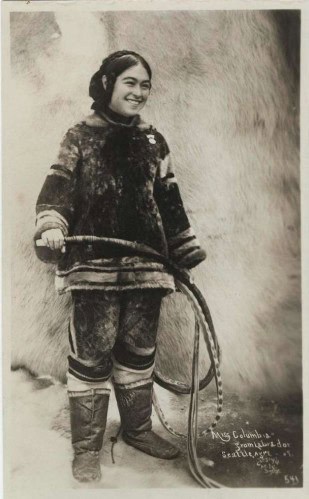
In the summer of 1892, two show promoters chartered a schooner to coastal Labrador looking to recruit Inuit natives for an ethnological or living exhibit (some would say human zoo) to be presented the following year at the Columbian World’s Fair. Promising wages, room and board, medical care, and a supply of hunting provisions on their return, sixty Inuit natives boarded a ship that fall, bound for Chicago.
Expanding on accounts of early Arctic explorers, the American exhibitors presented these people as “Arctic primitives living in ice houses,” and “untouched by the hand of civilization.” But these people were from Labrador, not the Arctic, and they were far from primitive. The unique history of Labrador meant that most natives spoke English and were among the earliest North American Indigenous people to have contact with Europeans, which resulted in long established relationships with the white culture.
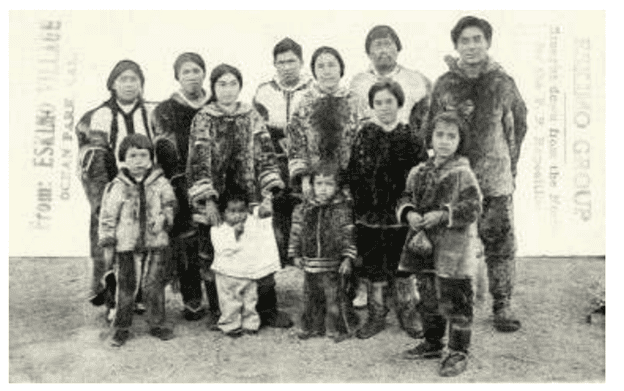
Twelve Inuit families were chosen, including the pregnant Esther Eneutsiak (then age 15) and her parents, Helene and Abile. They arrived in Chicago in October 1892. They were housed in squalor on fairground property while the buildings and concessions for the fair were being constructed. In January 1893 three Inuit women gave birth on the fairgrounds, including Esther.
Gathering people from their native environments to be displayed to the paying public in a natural state was not a new idea peculiar to the Columbian Fair. The practice morphed from the displaying of human oddity in “freak shows” that were popularized by P. T. Barnum some 50 years earlier. By the 1870s exhibitions of so-called “exotic populations” had become popular throughout the western world, first starting in the major cities of Europe and becoming successful enough that they were incorporated into the 1889 Paris World Fair, then crossing the Atlantic and arriving in the United States with the Chicago World’s Fair of 1893.
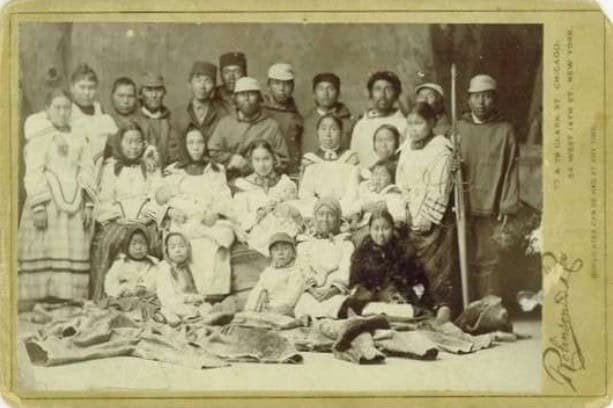
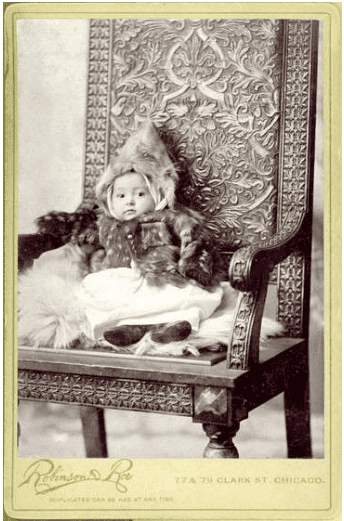
Probably for publicity reasons, wealthy socialite Berthe Honore Palmer, president of the Columbian Exposition Board of Lady Managers, played the role of godmother to Esther’s baby choosing her name: Nancy Helene Columbia Palmer. Even as a baby Columbia’s attractive features and disposition were used to market her and her troupe, with printed advertisements reading “a mite in seal skins,” “the cutest baby ever seen,” “every man, woman, and child must see this baby!” and “the only Yankee Esquimaux on earth.”
A dispute over living conditions on the fairground resulted in the Inuit families filing suit in court and quitting the fairground village before the Exposition opened. With local backing they eventually established their own Eskimo Village just outside the fairground gates. Deciding not to return to Labrador after the Fair closed in October, the family continued the “Eskimo Village” concept and toured nationally appearing at state fairs and traveling with the Barnum & Bailey Circus. In 1896 Columbia’s grandparents returned to Labrador taking three-year-old Columbia with them. There she lived between the ages of three and six, the only time she lived in Labrador.
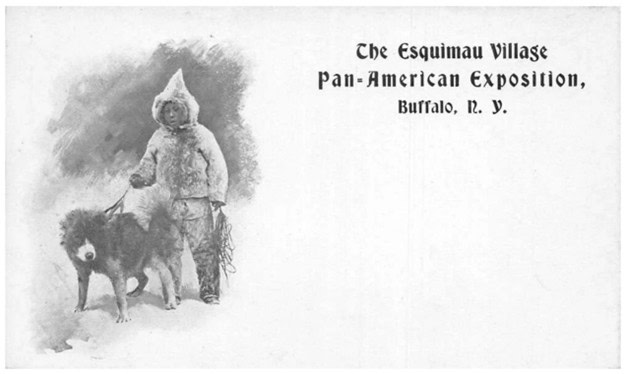
In 1899 Columbia’s mother and the family’s promoter returned to Canada to recruit another group to tour, this time overseas. The newly assembled group of 30 people, again mostly relatives including her parents and Columbia, departed for Europe and North Africa performing in major cities as “The Eskimo Encampment.” By early 1901 they were back in the United States setting up “villages” at the Pan-American Exposition in Buffalo in 1901 and at the 1904 St. Louis World’s Fair. Between 1903 and 1907 the family lived in New York City, the troupe becoming a popular feature at the Luna Park amusement park on Coney Island while using the city as a home base while appearing at major events elsewhere.
By the time of the Alaska Yukon Exposition in 1909, Columbia was a seasoned entertainer who had blossomed into an attractive young woman with an engaging personality. She could speak four languages, play multiple musical instruments, and had completely shed the image of being a native curiosity. When celebrities visited the fairgrounds, local newspaper coverage frequently reported a meeting with her. For an exposition primarily focused on the resources, history, and mystique of Alaska, friendly photogenic Miss Columbia was a public relations dream, and the Eskimo Village became the third-most profitable Pay Streak concession, certainly due to Columbia’s high profile during the Expositions run.
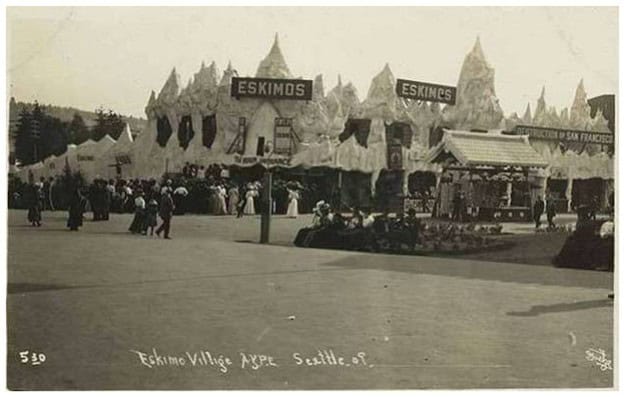
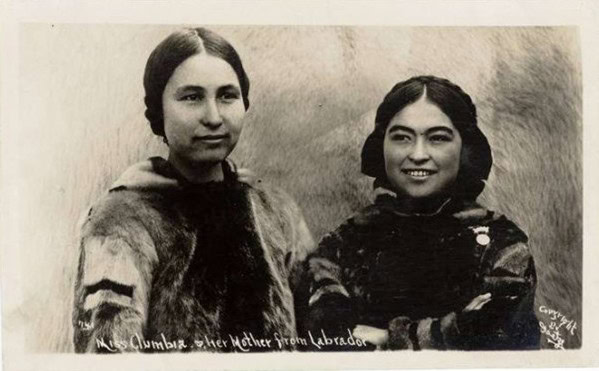
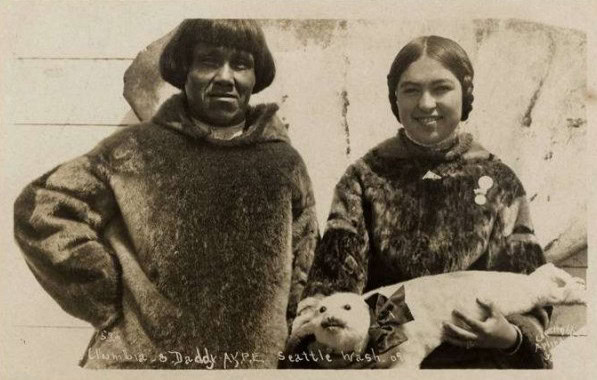
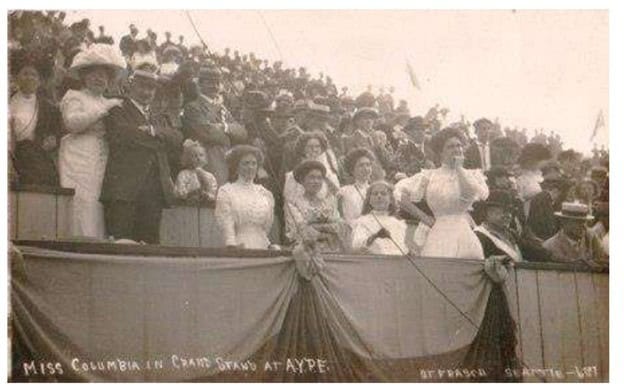
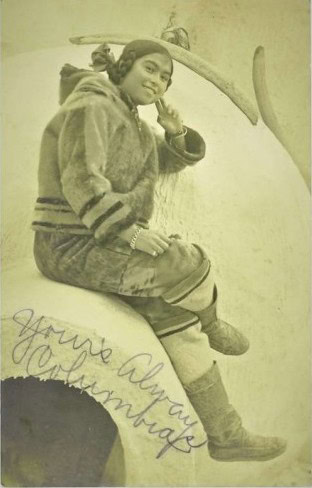
The Seattle Daily Times announced, “Columbia, the belle of the Eskimo Village” on the Pay Streak at the exposition and voted in popular contest to be the prettiest woman on the great joy path, where on Concessionaire’s Day recently she was the reigning monarch, will hold a series of public receptions in the Eskimo Village every afternoon and evening this week at which she will converse with her visitors, tell them of her daily life, or her experience in the North, and present each with an autographed postcard of herself.
After the Alaska Yukon Exposition ended Columbia and family shifted their attention to the newly developing film industry and in 1911 she wrote, directed and had the lead in the silent film “The Way of the Eskimo.” The film received positive reviews and international distribution leading to a second movie “Lost in the Arctic.” Unfortunately, no copies of either film exist today. Over the next 10 years the family would appear in at least 19 silent films, mostly cast in indigenous roles due to their native appearances, their final film appearance was the 1920 adaptation of the film “The Last of the Mohicans.”
Plans were made for the troupe to appear at the 1915 San Francisco World Fair, but a deal made by their manager had them opening an Eskimo Village concession on the Ocean Park Pier near Santa Monica, California. There they performed until a devastating fire destroyed the pier in December, effectively ending their years of touring.
With the waning of the popularity of ethnic attractions and the discontinuance of World Fairs as World War I approached, the family was no longer in demand. Columbia’s life as a performer, world traveler, and celebrity was over. She married a motion picture projectionist, had a child, and settled in Southern California where she managed an apartment hotel complex, living a quiet uneventful life. She suffered a debilitating stroke in 1948 and passed away in August 1959.
A life finished, her story forgotten. Her mother Ester outlived her by two years and today they lie buried side by side in Encino, California.
Interesting article but just one moot point. Mention is made that by 1915, with the First World War approaching, the troupe’s appearances lessened. I would point out that by then the war was already a year old although America didn’t get involved until it was nearly over and made a token appearance towards the end of hostilities which finally happened in 1918. Just a thought.
Great article. I love history. Kind of a behind the scenes. Thank you Phil.