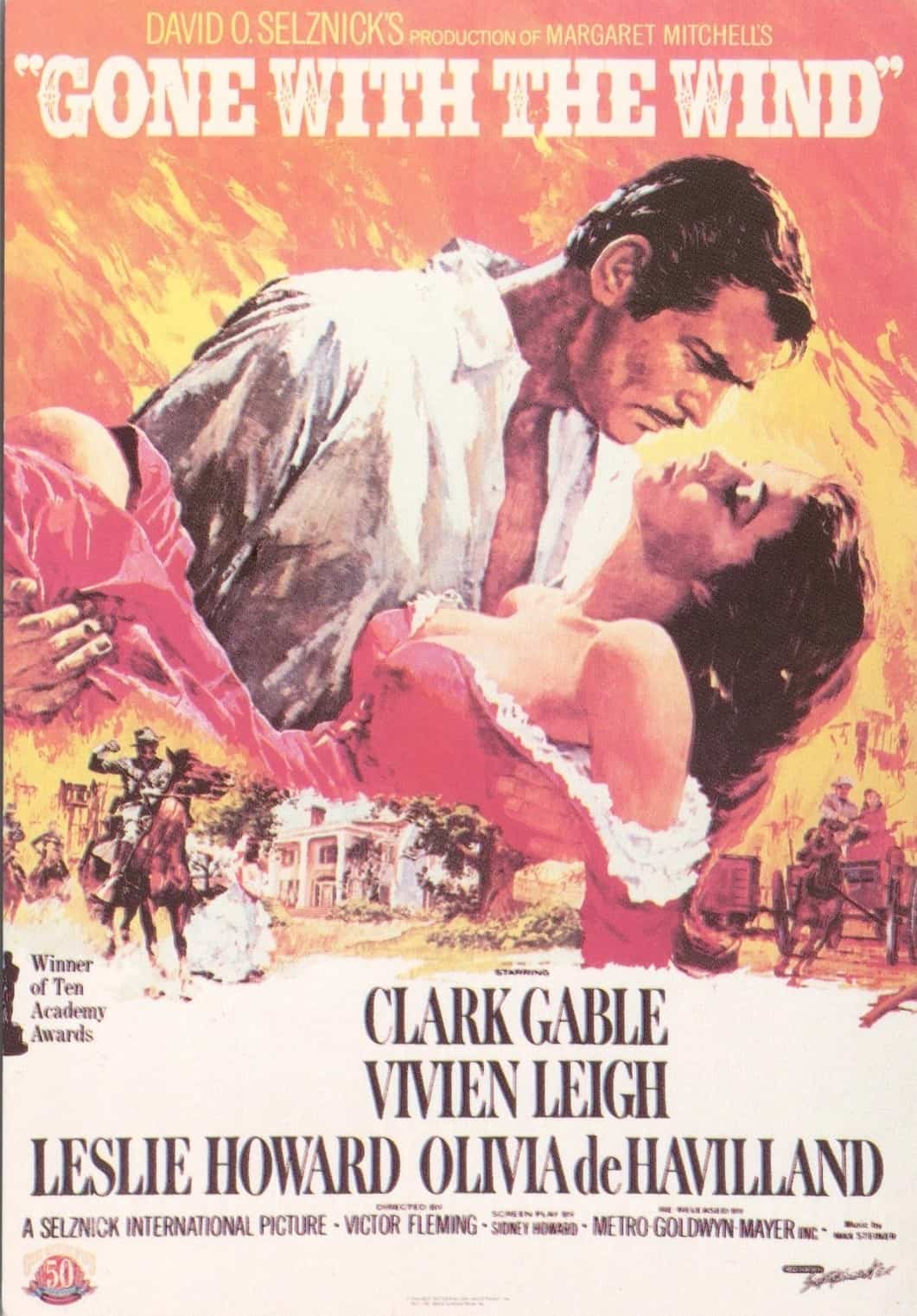
Gone with the Wind postcards are plentiful, but for as long as I have collected movie postcards, I have never met anyone who is solely a Gone With the Wind collector. I have managed to collect two of the better known sets – there are six: three from America (plus a reprint set), one from Germany, and one from France.
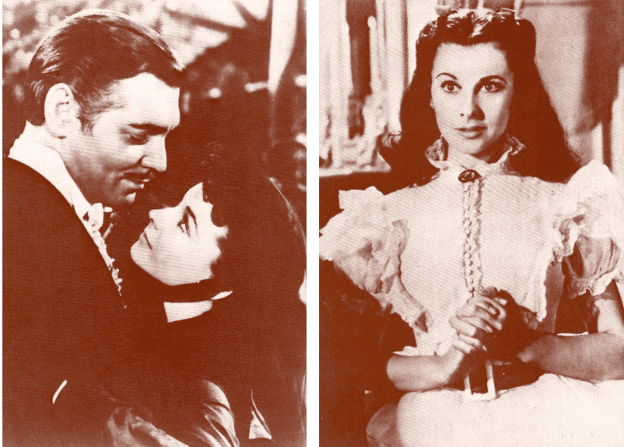
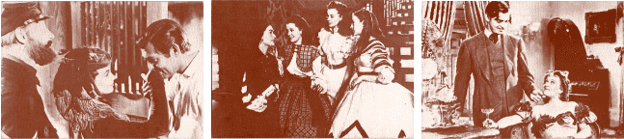
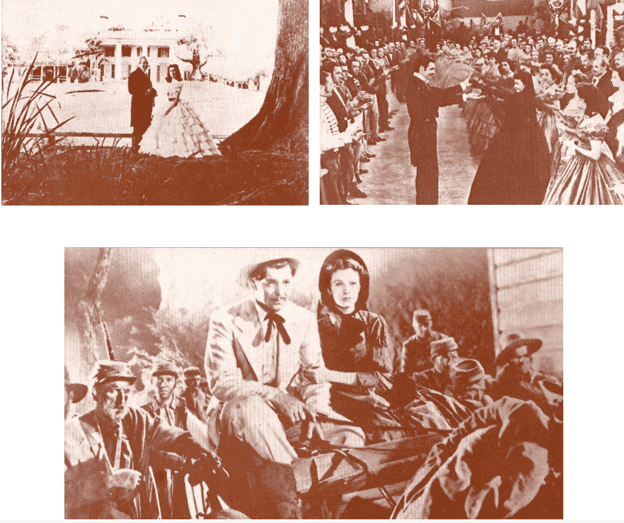
My favorite is the original 1939 souvenir set that was sold in the theatres for nearly a decade, then the reprints (see below) for another dozen or more years. The only regret collectors may have is that all twelve cards, except one, show only Gable or Leigh. And the same is true with the other sets, none of the 25 named cast characters and 17 minor characters appear in the photos, not even DeHavilland, Howard, nor McDaniels.
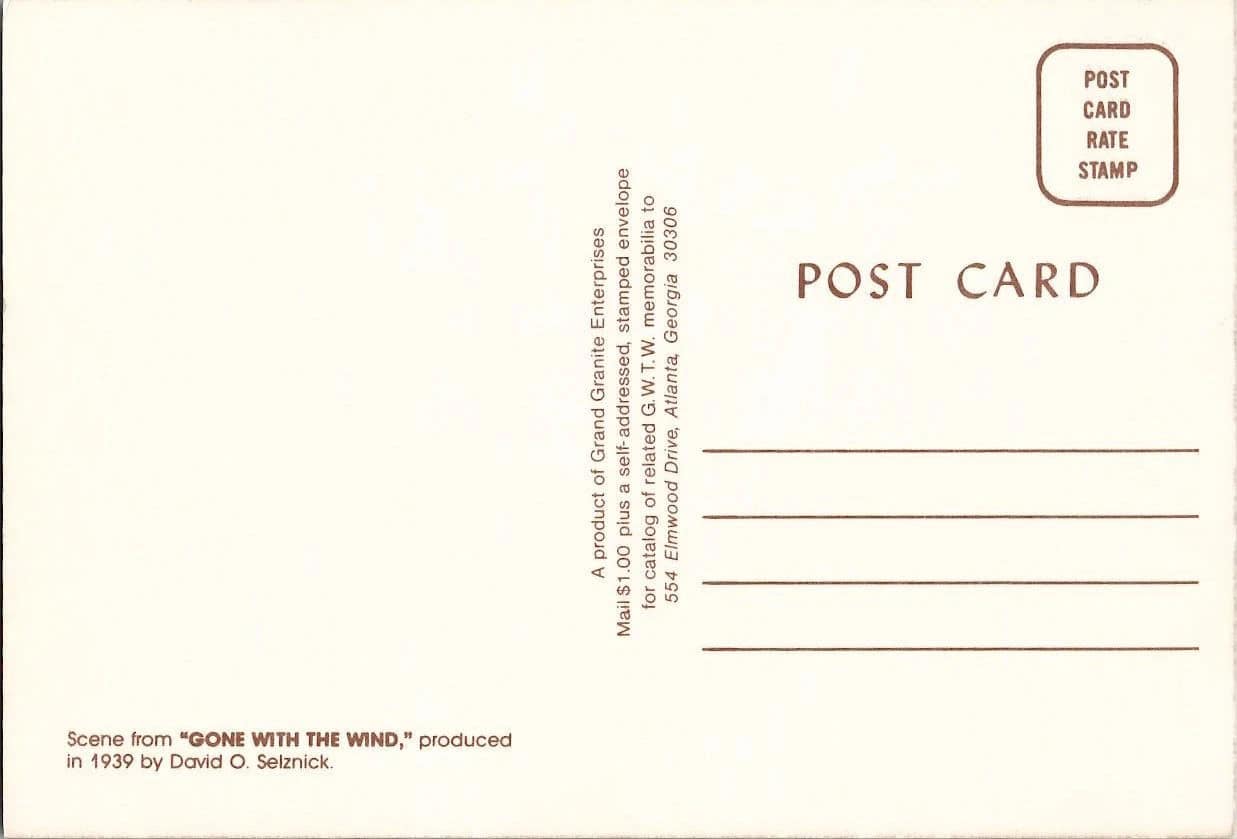
The images are sepia toned photographs – some studio shots, other action pictures. The backs are printed in brown ink that very successfully connotes authenticity and genuineness. There is a brief caption in the bottom left corner of every card that reads: Scene from “GONE WITH THE WIND,” produced in 1939 by David O. Selznick.
Few films in Hollywood history have loomed as large as Gone With the Wind. Its production was a near indescribable spectacle. It was lavish and chaotic, and fueled by the oversized personalities, actors and producers alike, who brought Margaret Mitchell’s novel to life. While the film is remembered for its sweeping Technicolor vistas and its outrageous closing line, its behind‑the‑scenes drama was every bit as operatic as the story on screen.
From the onset forward, producer David O. Selznick approached the project with a kind of fevered obsession. His most notorious undertaking was the search for an actress to play the Scarlett O’Hara character, a process that became a national fixation. More than a thousand women auditioned, and Selznick himself screen‑tested dozens, including established stars like Paulette Goddard and Joan Crawford. The eventual choice, Vivien Leigh, an unknown to most Americans British actress arrived on set almost like a secret weapon. Legend has it that she was introduced to Selznick during the filming of the burning of Atlanta sequence, the flames lighting her face as if announcing the arrival of Scarlett herself.
Leigh’s performance was dazzling, but her time on set was far from easy. She clashed frequently with director Victor Fleming, who found her too precise, too intellectual, too unwilling to surrender to his style of direction. Leigh, for her part, thought Fleming crude and resented his impatience. She often sought comfort from Laurence Olivier, her lover at the time, by writing letters about her exhaustion and the strain of playing a character such as Scarlett.
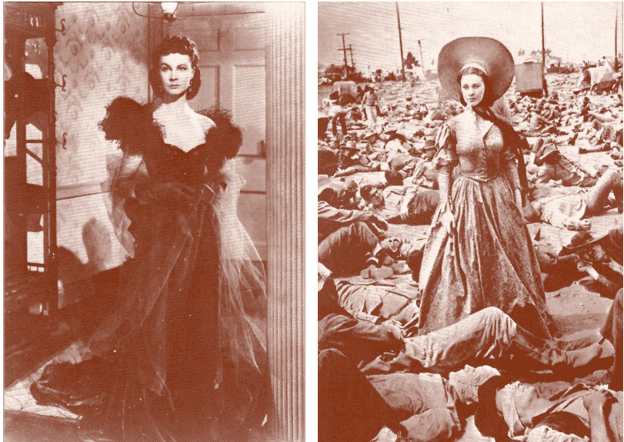
Clark Gable, meanwhile, brought his own set of obstacles. Already a major star, he resisted certain scenes like the moment where Rhett Butler is supposed to cry. Gable insisted that “real men don’t cry,” and only relented after Olivia de Havilland privately encouraged him to trust the emotion of the moment. Gable also disliked the idea of working with multiple directors, and his relationship with Selznick was a constant battle over creative control.
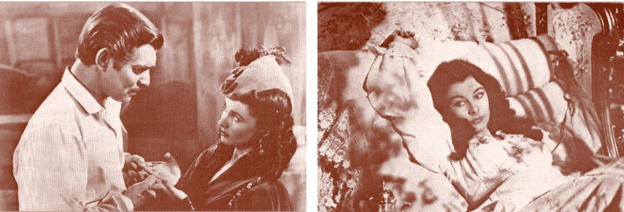
Olivia de Havilland and Hattie McDaniel provided the calm center of the storm. De Havilland was known for her grace and professionalism, while McDaniel, who would become the first African American to win an Academy Award, brought warmth and humor to the set. Yet even McDaniel’s triumph was shadowed by the realities of segregation; she was not permitted to attend the film’s Atlanta premiere due to Jim Crow laws.
Despite the turmoil, the film emerged as a monumental achievement. Its scale was unprecedented, its performances unforgettable, and its emotional power enduring. The final scene, in which Scarlett vows to win Rhett back, culminates in one of the most famous lines in cinema history—Rhett Butler’s cool dismissal: “Frankly, my dear, I don’t give a damn.” That single sentence, delivered with weary finality, became a cultural exclamation, symbolizing both the end of a romance and the end of an era.
***
In the decades since its 1939 release, Gone With the Wind has remained a milestone in American film—not only for its artistry, but for the tempestuous, glamorous, and sometimes painful human stories that Mitchell herself wrote to be part of her novel’s creation.
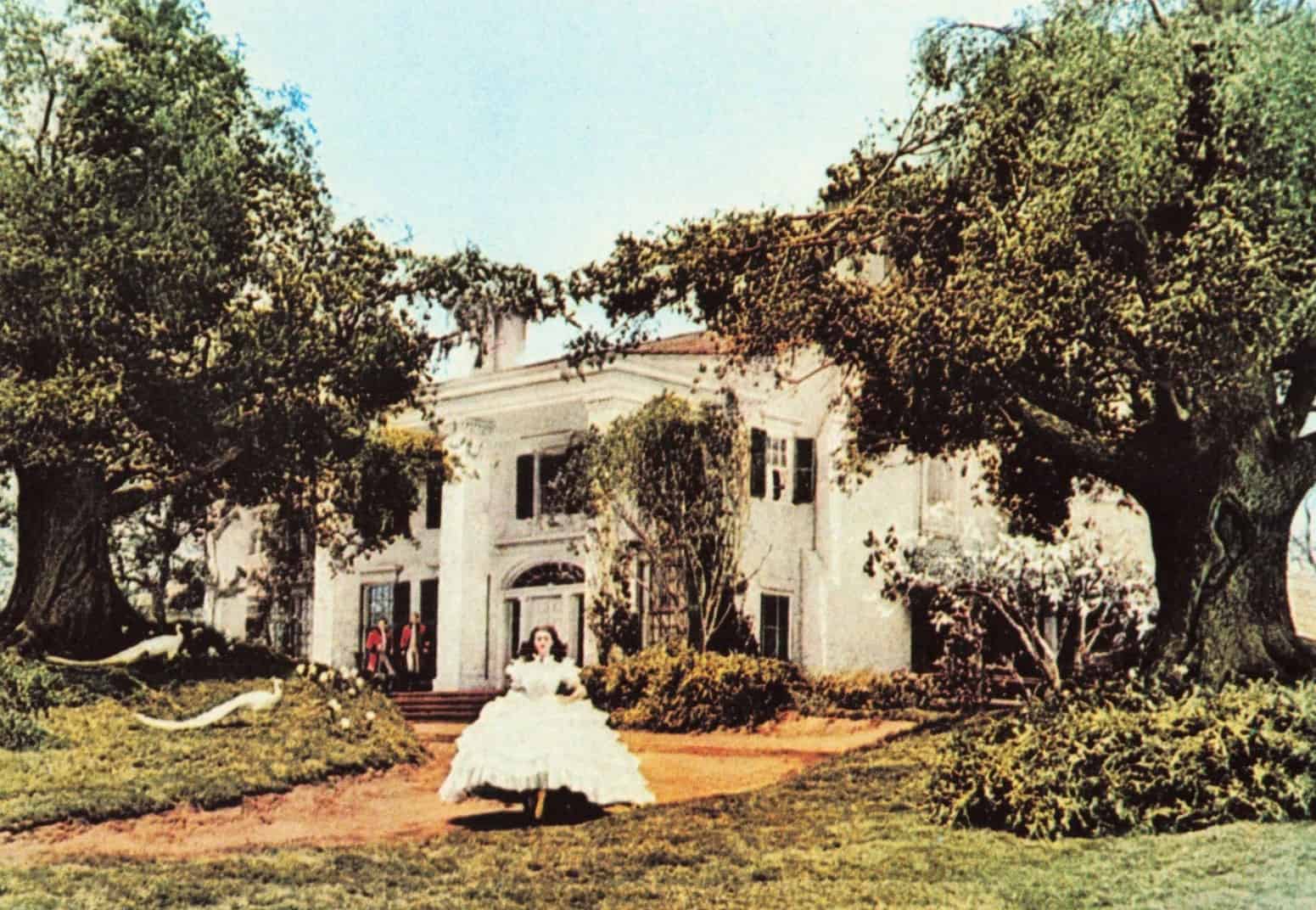
The film alone mirrors Hollywood itself. It is legendary for many reasons: ambition, conflict, brilliance, and contradiction – all without resolution.
Hello Martha, thank you for so much “back stage” information. That was all new to me. Gone With The Wind was one of the first movies I saw in 1975 with my future wife of 50 years… All good memories.
In the fall of 1969 the cast had a reunion in a hotel in Atlanta. The company I worked for was having a meeting in the same hotel and our was across from theirs. I had the opportunity to see the returning cast as they entered their room. An experience I will never forget.
Thank you Martha for a good summary. It brought back fond memories and a couple of lines I have used many times with students of a ‘certain age.’ What an exciting experience for Mike Schwartz.
An enjoyable read! Thank you:)