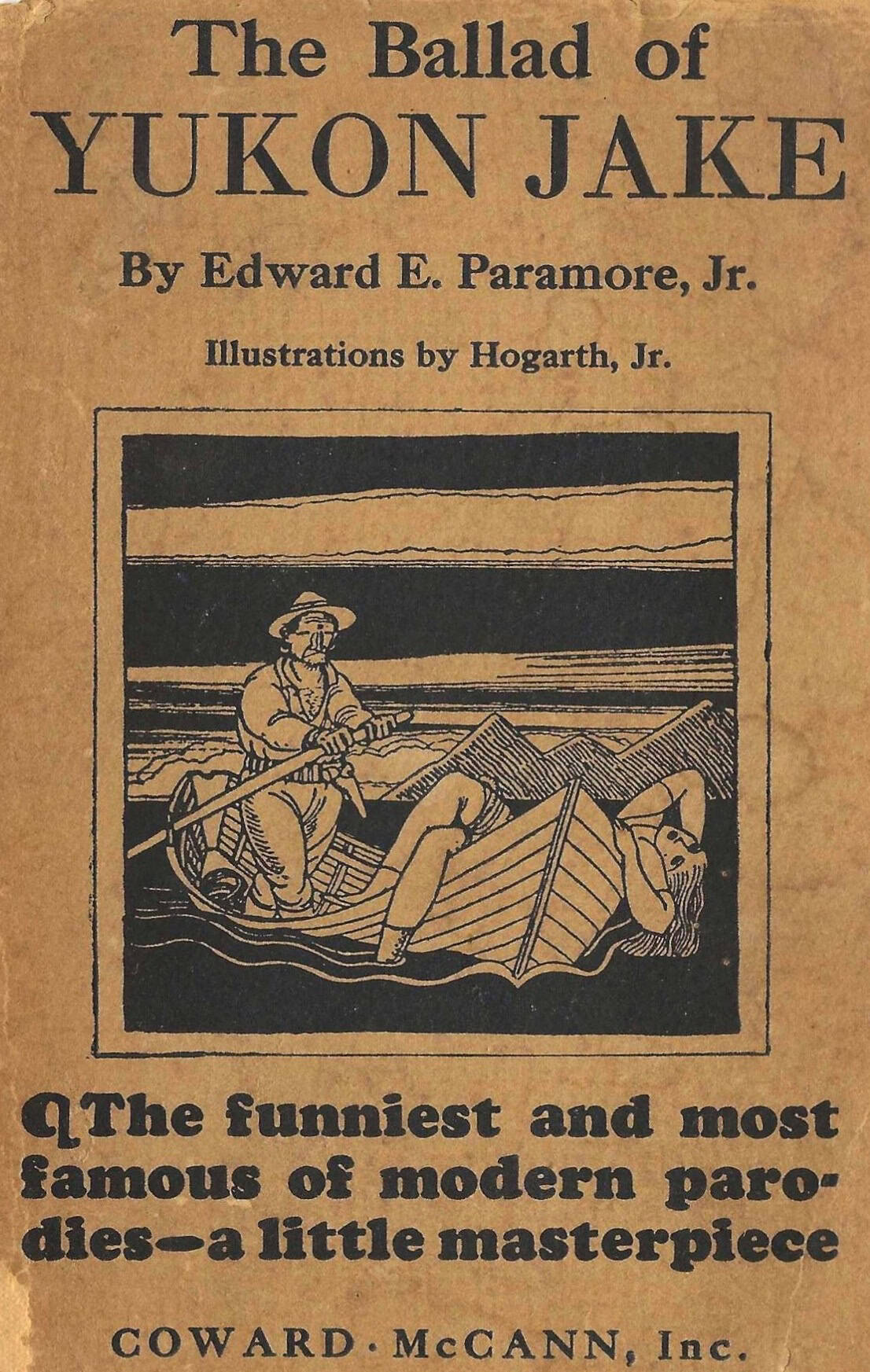
This postcard is one of the saddest examples of advertising in my collection of postcards about books. (When using the word “saddest,” it is sad because of condition.) The card is on a soft wood-pulp paper that has “yellowed” beyond description. The corners are bent and chipped. And it was used to tell someone’s mother that Bobby will be home on Sunday for dinner on May 13, 1929.
Apparently, Bobby was no genius. Did he not realize that he was inviting himself to Mother’s Day dinner at his mother’s house? Why wasn’t he inviting his mother out to dinner? I guess there are “sons” who really are both thoughtless and cheap.
Forget Bobby! The card is fascinating.
Yukon Jake is a fictional character, in the ballad that bears his name, but he is not just a character, he is a rough neck, a rogue, and a reckless, selfish rascal.
The poem, The Ballad of Yukon Jake by Edward E. Paramore, Jr., first appeared in a 1921 issue of Vanity Fair. Seven years later the author copyrighted his work, and it appeared in a “chapbook” format by Coward-McCann, Inc. of New York.
It is not a historical account, but a humorous, deliberately over‑the‑top parody written “begging Robert W. Service’s pardon.” It mimics the tone of Service’s Klondike ballads (The Shooting of Dan McGrew, The Cremation of Sam McGee), even referencing them directly.
Paramore’s poetic masterpiece is a tongue-in-cheek parody told by an unnamed narrator. The title character’s real name is Jacob Kaime, once a pious Iowa farm boy. After reading tales of Yukon vice, he abandons morality and heads to Nome, where he becomes a violent, hard‑drinking outlaw. Jacob terrorizes saloons, robs patrons, and even bullies characters borrowed from Service’s universe (Dan McGrew, Lou, and Sam McGee). Eventually he isolates himself on Shark‑Tooth Shoal in the Bering Sea, living as a feared hermit. Meanwhile, a woman he wronged in youth travels north to redeem him, her action set up a melodramatic moral confrontation.
The poem is intentionally outrageous!
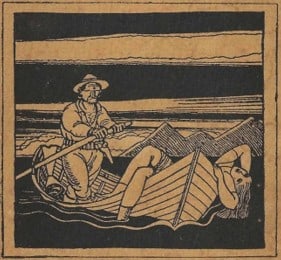
And he sold her to Dan McGrew
For a huskie dog and some hot egg nog-
As rascals are wont to do.
Paramore’s poem is a contrivance of Klondike mythmaking rather than a genuine frontier biography and should never be confused with the Mack Sennett slapstick western short film with the same name.
I’m slightly outraged at the poem’s trespassing into Robert Service territory, but I suppose it’s an homage, too. Thanks for bringing back a memory. My dad used to read Robert Service poems aloud at the dinner table. The Cremation of Sam McGee was a favorite.
Quite entertaining!
I’m a big fan of Robert W. Service… I did not know about Yukon Jake! A very enjoyable read and to become one of my favorites. Thanks.