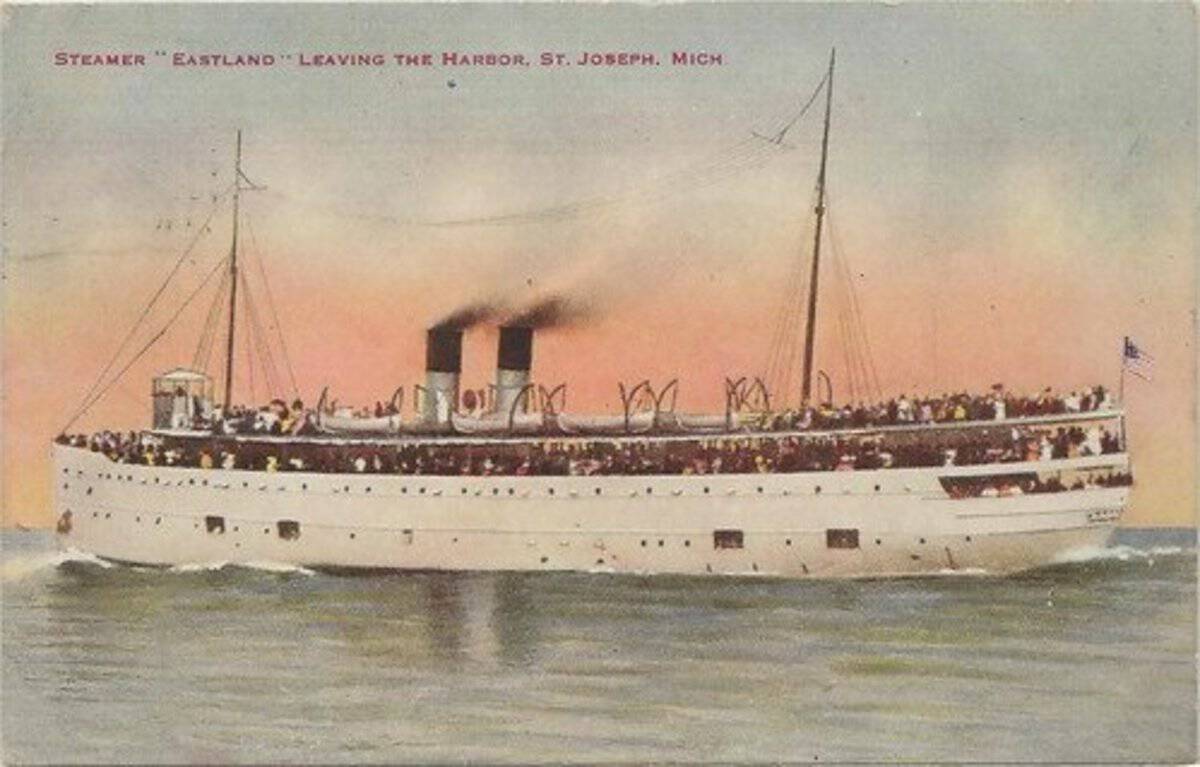
Published by Burkhand Brothers, St. Joseph, Mich.
Before the summer of 1915, tens-of-thousands enjoyed outings on Lakes Michigan, Huron, and Erie, aboard the S. S. Eastland, a passenger steamer built by the Jenks Ship Building Company in Port Huron, Michigan, and launched on May 6, 1903.
It was early on Sunday morning, July 25, 1915, when disaster made its way to the docks in Chicago. The S. S. Eastland sank in just twenty feet of water.
The front page of the Chicago Tribune on July 26, 1915, seemed more interested in placing blame and making excuses than the welfare of the survivors and the disposition of the victims. The banner headline read; BLAME U. S. OFFICIALS.
The sinking of the S. S. Eastland in the Chicago River remains among the deadliest maritime disasters in American history — a catastrophe that unfolded not on the open lake, but in the heart of a major city, in full view of thousands. In just minutes, a seemingly ordinary excursion steamer bound for a company picnic became a mass-casualty event that claimed 844 lives, reshaped maritime safety debates, and left a lasting imprint on Chicago’s collective memory.
The Eastland was a troubled vessel long before that summer morning. Built in 1903, she was known among sailors as a “cranky” ship, one with a tendency to list even under moderate load. Her design featured a shallow draft and a broad hull, meant to navigate river and nearshore waters, but these same features made her unusually sensitive to weight distribution. Over the years, inspectors, crew members, and even passengers had noted her instability. Several near accidents occurred, including a serious listing episode in 1904. Yet the ship continued in service, passing inspections and carrying thousands on pleasure excursions.
The disaster occurred at the Western Electric Company’s annual employee picnic, a major event that drew workers and their families from the Hawthorne Works in Cicero. Western Electric was the primary manufacturing arm and a wholly owned subsidiary of AT&T that produced telephones, cables, and electrical equipment. More than 7,000 people were expected to travel by a fleet of excursion steamers to Michigan City, Indiana. Eastland was the first scheduled to depart, and by 7:00 a.m., the dock at the Clark Street Bridge was crowded with excited employees, many dressed in their best clothes for a day of celebration.
As passengers boarded, the ship began to show signs of trouble. Witnesses later recalled a noticeable list to port even before departure. The crew attempted to correct the imbalance by adjusting ballast tanks, but the situation worsened. A key factor was the recent enforcement of the Seaman’s Act of 1915, passed after the Titanic disaster. The law required ships to carry more lifeboats and life rafts. (The Act was a well‑intentioned reform that inadvertently added significant top‑heavy weight to vessels like the Eastland, exacerbating her already precarious stability).
By 7:28 a.m., with more than 2,500 passengers and crew aboard, the Eastland lurched sharply to port. People screamed as dishes slid from tables and water poured across the deck. Within seconds, the ship rolled completely onto her side, trapping hundreds inside the enclosed cabins.
She settled in just 20 feet of water, but the shallow depth offered little mercy: passengers were crushed, pinned, or drowned as the river rushed in.
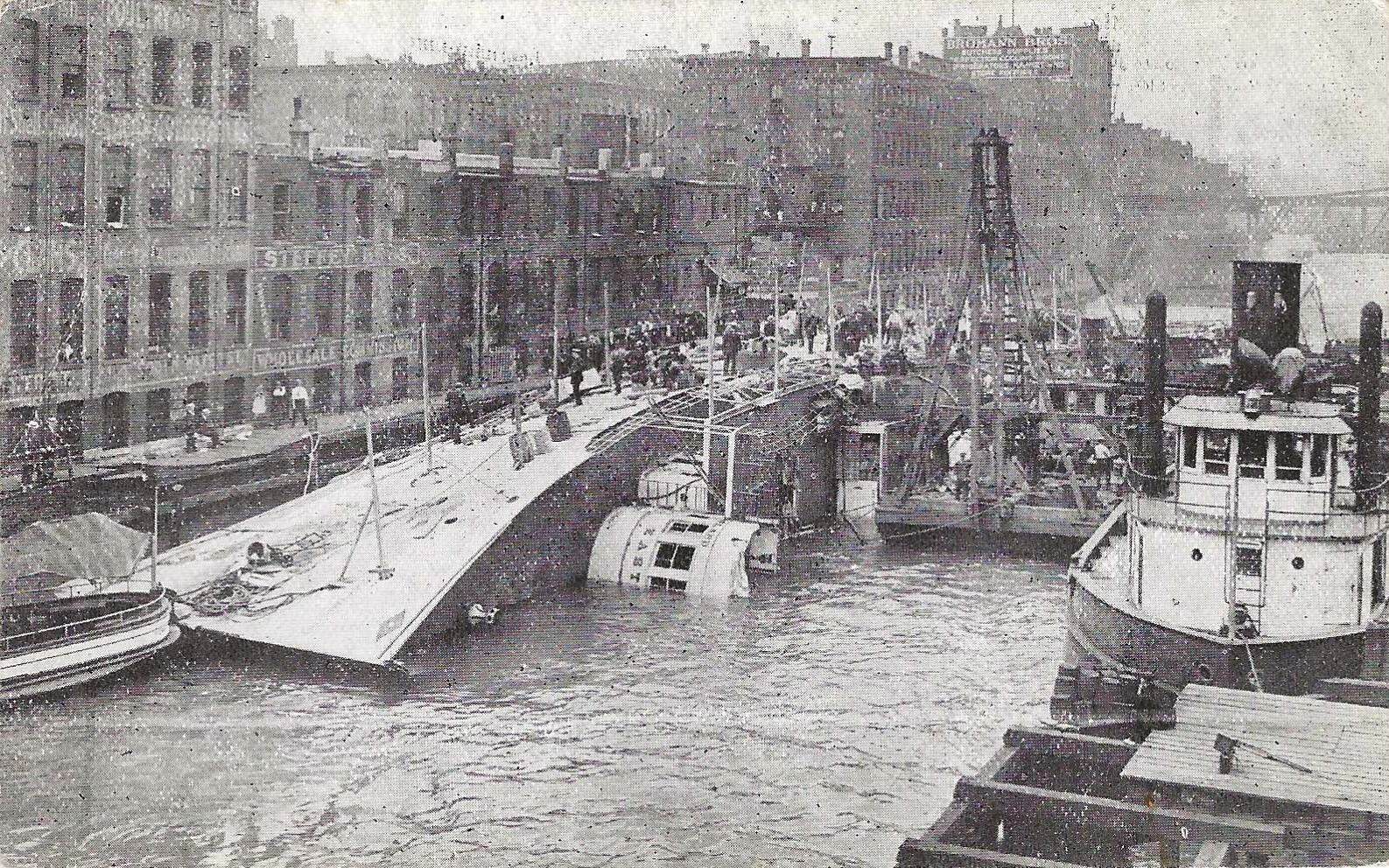
The response was immediate yet chaotic. The riverbank erupted into panic as onlookers rushed to help. Some leapt into the water; others formed human chains to pull survivors from the hull. Firefighters, police, and volunteers worked frantically, but the scale of the disaster was overwhelming. Rescue workers cut through the ship’s steel with torches – pulling out survivors and bodies — for hours.
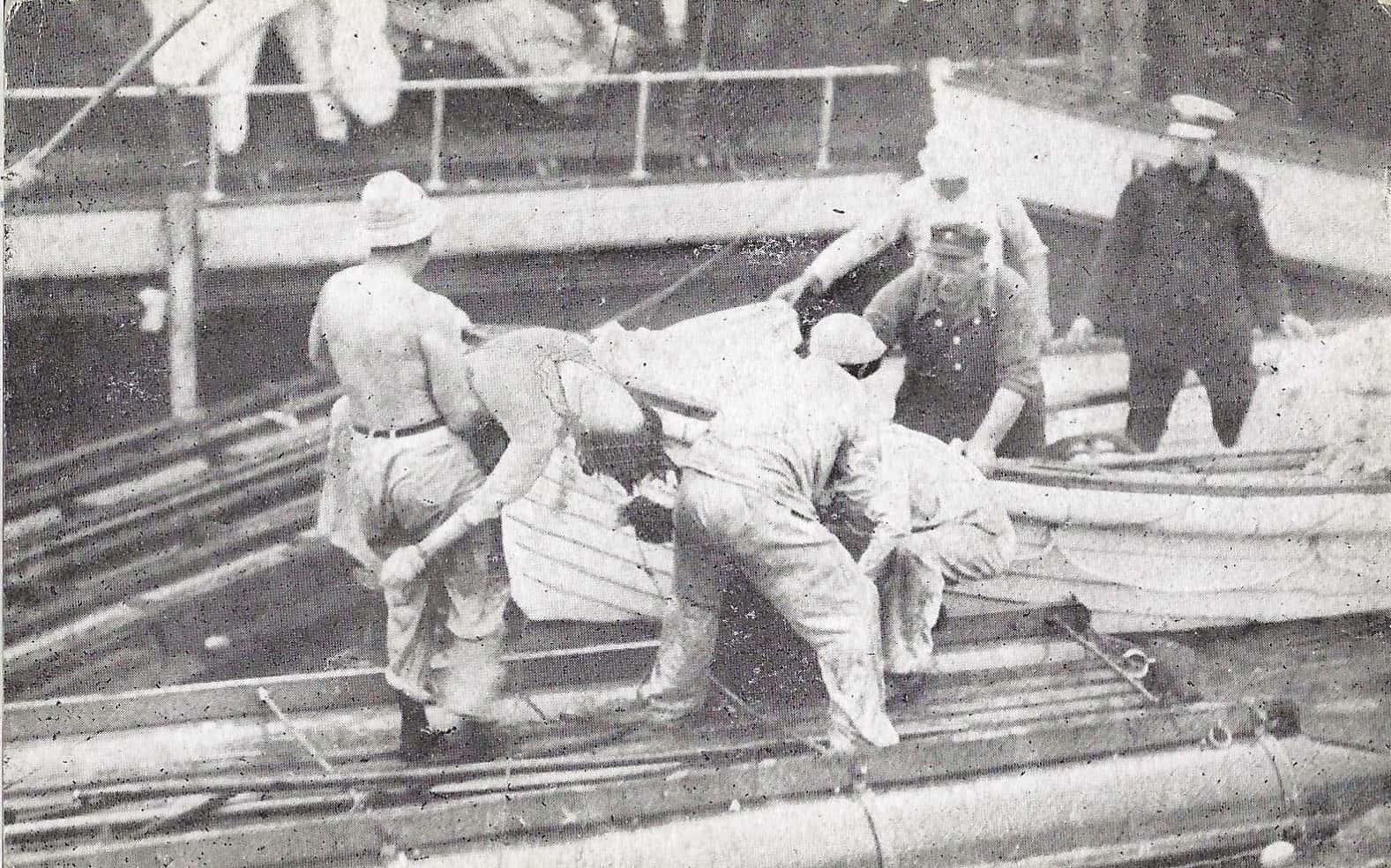
One of the most gruesome sites in the aftermath was the near parade of mortuary wagons arriving at the curb across the street from the docks where temporary morgues were set up along the river, including one in the Reid‑Murdoch Building, where families walked among rows of victims searching for loved ones.
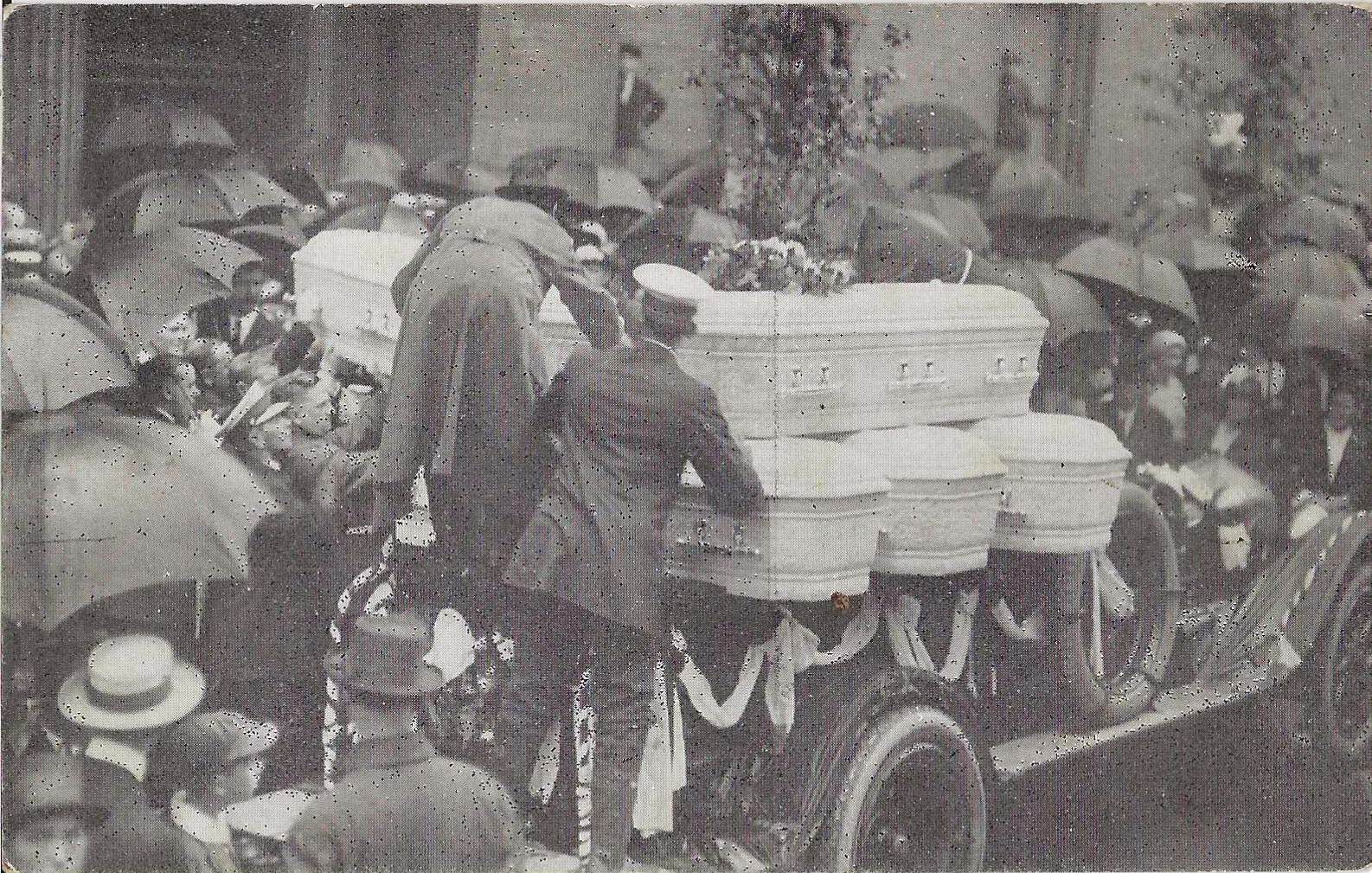
The human toll was staggering. Entire families perished. Of the 844 dead, over 200 were children. The Hawthorne Works community was devastated; nearly every department lost employees. The tragedy struck particularly hard among immigrant families — Czech, Polish, Lithuanian — who formed much of the factory’s workforce.
Their grief echoed through Chicago’s neighborhoods for years, but it started immediately. On the front page of Monday’s Tribune one headline read, “Mothers Self-Sacrifice One of Many Stories in Disaster Aftermath,” and it told of how a mother put her baby on a folded deck chair and floated it out into the river and as the child floated away the mother smiled and threw a kiss at it as she sunk below the water. Sadly, the baby was not part of the story. No one knows the result.
In the aftermath, public outrage demanded accountability. The ship’s owners, the Chicago-St. Louis Steamship Company, were indicted, along with the captain and several inspectors. Yet after months of hearings, the courts ruled that the Eastland had met existing safety regulations. No one was convicted. The verdict infuriated many, but it also underscored a grim truth: the regulatory system itself had failed.
And that was not the only failure. In the end, lists of the dead and of unclaimed bodies appeared in the Chicago papers. More than a dozen bodies were left unclaimed at the Regiment Armory (the site of a temporary morgue) and were listed in a cold and almost uncaring fashion, e.g., [Body] No. 679 – Woman, 30 years old, five feet five inches, 108 pounds, sandy hair, dark complexion, full face; or No. 396 – Boy, 11 years old, short; brown hair, black rubber sole shoes, brown suit; and a dozen more. The same happened in other temporary morgues. [Must we assume there were victims with family, friends, or neighbors who did not miss them?]
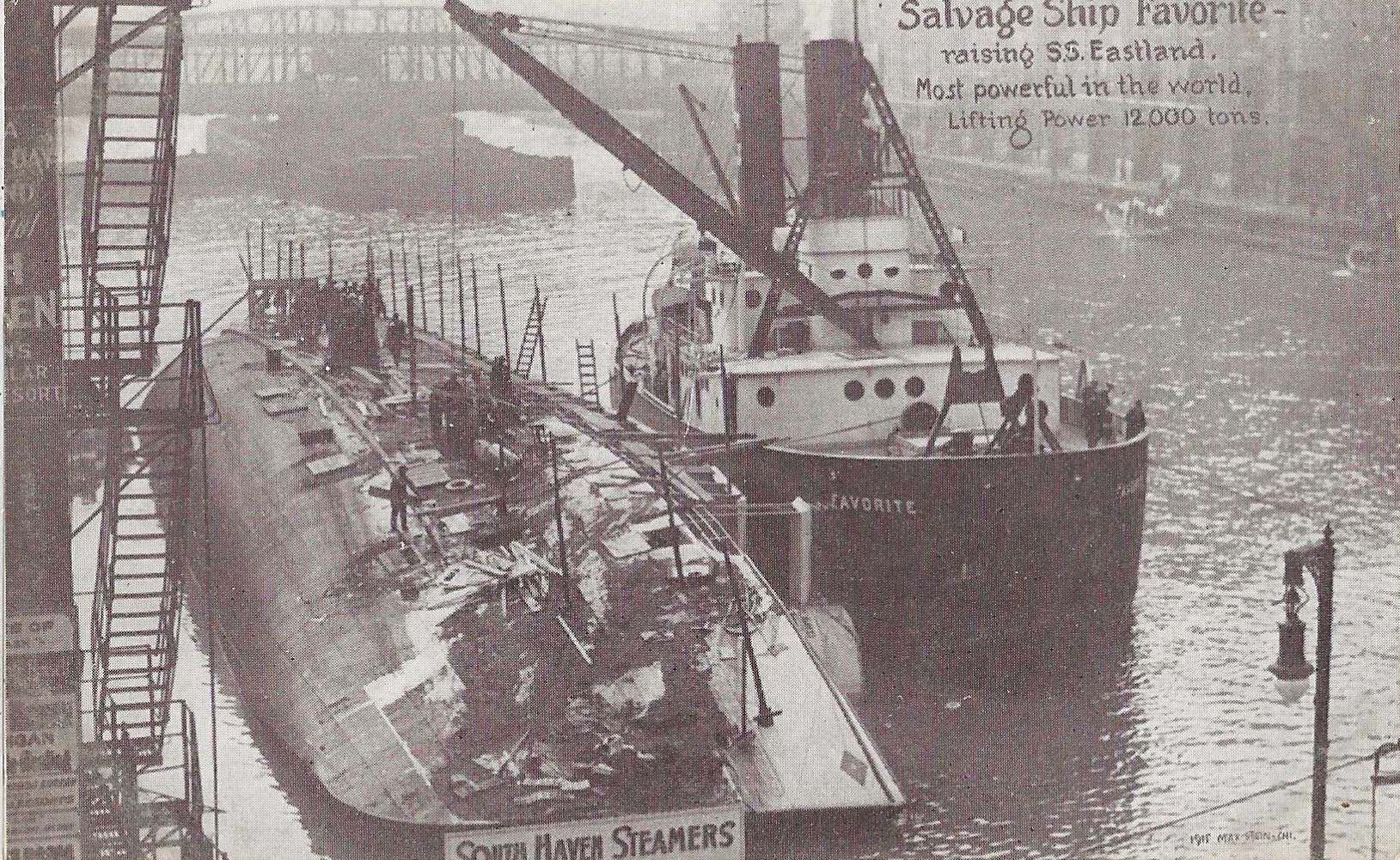
Salvage began immediately. On Tuesday morning the “righting” began and was managed by the crew of a work-tub named Favorite. The tug anchored, almost in mid-river immediately behind Eastland’s exhaust stack, used its lifting crane to “parbuckle” Eastland about midship and was brought up to its full lifting power of 12,000 tons. The strain of the engines was heard (reportedly) from three miles away.
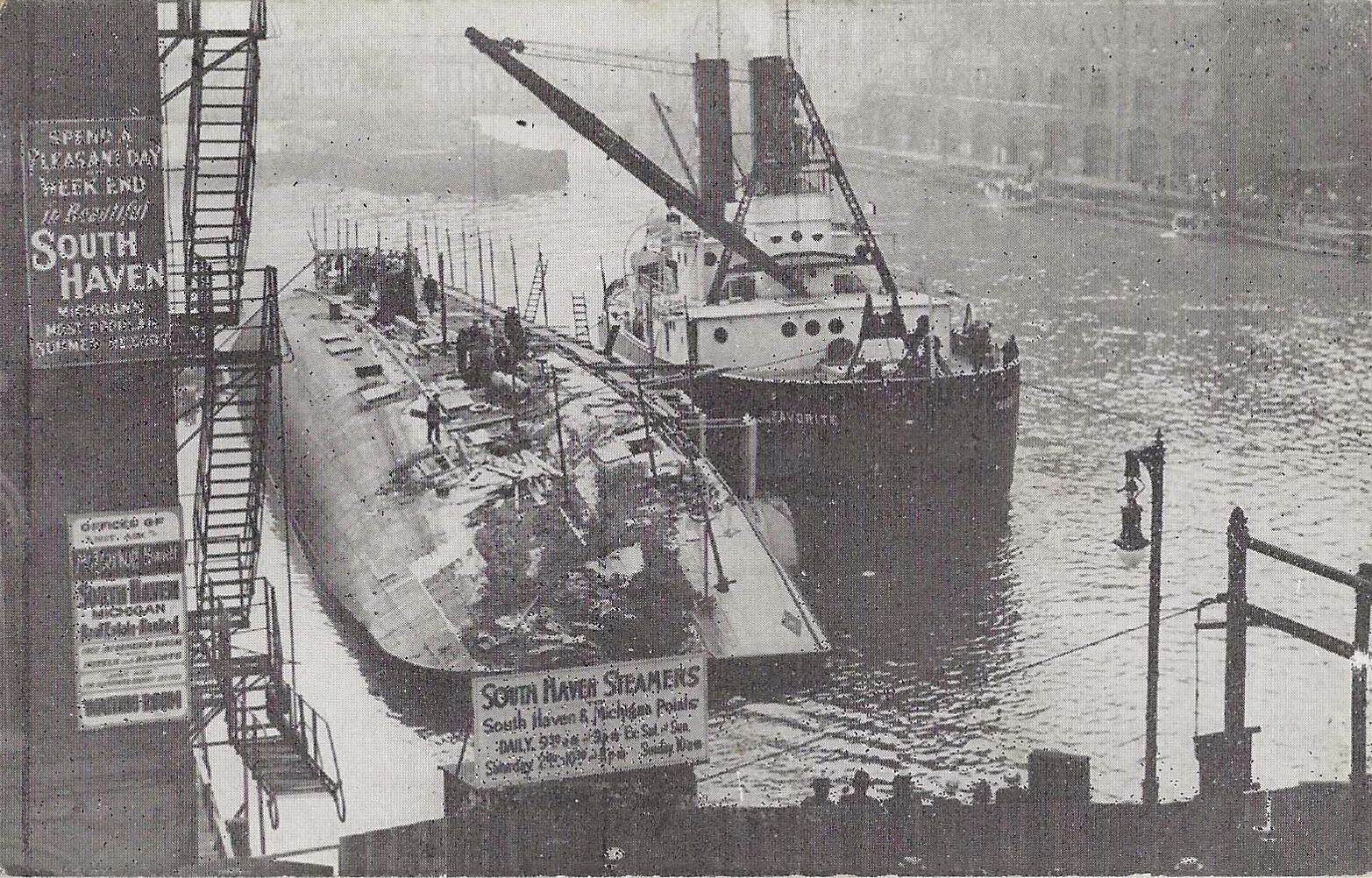
By first-day’s end, the Eastland was back to 45°, but there were weeks of work ahead. “Refloating” in the Salvage Industry is not considered complete until a sunken or grounded vessel is buoyant enough to float on its own.
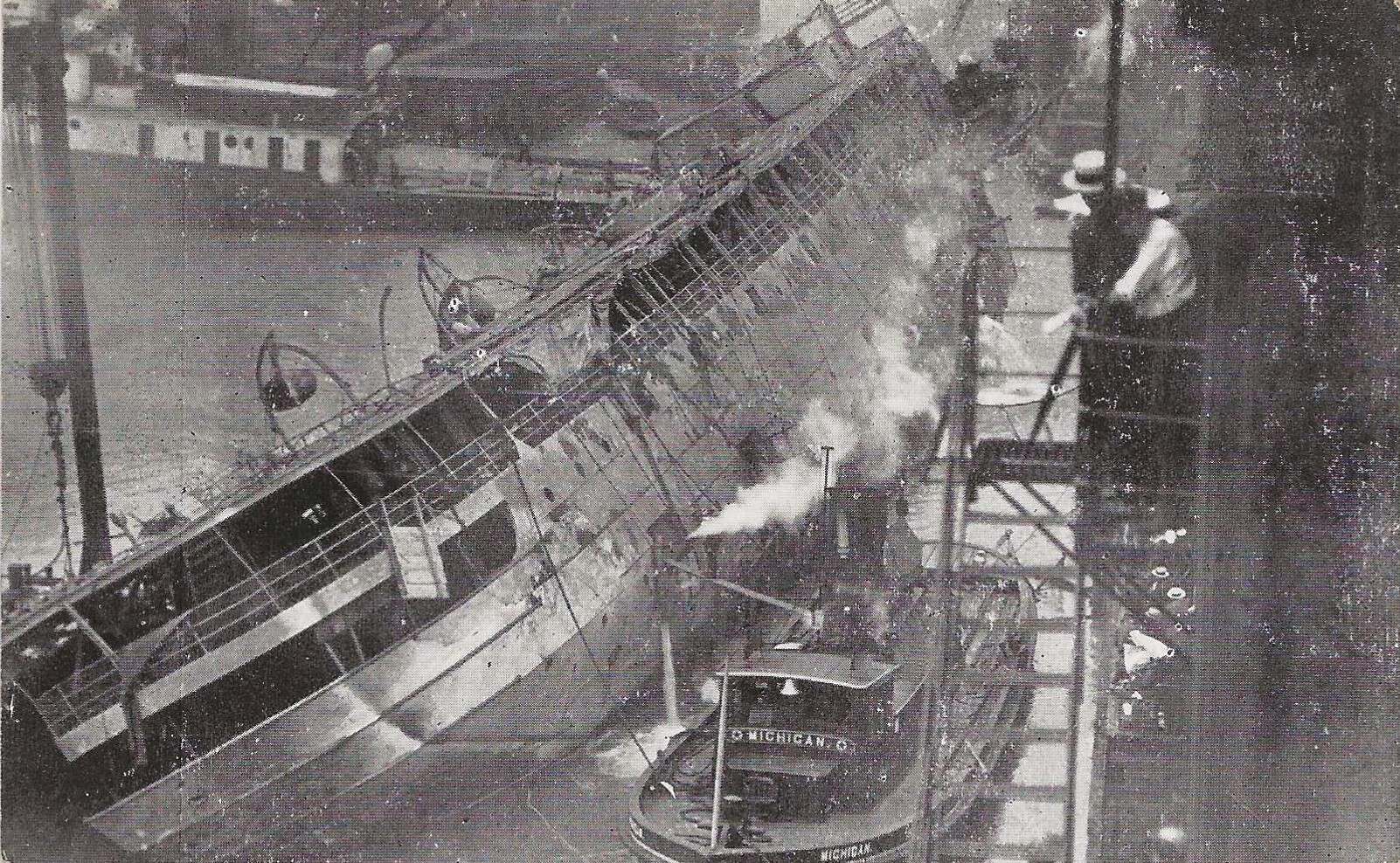
The Eastland disaster prompted renewed scrutiny of maritime safety, especially regarding vessel stability and the unintended consequences of the Seaman’s Act. Engineers and naval architects argued that simply adding lifeboats without considering structural design could endanger ships.
The tragedy became a case study in the importance of safety standards — a lesson that influenced future regulations.
***
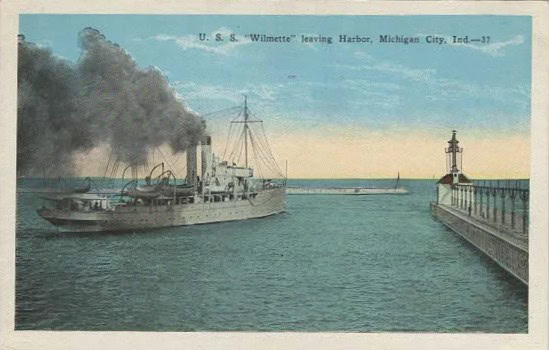
The ship’s own fate was unusual. After being raised from the river, the Eastland was sold to the U.S. Navy, refitted as the USS Wilmette, and used as a training vessel on Lake Michigan. She served until 1945, a strange second life for a ship remembered primarily for tragedy.
***
As for the salvage boat Favorite. It had a reputation in Chicago as a vessel with a long, gritty history on the Chicago River. Although overshadowed by the tragedy of the Eastland, Favorite was one of the most important industrial craft in Chicago at the time — a purpose‑built wrecking tug operated by the Chicago House and River Wrecking Company, famous for handling heavy river salvage, demolition, and construction support.
Favorite’s work on the river did not end with the Eastland disaster. Built for heavy lifting, wreck removal, and construction support, not for towing passengers or cargo. It worked typically with derrick barges, pile drivers, and cranes. Her exact dimensions are unknown, but photographs show a broad‑beamtug with reinforced timbers and heavy winch gear.
After the S. S. Eastland disaster. The U.S. government ordered the ship raised from the Clark Street dock so it could be inspected, sold, and eventually repurposed. A salvage contract went to the Chicago Wrecking Company, and Favorite became the primary working tug.
By August 14, 1915, the wreck was successfully righted.
***
Postcards of this disaster are plentiful and were published with both divided and undivided backs. The best images are those printed by the Max Rigot Selling Co. of 37 Wabash Avenue, Chicago. Also published in 1915 by Max Stein, of Chicago was a high-quality set of cards with very appropriate captions on the face of the card. At least one other set was published by an unnamed publisher.