It is a rare occasion for me to write about an artist whose work I have never seen, but in the fifty-five years during which I have traveled to six continents where art is exhibited, only once have I heard of or been informed that an exhibit of art by Gisbert Combaz had been mounted. That was in the Royal Library of Belgium, in the fall of 1999. I had a calendar conflict and could not attend.
If you are an English speaker/reader and if you wish to pronounce this artist’s name, you will be most successful if you use the following phonetic spelling: GIZ-bair Kohm-BAHZ.
Combaz was a leading figure in the Belgian Art Nouveau movement, though today he is nearly forgotten, but since he was remarkably versatile as a painter, lithographer, illustrator, poster designer, furniture designer, sculptor, teacher, art historian, and even a trained lawyer, it is hard to fathom why. Many of his students and their contemporaries, i.e. Rene Magritte, Max Ernst, the German Surrealist; Salvador Dalí, the Spaniard; Joan Miró, the abstract genius, and Giorgio de Chirico all have achieved far greater fame.
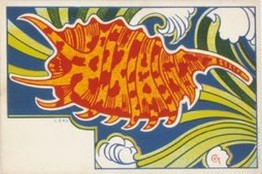
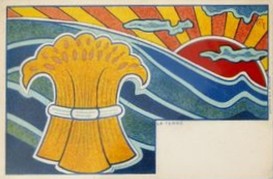
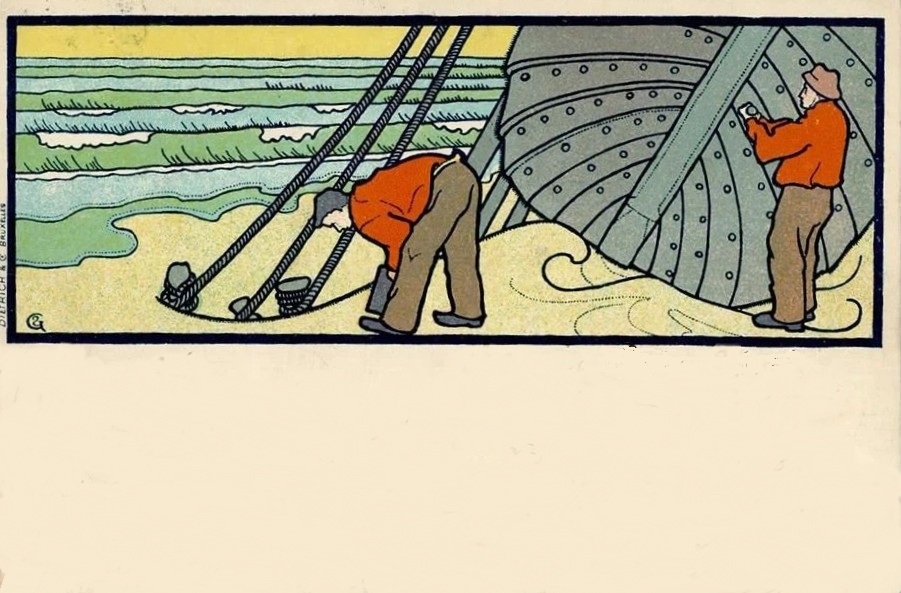
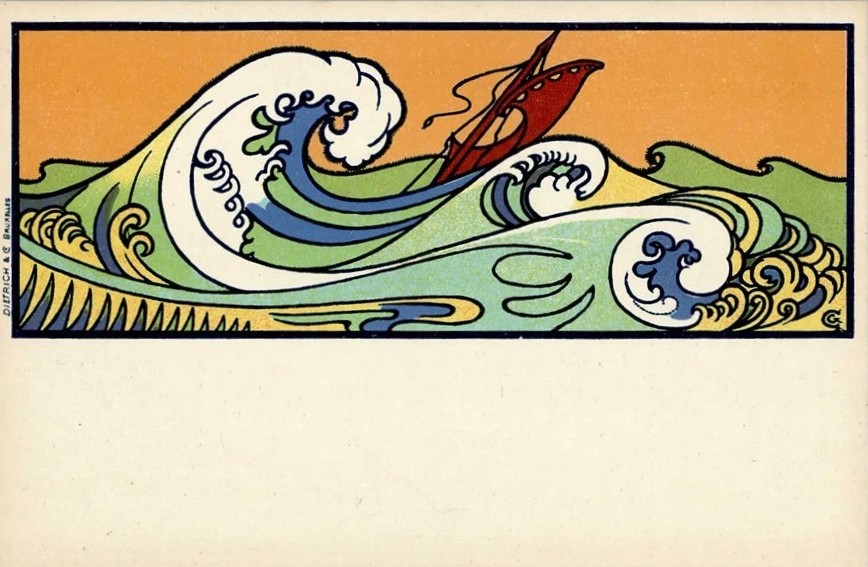
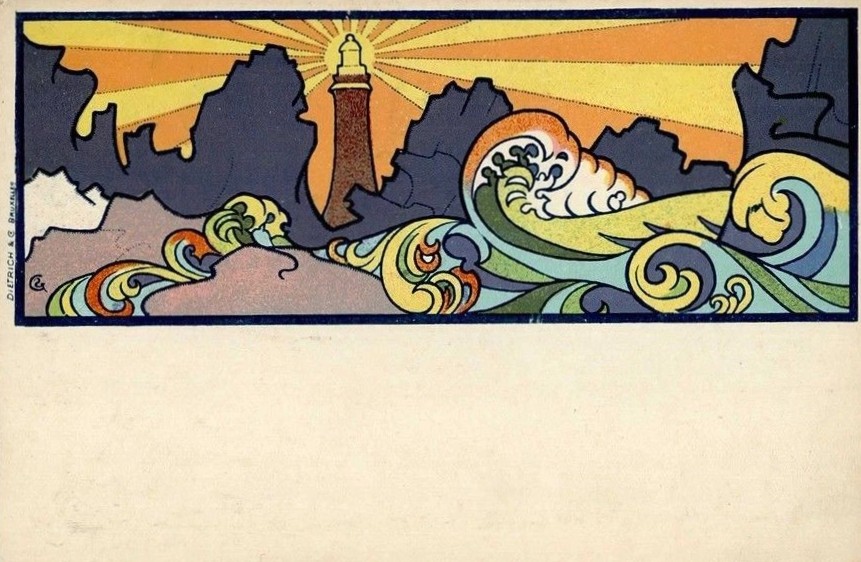
The artist’s contribution to the postcard world was very small – yet quite significant. Only 36 cards are known. His three 12-card sets (published by Dietrich & Co., Bruxelles) are highly sought after collectibles. The series titles are: Les Elements, La Mer, and Les Devises (“The Mottoes”) the set featured in this article.
Sample images from Les Elements
Sample images from La Mer
Images from Les Devises (“The Mottoes”)
This much celebrated set of 12 Art Nouveau postcards is generally known as Les Devises or “The Mottoes.” What makes the series unusual is that each postcard illustrates a French motto, proverb, or heraldic phrase. (The suggestion that the images represent the months of the year is completely erroneous.) Combaz transformed these short expressions into highly decorative symbolic images in his own distinctive style.
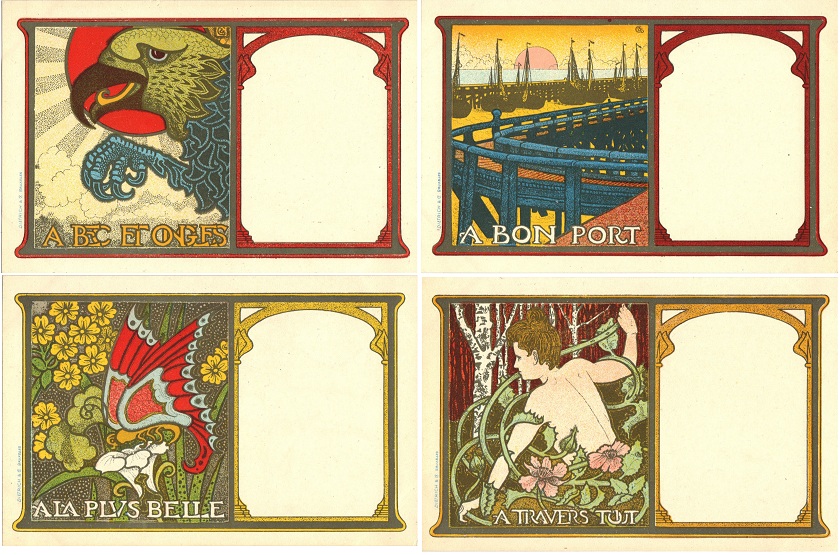
TRANSLATIONS: FRENCH TO ENGLISH
À bec et ongles (“with beak and claws”) means to defend something fiercely.
À bon port means “safe in harbor” or “safely arrived.”
À la plus belle is associated with chivalric devotion, roughly “to the fairest.”
À travers tout suggests perseverance or pushing through every obstacle.
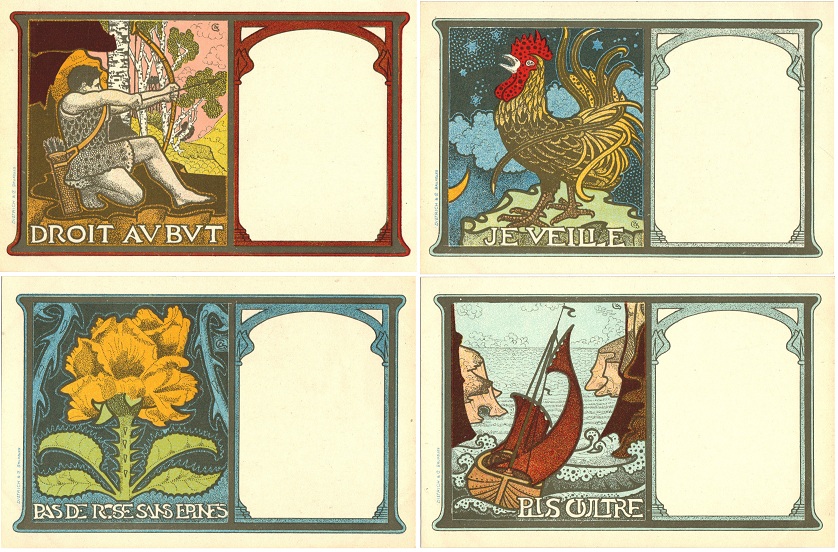
TRANSLATIONS: FRENCH TO ENGLISH
Droit aubut is “Straight to the point.” There will be no negotiations.
Je Vielle or I Keep Watch so you can relax and be safe.
Pas de rose sans erns means there is no rose without thorns or beauty without peril.
Plus oultre or Further beyond means that what lies ahead is never known.
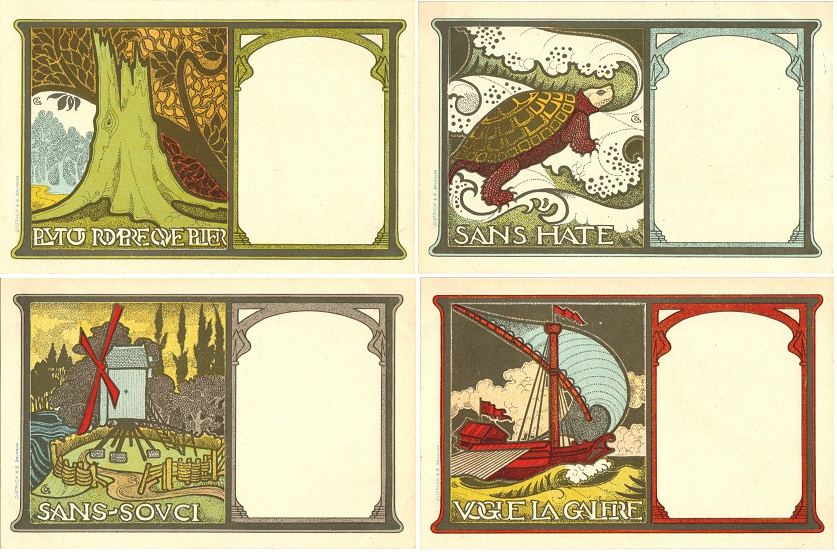
TRANSLATIONS: FRENCH TO ENGLISH
Plutot ropreoveplier or Clean up after you work. The seasons repeat.
Sans Hate means work without haste; do it better.
Sans-souci or Be carefree; live without worry, do not despair.
Vogue la galere or Sail on, come what may.
The cards are related by a common concept: each is a visual emblem built around a motto common to all mankind. In that sense they resemble a renaissance of symbolic emblems found in books, where an image and a phrase work together to convey an idea. Hence, the significance of the images is that they are visual interpretations of twelve mottoes, created as a unified portfolio. What makes Gisbert Combaz especially fascinating is that he brought scholarship into his work that feels both decorative and intellectual.
***
Combaz: the man, the lawyer, the artist…
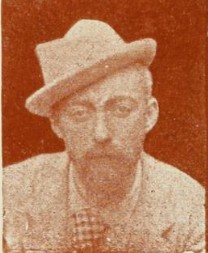
Born in Antwerp on September 23, 1869, Combaz earned a law degree from the university in Brussels and briefly practiced law. He was dissatisfied and in 1893 he abandoned the legal profession to devote himself entirely to art and art education.
There was little reluctance when Combaz became associated with the Belgian avant-garde circle that called itself the Free Aesthetic. As the successor to the famous artists’ group Les XX. By the late 1890s, he designed exhibition posters that are now considered among the finest examples of Belgian Art Nouveau graphic design for their bold color, elegant patterns, and stylized floral and symbolic motifs. Unlike many Art Nouveau artists whose work feels delicate and flowing, Combaz often used stronger forms and richer color contrasts, giving his designs a distinctive visual power.
Teaching was a major part of his life. He taught decorative arts for more than forty years and later became a professor at the Royal Academy of Fine Arts in Brussels, where he remained until his death in 1941.
What made Gisbert Combaz especially fascinating is that he brought scholarship into his work to make his art feel both decorative and intellectual.