Another college football season is upon us. The bratwursts are on the grill and the beer in the cooler so sit back and enjoy another trek across America to view college football stadiums captured on postcards.
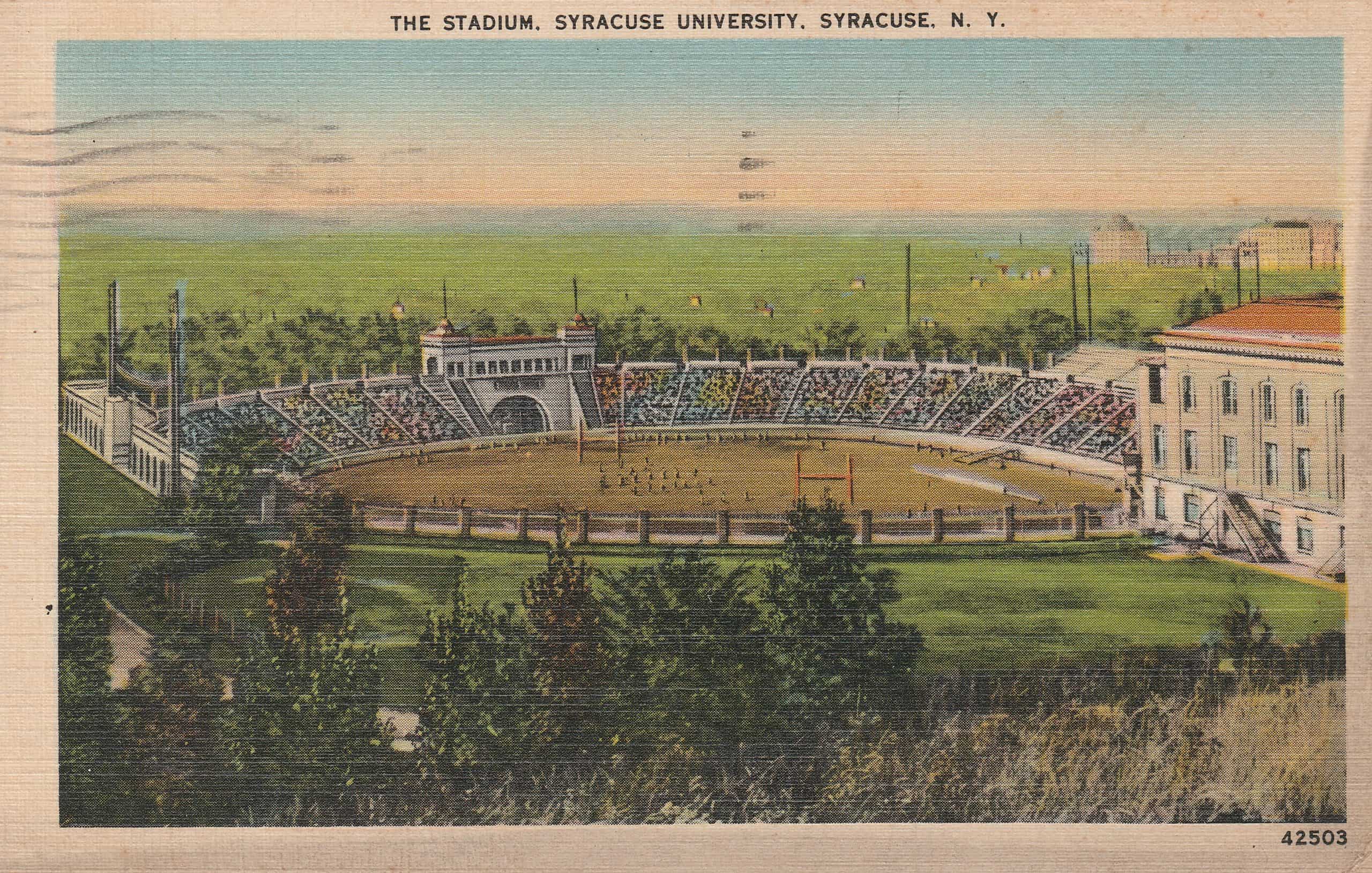
Archbold Stadium served as the home field of the Syracuse University Orangemen from 1907 until 1978. Named for John D. Archbold, President of Standard Oil, who donated $600,000 for the stadium’s construction. Initially Archbold Stadium seated 25,000 spectators. Built entirely of concrete, at the time of its construction, it was only one of three concrete stadiums in the world and displaced Harvard as the largest. The fans dubbed it the “greatest athletic arena in America.”
Its main entrance resembled a castle, with two turrets framing the gateway; designed to resemble the Roman Coliseum and never appear outdated. In the 1950s, the stadium was expanded, bringing seating capacity to 40,000. In the 1970s, stricter fire codes forced a reduction in capacity to 26,000.
During its lifetime, more than six million fans attended football games at Archbold Stadium. By the 1970s, Syracuse needed a larger venue for football. Archbold Stadium was showing its age and expansion was impossible. Archbold was demolished. In 1980 the new Carrier Dome (now the JMA Wireless Dome) was built on the site of the demolished stadium.
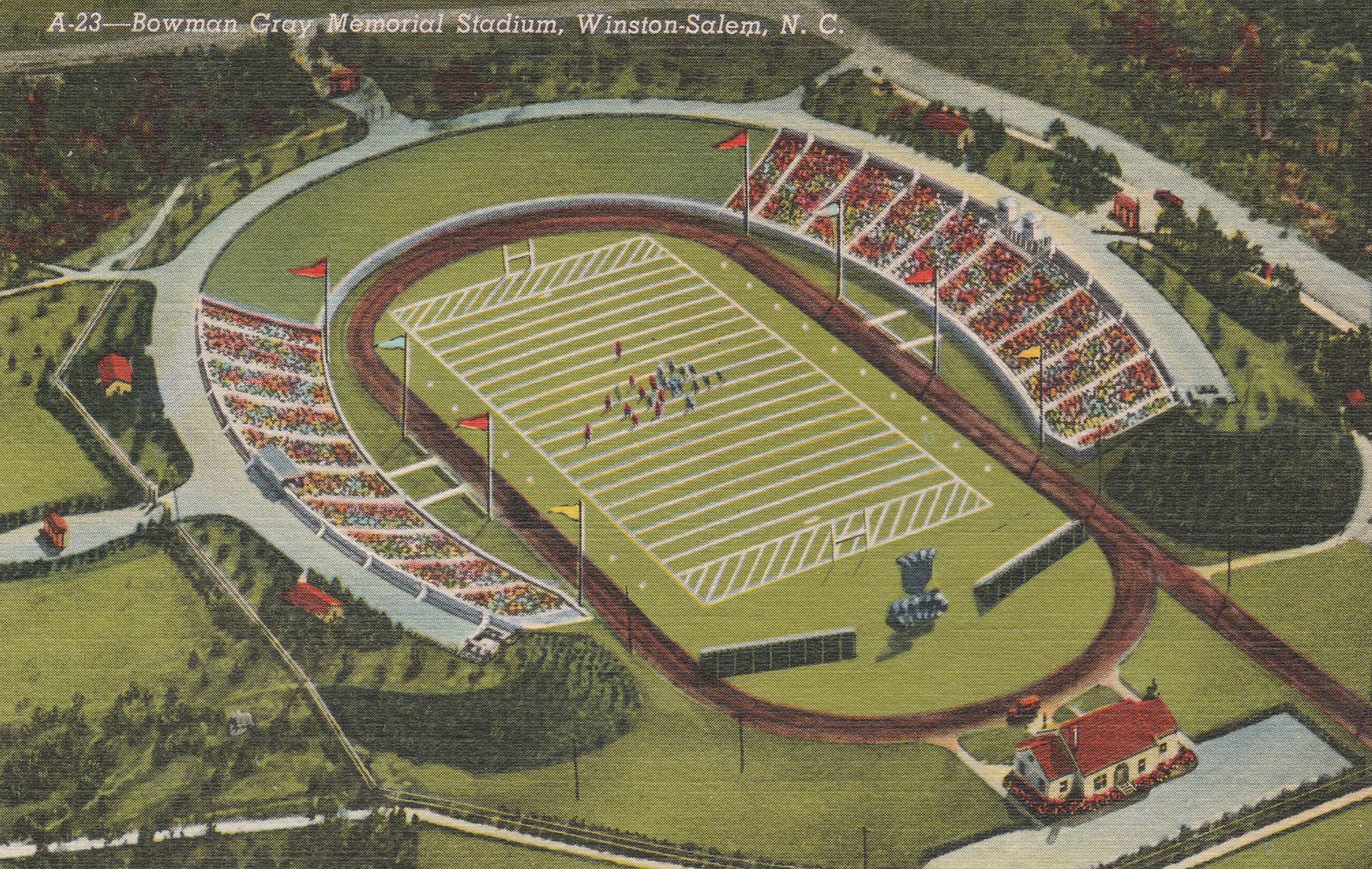
Winston–Salem, North Carolina’s Bowman Gray Memorial Stadium is named after Bowman Gray, Sr, a former president of the R. J. Reynolds Tobacco Company. His widow provided $35,000 to fund the stadium’s construction with the remainder of the $200,000 construction cost coming from the federal Works Progress Administration (WPA). The horseshoe shaped stadium seated 14,000 and opened in the spring of 1938. The first college football game was in October 1938. The Duke University Blue Devils defeated the Demon Deacons of Wake Forest College.
Initially, Bowman Gray Memorial Stadium did not serve as the home field for a collegiate team. In 1956, the Demon Deacons of Wake Forest moved to Bowman Gray and remained there until 1967. Also from 1956 until the present, it has been the home field for the Winston-Salem State University Rams, a historically black university.
Since the late 1940s, Bowman Gray has also served as an auto racing track. Seating increased to 17,000 due to the sold out crowds. NASCAR hosts several short track events annually at Bowman Gray.
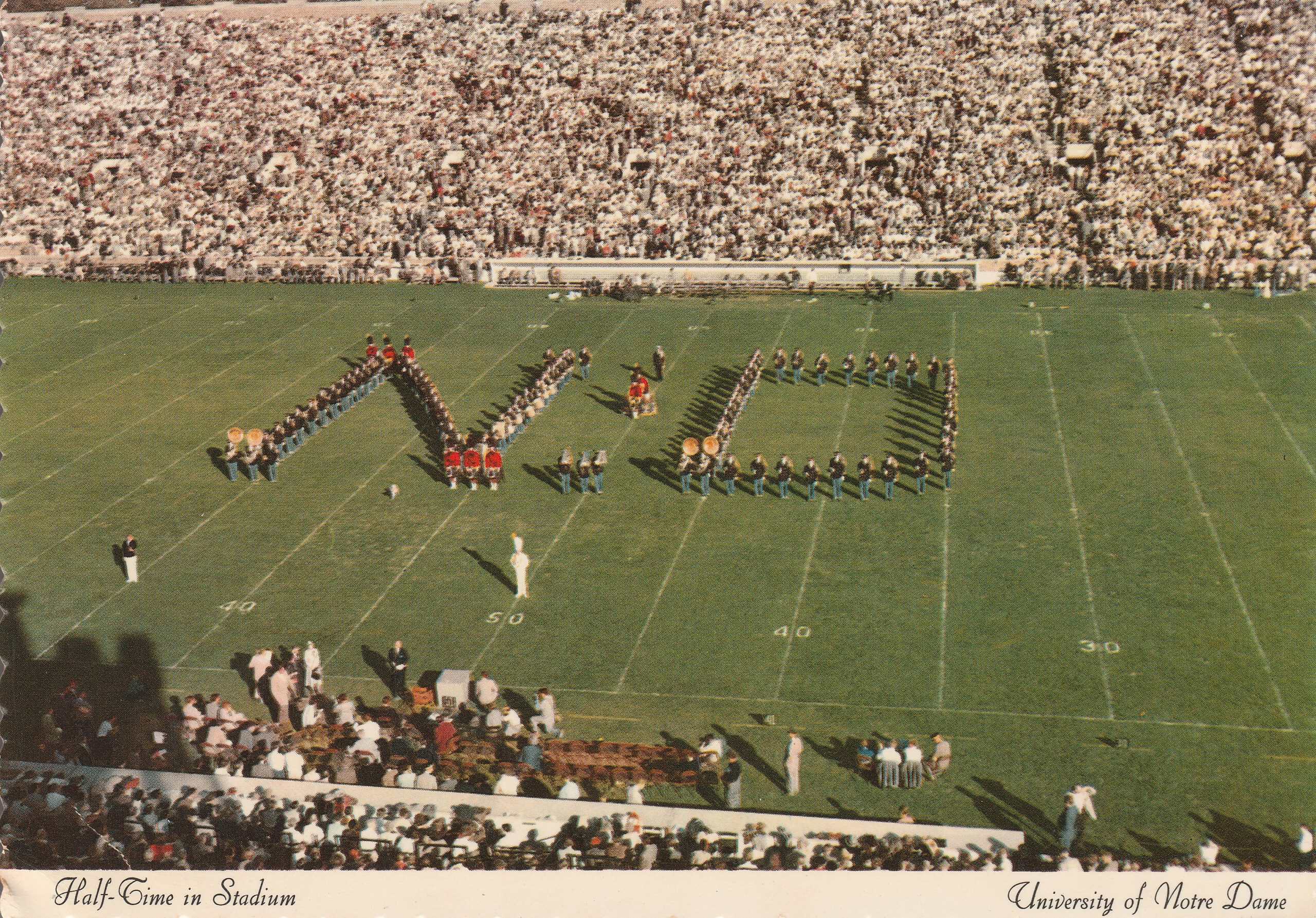
Notre Dame Stadium in South Bend, Indiana, built in 1930, known as the house that Knut Rockne built.” At first there was seating for 54,000 Fighting Irish fans, but later the seating increased to over 80,000. A 2014 renovation decreased seating to 77,000. Every home game has sold out since 1964.
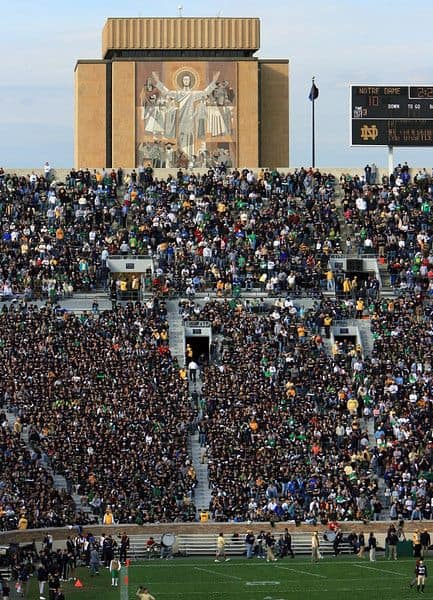
One iconic aspect of the stadium is the 134- x 68-foot mosaic mural “The Word of Life,” installed on a wall of the Hesburgh Library in 1964. The mural looms over the stadium and shows Christ with his arms upraised. Fans saw Jesus signaling a touchdown in the manner of a football referee rather than its religious significance and nicknamed the mosaic “Touchdown Jesus.” Since the stadium’s expansion in mid-1990s, the mural is visible from fewer seats but is seen during television broadcasts when Notre Dame scores.
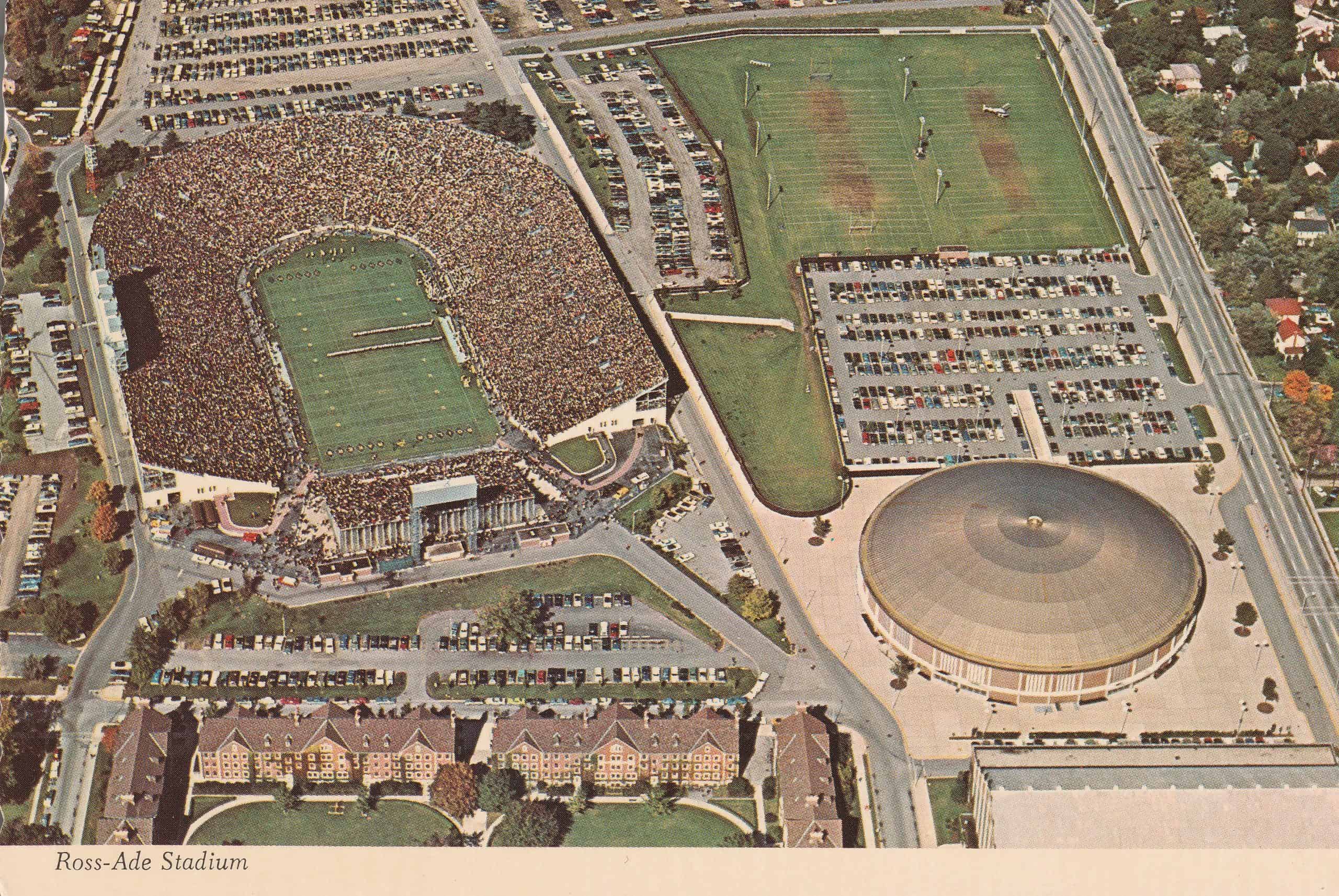
Ross-Ade Stadium at Purdue University in West Lafayette, Indiana, dedicated in November 1924, is named for two alumni: David Ross and George Ade, who provided financial support for the stadium’s construction. Its original seating capacity was 13,500 with room for 6,000 standing fans. Six expansions over the decades increased capacity to 69,200 (including standing room) Boilermaker fans by 1970.
A $70 million renovation began in 2001 added luxury suites and a $45.4 million renovation in 2024 added a new south end zone stand increasing student seating. Current seating is 61,444. There was no stadium lighting until 2017. In 2019 it was renamed Rohrman Field at Ross–Ade Stadium. The current attendance record was set at 71,629 on November 22, 1980, when Purdue played the University of Indiana.
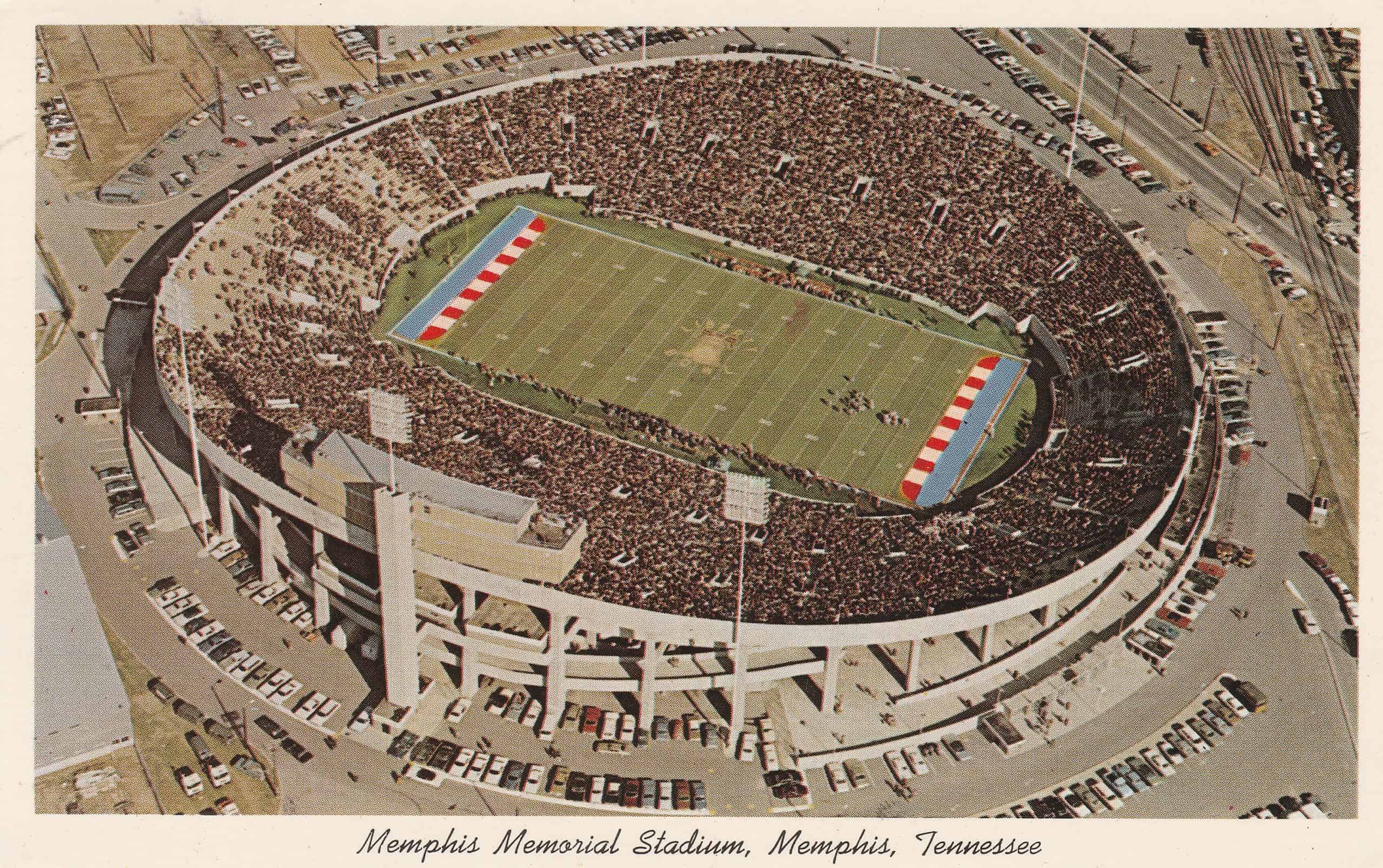
Memphis Memorial Stadium, completed in 1965, cost $3.7 million. It was renamed Liberty Bowl Memorial Stadium in 1975 and Simmons Bank Liberty Stadium in 2023. Since its completion, it has been the home to the Memphis State University Tigers as well as the venue for the post-season Liberty Bowl.
Established in 1959, the Liberty Bowl moved from Philadelphia to Memphis due to weather issues and declining ticket sales. Seating capacity is presently 50,000. The Southern Heritage Classic between HBCU’s Jackson State University and Tennessee State University was played there from 1994 until 2022. The high energy battle between the bands of the two schools at halftime was extremely popular. Jackson State ended its participation due to conference conflicts.
In 2026 the University of Arkansas at Pine Bluff will play Mississippi’s Alcorn State University in the Southern Heritage Classic. The halftime show will feature performances by the University of Arkansas at Pine Bluff’s Marching Musical Machine of the Mid-South and Alcorn State University’s Sounds of Dyn-O-Mite.
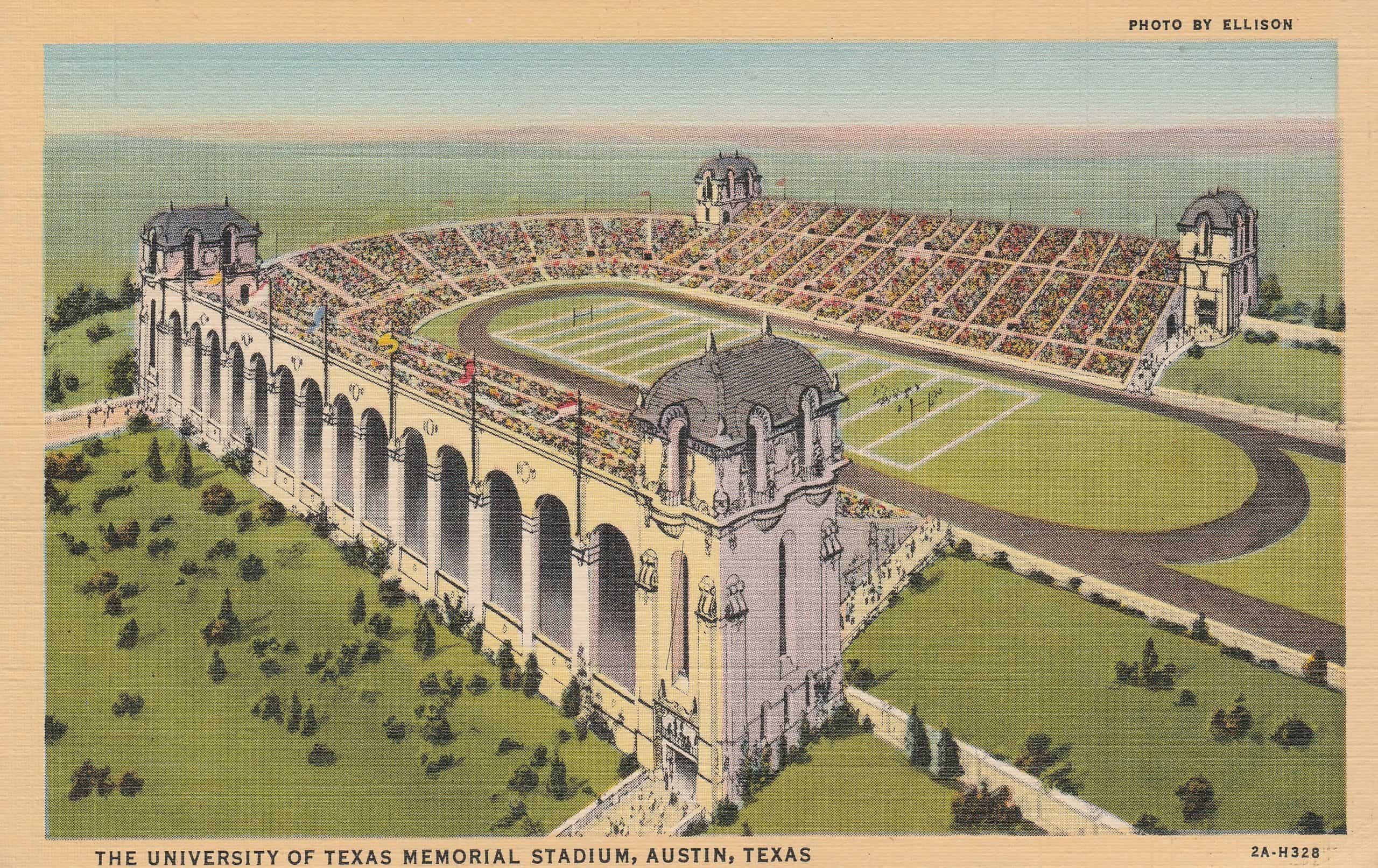
Darrell K. Royall – Texas Memorial Stadium in Austin is the seventh largest stadium in the United States and the ninth largest stadium in the world. It currently seats 100,119 spectators. On October 19, 2024, the stadium saw a record attendance of 105,215 when the Longhorns played the University of Georgia Bulldogs.
The first game was played at War Memorial Stadium (its name from 1924–1947) in November 1924. The initial seating capacity was set at 27,000 and it cost $275,000 to construct. It was named in honor of Texans who served in World War I and the state’s 5,280 soldiers who died in the conflict.
In 1926 Texas Memorial Stadium underwent its first expansion, adding 13,500 seats to the “horseshoe” at the north end. In 1948 two L-shaped sections were added to the stadium’s east and west stands, increasing seating capacity to 60,130. It was renamed Texas Memorial Stadium in September 1948 to honor Texans who had died in World War II. Lights were added in 1955 and several expansion projects over the decades have brought the stadium to its current capacity.
In 1996 the University of Texas honored its legendary football coach and athletic director Darrell K. Royal by renaming the stadium the Darrell K. Royal – Texas Memorial Stadium. Royal led the Texas Longhorns from 1957 through 1976 and won National Championships in 1963, 1969, and 1970.
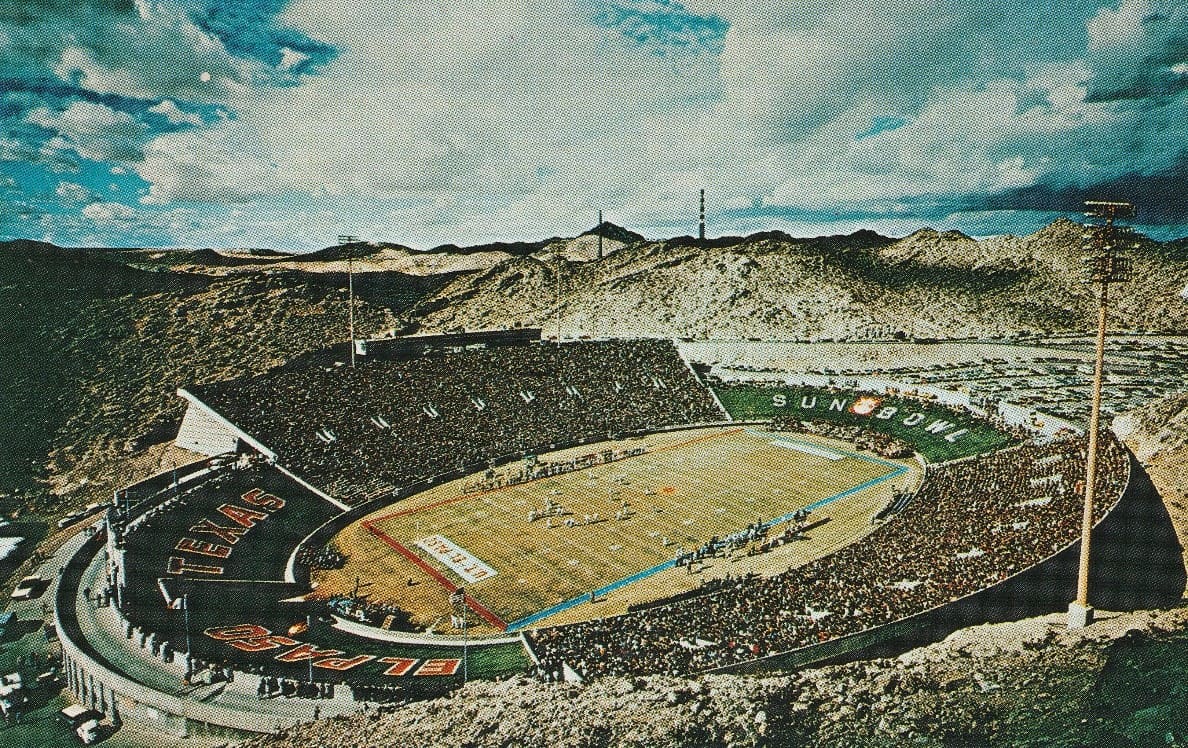
Sun Bowl Stadium in El Paso, Texas, is home to the University of Texas – El Paso Miners and the postseason Sun Bowl has played there annually since 1936. Built in a natural depression on the University of Texas – El Paso campus, it opened in 1963 and initially seated 30,000 spectators. Renovations in the early 1980s increased capacity to 52,000. Another project between 2018 and 2021 added luxury boxes and improved fan amenities. Current seating capacity is 45,971.
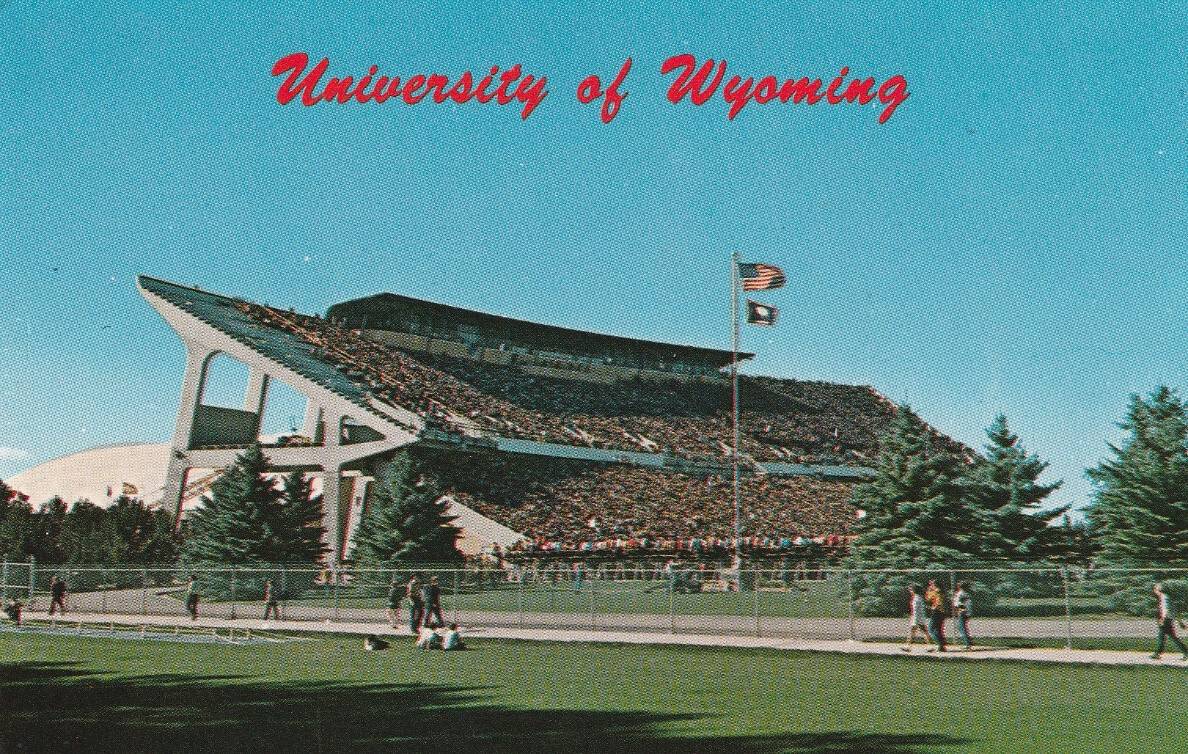
War Memorial Stadium at the University of Wyoming in Laramie was built in 1950. Its elevation is 7,215 feet above sea level making it the highest football stadium in the United States. Original seating capacity was 20,000. The postcard shows the stadium after the 1970 expansion added an upper deck to the west grandstand holding 5,550 seats and a new press box. In 1978, seating capacity increased to 33,500 with the addition of an upper deck to the east grandstand and bleachers in the north end zone.